
RIPK3/RIP3 Antibody (1312A) [mFluor Violet 500 SE]
Novus Biologicals | Catalog # FAB76041MFV500
Recombinant Monoclonal Antibody

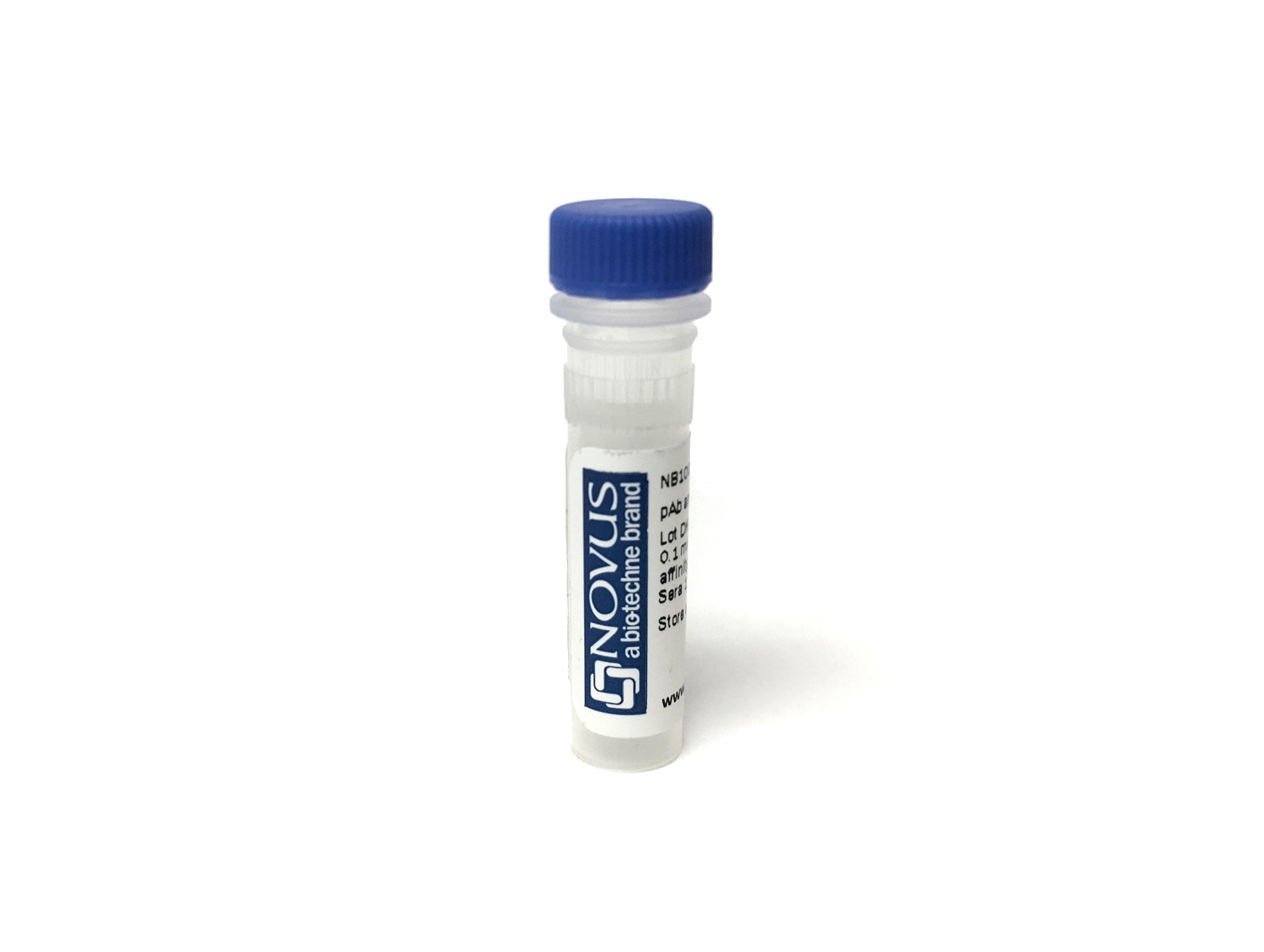
Key Product Details
Species Reactivity
Human
Applications
Western Blot
Label
mFluor Violet 500 SE (Excitation = 410 nm, Emission = 501 nm)
Antibody Source
Recombinant Monoclonal Rabbit IgG Clone # 1312A
Loading...
Product Specifications
Immunogen
Synthetic peptide containing human RIPK3/RIP3
Accession # Q9Y572
Accession # Q9Y572
Specificity
Detects human RIPK3/RIP3 in direct ELISAs.
Clonality
Monoclonal
Host
Rabbit
Isotype
IgG
Description
This conjugate is made on demand and is not held in inventory. Each order represents a unique lot. All conjugates are generated using validated conjugation protocols and meet strict degree of labeling (F/P) specifications; additional information is available upon request. The antibody concentration is provided on the individual product label.
For specialized conjugation needs, like large quantities, specific concentrations, and defined F/P ratios, bulk and custom antibody conjugation services are available.
For specialized conjugation needs, like large quantities, specific concentrations, and defined F/P ratios, bulk and custom antibody conjugation services are available.
Applications for RIPK3/RIP3 Antibody (1312A) [mFluor Violet 500 SE]
Application
Recommended Usage
Western Blot
Optimal dilutions of this antibody should be experimentally determined.
Application Notes
Recommended applications are based on validated applications from the unconjugated base product MAB76041. This conjugated antibody is not kept in inventory and is made to order using validated conjugation protocols.
Formulation, Preparation, and Storage
Purification
Protein A or G purified from cell culture supernatant
Formulation
50mM Sodium Borate
Preservative
0.05% Sodium Azide
Concentration
Please see the vial label for concentration. If unlisted please contact technical services.
Shipping
The product is shipped with polar packs. Upon receipt, store it immediately at the temperature recommended below.
Stability & Storage
Store at 4C in the dark.
Background: RIPK3/RIP3
RIPK3 has several phosphorylation sites that are required for its role in necroptosis. For example, serine204 in mouse, which is conserved in the human (serine199), is necessary for necroptosis while serine residues 232 and 227 are both required for RIPK3s interaction with MLKL (2). The core necroptosis proteins RIPK1/RIPK3 and MLKL are implicated in several disease states such as neurodegeneration, cardiovascular, hepatic and pulmonary disease (3).
References
1. Orozco, S., & Oberst, A. (2017). RIPK3 in cell death and inflammation: the good, the bad, and the ugly. Immunological Reviews. https://doi.org/10.1111/imr.12536
2. Dhuriya, Y. K., & Sharma, D. (2018). Necroptosis: A regulated inflammatory mode of cell death. Journal of Neuroinflammation. https://doi.org/10.1186/s12974-018-1235-0
3. Choi, M. E., Price, D. R., Ryter, S. W., & Choi, A. M. K. (2019). Necroptosis: A crucial pathogenic mediator of human disease. JCI Insight. https://doi.org/10.1172/jci.insight.128834
4. Lee, K.-H., & Kang, T.-B. (2019). The Molecular Links between Cell Death and Inflammasome. Cells. https://doi.org/10.3390/cells8091057
Long Name
Receptor (TNFRSF)-Interacting Serine-Threonine Kinase 3
Alternate Names
RIP3
Additional RIPK3/RIP3 Products
Product Documents for RIPK3/RIP3 Antibody (1312A) [mFluor Violet 500 SE]
Certificate of Analysis
To download a Certificate of Analysis, please enter a lot or batch number in the search box below.
Product Specific Notices for RIPK3/RIP3 Antibody (1312A) [mFluor Violet 500 SE]
mFluor(TM) is a trademark of AAT Bioquest, Inc. This conjugate is made on demand. Actual recovery may vary from the stated volume of this product. The volume will be greater than or equal to the unit size stated on the datasheet.
This product is for research use only and is not approved for use in humans or in clinical diagnosis. Primary Antibodies are guaranteed for 1 year from date of receipt.
Related Research Areas
Customer Reviews for RIPK3/RIP3 Antibody (1312A) [mFluor Violet 500 SE]
There are currently no reviews for this product. Be the first to review RIPK3/RIP3 Antibody (1312A) [mFluor Violet 500 SE] and earn rewards!
Have you used RIPK3/RIP3 Antibody (1312A) [mFluor Violet 500 SE]?
Submit a review and receive an Amazon gift card!
$25/€18/£15/$25CAN/¥2500 for a review with an image
$10/€7/£6/$10CAN/¥1110 for a review without an image
Submit a review
Protocols
Find general support by application which include: protocols, troubleshooting, illustrated assays, videos and webinars.
- Cellular Response to Hypoxia Protocols
- R&D Systems Quality Control Western Blot Protocol
- Troubleshooting Guide: Western Blot Figures
- Western Blot Conditions
- Western Blot Protocol
- Western Blot Protocol for Cell Lysates
- Western Blot Troubleshooting
- Western Blot Troubleshooting Guide
- View all Protocols, Troubleshooting, Illustrated assays and Webinars
FAQs for RIPK3/RIP3 Antibody (1312A) [mFluor Violet 500 SE]
Showing
1
-
3 of
3 FAQs
Showing All
-
Q: If this product is used in an application or species as a part of a customer review, will that validate this product in the application/species?
A: If any of our primary antibodes are used in an untested application or species and it is shown to work through images from customer reviews or through publications, this validates the application/species for this product. Please check out our Innovator's Reward Program if you decide to test an antibody with a species or application that is not currently listed.
-
Q: What is the theoretical molecular weight for your RIPK3/RIP3 antibodies?
A: This depends on the immunogen. We have one RIPK3/RIP3 antibody [NBP1-77299] that is raised against murine RIP3. The theoretical molecular weight for this product is 53 kDa. The rest of our RIPK3/RIP3 antibodies are developed against human RIP3 and have a theoretical molecular weight of 56.7 kDa.
-
Q: What research areas can this product be used in?
A: All RIPK3/RIP3 products can be used in: Cancer, Cell Biology, Immunology, Necroptosis, Protein Kinase, Signal Transduction.
-
Q: If this product is used in an application or species as a part of a customer review, will that validate this product in the application/species?
A: If any of our primary antibodes are used in an untested application or species and it is shown to work through images from customer reviews or through publications, this validates the application/species for this product. Please check out our Innovator's Reward Program if you decide to test an antibody with a species or application that is not currently listed.
-
Q: What is the theoretical molecular weight for your RIPK3/RIP3 antibodies?
A: This depends on the immunogen. We have one RIPK3/RIP3 antibody [NBP1-77299] that is raised against murine RIP3. The theoretical molecular weight for this product is 53 kDa. The rest of our RIPK3/RIP3 antibodies are developed against human RIP3 and have a theoretical molecular weight of 56.7 kDa.
-
Q: What research areas can this product be used in?
A: All RIPK3/RIP3 products can be used in: Cancer, Cell Biology, Immunology, Necroptosis, Protein Kinase, Signal Transduction.
-
Q: If this product is used in an application or species as a part of a customer review, will that validate this product in the application/species?
A: If any of our primary antibodes are used in an untested application or species and it is shown to work through images from customer reviews or through publications, this validates the application/species for this product. Please check out our Innovator's Reward Program if you decide to test an antibody with a species or application that is not currently listed.
-
Q: What is the theoretical molecular weight for your RIPK3/RIP3 antibodies?
A: This depends on the immunogen. We have one RIPK3/RIP3 antibody [NBP1-77299] that is raised against murine RIP3. The theoretical molecular weight for this product is 53 kDa. The rest of our RIPK3/RIP3 antibodies are developed against human RIP3 and have a theoretical molecular weight of 56.7 kDa.
-
Q: What research areas can this product be used in?
A: All RIPK3/RIP3 products can be used in: Cancer, Cell Biology, Immunology, Necroptosis, Protein Kinase, Signal Transduction.
Loading...