
Simple Plex Human Phospho-Tau (T217) ALZpath Cartridge
R&D Systems | Catalog # SPCKB-PS-011938

Key Product Details
Assay Length
Sample Type & Volume Required Per Well*
Sensitivity
Assay Range
Simple Plex Human Phospho-Tau (T217) ALZpath Cartridge Summary
*The Sample Volume represented is based on the amount of sample incorporated into the reaction after taking into account the assay's minimum required dilution for a given matrix. Serial dilution may be necessary to achieve some of the final sample volumes represented.
Compatible Instruments
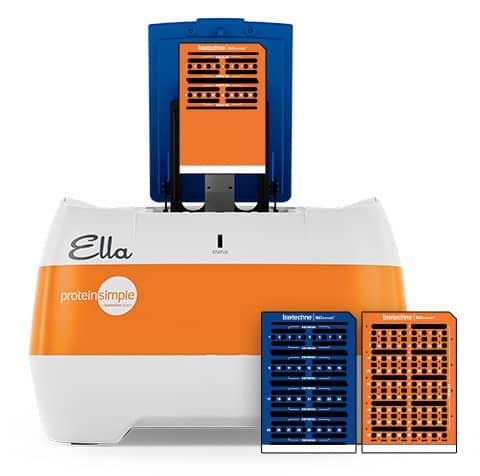
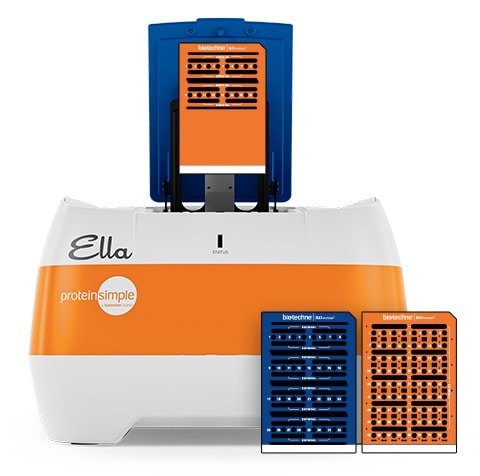
Ella Automated Immunoassay System
Product Specifications
Assay Type
Format
Species
Specificity
Cross-reactivity
Interference
Precision
Intra-Assay Precision (Precision within an assay) Each control was tested multiple times in one Phospho-Tau 217 assay.
Inter-Assay Precision (Precision between assays) Replicates of each Phospho-Tau 217 control were tested in multiple assays performed by at least three technicians using two lots of reagents for human Phospho-Tau 217.
Cerebrospinal Fluid, EDTA Plasma, Heparin Plasma, Serum
| Intra-Assay Precision | Inter-Assay Precision | |||
|---|---|---|---|---|
| Sample | 1 | 2 | 1 | 2 |
| n | 16 | 16 | 66 | 66 |
| Mean (pg/mL) | 8.3 | 444 | 8.7 | 422 |
| Standard Deviation | 0.36 | 19.9 | 0.91 | 38.0 |
| CV% | 4.3 | 4.5 | 10.5 | 8.9 |
Recovery for Simple Plex Human Phospho-Tau (T217) ALZpath Cartridge
Recovery for the Human Phospho-Tau 217 ALZpath assays was evaluated at three different spiked concentrations of p-Tau 217 protein.
| Sample Type | Average % Recovery | Range % |
|---|---|---|
| Cerebrospinal Fluid (n=4) | 138 | 131-142 |
| EDTA Plasma (n=4) | 97 | 83-109 |
| Heparin Plasma (n=4) | 92 | 82-98 |
| Serum (n=4) | 92 | 87-96 |
Linearity
Samples containing and/or spiked with high concentrations of recombinant human phospho-tau 217 were serially diluted with Sample Diluent to produce samples within the dynamic range of the assay.
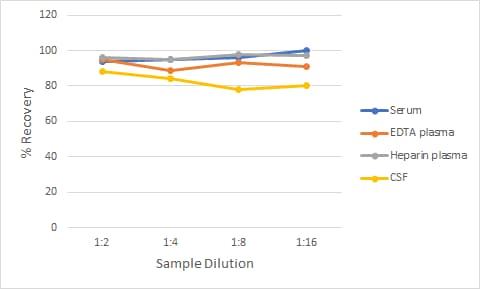
Scientific Data Images for Simple Plex Human Phospho-Tau (T217) ALZpath Cartridge
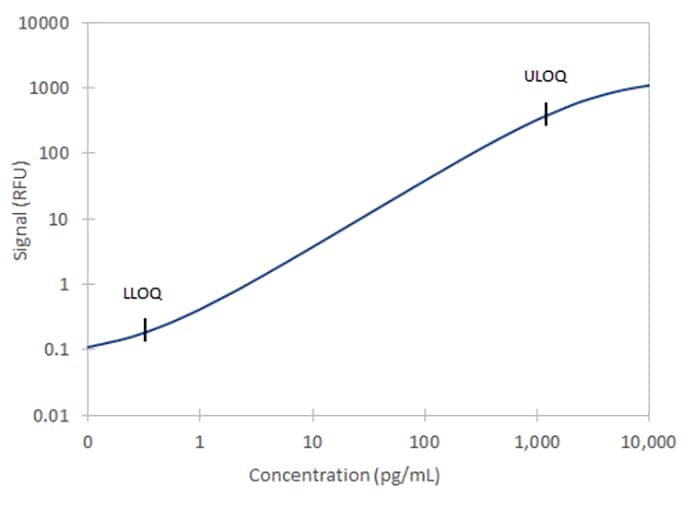
Simple Plex Human Phospho-Tau 217 Assay Standard Curve
Data shown represents typical performance results for Lower Limit of Quantitation (LLOQ) and Upper Limit of Quantitation (ULOQ) for Human Phospho-Tau 217 ALZpath Assay. Assay range is 0.32 to 1,200 pg/mL.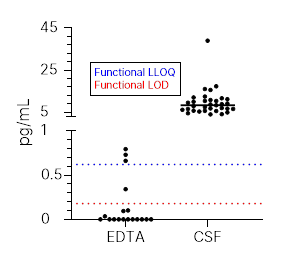
Human Phospho-Tau 217 ALZpath Assay Endogenous Sample Values
EDTA plasma and CSF samples from apparently healthy individuals were tested with the Simple Plex Human Phospho-Tau 217 ALZpath Assay. With this small cohort of samples, 100% detectability of CSF samples was observed and 22% of EDTA plasma samples were detectable above the assays functional limit of detection (LOD) of 0.09 pg/mL. Functional LOD and functional LLOQ are calculated as the LOD and LLOQ of the assay multiplied by the minimum required dilution (MRD) for the sample type.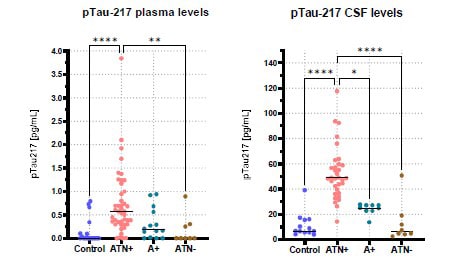
Plasma and CSF p-Tau 217 Levels in Alzheimer’s Disease Patients
Plasma and CSF p-tau 217 levels of healthy control donors and clinically diagnosed Alzheimer’s disease patients were measured using the Simple Plex Human Phospho-Tau 217 ALZpath Assay. ATN positive patients (ATN+) showed elevated plasma and CSF phosphorylated tau 217 levels when compared to both healthy controls as well as ATN negative patients (ATN-). Significant difference in CSF phosphorylated tau 217 levels was also found upon comparison of ATN+ and Amyloid positive (A+) patient groups.Preparation and Storage
Shipping
Stability & Storage
Background: Tau
The Tau protein is a microtubule-associated protein expressed primarily in axons of central nervous system neurons. Tau is also detected in oligodendrocytes, the somatodendritic compartment within neurons, and some non-neuronal tissues. In healthy neurons, Tau promotes the assembly and stabilization of microtubules along with other MAP proteins, especially MAP1B. It is believed that other proteins can compensate for loss of Tau protein function as Tau knockout mice are viable and show no signs of neurodegeneration. There are multiple isoforms of Tau created by alternative splicing of exons 2, 3, and 10. And Tau protein is heavily phosphorylated throughout the protein mostly occurring on Ser-Pro and Thr-Pro motifs. Several kinases and phosphatases regulate the phosphorylation state of Tau.
Hyperphosphorylation of Tau is an underlying cause of tauopathies, a group of neurodegenerative diseases that are characterized by accumulation of misfolded Tau protein into neurofibrillary tangles (NFT). Alzheimer’s disease and Parkinson’s disease are two tauopathies. Hyperphosphorylated Tau protein exhibits lower affinity for microtubules resulting in destabilization of the cytoskeleton and a reduction in axonal transport. When Tau protein gets hyperphosphorylated, it promotes misfolding and oligomerization into NFT ultimately causing neuronal impairment and cell death.
Long Name
Alternate Names
Gene Symbol
Additional Tau Products
Product Documents for Simple Plex Human Phospho-Tau (T217) ALZpath Cartridge
Certificate of Analysis
To download a Certificate of Analysis, please enter your Simple Plex catalog number and lot number in the search boxes below.
Product Specific Notices for Simple Plex Human Phospho-Tau (T217) ALZpath Cartridge
For research use only
Related Research Areas
Citations for Simple Plex Human Phospho-Tau (T217) ALZpath Cartridge
View all citations for the Simple Plex platform.
Please visit our Instrument Citation Database to search our collection of scientific articles that feature our instruments.
 Powered by Bioz
Customer Reviews for Simple Plex Human Phospho-Tau (T217) ALZpath Cartridge
There are currently no reviews for this product. Be the first to review Simple Plex Human Phospho-Tau (T217) ALZpath Cartridge and earn rewards!
Have you used Simple Plex Human Phospho-Tau (T217) ALZpath Cartridge?
Submit a review and receive an Amazon gift card!
$25/€18/£15/$25CAN/¥2500 for a review with an image
$10/€7/£6/$10CAN/¥1110 for a review without an image
Submit a review