
TREM2 Antibody (014) - Azide and BSA Free
Novus Biologicals | Catalog # NBP2-90452
Recombinant Monoclonal Antibody

Key Product Details
Species Reactivity
Mouse
Applications
ELISA, Immunocytochemistry/ Immunofluorescence
Label
Unconjugated
Antibody Source
Recombinant Monoclonal Rabbit IgG Clone # 014 expressed in HEK293
Format
Azide and BSA Free
Loading...
Product Specifications
Immunogen
This antibody was obtained from a rabbit immunized with purified, recombinant Mouse TREM2 (Accession#: NP_112544.1; Met1-Pro168).
Clonality
Monoclonal
Host
Rabbit
Isotype
IgG
Description
This antibody can be stored at 2C-8C for one month without detectable loss of activity. Antibody products are stable for twelve months from date of receipt when stored at -20C to -80C. Avoid repeated freeze-thaw cycles.
Scientific Data Images for TREM2 Antibody (014) - Azide and BSA Free
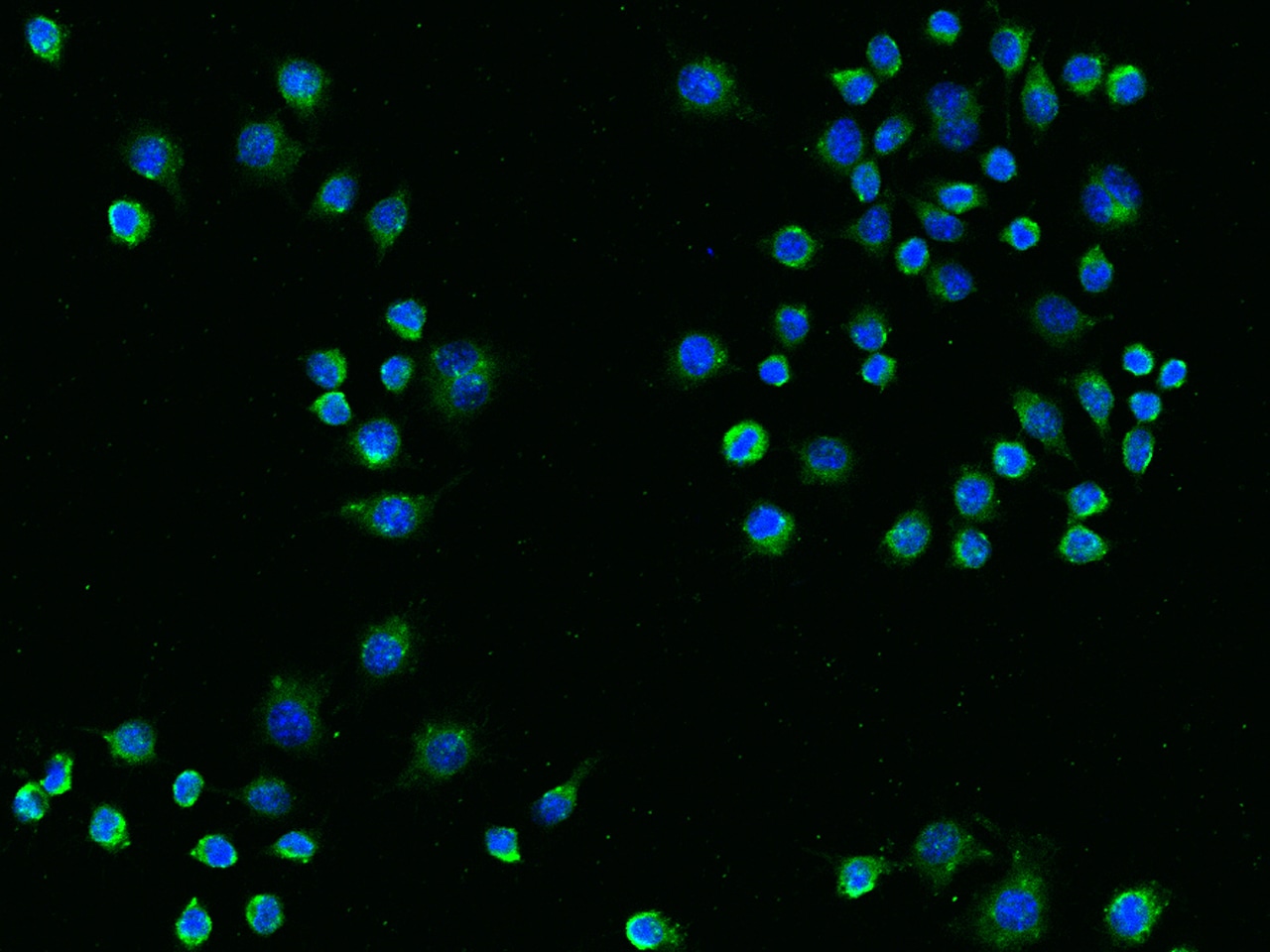
Immunocytochemistry/Immunofluorescence: TREM2 Antibody (014) [NBP2-90452] -
Immunocytochemistry/Immunofluorescence: TREM2 Antibody (014) [NBP2-90452] - Immunofluorescence staining of TREM2 in RAW264.7 cells. Cells were fixed with 4% PFA, blocked with 10% serum, and incubated with NBP2-90452 antibody (dilution ratio 1:60) at 4C overnight. Then cells were stained with the Alexa Fluor(R)488-conjugated Goat Anti-rabbit IgG Secondary antibody (green) and counterstained with DAPI (blue).Positive staining was localized to Cytoplasm and cell membrane.Applications for TREM2 Antibody (014) - Azide and BSA Free
Application
Recommended Usage
ELISA
1:5000-1:10000
Immunocytochemistry/ Immunofluorescence
1:20-1:100
Formulation, Preparation, and Storage
Purification
Protein A purified
Formulation
0.2 um filtered solution in PBS
Format
Azide and BSA Free
Preservative
No Preservative
Concentration
Please see the vial label for concentration. If unlisted please contact technical services.
Shipping
The product is shipped with polar packs. Upon receipt, store it immediately at the temperature recommended below.
Stability & Storage
Store at 4C short term. Aliquot and store at -20C long term. Avoid freeze-thaw cycles.
Background: TREM2
TREM2 is upregulated under many pathological conditions and has been of particular interest in neurodegenerative disorders like Alzheimer's disease (AD) where it helps activate microglial responses (1-3,5). Studies have found that sTREM2 is typically elevated in the cerebral spinal fluid (CSF) of AD patients compared to healthy counterparts and may serve as a biomarker of AD (2). While TREM2-mediated microglial activation is considered beneficial in some disease contexts (e.g. demyelinating diseases, ischemia), it is detrimental in others (e.g. peripheral nerve injury) and may be dependent on disease stage, as observed in AD (2,5). Microglia promote amyloid-beta (Abeta) clearance, phagocytosis and reduce tau proliferation in the early stages of AD but can increase Abeta accumulation and tau propagation in late stages of AD (2). Recent studies have also suggested a role for TREM2 in cancer, where it supports an immune-suppressive tumor microenvironment such as reduced of T cell proliferation (1,6). Therapeutic targeting of the TREM2 pathway can be directed towards ligand binding to downstream signaling (1). Potential therapeutic strategies include using monoclonal antibodies or small molecules to either enhance or block signaling (1,6). While more work needs to be done, initial studies targeting TREM2 for cancer immunotherapy is promising (6).
References
1. Deczkowska A, Weiner A, Amit I. The Physiology, Pathology, and Potential Therapeutic Applications of the TREM2 Signaling Pathway. Cell. 2020; 181(6):1207-1217. https://doi.org/10.1016/j.cell.2020.05.003
2. Qin Q, Teng Z, Liu C, Li Q, Yin Y, Tang Y. TREM2, microglia, and Alzheimer's disease. Mech Ageing Dev. 2021; 195:111438. https://doi.org/10.1016/j.mad.2021.111438
3. Kober DL, Brett TJ. TREM2-Ligand Interactions in Health and Disease. J Mol Biol. 2017; 429(11):1607-1629. https://doi.org/10.1016/j.jmb.2017.04.004
4. Uniprot (Q9NZC2)
5. Konishi H, Kiyama H. Microglial TREM2/DAP12 Signaling: A Double-Edged Sword in Neural Diseases. Front Cell Neurosci. 2018; 12:206. https://doi.org/10.3389/fncel.2018.00206
Long Name
Triggering Receptor Expressed on Myeloid Cells 2
Alternate Names
PLOSL2, TREM-2
Gene Symbol
TREM2
Additional TREM2 Products
Product Documents for TREM2 Antibody (014) - Azide and BSA Free
Certificate of Analysis
To download a Certificate of Analysis, please enter a lot or batch number in the search box below.
Product Specific Notices for TREM2 Antibody (014) - Azide and BSA Free
This product is for research use only and is not approved for use in humans or in clinical diagnosis. Primary Antibodies are guaranteed for 1 year from date of receipt.
Related Research Areas
Citations for TREM2 Antibody (014) - Azide and BSA Free
 Powered by Bioz
Customer Reviews for TREM2 Antibody (014) - Azide and BSA Free
There are currently no reviews for this product. Be the first to review TREM2 Antibody (014) - Azide and BSA Free and earn rewards!
Have you used TREM2 Antibody (014) - Azide and BSA Free?
Submit a review and receive an Amazon gift card!
$25/€18/£15/$25CAN/¥2500 Yen for a review with an image
$10/€7/£6/$10CAN/¥1110 Yen for a review without an image
Submit a review
Protocols
Find general support by application which include: protocols, troubleshooting, illustrated assays, videos and webinars.
- Appropriate Fixation of IHC/ICC Samples
- Cellular Response to Hypoxia Protocols
- ClariTSA™ Fluorophore Kits
- Detection & Visualization of Antibody Binding
- ELISA Sample Preparation & Collection Guide
- ELISA Troubleshooting Guide
- How to Run an R&D Systems DuoSet ELISA
- How to Run an R&D Systems Quantikine ELISA
- How to Run an R&D Systems Quantikine™ QuicKit™ ELISA
- ICC Cell Smear Protocol for Suspension Cells
- ICC Immunocytochemistry Protocol Videos
- ICC for Adherent Cells
- Immunocytochemistry (ICC) Protocol
- Immunocytochemistry Troubleshooting
- Immunofluorescence of Organoids Embedded in Cultrex Basement Membrane Extract
- Immunohistochemistry (IHC) and Immunocytochemistry (ICC) Protocols
- Preparing Samples for IHC/ICC Experiments
- Preventing Non-Specific Staining (Non-Specific Binding)
- Primary Antibody Selection & Optimization
- Protocol for VisUCyte™ HRP Polymer Detection Reagent
- Protocol for the Fluorescent ICC Staining of Cell Smears - Graphic
- Protocol for the Fluorescent ICC Staining of Cultured Cells on Coverslips - Graphic
- Protocol for the Preparation and Fluorescent ICC Staining of Cells on Coverslips
- Protocol for the Preparation and Fluorescent ICC Staining of Non-adherent Cells
- Protocol for the Preparation and Fluorescent ICC Staining of Stem Cells on Coverslips
- Protocol for the Preparation of a Cell Smear for Non-adherent Cell ICC - Graphic
- Quantikine HS ELISA Kit Assay Principle, Alkaline Phosphatase
- Quantikine HS ELISA Kit Principle, Streptavidin-HRP Polymer
- Sandwich ELISA (Colorimetric) – Biotin/Streptavidin Detection Protocol
- Sandwich ELISA (Colorimetric) – Direct Detection Protocol
- TUNEL and Active Caspase-3 Detection by IHC/ICC Protocol
- The Importance of IHC/ICC Controls
- Troubleshooting Guide: ELISA
- View all Protocols, Troubleshooting, Illustrated assays and Webinars
Loading...