
Ubiquitin Specific Peptidase 8 (USP8), also known as Ubiquitin Isopeptidase Y (UBPY), is a widely expressed deubiquitinating enzyme belonging to the peptidase C19 family. It has a predicted molecular weight of 127.5 kDa. Human USP8 is 1118 amino acids (aa) in length and shares 84% aa sequence identity with the mouse and rat orthologs. It contains an N-terminal MIT domain (aa 33-116) that mediates endosomal localization, CHMP-binding, and maintenance of ESCRT-0. USP8 also has a rhodanese domain (aa 181-319) that binds NRDP1 Ubiquitin ligase (E3), a SH3 domain binding sequence (aa 405-413), and a C-terminal catalytic domain (aa 734-1110). USP8 is a growth-regulated enzyme that controls the internalization and endocytic trafficking of cell surface receptors. Some receptors are targeted for internalization and degradation by ubiquitination. USP8 has been shown to disrupt the down-regulation of multiple receptors, including EGF R/ErbB1, ErbB2/Her2, and Smoothened, via their deubiquitination. Conversely, USP8 appears to have the opposite effect on the trafficking of CXCR4, PAR2, and the delta-opioid receptor. Depletion or catalytic inactivation of USP8 stabilized their expression. It is thought that deubiquitination of these receptors down-stream of the sorting endosome commits them to lysosomal degradation. USP8 can be phosphorylated at Ser680 allowing for 14-3-3-epsilon binding, which subsequently inhibits USP8 activity. Additionally, USP8 undergoes tyrosine phosphorylation at its N-terminus following EGF activation of the EGF R/ErbB1 / ErbB2/Her2 receptor complex.

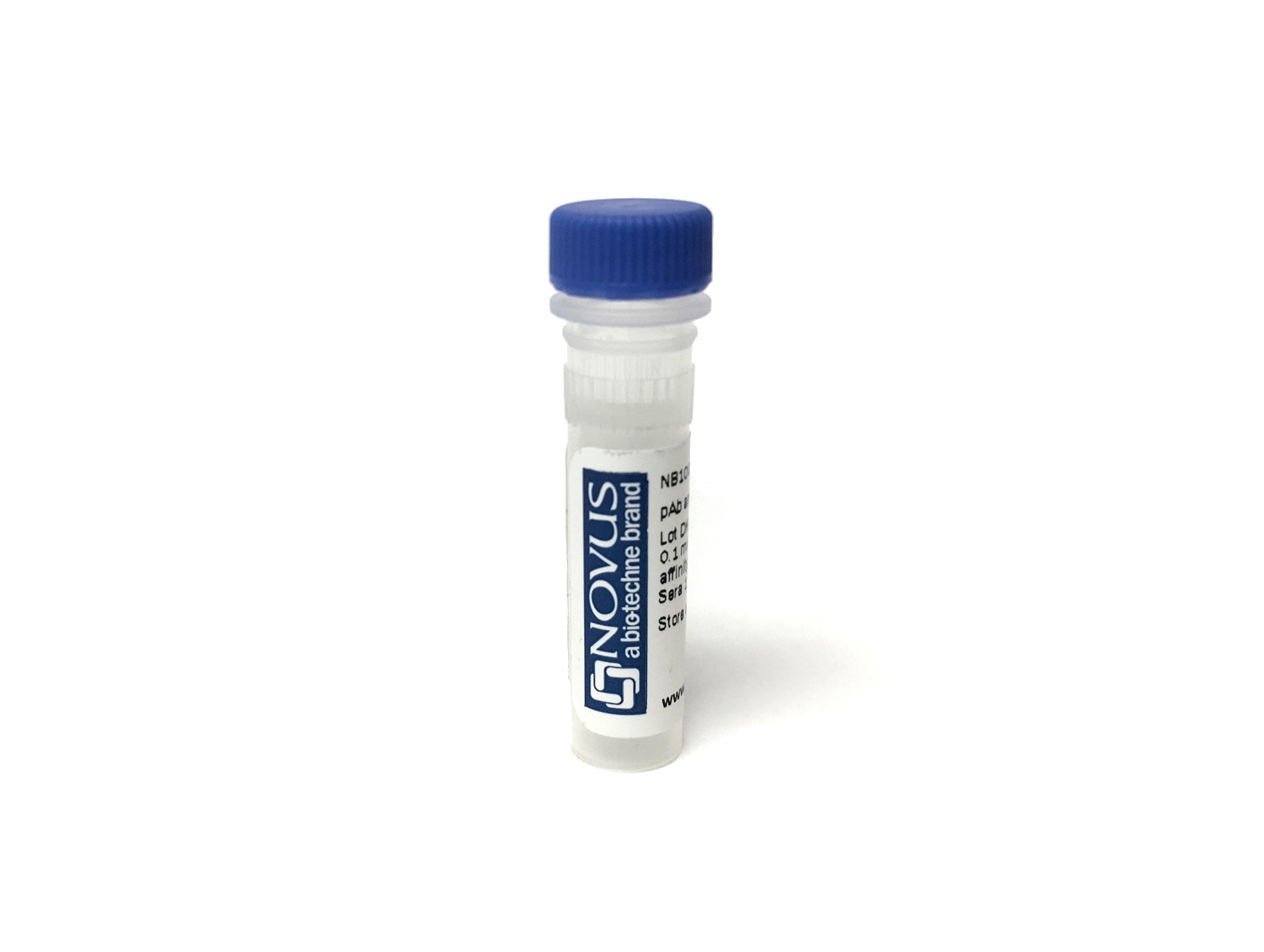
Key Product Details
Species Reactivity
Human
Applications
Western Blot
Label
FITC (Excitation = 495 nm, Emission = 519 nm)
Antibody Source
Polyclonal Sheep IgG
Loading...
Product Specifications
Immunogen
E. coli-derived recombinant human USP8
Met1-Thr1118
Accession # P40818
Met1-Thr1118
Accession # P40818
Specificity
Detects human USP8 in direct ELISAs and Western blots. In direct ELISAs, less than 1% cross-reactivity with recombinant human USP2 is observed.
Clonality
Polyclonal
Host
Sheep
Isotype
IgG
Description
This conjugate is made on demand and is not held in inventory. Each order represents a unique lot. All conjugates are generated using validated conjugation protocols and meet strict degree of labeling (F/P) specifications; additional information is available upon request. The antibody concentration is provided on the individual product label.
For specialized conjugation needs, like large quantities, specific concentrations, and defined F/P ratios, bulk and custom antibody conjugation services are available.
For specialized conjugation needs, like large quantities, specific concentrations, and defined F/P ratios, bulk and custom antibody conjugation services are available.
Applications for UBPY/USP8 Antibody [FITC]
Application
Recommended Usage
Western Blot
Optimal dilutions of this antibody should be experimentally determined.
Application Notes
Recommended applications are based on validated applications from the unconjugated base product AF7735. This conjugated antibody is not kept in inventory and is made to order using validated conjugation protocols.
Formulation, Preparation, and Storage
Purification
Antigen Affinity-purified
Formulation
PBS
Preservative
0.05% Sodium Azide
Concentration
Please see the vial label for concentration. If unlisted please contact technical services.
Shipping
The product is shipped with polar packs. Upon receipt, store it immediately at the temperature recommended below.
Stability & Storage
Store at 4C in the dark.
Background: USP8
Long Name
Ubiquitin Specific Protease 8
Alternate Names
UBPY
Gene Symbol
USP8
Additional USP8 Products
Product Documents for UBPY/USP8 Antibody [FITC]
Certificate of Analysis
To download a Certificate of Analysis, please enter a lot or batch number in the search box below.
Product Specific Notices for UBPY/USP8 Antibody [FITC]
This product is for research use only and is not approved for use in humans or in clinical diagnosis. Primary Antibodies are guaranteed for 1 year from date of receipt.
Related Research Areas
Customer Reviews for UBPY/USP8 Antibody [FITC]
There are currently no reviews for this product. Be the first to review UBPY/USP8 Antibody [FITC] and earn rewards!
Have you used UBPY/USP8 Antibody [FITC]?
Submit a review and receive an Amazon gift card!
$25/€18/£15/$25CAN/¥2500 for a review with an image
$10/€7/£6/$10CAN/¥1110 for a review without an image
Submit a review
Protocols
Find general support by application which include: protocols, troubleshooting, illustrated assays, videos and webinars.
- Cellular Response to Hypoxia Protocols
- R&D Systems Quality Control Western Blot Protocol
- Troubleshooting Guide: Western Blot Figures
- Western Blot Conditions
- Western Blot Protocol
- Western Blot Protocol for Cell Lysates
- Western Blot Troubleshooting
- Western Blot Troubleshooting Guide
- View all Protocols, Troubleshooting, Illustrated assays and Webinars
Loading...