
USP15 Antibody - BSA Free
Novus Biologicals | Catalog # NB110-40690

![Knockdown Validated: USP15 Antibody [NB110-40690]](https://resources.rndsystems.com/images/products/USP15-Antibody-Knockdown-Validated-NB110-40690-img0010.jpg "Western Blot: USP15 Antibody [NB110-40690]")
Scientific images may be resized, cropped, or adjusted for brightness or contrast for presentation purposes. These updates are limited to presentation and do not affect the underlying scientific interpretation of the data. Where available, additional source data may be provided upon request.
Key Product Details
Validated by
Species Reactivity
Validated:
Cited:
Predicted:
Applications
Validated:
Cited:
Label
Antibody Source
Format
Product Specifications
Immunogen
Clonality
Host
Isotype
Scientific Data Images for USP15 Antibody - BSA Free
![Western Blot: USP15 Antibody [NB110-40690]](https://resources.rndsystems.com/images/products/USP15-Antibody-Western-Blot-NB110-40690-img0011.jpg "Western Blot: USP15 Antibody [NB110-40690]")
Western Blot: USP15 Antibody [NB110-40690]
Western Blot: USP15 Antibody [NB110-40690] - Whole cell lysate (50 ug) from HeLa, K-562, MCF-7, U2OS, RKO, TCMK-1, and NIH 3T3 cells prepared using NETN lysis buffer. Antibody: Affinity purified rabbitanti-USP15 antibody used for WB at 0.1 ug/ml. Detection: Chemiluminescence withan exposure time of 30 seconds.![Western Blot: USP15 Antibody [NB110-40690]](https://resources.rndsystems.com/images/products/USP15-Antibody-Western-Blot-NB110-40690-img0006.jpg "Western Blot: USP15 Antibody [NB110-40690]")
Western Blot: USP15 Antibody [NB110-40690]
Western Blot: USP15 Antibody [NB110-40690] - Whole cell lysate from HeLa (5, 15 and 50 mcg for WB; 1 mg for IP, 20% of IP loaded) and 293T (T; 50 mcg) cells. Affinity purified rabbit anti- USP15 antibody NB110-40690 used for WB at 0.4 mcg/ml (A) and 1.0 mcg/ml (B) and used for IP at 3 mcg/mg lysate (B).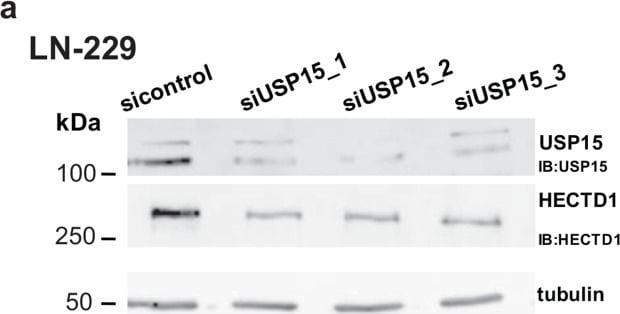
Western Blot: USP15 Antibody [NB110-40690] -
Western Blot: USP15 Antibody [NB110-40690] - USP15 knockdown leads to decreased HECTD1 protein levels(a) USP15 knockdown with three siRNAs in LN-229 & (b) two siRNAs in LN-428. Image collected & cropped by CiteAb from the following publication (https://www.oncotarget.com/lookup/doi/10.18632/oncotarget.22798), licensed under a CC-BY license. Not internally tested by Novus Biologicals.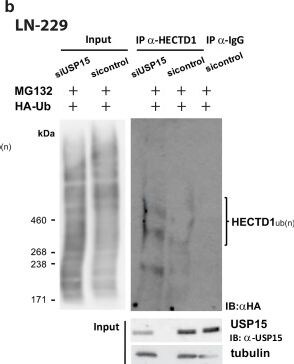
Western Blot: USP15 Antibody [NB110-40690] -
Western Blot: USP15 Antibody [NB110-40690] - USP15 de-ubiquitinates & stabilizes HECTD1 in LN-229The de-ubiquitination assay was performed in cells transfected with an expression plasmid for HA-Ubiquitin that 40 hours after transfection were treated for 8 hours with the proteasome inhibitor MG132 (5μM). The cells were lyzed & used for IP using an antibody against the endogenous HECTD1, or an AB against rabbit IgG in the negative control. The immunoprecipitated proteins were then analyzed by Western blot using an anti HA antibody to detect ubiquitination. (a) LN-229 cells stably expressing USP15, the mutant USP15C/S, or the empty vector control, respectively. Lanes 1 to 3 correspond to the input controls. The USP15 wt overexpressing LN-229 cells show lower ubiquitination levels of HECTD1 than the vector control. The mutant USP15-C/S overexpressing cells displayed the highest ubiquitination of HECTD1. (b) De-ubiquitination assay in LN-229 depleted for endogenous USP15 by siRNA against USP15 or the respective si-control. LN-229 cells depleted for endogenous USP15 display higher ubiquitination of HECTD1 than the sicontrol cells. Image collected & cropped by CiteAb from the following publication (https://www.oncotarget.com/lookup/doi/10.18632/oncotarget.22798), licensed under a CC-BY license. Not internally tested by Novus Biologicals.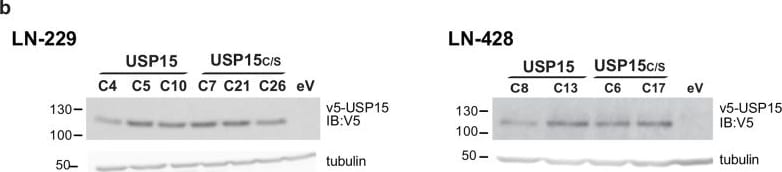
Western Blot: USP15 Antibody [NB110-40690] -
Western Blot: USP15 Antibody [NB110-40690] - Effect of USP15 on cell growth in LN-229(a) Structure of the wildtype USP15 construct with the V5 protein tag, & the respective catalytic mutant USP15C298S. (b) Protein expression by Western blot using an anti-V5 AB, loading control tubulin for the selected clones from LN-229 & LN-428 with stable expression of USP15, or USP15C298S (USPC/S), or empty vector controls. (c) Growth of USP15, or USP15C298S (USPC/S) overexpressing clones, & respective empty vector control (pIRES2/EGFP) followed over 5 days in culture. The error bars indicate standard deviations of triplicate samples. (d) Adhesion-independent growth in soft agar, representative images, & quantification of total colony numbers. Empty vector control, eV, black; USP15, blue; USP15C/S, green. Histogram shows data as mean +/-SD. Image collected & cropped by CiteAb from the following publication (https://www.oncotarget.com/lookup/doi/10.18632/oncotarget.22798), licensed under a CC-BY license. Not internally tested by Novus Biologicals.Applications for USP15 Antibody - BSA Free
Immunoprecipitation
Western Blot
Formulation, Preparation, and Storage
Purification
Formulation
Format
Preservative
Concentration
Shipping
Stability & Storage
Background: USP15
Long Name
Alternate Names
Entrez Gene IDs
Gene Symbol
UniProt
Additional USP15 Products
Product Documents for USP15 Antibody - BSA Free
Certificate of Analysis
To download a Certificate of Analysis, please enter a lot or batch number in the search box below.
Product Specific Notices for USP15 Antibody - BSA Free
This product is for research use only and is not approved for use in humans or in clinical diagnosis. Primary Antibodies are guaranteed for 1 year from date of receipt.
Related Research Areas
Citations for USP15 Antibody - BSA Free
 Powered by Bioz
Customer Reviews for USP15 Antibody - BSA Free
There are currently no reviews for this product. Be the first to review USP15 Antibody - BSA Free and earn rewards!
Have you used USP15 Antibody - BSA Free?
Submit a review and receive an Amazon gift card!
$25/€18/£15/$25CAN/¥2500 for a review with an image
$10/€7/£6/$10CAN/¥1110 for a review without an image
Submit a review
Protocols
Find general support by application which include: protocols, troubleshooting, illustrated assays, videos and webinars.
- Cellular Response to Hypoxia Protocols
- Immunoprecipitation Protocol
- R&D Systems Quality Control Western Blot Protocol
- Troubleshooting Guide: Western Blot Figures
- Western Blot Conditions
- Western Blot Protocol
- Western Blot Protocol for Cell Lysates
- Western Blot Troubleshooting
- Western Blot Troubleshooting Guide
- View all Protocols, Troubleshooting, Illustrated assays and Webinars