
XPB Antibody - BSA Free
Novus Biologicals | Catalog # NB100-61060

![Western Blot: XPB Antibody [NB100-61060]](https://resources.rndsystems.com/images/products/XPB-Antibody-Western-Blot-NB100-61060-img0006.jpg "Western Blot: XPB Antibody [NB100-61060]")
Scientific images may be resized, cropped, or adjusted for brightness or contrast for presentation purposes. These updates are limited to presentation and do not affect the underlying scientific interpretation of the data. Where available, additional source data may be provided upon request.
Key Product Details
Validated by
Species Reactivity
Validated:
Cited:
Predicted:
Applications
Validated:
Cited:
Label
Antibody Source
Format
Product Specifications
Immunogen
Reactivity Notes
Clonality
Host
Isotype
Scientific Data Images for XPB Antibody - BSA Free
Western Blot: XPB Antibody [NB100-61060]
Western Blot: XPB Antibody [NB100-61060] - Whole cell lysate (15 ug) from HeLa, 293T, Jurkat, mouse TCMK-1, and mouse NIH3T3 cells prepared using NETN lysis buffer. Antibody: Affinity purified rabbit antiERCC3 antibody used for WB at 0.1 ug/mL. Detection: Chemiluminescence with an exposure time of 3 minutes.![Immunoprecipitation: XPB Antibody [NB100-61060]](https://resources.rndsystems.com/images/products/XPB-Antibody-Immunoprecipitation-NB100-61060-img0005.jpg "Immunoprecipitation: XPB Antibody [NB100-61060]")
Immunoprecipitation: XPB Antibody [NB100-61060]
Immunoprecipitation: XPB Antibody [NB100-61060] - Detection of human ERCC3 by western blot of immunoprecipitates. Samples: Whole cell lysate (1.0 mg per IP reaction; 20% of IP loaded) from HEK293T cells prepared using NETN lysis buffer. Antibodies: Affinity purified rabbit anti-ERCC3 antibody NB100-61060 used for IP at 3 ug per reaction. ERCC3 was also immunoprecipitated by rabbit anti-ERCC3 antibody NB100-61059. For blotting immunoprecipitated ERCC3, NB100-61060 was used at 1 ug/ml. Detection: Chemiluminescence with an exposure time of 3 minutes.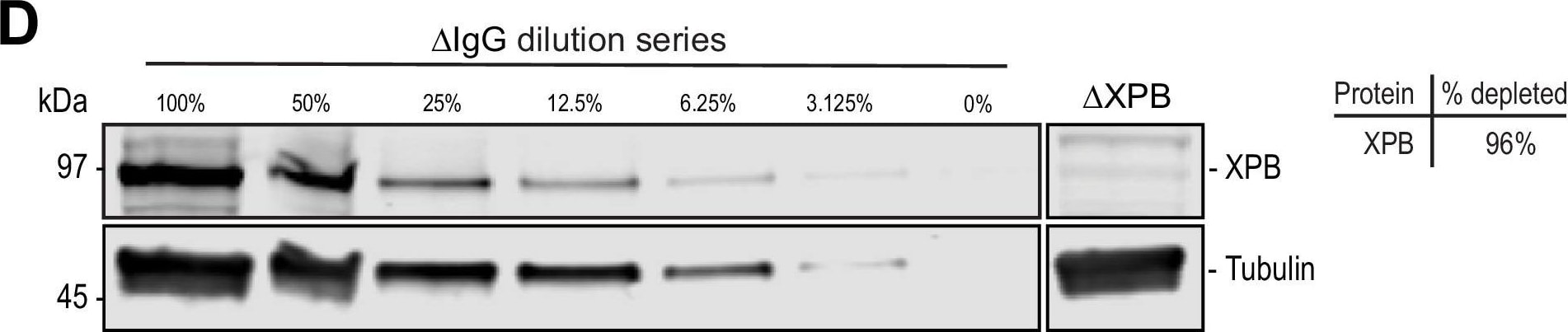
Western Blot: XPB Antibody [NB100-61060] -
nb100-61060_rabbit-polyclonal-xpb-antibody-2092023181154.jpg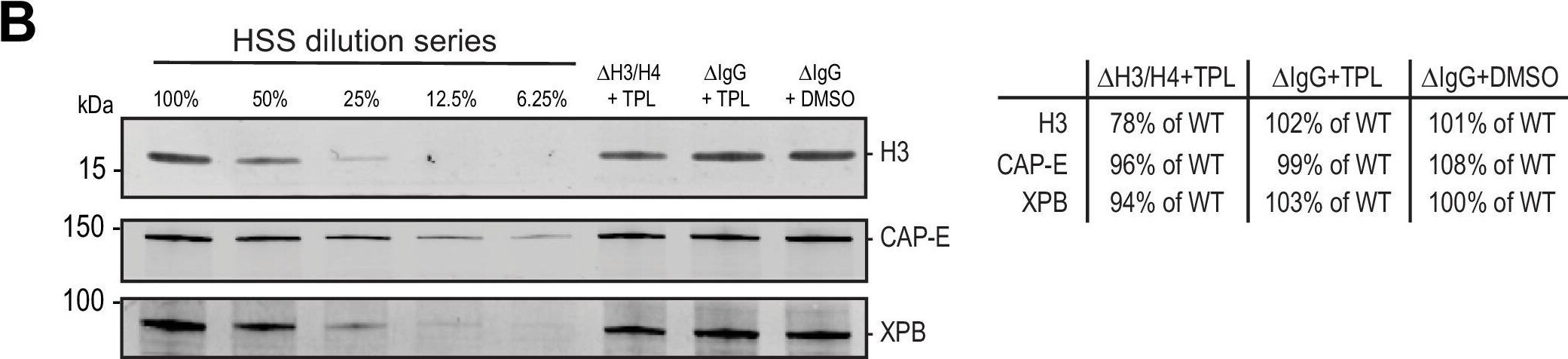
Western Blot: XPB Antibody [NB100-61060] -
Western Blot: XPB Antibody [NB100-61060] - Effects of triptolide & histone depletion on condensation using mouse sperm.(A) Representative fluorescence images of chromatid assembly at steady state with mouse sperm nuclei in egg extracts (180 min after sperm nuclei addition) in the presence of indicated inhibitors. Triptolide or DMSO control was added at 25 min after nuclei addition. Triptolide was added at 50 μM. (B) Western blot for histone H3, CAP-E, & XPB in histone H4K12ac or IgG-depleted extracts in the presence of triptolide (TPL) or DMSO. Relative percentage of protein remaining after indicated treatments is shown.Figure 5—figure supplement 1—source data 1.Source data for Figure 5—figure supplement 1B.Source data for Figure 5—figure supplement 1B. Image collected & cropped by CiteAb from the following publication (https://pubmed.ncbi.nlm.nih.gov/35293859), licensed under a CC-BY license. Not internally tested by Novus Biologicals.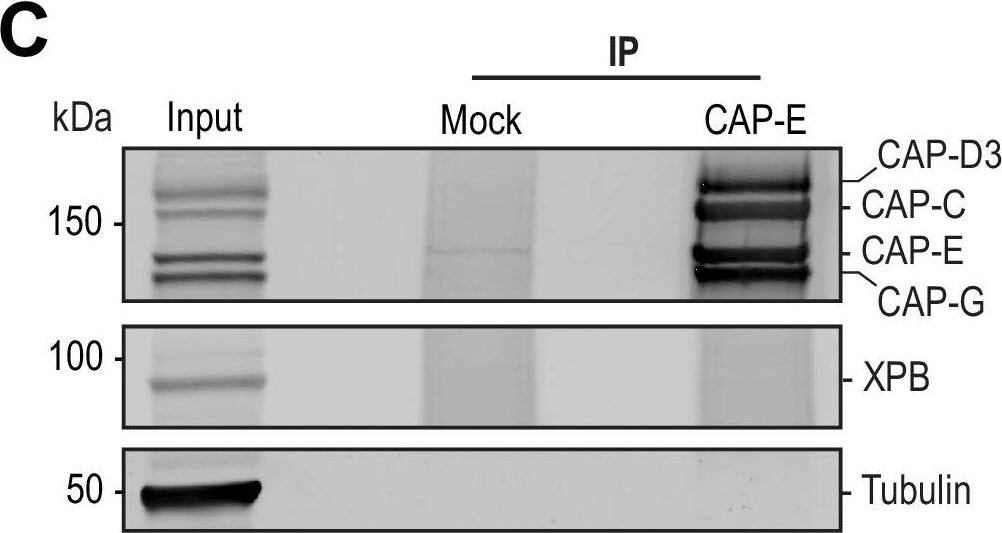
Western Blot: XPB Antibody [NB100-61060] -
Western Blot: XPB Antibody [NB100-61060] - The TFIIH complex is required for the enrichment of condensins on chromosomes.(A) Left: Representative immunofluorescence images of Xenopus sperm nuclei incubated with Mock or CAP-E depleted extracts for 180 min. Chromatids were labeled with Hoechst & anti-XPB antibodies. Right: Quantification of fluorescence intensity of XPB on chromatin, normalized to Mock depleted condition. n = 24 structures for each condition. Error bars represent SD, & ‘NS’ indicates no statistically significant difference (p > 0.001). A.U., arbitrary units. Two biological replicates were performed, quantified structures are from a single experiment. (B) Western blot for indicated proteins that copurify with anti-XPB or IgG beads isolated from HSS extracts. IP, immunoprecipitate. (C) Western blot for indicated proteins that copurify with anti-CAP-E or Mock-treated beads isolated from HSS extracts. For condensin subunit detection, the blot was probed simultaneously with the indicated antibodies. Beads were coupled to either anti-CAP-E or pre-immune serum (“Mock”) & processed as indicated in the methods. IP, immunoprecipitate. (D) Representative immunofluorescence images of Xenopus sperm nuclei incubated with HSS extracts for 180 min. Chromatids were labeled with Hoechst & co-stained with anti-XPB & anti-CAP-E antibodies. Images of three representative individual chromatids are shown.Figure 3—figure supplement 1—source data 1.Source data for Figure 3—figure supplement 1B & C.Source data for Figure 3—figure supplement 1B & C. Image collected & cropped by CiteAb from the following publication (https://pubmed.ncbi.nlm.nih.gov/35293859), licensed under a CC-BY license. Not internally tested by Novus Biologicals.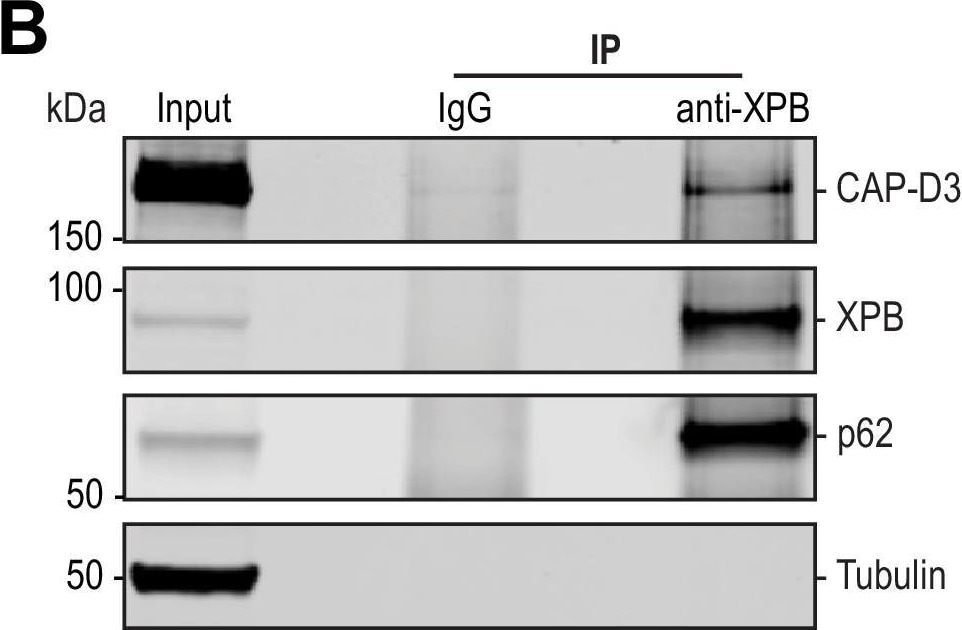
Western Blot: XPB Antibody [NB100-61060] -
Western Blot: XPB Antibody [NB100-61060] - The TFIIH complex is required for the enrichment of condensins on chromosomes.(A) Left: Representative immunofluorescence images of Xenopus sperm nuclei incubated with Mock or CAP-E depleted extracts for 180 min. Chromatids were labeled with Hoechst & anti-XPB antibodies. Right: Quantification of fluorescence intensity of XPB on chromatin, normalized to Mock depleted condition. n = 24 structures for each condition. Error bars represent SD, & ‘NS’ indicates no statistically significant difference (p > 0.001). A.U., arbitrary units. Two biological replicates were performed, quantified structures are from a single experiment. (B) Western blot for indicated proteins that copurify with anti-XPB or IgG beads isolated from HSS extracts. IP, immunoprecipitate. (C) Western blot for indicated proteins that copurify with anti-CAP-E or Mock-treated beads isolated from HSS extracts. For condensin subunit detection, the blot was probed simultaneously with the indicated antibodies. Beads were coupled to either anti-CAP-E or pre-immune serum (“Mock”) & processed as indicated in the methods. IP, immunoprecipitate. (D) Representative immunofluorescence images of Xenopus sperm nuclei incubated with HSS extracts for 180 min. Chromatids were labeled with Hoechst & co-stained with anti-XPB & anti-CAP-E antibodies. Images of three representative individual chromatids are shown.Figure 3—figure supplement 1—source data 1.Source data for Figure 3—figure supplement 1B & C.Source data for Figure 3—figure supplement 1B & C. Image collected & cropped by CiteAb from the following publication (https://pubmed.ncbi.nlm.nih.gov/35293859), licensed under a CC-BY license. Not internally tested by Novus Biologicals.Applications for XPB Antibody - BSA Free
Immunoprecipitation
Western Blot
Reviewed Applications
Read 2 reviews rated 4.5 using NB100-61060 in the following applications:
Formulation, Preparation, and Storage
Purification
Formulation
Format
Preservative
Concentration
Shipping
Stability & Storage
Background: XPB
Long Name
Alternate Names
Gene Symbol
UniProt
Additional XPB Products
Product Documents for XPB Antibody - BSA Free
Certificate of Analysis
To download a Certificate of Analysis, please enter a lot or batch number in the search box below.
Product Specific Notices for XPB Antibody - BSA Free
This product is for research use only and is not approved for use in humans or in clinical diagnosis. Primary Antibodies are guaranteed for 1 year from date of receipt.
Citations for XPB Antibody - BSA Free
 Powered by Bioz
Customer Reviews for XPB Antibody - BSA Free (2)
Have you used XPB Antibody - BSA Free?
Submit a review and receive an Amazon gift card!
$25/€18/£15/$25CAN/¥2500 for a review with an image
$10/€7/£6/$10CAN/¥1110 for a review without an image
Submit a review
Customer Images
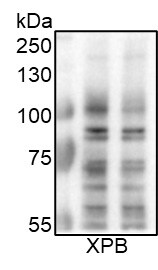
-
Application: Western BlotSample Tested: primary neonatal ventricular cardiomyocytesSpecies: RatVerified Customer | Posted 04/23/2026Protein lysates were analyzed by immunoblotting using an anti-XPB antibody (NB100-61060). Multiple bands were detected, with relatively strong signals both above and below the 75 kDa marker.
 Bio-Techne ResponseThis review reflects a new species or application tested on a primary antibody.
 -
Application: Chromatin ImmunoprecipitationSample Tested: CD8 T lymphocytes and human lymphocytes, whole cell lysateSpecies: HumanVerified Customer | Posted 04/23/2019chIP on T lymphocyte
There are no reviews that match your criteria.
Protocols
Find general support by application which include: protocols, troubleshooting, illustrated assays, videos and webinars.
- Cellular Response to Hypoxia Protocols
- ChIP Protocol Video
- Chromatin Immunoprecipitation (ChIP) Protocol
- Chromatin Immunoprecipitation Protocol
- Immunoprecipitation Protocol
- R&D Systems Quality Control Western Blot Protocol
- Troubleshooting Guide: Western Blot Figures
- Western Blot Conditions
- Western Blot Protocol
- Western Blot Protocol for Cell Lysates
- Western Blot Troubleshooting
- Western Blot Troubleshooting Guide
- View all Protocols, Troubleshooting, Illustrated assays and Webinars