Simple Plex Assays for Host Cell Protein and Impurity Testing
Host cell proteins (HCPs) are process-related impurities generated by the expression systems used to manufacture biologics. Chinese Hamster Ovary (CHO) cells are the predominant host cell line for recombinant protein production, while Human Embryonic Kidney (HEK) 293 cells are widely used for viral vector scale-up in cell and gene therapy manufacturing workflows. If not adequately removed, residual HCPs can compromise drug quality, reduce product efficacy, and trigger immunogenic reactions upon administration — making their monitoring a critical safety and regulatory requirement. Beyond HCPs, additional process-related impurities must be monitored depending on the specific manufacturing process. Endonuclease, routinely used to digest host cell nucleic acids during bioprocessing, must be verified as removed from the final product. Protein A, a key reagent in monoclonal antibody purification, can leach from affinity resins and persist as a potentially immunogenic contaminant. In gene therapy and viral vector m
Simple Plex assays on Ella provide the fast, sensitive, and reproducible measurements needed to monitor this broad spectrum of process-related impurities, helping biopharmaceutical manufacturers validate purification efficiency and maintain regulatory compliance throughout the entire manufacturing process.

Automated Host Cell Protein Analysis Using Simple Plex Assays
Residual HCPs have the ability to alter drug quality, decrease product efficacy and can even trigger an immunogenic reaction when administered as a biotherapeutic or cell and gene therapy. The successful removal of these in-process impurities is important during the manufacturing process of a biotherapeutic and is easily monitored with Simple Plex Assays.
Host Cell Protein Analysis - Chinese Hamster Ovary (CHO) Cells
Chinese Hamster Ovary (CHO) cells are the predominant expression system in biopharmaceutical manufacturing, widely used for the production of recombinant proteins and monoclonal antibodies. Their adoption is driven by their capacity for human-like post-translational modifications, high volumetric yields, and an extensive regulatory track record. Despite rigorous downstream purification, residual CHO host cell proteins (HCPs) can persist in the final drug product, posing potential immunogenicity and safety risks to patients. The Cygnus CHO HCP ELISA Kit, 3G (F550-1) has become the industry gold standard for this application, offering broad, well-characterized antibody coverage validated against more than 1,000 individual CHO HCPs using Antibody Affinity Extraction™ (AAE™) and mass spectrometry — giving manufacturers confidence in the completeness and reproducibility of their HCP detection.
Building on this trusted foundation, the Cygnus CHO HCP assay is now available on the Ella automated immunoassay platform as the Simple Plex CHO HCP 3G-1 assay (SPCKB-OT-003714), utilizing the same rigorously characterized antibodies as the plate-based ELISA. The Ella system delivers several meaningful analytical advantages, including an extended linear dynamic range that reduces the number of sample dilutions needed to fall within the detection window — minimizing setup time and the risk of sample preparation error. Head-to-head comparisons confirm that the Simple Plex assay tracks CHO HCP reduction during bioproduction equivalently to the plate ELISA, while delivering improved precision and lower variability. Stringent lot-by-lot QC of Simple Plex cartridges ensures longitudinal consistency, making the Ella system well-suited for high-throughput HCP monitoring across cell therapy and biotherapeutic manufacturing workflows where reproducible, comparable data across multiple users and sites is critical.
Comparison of Simple Plex CHO HCP Assay with ELISA
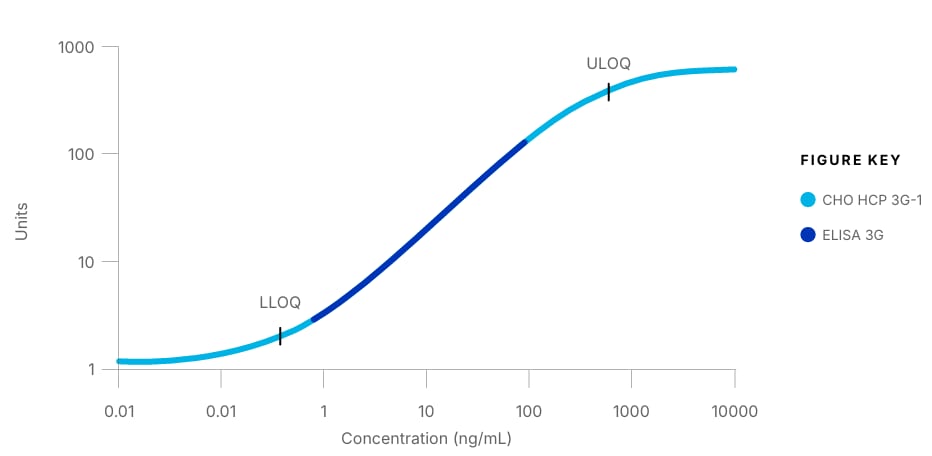
Standard curve of the Simple Plex CHO HCP, 3G-1 Assay (light blue) and conventional Cygnus CHO HCP, 3G ELISA (blue). The Simple Plex CHO HCP, 3G-1 Lower Limit of Quantitation (LLOQ) and Upper Limit of Quantitation (ULOQ) are indicated on the standard curve.
Host Cell Proteins Analysis- HEK 293 Cells
Human Embryonic Kidney 293 (HEK 293) cells are a widely used mammalian expression system for the production of recombinant proteins, viral vectors, and gene therapy products. As with CHO-based processes, residual HEK 293 host cell proteins that co-purify with the therapeutic product can pose immunogenicity and safety risks, requiring comprehensive HCP monitoring as a core quality control requirement. The Cygnus HEK 293 HCP ELISA Kit, 3G Resupply 1 (F650S) is the industry reference for this application. Antibodies were raised against a mild lysate of HEK 293 HCPs using specialized immunization strategies to ensure broad representation of low molecular weight, less immunogenic, and high molecular weight impurities. Coverage was further characterized by Antibody Affinity Extraction™ (AAE™) and mass spectrometry, confirming reactivity to the majority of HCPs present in HEK 293 strains. The result is a sensitive, reproducible assay validated for use across process development, in-process monitoring, and final pro
The Cygnus HEK 293 HCP assay is available on the Ella automated immunoassay platform as the Simple Plex HEK 293 HCP 3G assay (SPCKB-OT-007066), leveraging the identical antibodies used in the validated plate-based ELISA. This transition to Ella preserves the proven performance of the Cygnus assay while introducing the analytical and operational advantages of the Simple Plex format. An extended linear dynamic range reduces the dilutions required to bring samples within the detection window, streamlining workflow and reducing sample preparation variability. Lot-by-lot QC of Simple Plex cartridges ensures consistent, reproducible results across runs, users, and manufacturing sites — a particularly important consideration for gene therapy and viral vector production environments where process consistency and data comparability are paramount.
Simple Plex HEK 293 HCP 3G Assay Has a Broad Dynamic Range
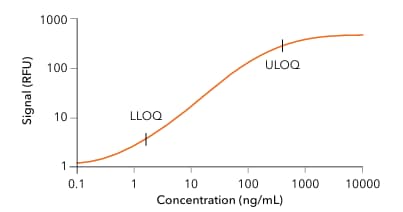
We compared the Simple Plex dynamic range to that of the Cygnus HEK 293 HCP ELISA Kit, 3G (F650S). The dynamic range was 1.64-400 ng/mL, which is comparable to the Cygnus ELISA. Built-in factory standards undergo a rigorous quality control process in order to ensure long-term lot-to-lot consistency.
Impurity Testing
Endonuclease
Endonuclease is widely used in biopharmaceutical manufacturing to degrade host cell nucleic acids during the production of viral vectors, vaccines, and other biotherapeutics. While effective at clearing DNA and RNA, residual endonuclease remaining in the final product constitutes a process-related impurity requiring removal and verification. Sensitive, reliable detection of residual endonuclease is therefore a critical quality control requirement across biotherapeutic development and manufacturing.
The Simple Plex Endonuclease assay on Ella provides an automated, highly sensitive solution for residual endonuclease detection in bioprocess samples. The assay delivers a broad 4-log dynamic range (LLOQ: 1.97 pg/mL; ULOQ: 18,750 pg/mL), with built-in factory standard curves and a hands-free workflow that returns triplicate results per sample in just 90 minutes. Inter-assay precision studies across multiple operators, cartridges, and cartridge lots demonstrated a combined CV of 10.5%, confirming robust reproducibility at low picogram levels. The assay has been validated for detection of both Benzonase® and Denarase® — the two most widely used commercial endonuclease products — confirming its broad applicability across bioprocess workflows.
High Inter-Assay Precision with Simple Plex Endonuclease Assay
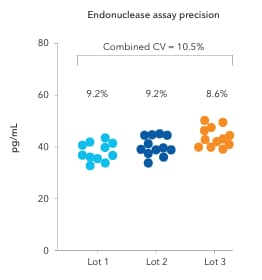
The automated, microfluidic design of the Simple Plex assay cartridge eliminates user-introduced variability providing high precision and reproducibility. To assess inter-assay precision, we evaluated endonuclease presence in a bioprocess sample that was loaded repeatedly across multiple cartridges and cartridge lots, by four operators. Even at low picogram levels, the results were reproducible regardless of operators, cartridge, or cartridge lot, with an overall coefficient of variance (CV) of 10.5%.
Impurity Testing - Protein A
Protein A is a cell wall constituent of Staphylococcus aureus that binds with high affinity to the Fc region of IgG-class immunoglobulins, a property that has made Protein A affinity chromatography the dominant capture step in monoclonal antibody and Fc-fusion protein purification. However, Protein A can leach from the resin during processing, introducing residual contamination into the drug substance. As a known immunogen, even trace levels pose a risk of adverse immune responses, making sensitive detection and verified clearance of residual Protein A a critical regulatory and quality control requirement for antibody-based therapeutics.
The Simple Plex Protein A assay on Ella (Cat. No. SPCKB-OT-009204) provides a rapid, automated solution for quantifying both natural and engineered variant Protein A in bioprocess samples, with an LOD of 4.34 pg/mL. This high sensitivity, combined with a broad dynamic range, enables reliable quantification across the full spectrum of Protein A concentrations encountered from early capture steps through final product release, with minimal sample dilution. The automated microfluidic design ensures consistent, reproducible detection of Protein A impurities across multiple operators and manufacturing sites — a particularly important capability for multi-site antibody manufacturing programs where inter-site data comparability is essential for process validation and lot release decisions
Simple Plex Protein A Assay Standard Curve
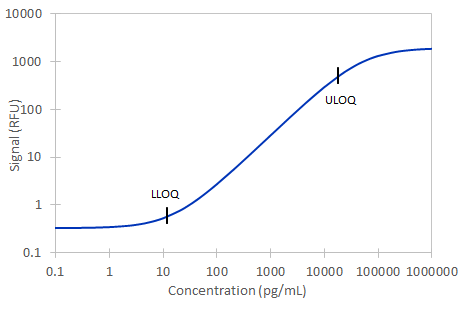
Data shown represents typical performance results for Lower Limit of Quantitation (LLOQ) and Upper Limit of Quantitation (ULOQ) for Simple Plex Protein A Assay. Assay range is 11.50-17,500 pg/mL.
Impurity Testing - GFP
Green Fluorescent Protein (GFP) is a 27 kDa bioluminescent protein originally isolated from the jellyfish Aequorea victoria that has become one of the most widely used reporter and tracer tools in biological research, with broad applications in fluorescence microscopy, reporter gene expression, and in vivo imaging. A laboratory-derived variant, GFPuv, incorporates three amino acid substitutions that confer faster expression and 18-fold greater fluorescence than native GFP, making it the preferred analog for intracellular protein localization studies. In biopharmaceutical manufacturing, GFP and GFPuv are commonly used as reporter proteins during process development and vector engineering. However, residual GFP in the final product constitutes a process-related impurity that must be detected and cleared, particularly in gene therapy and viral vector manufacturing workflows where GFP-tagged constructs are routinely employed.
The Simple Plex GFP assay on Ella (Cat. No. SPCKB-OT-002820) provides a highly sensitive, automated method for detecting residual GFP impurities in bioprocess samples, with an exceptional LOD of 0.71 pg/mL. This sub-picogram sensitivity is particularly valuable for final product release testing, where GFP impurity levels are expected to be at or near the limits of detection. The broad dynamic range of the Simple Plex platform minimizes the sample dilutions required across different stages of the manufacturing process, from early upstream development through downstream purification and final product clearance studies. Combined with the automated, microfluidic workflow of Ella, the assay delivers reproducible, high-precision results across operators and sites, supporting robust process development and quality control decisions in GFP-tagged biotherapeutic programs.
Related Products
| Simple Plex Assay | Catalog Number |
|---|---|
| CHO HCP 3G-1 Assay | SPCKB-OT-003714 |
| HEK 293 HCP 3G | SPCKB-OT-007066 |
| Endonuclease Assay | SPCKC-OT-008612 |
| Protein A Assay | SPCKB-OT-009204 |
| Green Fluorescent Protein (GFP) Assay | SPCKB-OT-002820 |
| Ella System | 600-100 |