
Endoplasmic Reticulum Enrichment Extraction Kit
Novus Biologicals | Catalog # NBP2-29482

Loading...
Key Product Details
Species
Human, Mouse
Applications
Immunohistochemistry, Immunoprecipitation, Western Blot
Kit Type
Extraction Kit
Product Summary for Endoplasmic Reticulum Enrichment Extraction Kit
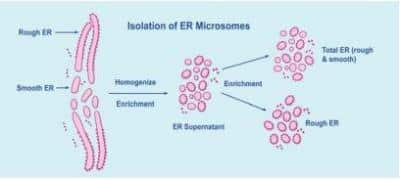
Isolating the ER may seem difficult due to its size and complex association with other components of the cytosol. The Endoplasmic Reticulum Enrichment Kit is a key tool that provides the necessary reagents together with an optimized protocol required to gently isolate and enrich for ER from tissues.
Loading...
Product Specifications
Applications
Immunohistochemistry-Paraffin (reported in scientific literature (PMID 33154371))
Western Blot (reported in scientific literature (PMID 23904601))
Immunoprecipitation (reported in scientific literature (PMID 33846551))
Western Blot (reported in scientific literature (PMID 23904601))
Immunoprecipitation (reported in scientific literature (PMID 33846551))
Application Notes
The kit is routinely tested using 0.5 gram of freshly isolated mouse liver tissue as the starting material. We typically get the following yields:
Total ER fraction: 350 uL (12 mg/mL = 4.2 mg) or
Rough ER fraction: 300 uL (9 mg/mL = 2.7 mg)
These yields are based on using the 0.5 gram starting material for either isolating the Total ER fraction or the Rough ER fraction. If the starting material is divided at Step C and both the Total and Rough ER fractions are isolated, then yields will be approximately 1/2. Please note that all yields are approximate and may vary depending on the tissue type used and other variables.
Reactivity Notes
Use in Human reported in scientific literature (PMID:33811847). Use in Mouse reported in scientific literature (PMID:33846551)
Scientific Data Images for Endoplasmic Reticulum Enrichment Extraction Kit
Endoplasmic Reticulum Enrichment Extraction Kit [NBP2-29482] - This kit is routinely tested and standardized using 0.5 gram of mouse liver tissue.
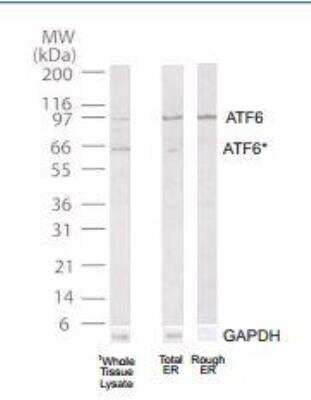
Endoplasmic Reticulum Enrichment Extraction Kit [NBP2-29482] - ATF6 (3 ug/mL) and GAPDH (0.25 ug/mL). ATF6 is an ER stress-regulated transmembrane transcription factor. The blots were probed with ATF6, stripped and reprobed with GAPDH. Full-length ATF6 was detected in all 3 lanes, and was enriched in the ER fractions. GAPDH was detected in the whole lysate and total ER fraction, but not in the rough ER fraction. ATF6* may represent partial or cleaved/active ATF6.
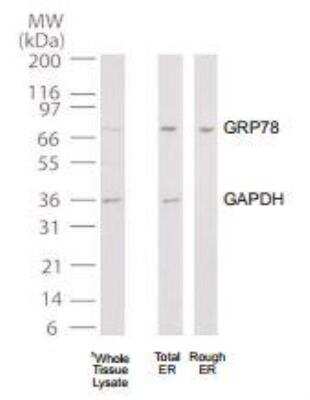
Endoplasmic Reticulum Enrichment Extraction Kit [NBP2-29482] - ATF6 (3 ug/mL) and GAPDH (0.25 ug/mL). GRP78 is an ER stress-regulated transmembrane transcription factor. The blots were probed with GRP78, stripped and reprobed with GAPDH. Full-length GRP78 was detected in all 3 lanes, and was enriched in the ER fractions. GAPDH was detected in the whole lysate and total ER fraction, but not in the rough ER fraction. GRP78* may represent partial or cleaved/active GRP78.
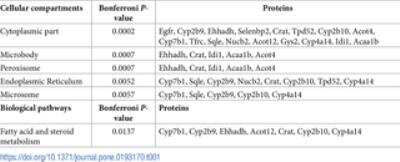
Endoplasmic Reticulum Enrichment Extraction Kit [NBP2-29482] - Ontology analyses of differentially expressed proteins in mouse cohorts.
Kit Contents for Endoplasmic Reticulum Enrichment Extraction Kit
- 100X Protease Inhibitor Cocktail (2 x 0.75 mL)
- 10X PBS (2 x 50 mL)
- 1X Suspension Buffer (30 mL)
- 5X Calcium Chloride Solution (60 mL)
- 5X Isosmotic Homogenization Buffer (30 mL)
Formulation, Preparation, and Storage
Concentration
Concentration is not relevant for this product. Please see the protocols for proper use of this product.
Shipping
The product is shipped with polar packs. Upon receipt, store it immediately at the temperature recommended below.
Storage
Storage of components varies. See protocol for specific instructions.
Background: Endoplasmic Reticulum Enrichment
Alternate Names
ER Enrichment
Additional Endoplasmic Reticulum Enrichment Products
Product Documents for Endoplasmic Reticulum Enrichment Extraction Kit
Certificate of Analysis
To download a Certificate of Analysis, please enter a lot or batch number in the search box below.
Product Specific Notices for Endoplasmic Reticulum Enrichment Extraction Kit
This product is for research use only and is not approved for use in humans or in clinical diagnosis. Kits are guaranteed for 6 months from date of receipt.
Citations for Endoplasmic Reticulum Enrichment Extraction Kit
 Powered by Bioz
Customer Reviews for Endoplasmic Reticulum Enrichment Extraction Kit
There are currently no reviews for this product. Be the first to review Endoplasmic Reticulum Enrichment Extraction Kit and earn rewards!
Have you used Endoplasmic Reticulum Enrichment Extraction Kit?
Submit a review and receive an Amazon gift card!
$25/€18/£15/$25CAN/¥2500 for a review with an image
$10/€7/£6/$10CAN/¥1110 for a review without an image
Submit a review
Protocols
Find general support by application which include: protocols, troubleshooting, illustrated assays, videos and webinars.
- Antigen Retrieval Protocol (PIER)
- Antigen Retrieval for Frozen Sections Protocol
- Appropriate Fixation of IHC/ICC Samples
- Cellular Response to Hypoxia Protocols
- Chromogenic IHC Staining of Formalin-Fixed Paraffin-Embedded (FFPE) Tissue Protocol
- Chromogenic Immunohistochemistry Staining of Frozen Tissue
- ClariTSA™ Fluorophore Kits
- Detection & Visualization of Antibody Binding
- Fluorescent IHC Staining of Frozen Tissue Protocol
- Graphic Protocol for Heat-induced Epitope Retrieval
- Graphic Protocol for the Preparation and Fluorescent IHC Staining of Frozen Tissue Sections
- Graphic Protocol for the Preparation and Fluorescent IHC Staining of Paraffin-embedded Tissue Sections
- Graphic Protocol for the Preparation of Gelatin-coated Slides for Histological Tissue Sections
- IHC Sample Preparation (Frozen sections vs Paraffin)
- Immunofluorescent IHC Staining of Formalin-Fixed Paraffin-Embedded (FFPE) Tissue Protocol
- Immunohistochemistry (IHC) and Immunocytochemistry (ICC) Protocols
- Immunohistochemistry Frozen Troubleshooting
- Immunohistochemistry Paraffin Troubleshooting
- Immunoprecipitation Protocol
- Preparing Samples for IHC/ICC Experiments
- Preventing Non-Specific Staining (Non-Specific Binding)
- Primary Antibody Selection & Optimization
- Protocol for Heat-Induced Epitope Retrieval (HIER)
- Protocol for Making a 4% Formaldehyde Solution in PBS
- Protocol for VisUCyte™ HRP Polymer Detection Reagent
- Protocol for the Preparation & Fixation of Cells on Coverslips
- Protocol for the Preparation and Chromogenic IHC Staining of Frozen Tissue Sections
- Protocol for the Preparation and Chromogenic IHC Staining of Frozen Tissue Sections - Graphic
- Protocol for the Preparation and Chromogenic IHC Staining of Paraffin-embedded Tissue Sections
- Protocol for the Preparation and Chromogenic IHC Staining of Paraffin-embedded Tissue Sections - Graphic
- Protocol for the Preparation and Fluorescent IHC Staining of Frozen Tissue Sections
- Protocol for the Preparation and Fluorescent IHC Staining of Paraffin-embedded Tissue Sections
- Protocol for the Preparation of Gelatin-coated Slides for Histological Tissue Sections
- R&D Systems Quality Control Western Blot Protocol
- TUNEL and Active Caspase-3 Detection by IHC/ICC Protocol
- The Importance of IHC/ICC Controls
- Troubleshooting Guide: Immunohistochemistry
- Troubleshooting Guide: Western Blot Figures
- Western Blot Conditions
- Western Blot Protocol
- Western Blot Protocol for Cell Lysates
- Western Blot Troubleshooting
- Western Blot Troubleshooting Guide
- View all Protocols, Troubleshooting, Illustrated assays and Webinars
FAQs for Endoplasmic Reticulum Enrichment Extraction Kit
Showing
1
-
5 的
8 FAQs
Showing All
-
Q: Could you tell us if the kit components contain ascorbic acid? #KC-415 1X Suspension Buffer, #KC-121 100X Protease Inhibitor Cocktail (PIC)
A: The kit components for our kit NBP2-29482 do not contain any ascorbic acid. The only component that contains any acids is KC-121, and this component contains 1% acetic acid.
-
Q: Could you tell us if this kit can be used to enrich from culture cells (e.g. Caco2 or HEK293)? If yes, please let us know detailed protocol and recovery ratio about that.
A: The short answer is Yes, this kit NBP2-29482 (Endoplasmic Reticulum Enrichment Extraction Kit) can be used in all cell lines. The yielding information/rate can also be obtained on our web datasheet. Endoplasmic Reticulum Enrichment Extraction Kit (NBP2-29482) datasheet, under the Title of "Applications/Dilutions".
-
Q: Does NBP2-29482 contain any polyclonal antibodies?
A:
Our kit NBP2-29482 does not contain any polyclonal antibodies. The components list for this kit can be found on page five of the manual
-
Q: I used Endoplasmic Reticulum Enrichment Extraction Kit (Cat. No. NBP2-29482) to extract the rough endoplasmic reticulum (RER) of plant mulberry leaves. After extraction, according to the kit procedure, I did a Western blot. The results showed that the GRP78 band in the supernatant after the final step of centrifugation was brighter than in the precipitate. What is the principle of adding calcium chloride when the kit is used to rough the endoplasmic reticulum? Because I want to try to increase the calcium chloride concentration to increase the yield of rough endoplasmic reticulum, What is the concentration of calcium chloride in the kit?
A: We recommend you to review paper entitled "A rapid calcium precipitation method of recovering large amounts of highly pure hepatocyte rough endoplasmic reticulum" by Hamilton et al ( published in Journal of Lipid Research Volume 40, 1999) wherein the modified calcium precipitation method had been described in more detail. The 5x CaCl2 solution is 40mM. You may be able to improve your results by using ice-cold 1x (8mM) CaCl2 and adding it drop-wise to the solution. The GRP78 protein is a ER marker but it will mark both smooth and rough ER, so the fact that there is plenty of GRP78 in your solution does not have to be an indication that the extraction was not complete. There are just smooth ER vesicles in the solution, which won't get precipitated until you spin it down at min 90 000xg.
-
Q: I used the ER enrichment kit, however the total ER fraction I collected at the procedure of C2 contained much of lysosome. (I confirmed it on WB of Lamp2 and enzyme assay of beta-galactosidase.) I would like to be informed if you have troubleshooting for this condition. The centrifuge I used is Beckman XE90, the rotor is SW41Ti.
The cell applied is 4x10^6 cells of COS7.A: With regard to your inquiry, my lab thinks that if the lysosomes are the same density and size as the ER population, they will be present in the ER collection. They recommend additional homogenization/lysis time on your cell population at the beginning of your enrichment process. They also think that further dilution could help as well. If possible, also try to add another centrifuge step to help remove other organelles prior to the high speed spin. We think these suggestions should help to eliminate the presence of the lysosomes in your ER collection.
-
Q: Regarding the Endoplasmic Reticulum Enrichment Kit, what is the common amount of ER when using this kit for cultured cells?
A: We have evaluated this Kit in tissues. We have not yet tested this Kit in cell lines. However, this kit has been described for use with cell lines in citation #2 in the product manual.
-
Q: To lysis cultured cells, should the tight or loose version of the glass homogenizer from Wheaton grinder be used? Also, does 90000 x g in the protocol correlate to max or average RCF with the Beckman centrifuge speed specification? With the JS-24.38, what RPM is recommended?
A: We use the Wheaton grinder loose version. With our centrifuge we set the speed at 90000 g, our rotor doesn't have options to specify max or average settings, there is just a setting. But if the options on your rotor are for max or average, then I would imagine average would be the one to choose, but either one might work just as well.
-
Q: What is the number of cells required for using this kit? If a sample includes detergent, will that effect the kit? Which fraction includes cell membrane fraction and Golgi body fraction after centrifugation several times?
A: We have used the kit with tissue. We haven't used the kit with cells. The customer will need to empirically determine the amount of cells needed. We unfortunately do not have any information on whether or not detergents will affect the usefulness of this kit. This kit is designed for endoplasmic reticulum enrichment. It is not designed for preservation of the Golgi and cell membrane fractions. The kit has been developed based on information in the general references listed in the manual provided with the kit.
-
Q: Could you tell us if the kit components contain ascorbic acid? #KC-415 1X Suspension Buffer, #KC-121 100X Protease Inhibitor Cocktail (PIC)
A: The kit components for our kit NBP2-29482 do not contain any ascorbic acid. The only component that contains any acids is KC-121, and this component contains 1% acetic acid.
-
Q: Could you tell us if this kit can be used to enrich from culture cells (e.g. Caco2 or HEK293)? If yes, please let us know detailed protocol and recovery ratio about that.
A: The short answer is Yes, this kit NBP2-29482 (Endoplasmic Reticulum Enrichment Extraction Kit) can be used in all cell lines. The yielding information/rate can also be obtained on our web datasheet. Endoplasmic Reticulum Enrichment Extraction Kit (NBP2-29482) datasheet, under the Title of "Applications/Dilutions".
-
Q: Does NBP2-29482 contain any polyclonal antibodies?
A:
Our kit NBP2-29482 does not contain any polyclonal antibodies. The components list for this kit can be found on page five of the manual
-
Q: I used Endoplasmic Reticulum Enrichment Extraction Kit (Cat. No. NBP2-29482) to extract the rough endoplasmic reticulum (RER) of plant mulberry leaves. After extraction, according to the kit procedure, I did a Western blot. The results showed that the GRP78 band in the supernatant after the final step of centrifugation was brighter than in the precipitate. What is the principle of adding calcium chloride when the kit is used to rough the endoplasmic reticulum? Because I want to try to increase the calcium chloride concentration to increase the yield of rough endoplasmic reticulum, What is the concentration of calcium chloride in the kit?
A: We recommend you to review paper entitled "A rapid calcium precipitation method of recovering large amounts of highly pure hepatocyte rough endoplasmic reticulum" by Hamilton et al ( published in Journal of Lipid Research Volume 40, 1999) wherein the modified calcium precipitation method had been described in more detail. The 5x CaCl2 solution is 40mM. You may be able to improve your results by using ice-cold 1x (8mM) CaCl2 and adding it drop-wise to the solution. The GRP78 protein is a ER marker but it will mark both smooth and rough ER, so the fact that there is plenty of GRP78 in your solution does not have to be an indication that the extraction was not complete. There are just smooth ER vesicles in the solution, which won't get precipitated until you spin it down at min 90 000xg.
-
Q: I used the ER enrichment kit, however the total ER fraction I collected at the procedure of C2 contained much of lysosome. (I confirmed it on WB of Lamp2 and enzyme assay of beta-galactosidase.) I would like to be informed if you have troubleshooting for this condition. The centrifuge I used is Beckman XE90, the rotor is SW41Ti.
The cell applied is 4x10^6 cells of COS7.A: With regard to your inquiry, my lab thinks that if the lysosomes are the same density and size as the ER population, they will be present in the ER collection. They recommend additional homogenization/lysis time on your cell population at the beginning of your enrichment process. They also think that further dilution could help as well. If possible, also try to add another centrifuge step to help remove other organelles prior to the high speed spin. We think these suggestions should help to eliminate the presence of the lysosomes in your ER collection.
-
Q: Regarding the Endoplasmic Reticulum Enrichment Kit, what is the common amount of ER when using this kit for cultured cells?
A: We have evaluated this Kit in tissues. We have not yet tested this Kit in cell lines. However, this kit has been described for use with cell lines in citation #2 in the product manual.
-
Q: To lysis cultured cells, should the tight or loose version of the glass homogenizer from Wheaton grinder be used? Also, does 90000 x g in the protocol correlate to max or average RCF with the Beckman centrifuge speed specification? With the JS-24.38, what RPM is recommended?
A: We use the Wheaton grinder loose version. With our centrifuge we set the speed at 90000 g, our rotor doesn't have options to specify max or average settings, there is just a setting. But if the options on your rotor are for max or average, then I would imagine average would be the one to choose, but either one might work just as well.
-
Q: What is the number of cells required for using this kit? If a sample includes detergent, will that effect the kit? Which fraction includes cell membrane fraction and Golgi body fraction after centrifugation several times?
A: We have used the kit with tissue. We haven't used the kit with cells. The customer will need to empirically determine the amount of cells needed. We unfortunately do not have any information on whether or not detergents will affect the usefulness of this kit. This kit is designed for endoplasmic reticulum enrichment. It is not designed for preservation of the Golgi and cell membrane fractions. The kit has been developed based on information in the general references listed in the manual provided with the kit.
Loading...