
GPR81 Antibody - BSA Free
Novus Biologicals | Catalog # NLS2095

![Immunocytochemistry/ Immunofluorescence: GPR81 Antibody - BSA Free [NLS2095]](https://resources.rndsystems.com/images/products/GPR81-Antibody-Immunocytochemistry-Immunofluorescence-NLS2095-img0010.jpg "Immunocytochemistry/ Immunofluorescence: GPR81 Antibody - BSA Free [NLS2095]")
Scientific images may be resized, cropped, or adjusted for brightness or contrast for presentation purposes. These updates are limited to presentation and do not affect the underlying scientific interpretation of the data. Where available, additional source data may be provided upon request.
Key Product Details
Species Reactivity
Validated:
Cited:
Predicted:
Applications
Validated:
Cited:
Label
Antibody Source
Format
Product Specifications
Immunogen
Epitope
Reactivity Notes
Localization
Specificity
Clonality
Host
Isotype
Description
Scientific Data Images for GPR81 Antibody - BSA Free
Immunocytochemistry/ Immunofluorescence: GPR81 Antibody - BSA Free [NLS2095]
GPR81-Antibody-Immunocytochemistry-Immunofluorescence-NLS2095-img0010.jpg![Immunohistochemistry-Paraffin: GPR81 Antibody - BSA Free [NLS2095]](https://resources.rndsystems.com/images/products/GPR81-Antibody-Immunohistochemistry-Paraffin-NLS2095-img0009.jpg "Immunohistochemistry-Paraffin: GPR81 Antibody - BSA Free [NLS2095]")
Immunohistochemistry-Paraffin: GPR81 Antibody - BSA Free [NLS2095]
Immunohistochemistry-Paraffin: GPR81 Antibody [NLS2095] - Brain, Substantia Nigra, pigmented and nonpigmented neurons.![Immunohistochemistry-Paraffin: GPR81 Antibody - BSA Free [NLS2095]](https://resources.rndsystems.com/images/products/GPR81-Antibody-Immunohistochemistry-Paraffin-NLS2095-img0002.jpg "Immunohistochemistry-Paraffin: GPR81 Antibody - BSA Free [NLS2095]")
Immunohistochemistry-Paraffin: GPR81 Antibody - BSA Free [NLS2095]
Immunohistochemistry-Paraffin: GPR81 Antibody [NLS2095] - Analysis of anti-FKSG80 / GPR81 antibody with human anterior pituitary.![Immunohistochemistry-Paraffin: GPR81 Antibody - BSA Free [NLS2095]](https://resources.rndsystems.com/images/products/GPR81-Antibody-Immunohistochemistry-Paraffin-NLS2095-img0004.jpg "Immunohistochemistry-Paraffin: GPR81 Antibody - BSA Free [NLS2095]")
Immunohistochemistry-Paraffin: GPR81 Antibody - BSA Free [NLS2095]
Immunohistochemistry-Paraffin: GPR81 Antibody [NLS2095] - Analysis of anti-FKSG80 / GPR81 antibody with human colon, carcinoma.![Immunohistochemistry-Paraffin: GPR81 Antibody - BSA Free [NLS2095]](https://resources.rndsystems.com/images/products/GPR81-Antibody-Immunohistochemistry-Paraffin-NLS2095-img0005.jpg "Immunohistochemistry-Paraffin: GPR81 Antibody - BSA Free [NLS2095]")
Immunohistochemistry-Paraffin: GPR81 Antibody - BSA Free [NLS2095]
Immunohistochemistry-Paraffin: GPR81 Antibody [NLS2095] - Human Skin, Melanoma formalin-fixed, paraffin-embedded tissue after heat-induced antigen retrieval.![Immunohistochemistry-Paraffin: GPR81 Antibody - BSA Free [NLS2095]](https://resources.rndsystems.com/images/products/GPR81-Antibody-Immunohistochemistry-Paraffin-NLS2095-img0006.jpg "Immunohistochemistry-Paraffin: GPR81 Antibody - BSA Free [NLS2095]")
Immunohistochemistry-Paraffin: GPR81 Antibody - BSA Free [NLS2095]
Immunohistochemistry-Paraffin: GPR81 Antibody [NLS2095] - Human Ovary, Carcinoma formalin-fixed, paraffin-embedded tissue after heat-induced antigen retrieval.![Immunohistochemistry-Paraffin: GPR81 Antibody - BSA Free [NLS2095]](https://resources.rndsystems.com/images/products/GPR81-Antibody-Immunohistochemistry-Paraffin-NLS2095-img0007.jpg "Immunohistochemistry-Paraffin: GPR81 Antibody - BSA Free [NLS2095]")
Immunohistochemistry-Paraffin: GPR81 Antibody - BSA Free [NLS2095]
Immunohistochemistry-Paraffin: GPR81 Antibody [NLS2095] - Human pancreas, carcinoma formalin-fixed, paraffin-embedded tissue after heat-induced antigen retrieval.![Immunohistochemistry-Paraffin: GPR81 Antibody - BSA Free [NLS2095]](https://resources.rndsystems.com/images/products/GPR81-Antibody-Immunohistochemistry-Paraffin-NLS2095-img0008.jpg "Immunohistochemistry-Paraffin: GPR81 Antibody - BSA Free [NLS2095]")
Immunohistochemistry-Paraffin: GPR81 Antibody - BSA Free [NLS2095]
Immunohistochemistry-Paraffin: GPR81 Antibody [NLS2095] - Breast, Carcinoma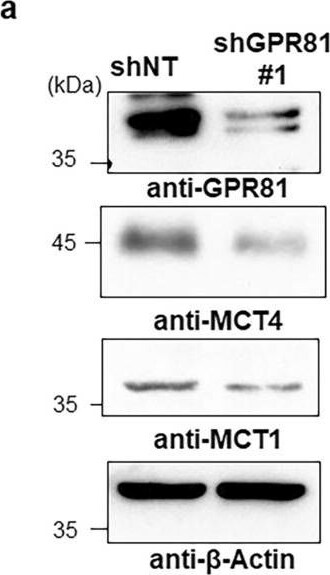
Western Blot: GPR81 Antibody - BSA Free [NLS2095] -
Western Blot: GPR81 Antibody - BSA Free [NLS2095] - Stable knockdown of GPR81 in MDA-MB-231 cells. Using a lentiviral system, GPR81 was stably knocked down in MDA-MB-231 cells with GPR81-specific short hairpin RNA (shGPR81 #1) & compared with cells containing scrambled shRNA as a control (shNT). Knockdown of GPR81 was confirmed by (a) western blotting & (b) RT-qPCR. The GPR81, MCT1, & MCT4 mRNA levels in the shGPR81 #1 cells are presented as the fold increase compared with those in shNT cells. Data are presented as the means ± s.d. (n = 3/group). **p < 0.01; Student’s t-test. (c) Lactate production in shNT & shGPR81 #1 cells. The cells were cultured for 24 h & lactate concentrations in the supernatants were determined (n = 3/group). **p < 0.01 (vs. shNT cells); Student’s t-test. Image collected & cropped by CiteAb from the following publication (https://pubmed.ncbi.nlm.nih.gov/35428832), licensed under a CC-BY license. Not internally tested by Novus Biologicals.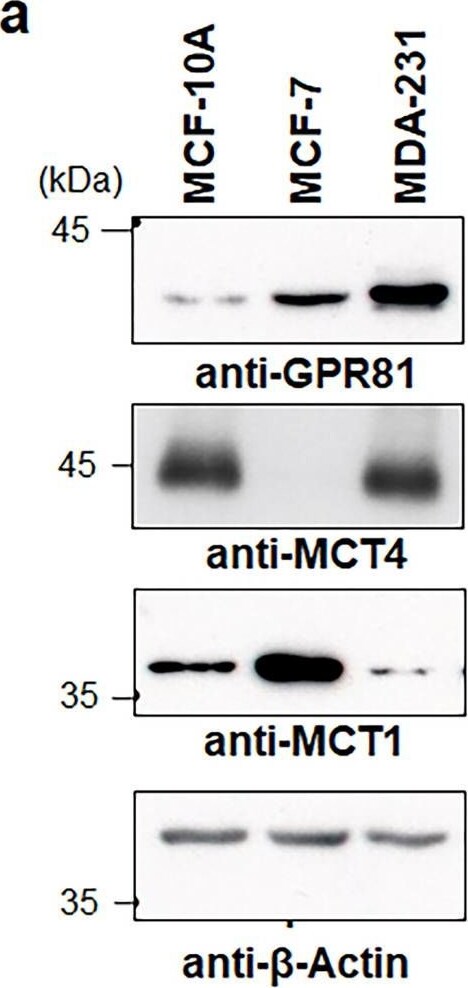
Western Blot: GPR81 Antibody - BSA Free [NLS2095] -
Western Blot: GPR81 Antibody - BSA Free [NLS2095] - Expression of GPR81 in breast cancer cells. (a) Western blot analysis of GPR81 in breast cancer cells (MCF-7 & MDA-MB-231) & non-tumorigenic epithelial cells (MCF-10A). Cell lysates were analyzed by immunoblotting using anti-GPR81, anti-MCT4, anti-MCT1, & anti-beta -actin antibodies. (b) Immunocytochemical analysis of GPR81 expression in breast cancer cells (MCF-7 & MDA-MB-231) & non-tumorigenic epithelial cells (MCF-10A). MCF-10A, MCF-7 & MDA-MB-231 cells were incubated with polyclonal antibodies against GPR81 followed by Alexa Fluor Plus 488-conjugated secondary antibody & visualized under a fluorescence microscope. Na/K ATPase was used as a cell membrane marker & the nuclei were stained with DAPI. Scale bar 10 μm. (c) MDA-MB-231 cells were cultured in the presence & absence of 20 mM lactate for 48 h, & cell lysates were analyzed by immunoblotting using anti-GPR81 & anti-beta -actin antibodies. Image collected & cropped by CiteAb from the following publication (https://pubmed.ncbi.nlm.nih.gov/35428832), licensed under a CC-BY license. Not internally tested by Novus Biologicals.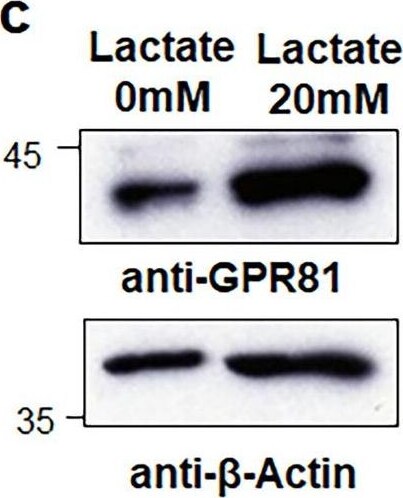
Western Blot: GPR81 Antibody - BSA Free [NLS2095] -
Western Blot: GPR81 Antibody - BSA Free [NLS2095] - Expression of GPR81 in breast cancer cells. (a) Western blot analysis of GPR81 in breast cancer cells (MCF-7 & MDA-MB-231) & non-tumorigenic epithelial cells (MCF-10A). Cell lysates were analyzed by immunoblotting using anti-GPR81, anti-MCT4, anti-MCT1, & anti-beta -actin antibodies. (b) Immunocytochemical analysis of GPR81 expression in breast cancer cells (MCF-7 & MDA-MB-231) & non-tumorigenic epithelial cells (MCF-10A). MCF-10A, MCF-7 & MDA-MB-231 cells were incubated with polyclonal antibodies against GPR81 followed by Alexa Fluor Plus 488-conjugated secondary antibody & visualized under a fluorescence microscope. Na/K ATPase was used as a cell membrane marker & the nuclei were stained with DAPI. Scale bar 10 μm. (c) MDA-MB-231 cells were cultured in the presence & absence of 20 mM lactate for 48 h, & cell lysates were analyzed by immunoblotting using anti-GPR81 & anti-beta -actin antibodies. Image collected & cropped by CiteAb from the following publication (https://pubmed.ncbi.nlm.nih.gov/35428832), licensed under a CC-BY license. Not internally tested by Novus Biologicals.Applications for GPR81 Antibody - BSA Free
Immunohistochemistry-Paraffin
Formulation, Preparation, and Storage
Purification
Formulation
Format
Preservative
Concentration
Shipping
Stability & Storage
Background: GPR81
Long Name
Alternate Names
Entrez Gene IDs
Gene Symbol
UniProt
Additional GPR81 Products
Product Documents for GPR81 Antibody - BSA Free
Certificate of Analysis
To download a Certificate of Analysis, please enter a lot or batch number in the search box below.
Product Specific Notices for GPR81 Antibody - BSA Free
This product is for research use only and is not approved for use in humans or in clinical diagnosis. Primary Antibodies are guaranteed for 1 year from date of receipt.
Citations for GPR81 Antibody - BSA Free
 Powered by Bioz
Customer Reviews for GPR81 Antibody - BSA Free
There are currently no reviews for this product. Be the first to review GPR81 Antibody - BSA Free and earn rewards!
Have you used GPR81 Antibody - BSA Free?
Submit a review and receive an Amazon gift card!
$25/€18/£15/$25CAN/¥2500 for a review with an image
$10/€7/£6/$10CAN/¥1110 for a review without an image
Submit a review
Protocols
View specific protocols for GPR81 Antibody - BSA Free (NLS2095):
Immunohistochemistry
1. Prepare tissue with formalin fixation and by embedding it in paraffin wax.
2. Make 4 um sections and place on pre-cleaned and charged microscope slides.
3. Heat in a tissue-drying oven for 45 minutes @ 60 degrees Celcius.
4. Deparaffinize the tissues by wash drying the slides in 3 changes of xylene for 5 minutes each @ RT.
5. Rehydrate the tissues by washing the slides in 3 changes of 100% alcohol for 3 minutes each @ RT.
6. Wash the slides in 2 changes of 95% alcohol for 3 minutes each @ RT.
7. Wash the slides in 1 change of 80% alcohol for 3 minutes @ RT.
8. Rinse the slides in gentle running distilled water for 5 minutes @ RT.
9. Perform antigen retrieval by steaming the slides in 0.01M sodium citrate buffer (pH 6.0) @ 99-100 degrees Celcius
for 20 minutes.
10. Remove the slides from the heat and let stand in buffer @ RT for 20 minutes.
11. Rinse the slides in 1X TBS-T for 1 minute @ RT.
**Do not allow the tissues to dry at any time during the staining procedure**
12. Begin the immunostaining by applying a universal protein block for 20 minutes @ RT.
13. Drain protein block from the slides and apply the diluted primary antibody for 45 minutes @ RT.
14. Rinse the slide in 1X TBS-T for 1 minute @ RT.
15. Apply a biotinylated anti-rabbit IgG (H+L) secondary for 30 minutes @ RT.
16. Rinse the slide in 1X TBS-T for 1 minute @ RT.
17. Apply an alkaline phosphatase steptavidin for 30 minutes @ RT.
18. Rinse the slide in 1X TBS-T for 1 minute @ RT.
19. Apply an alkaline phosphatase chromagen substrate for 30 minutes @ RT.
20. Rinse the slide in distilled water for 1 minute @ RT.
**This method should only be used if the chromagen substrate is alcohol insoluble (ie: Vector Red, DAB)**
21. Dehydrate the tissue by washing the slides in 2 changes of 80% alcohol for 1 minute each @ RT.
22. Wash the slides in 2 changes of 95% alcohol for 1 minute each @ RT.
23. Wash the slides in 3 changes of 100% alcohol for 1 minute each @ RT.
24. Wash the slides in 3 changes of xylene for 1 minute each @ RT.
25. Apply cover slip.
Find general support by application which include: protocols, troubleshooting, illustrated assays, videos and webinars.
- Antigen Retrieval Protocol (PIER)
- Antigen Retrieval for Frozen Sections Protocol
- Appropriate Fixation of IHC/ICC Samples
- Cellular Response to Hypoxia Protocols
- Chromogenic IHC Staining of Formalin-Fixed Paraffin-Embedded (FFPE) Tissue Protocol
- Chromogenic Immunohistochemistry Staining of Frozen Tissue
- ClariTSA™ Fluorophore Kits
- Detection & Visualization of Antibody Binding
- Fluorescent IHC Staining of Frozen Tissue Protocol
- Graphic Protocol for Heat-induced Epitope Retrieval
- Graphic Protocol for the Preparation and Fluorescent IHC Staining of Frozen Tissue Sections
- Graphic Protocol for the Preparation and Fluorescent IHC Staining of Paraffin-embedded Tissue Sections
- Graphic Protocol for the Preparation of Gelatin-coated Slides for Histological Tissue Sections
- ICC Cell Smear Protocol for Suspension Cells
- ICC Immunocytochemistry Protocol Videos
- ICC for Adherent Cells
- IHC Sample Preparation (Frozen sections vs Paraffin)
- Immunocytochemistry (ICC) Protocol
- Immunocytochemistry Troubleshooting
- Immunofluorescence of Organoids Embedded in Cultrex Basement Membrane Extract
- Immunofluorescent IHC Staining of Formalin-Fixed Paraffin-Embedded (FFPE) Tissue Protocol
- Immunohistochemistry (IHC) and Immunocytochemistry (ICC) Protocols
- Immunohistochemistry Frozen Troubleshooting
- Immunohistochemistry Paraffin Troubleshooting
- Preparing Samples for IHC/ICC Experiments
- Preventing Non-Specific Staining (Non-Specific Binding)
- Primary Antibody Selection & Optimization
- Protocol for Heat-Induced Epitope Retrieval (HIER)
- Protocol for Making a 4% Formaldehyde Solution in PBS
- Protocol for VisUCyte™ HRP Polymer Detection Reagent
- Protocol for the Fluorescent ICC Staining of Cell Smears - Graphic
- Protocol for the Fluorescent ICC Staining of Cultured Cells on Coverslips - Graphic
- Protocol for the Preparation & Fixation of Cells on Coverslips
- Protocol for the Preparation and Chromogenic IHC Staining of Frozen Tissue Sections
- Protocol for the Preparation and Chromogenic IHC Staining of Frozen Tissue Sections - Graphic
- Protocol for the Preparation and Chromogenic IHC Staining of Paraffin-embedded Tissue Sections
- Protocol for the Preparation and Chromogenic IHC Staining of Paraffin-embedded Tissue Sections - Graphic
- Protocol for the Preparation and Fluorescent ICC Staining of Cells on Coverslips
- Protocol for the Preparation and Fluorescent ICC Staining of Non-adherent Cells
- Protocol for the Preparation and Fluorescent ICC Staining of Stem Cells on Coverslips
- Protocol for the Preparation and Fluorescent IHC Staining of Frozen Tissue Sections
- Protocol for the Preparation and Fluorescent IHC Staining of Paraffin-embedded Tissue Sections
- Protocol for the Preparation of Gelatin-coated Slides for Histological Tissue Sections
- Protocol for the Preparation of a Cell Smear for Non-adherent Cell ICC - Graphic
- R&D Systems Quality Control Western Blot Protocol
- TUNEL and Active Caspase-3 Detection by IHC/ICC Protocol
- The Importance of IHC/ICC Controls
- Troubleshooting Guide: Immunohistochemistry
- Troubleshooting Guide: Western Blot Figures
- Western Blot Conditions
- Western Blot Protocol
- Western Blot Protocol for Cell Lysates
- Western Blot Troubleshooting
- Western Blot Troubleshooting Guide
- View all Protocols, Troubleshooting, Illustrated assays and Webinars
FAQs for GPR81 Antibody - BSA Free
-
Q: We would like to know the Molecular weight of NLS2095.
A: This antibody was raised to a synthetic 19 amino acid peptide derived from the C-terminus of the human protein. Human GPR81 has a theoretical molecular weight of approximately 39kDa according to the Uniprot accession: Uniprot site