

Human BDNF Antibody Summary
Arg128-Arg247
Accession # P23560
Applications
Please Note: Optimal dilutions should be determined by each laboratory for each application. General Protocols are available in the Technical Information section on our website.
Scientific Data
View Larger
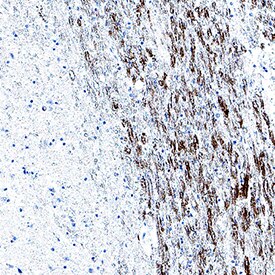
Detection of BDNF in Human Spinal Cord. BDNF was detected in immersion fixed paraffin-embedded sections of human spinal cord using Mouse Anti-Human BDNF Monoclonal Antibody (Catalog # MAB248R) at 5 µg/ml for 1 hour at room temperature followed by incubation with the Anti-Mouse IgG VisUCyte™ HRP Polymer Antibody (Catalog # VC001) or the HRP-conjugated Anti-Mouse IgG Secondary Antibody (Catalog # HAF007). Before incubation with the primary antibody, tissue was subjected to heat-induced epitope retrieval using VisUCyte Antigen Retrieval Reagent-Basic (Catalog # VCTS021). Tissue was stained using DAB (brown) and counterstained with hematoxylin (blue). Specific staining was localized to the cytoplasm. View our protocol for IHC Staining with VisUCyte HRP Polymer Detection Reagents.
Reconstitution Calculator
Preparation and Storage
- 12 months from date of receipt, -20 to -70 °C as supplied.
- 1 month, 2 to 8 °C under sterile conditions after reconstitution.
- 6 months, -20 to -70 °C under sterile conditions after reconstitution.
Background: BDNF
Brain-derived neurotrophic factor (BDNF) is a member of the NGF family of neurotrophic factors (also named neurotrophins) that are required for the differentiation and survival of specific neuronal subpopulations in both the central as well as the peripheral nervous system. The neurotrophin family is comprised of at least four proteins including NGF, BDNF, NT-3, and NT-4/5. These secreted cytokines are synthesized as prepropeptides that are proteolytically processed to generate the mature proteins. All neurotrophins have six conserved cysteine residues that are involved in the formation of three disulfide bonds and all share approximately 55% sequence identity at the amino acid level. Similarly to NGF, bioactive BDNF is predicted to be a non-covalently linked homodimer.
BDNF cDNA encodes a 247 amino acid residue precursor protein with a signal peptide and a proprotein that are cleaved to yield the 119 amino acid residue mature BDNF. The amino acid sequence of mature BDNF is identical in all mammals examined. High levels of expression of BDNF have been detected in the hippocampus, cerebellum, fetal eye, and placenta. In addition, low levels of BDNF expression are also found in the pituitary gland, spinal cord, heart, lung, and skeletal muscle. BDNF binds with high affinity and specifically activates the TrkB tyrosine kinase receptor.

- Eide, F.F. et al. (1993) Exp. Neurol. 121:200.
- Snider, W.D. (1994) Cell 77:627.
- Barbacid, M. (1994) J. Neurobiol. 25:1386.
Product Datasheets
FAQs
No product specific FAQs exist for this product, however you may
View all Antibody FAQsReviews for Human BDNF Antibody
There are currently no reviews for this product. Be the first to review Human BDNF Antibody and earn rewards!
Have you used Human BDNF Antibody?
Submit a review and receive an Amazon gift card.
$25/€18/£15/$25CAN/¥75 Yuan/¥2500 Yen for a review with an image
$10/€7/£6/$10 CAD/¥70 Yuan/¥1110 Yen for a review without an image
