
Cystatin E/M encoded by the CST6 gene is a member of family 2 of the cystatin superfamily (1, 2). It inhibits papain and cathepsin B, two of the cysteine proteases. Its mRNA was found in many tissues by the two groups who did initial cloning (1, 2). However, its protein was found only in skin and sweat glands by a third group (3). In addition to being a cysteine protease inhibitor, cystatin E/M is also a substrate for transglutaminases (3). It is required for viability and for correct formation of cornified layers in the epidermis and hair follicles, as ichq mice, with a null mutation in the cystatin E/M gene, have defects in epidermal cornification and die between 5 and 12 days of age (4). Cystatin E/M expression and function may not be limited to cutaneous epithelia. For example, it is found in rat brain and is induced during neuronal cell differentiation (5).

Scientific images may be resized, cropped, or adjusted for brightness or contrast for presentation purposes. These updates are limited to presentation and do not affect the underlying scientific interpretation of the data. Where available, additional source data may be provided upon request.
Key Product Details
Species Reactivity
Validated:
Cited:
Applications
Validated:
Cited:
Label
Antibody Source
Product Specifications
Immunogen
Arg29-Met149
Accession # Q15828
Specificity
Clonality
Host
Isotype
Scientific Data Images for Human Cystatin E/M Antibody
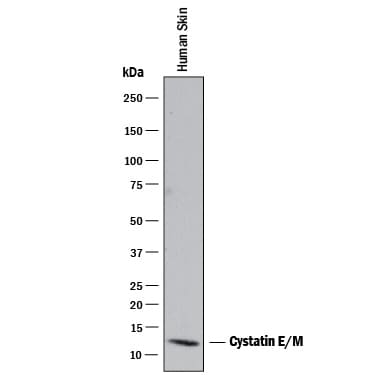
Detection of Human Cystatin E/M by Western Blot.
Western blot shows lysates of human skin tissue. PVDF membrane was probed with 1 µg/mL of Goat Anti-Human Cystatin E/M Antigen Affinity-purified Polyclonal Antibody (Catalog # AF1286) followed by HRP-conjugated Anti-Goat IgG Secondary Antibody (Catalog # HAF017). A specific band was detected for Cystatin E/M at approximately 13 kDa (as indicated). This experiment was conducted under reducing conditions and using Immunoblot Buffer Group 1.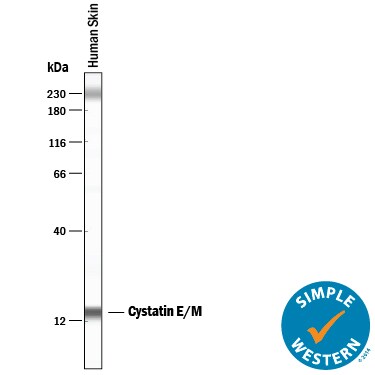
Detection of Human Cystatin E/M by Simple WesternTM.
Simple Western lane view shows lysates of human skin tissue, loaded at 0.2 mg/mL. A specific band was detected for Cystatin E/M at approximately 13 kDa (as indicated) using 50 µg/mL of Goat Anti-Human Cystatin E/M Antigen Affinity-purified Polyclonal Antibody (Catalog # AF1286) followed by 1:50 dilution of HRP-conjugated Anti-Goat IgG Secondary Antibody (Catalog # HAF109). This experiment was conducted under reducing conditions and using the 12-230 kDa separation system. Non-specific interaction with the 230 kDa Simple Western standard may be seen with this antibody.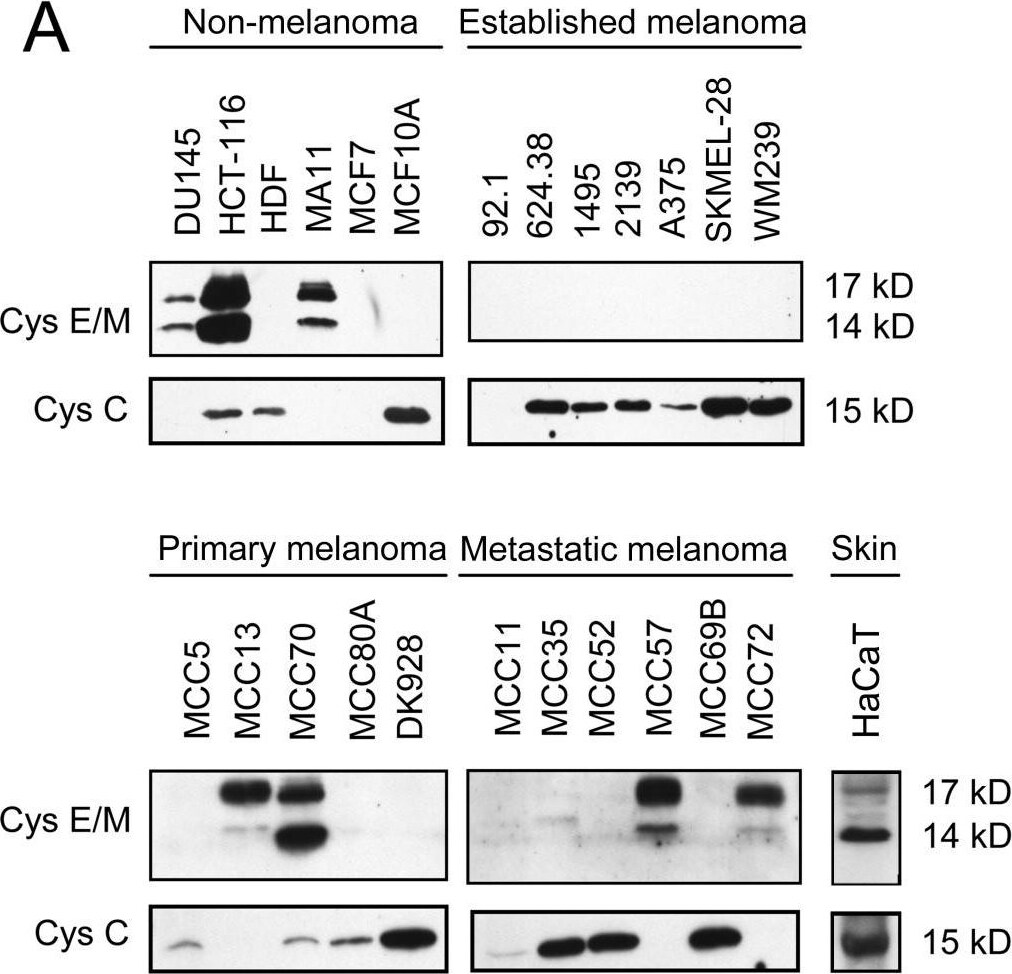
Detection of Human Cystatin E/M/CST6 by Western Blot
Cystatin E/M and C secretions from various cell lines: Common laboratory non-melanoma and established laboratory melanoma cell lines (top), and primary and metastatic melanoma cell lines established from patients, as well as skin control (bottom). (A) Equal amounts of serum free media were collected from 5 × 10⁵ cells 48 h after changing from ordinary growth media and secreted proteins were concentrated by TCA-precipitation and subjected to SDS-PAGE and immunoblotting. The filters were stained with a cystatin E/M-specific (upper panels) or a cystatin C-specific (lower panel) antibody, respectively. (B) Inhibitory activity against legumain was measured in the conditioned media as residual legumain activity. A partially purified legumain fraction from rat kidney was mixed with conditioned media and the ability to cleave the substrate Z-Ala-Ala-Asn-NHMec was measured by fluorometry. Control bar (100%) represents activity in the rat legumain fraction without addition of conditioned media. Image collected and cropped by CiteAb from the following open publication (https://pubmed.ncbi.nlm.nih.gov/20074384), licensed under a CC-BY license. Not internally tested by R&D Systems.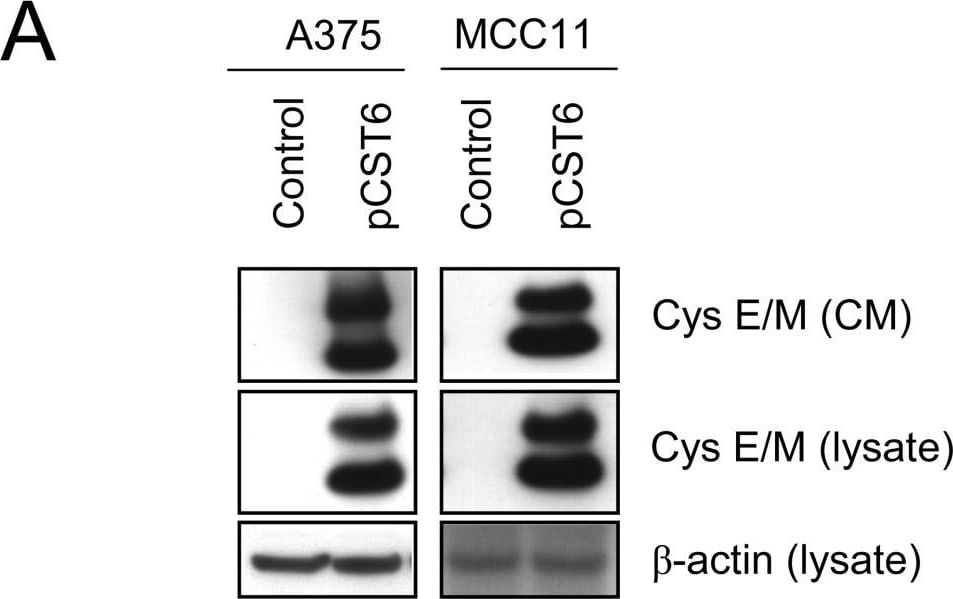
Detection of Cystatin E/M/CST6 by Western Blot
Cystatin E/M over-expression in melanoma cells suppressed legumain activity: A375 and MCC11 cells were transfected with pCST6 (closed bars) or empty pTracer vector (control; open bars), media were changed the following day, and serum-free conditioned media and cell lysates were collected 24 h later. (A) Immunoblots of cystatin E/M in conditioned media (CM) and lysates. Secreted proteins were TCA-precipitated prior to SDS-PAGE and immunoblotting. The filters were stained with a cystatin E/M-specific (upper and middle panels) or a beta -actin specific (lower panel; loading control) antibody, respectively. (B) Inhibitory activity against legumain was measured in the conditioned media as residual legumain activity using fluorometry, a fixed amount of partially purified legumain from rat kidney and the substrate Z-Ala-Ala-Asn-NHMec (A375, p < 0.0001; MCC11, p = 0.002). (C) Activity of legumain in cell lysates measured by cleavage of Z-Ala-Ala-Asn-NHMec (A375, p < 0.0001; MCC11, p = 0.0012). Error bars represent the standard error of the mean (SEM). Image collected and cropped by CiteAb from the following open publication (https://pubmed.ncbi.nlm.nih.gov/20074384), licensed under a CC-BY license. Not internally tested by R&D Systems.Applications for Human Cystatin E/M Antibody
Immunohistochemistry
Sample: Immersion fixed paraffin-embedded sections of human skin
Immunoprecipitation
Sample: Conditioned cell culture medium spiked with Recombinant Human Cystatin E/M (Catalog # 1286-PI), see our available Western blot detection antibodies
Simple Western
Sample: Human skin tissue
Western Blot
Sample: Human skin tissue
Reviewed Applications
Read 1 review rated 5 using AF1286 in the following applications:
Formulation, Preparation, and Storage
Purification
Reconstitution
Reconstitute at 0.2 mg/mL in sterile PBS. For liquid material, refer to CoA for concentration.
Formulation
Shipping
Stability & Storage
- 12 months from date of receipt, -20 to -70 °C as supplied.
- 1 month, 2 to 8 °C under sterile conditions after reconstitution.
- 6 months, -20 to -70 °C under sterile conditions after reconstitution.
Calculators
Background: Cystatin E/M
References
- Sotiropoulou, G. et al. (1997) J. Biol. Chem. 272:903.
- Ni, J. et al. (1997) J. Biol. Chem. 272:10853.
- Zeeuwen, P.L. et al. (2001) J. Invest. Dermatol. 116:693.
- Zeeuwen, P.L. et al. (2002) Hum. Mol. Genet. 11:2867.
- Hong, J. et al. (2002) J. Neurochem. 81:922.
Alternate Names
Gene Symbol
UniProt
Additional Cystatin E/M Products
Product Documents for Human Cystatin E/M Antibody
Certificate of Analysis
To download a Certificate of Analysis, please enter a lot or batch number in the search box below.
Note: Certificate of Analysis not available for kit components.
Product Specific Notices for Human Cystatin E/M Antibody
For research use only
Related Research Areas
Citations for Human Cystatin E/M Antibody
 Powered by Bioz
Customer Reviews for Human Cystatin E/M Antibody (1)
Have you used Human Cystatin E/M Antibody?
Submit a review and receive an Amazon gift card!
$25/€18/£15/$25CAN/¥2500 for a review with an image
$10/€7/£6/$10CAN/¥1110 for a review without an image
Submit a review
-
Application: Western BlotSample Tested: See PMID 22902879Species: HumanVerified Customer | Posted 01/05/2015
There are no reviews that match your criteria.
Protocols
Find general support by application which include: protocols, troubleshooting, illustrated assays, videos and webinars.
- Antigen Retrieval Protocol (PIER)
- Antigen Retrieval for Frozen Sections Protocol
- Appropriate Fixation of IHC/ICC Samples
- Cellular Response to Hypoxia Protocols
- Chromogenic IHC Staining of Formalin-Fixed Paraffin-Embedded (FFPE) Tissue Protocol
- Chromogenic Immunohistochemistry Staining of Frozen Tissue
- ClariTSA™ Fluorophore Kits
- Detection & Visualization of Antibody Binding
- Fluorescent IHC Staining of Frozen Tissue Protocol
- Graphic Protocol for Heat-induced Epitope Retrieval
- Graphic Protocol for the Preparation and Fluorescent IHC Staining of Frozen Tissue Sections
- Graphic Protocol for the Preparation and Fluorescent IHC Staining of Paraffin-embedded Tissue Sections
- Graphic Protocol for the Preparation of Gelatin-coated Slides for Histological Tissue Sections
- IHC Sample Preparation (Frozen sections vs Paraffin)
- Immunofluorescent IHC Staining of Formalin-Fixed Paraffin-Embedded (FFPE) Tissue Protocol
- Immunohistochemistry (IHC) and Immunocytochemistry (ICC) Protocols
- Immunohistochemistry Frozen Troubleshooting
- Immunohistochemistry Paraffin Troubleshooting
- Immunoprecipitation Protocol
- Preparing Samples for IHC/ICC Experiments
- Preventing Non-Specific Staining (Non-Specific Binding)
- Primary Antibody Selection & Optimization
- Protocol for Heat-Induced Epitope Retrieval (HIER)
- Protocol for Making a 4% Formaldehyde Solution in PBS
- Protocol for VisUCyte™ HRP Polymer Detection Reagent
- Protocol for the Preparation & Fixation of Cells on Coverslips
- Protocol for the Preparation and Chromogenic IHC Staining of Frozen Tissue Sections
- Protocol for the Preparation and Chromogenic IHC Staining of Frozen Tissue Sections - Graphic
- Protocol for the Preparation and Chromogenic IHC Staining of Paraffin-embedded Tissue Sections
- Protocol for the Preparation and Chromogenic IHC Staining of Paraffin-embedded Tissue Sections - Graphic
- Protocol for the Preparation and Fluorescent IHC Staining of Frozen Tissue Sections
- Protocol for the Preparation and Fluorescent IHC Staining of Paraffin-embedded Tissue Sections
- Protocol for the Preparation of Gelatin-coated Slides for Histological Tissue Sections
- R&D Systems Quality Control Western Blot Protocol
- TUNEL and Active Caspase-3 Detection by IHC/ICC Protocol
- The Importance of IHC/ICC Controls
- Troubleshooting Guide: Immunohistochemistry
- Troubleshooting Guide: Western Blot Figures
- Western Blot Conditions
- Western Blot Protocol
- Western Blot Protocol for Cell Lysates
- Western Blot Troubleshooting
- Western Blot Troubleshooting Guide
- View all Protocols, Troubleshooting, Illustrated assays and Webinars