
Hemopexin (HPX) is a 60 kDa plasma glycoprotein with two four-bladed beta -propeller folds. This structural motif has been found in other proteins including collagenases and provides sites for protein-protein interactions (1‑3). The liver is the major synthesizing organ. Expression in the central nervous system, in the retina, and in peripheral nerves has also been observed. Hemopexin belongs to the family of the acute-phase proteins whose synthesis is induced after an inflammatory event. Hemopexin participates in maintaining and recycling the iron pool by utilizing its high binding affinity toward heme composed of protoporphyrin IX and iron. It also functions in preventing oxidation caused by heme after hemolysis. Hydrophobic heme molecules can intercalate into lipid membranes and participate in the oxidation of lipid membrane components through the Fenton reaction resulting in lipid peroxidation. Hemopexin undergoes a conformational change upon the binding of heme. The conformational change allows hemopexin to interact with a specific receptor, forming a complex which is then internalized. In the plasma, it is likely that heme binds albumin (35‑55 g/L) first because of the higher concentration of albumin in plasma than hemopexin (0.5‑1.2 g/L), and is then transferred to hemopexin, which has a much higher affinity (Kd ~ 1 pM) toward heme. Heme concentrations in plasma increase after hemolysis, which is associated with several pathological conditions such as reperfusion injury and ischemia.

Scientific images may be resized, cropped, or adjusted for brightness or contrast for presentation purposes. These updates are limited to presentation and do not affect the underlying scientific interpretation of the data. Where available, additional source data may be provided upon request.
Key Product Details
Species Reactivity
Applications
Label
Antibody Source
Product Specifications
Immunogen
Thr24-His462
Accession # P02790
Specificity
Clonality
Host
Isotype
Scientific Data Images for Human Hemopexin Antibody
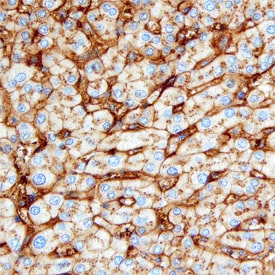
Hemopexin in Human Liver.
Hemopexin was detected in immersion fixed paraffin-embedded sections of human liver using Sheep Anti-Human Hemopexin Antigen Affinity-purified Polyclonal Antibody (Catalog # AF4490) at 3 µg/mL overnight at 4 °C. Before incubation with the primary antibody, tissue was subjected to heat-induced epitope retrieval using Antigen Retrieval Reagent-Basic (Catalog # CTS013). Tissue was stained using the Anti-Sheep HRP-DAB Cell & Tissue Staining Kit (brown; Catalog # CTS019) and counter-stained with hematoxylin (blue). Specific staining was localized to bile canaliculi. View our protocol for Chromogenic IHC Staining of Paraffin-embedded Tissue Sections.Applications for Human Hemopexin Antibody
Immunohistochemistry
Sample: Immersion fixed paraffin-embedded sections of human liver
Formulation, Preparation, and Storage
Purification
Reconstitution
Sterile PBS to a final concentration of 0.2 mg/mL. For liquid material, refer to CoA for concentration.
Formulation
Shipping
Stability & Storage
- 12 months from date of receipt, -20 to -70 °C as supplied.
- 1 month, 2 to 8 °C under sterile conditions after reconstitution.
- 6 months, -20 to -70 °C under sterile conditions after reconstitution.
Calculators
Background: Hemopexin
References
- Tolosano, E. and Altruda, F. (2002) DNA and Cell Biol. 21:297.
- Mauk, M. R. et al. (2007) Nature Pro. Rep. 24:523.
- Ascenzi, P. et al. (2005) IUMB Life. 57:749.
Alternate Names
Gene Symbol
UniProt
Additional Hemopexin Products
Product Documents for Human Hemopexin Antibody
Certificate of Analysis
To download a Certificate of Analysis, please enter a lot or batch number in the search box below.
Note: Certificate of Analysis not available for kit components.
Product Specific Notices for Human Hemopexin Antibody
For research use only
Related Research Areas
Customer Reviews for Human Hemopexin Antibody
There are currently no reviews for this product. Be the first to review Human Hemopexin Antibody and earn rewards!
Have you used Human Hemopexin Antibody?
Submit a review and receive an Amazon gift card!
$25/€18/£15/$25CAN/¥2500 for a review with an image
$10/€7/£6/$10CAN/¥1110 for a review without an image
Submit a review
Protocols
Find general support by application which include: protocols, troubleshooting, illustrated assays, videos and webinars.
- Antigen Retrieval Protocol (PIER)
- Antigen Retrieval for Frozen Sections Protocol
- Appropriate Fixation of IHC/ICC Samples
- Cellular Response to Hypoxia Protocols
- Chromogenic IHC Staining of Formalin-Fixed Paraffin-Embedded (FFPE) Tissue Protocol
- Chromogenic Immunohistochemistry Staining of Frozen Tissue
- ClariTSA™ Fluorophore Kits
- Detection & Visualization of Antibody Binding
- Fluorescent IHC Staining of Frozen Tissue Protocol
- Graphic Protocol for Heat-induced Epitope Retrieval
- Graphic Protocol for the Preparation and Fluorescent IHC Staining of Frozen Tissue Sections
- Graphic Protocol for the Preparation and Fluorescent IHC Staining of Paraffin-embedded Tissue Sections
- Graphic Protocol for the Preparation of Gelatin-coated Slides for Histological Tissue Sections
- IHC Sample Preparation (Frozen sections vs Paraffin)
- Immunofluorescent IHC Staining of Formalin-Fixed Paraffin-Embedded (FFPE) Tissue Protocol
- Immunohistochemistry (IHC) and Immunocytochemistry (ICC) Protocols
- Immunohistochemistry Frozen Troubleshooting
- Immunohistochemistry Paraffin Troubleshooting
- Preparing Samples for IHC/ICC Experiments
- Preventing Non-Specific Staining (Non-Specific Binding)
- Primary Antibody Selection & Optimization
- Protocol for Heat-Induced Epitope Retrieval (HIER)
- Protocol for Making a 4% Formaldehyde Solution in PBS
- Protocol for VisUCyte™ HRP Polymer Detection Reagent
- Protocol for the Preparation & Fixation of Cells on Coverslips
- Protocol for the Preparation and Chromogenic IHC Staining of Frozen Tissue Sections
- Protocol for the Preparation and Chromogenic IHC Staining of Frozen Tissue Sections - Graphic
- Protocol for the Preparation and Chromogenic IHC Staining of Paraffin-embedded Tissue Sections
- Protocol for the Preparation and Chromogenic IHC Staining of Paraffin-embedded Tissue Sections - Graphic
- Protocol for the Preparation and Fluorescent IHC Staining of Frozen Tissue Sections
- Protocol for the Preparation and Fluorescent IHC Staining of Paraffin-embedded Tissue Sections
- Protocol for the Preparation of Gelatin-coated Slides for Histological Tissue Sections
- TUNEL and Active Caspase-3 Detection by IHC/ICC Protocol
- The Importance of IHC/ICC Controls
- Troubleshooting Guide: Immunohistochemistry
- View all Protocols, Troubleshooting, Illustrated assays and Webinars