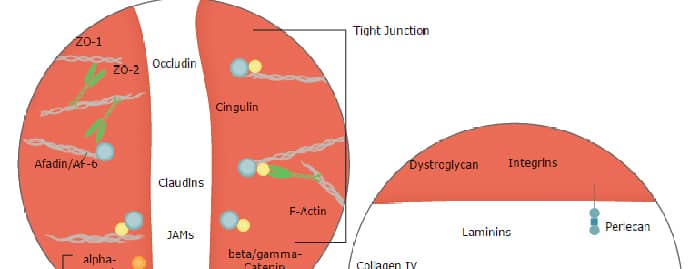
Integrin alpha X beta 2, also called CD11c/CD18, p150/95 or complement receptor type 4 (CR4), is one of four beta 2 integrins. The non-covalent heterodimer of 150 kDa alpha X/CD11c and 95 kDa beta 2/CD18 integrin subunits is expressed on macrophages, dendritic cells and hairy cell leukemias, with lower amounts on other myeloid cells and activated B, NK and some cytotoxic T cells (1‑7). Like other integrins, alpha X beta 2 has multiple activation states (3). In the presence of divalent cations and "inside-out" signaling, alpha X beta 2 is fully active and extended. The alpha X vWFA or I-domain, which contains the adhesion sites, forms the N-terminal head region with the alpha X beta-propeller and the beta 2 vWFA domain (1, 8). In the inactive state, the heterodimer flexes in the center at the alpha X thigh and calf domains and beta 2 I-EGF domains, impeding access to adhesion sites (1). The 1088 aa human alpha X/CD11c ECD shares 70‑76% aa sequence identity with mouse, rat and canine alpha X while the 678 aa human beta 2/CD18 ECD shares 81‑83% aa sequence identity with mouse, rat, cow, dog, goat, sheep, and pig beta 2. Potential alpha X isoforms containing 719 and 725 aa (as compared to full-length 1163 aa alpha X) lack the vWFA domain and the N-terminus. Active alpha X beta 2 shares some adhesion partners with alpha M beta 2/CD11b/CD18, including complement opsonin fragment iC3b, ICAMs, vWF and fibrinogen, and is expressed on many of the same cells (4‑11). However, alpha M beta 2 activity is often constitutive, while alpha X beta 2 activity requires cell activation (4‑7). alpha X beta 2 also binds osteopontin, Thy-1, plasminogen, heparin, and proteins with abnormally exposed acidic residues (11‑16). The adhesion events are important for proliferation, degranulation, chemotactic migration, and phagocytosis of complement-opsonized particles (5, 6, 9, 11, 12, 16). Mutations of beta 2, especially in the vWFA domain, cause leukocyte adhesion deficiency (LAD-1) and susceptibility to bacterial infections (17).
Human Integrin beta 2/CD18 Antibody (212701) [PE]
R&D Systems | Catalog # FAB1730P

Scientific images may be resized, cropped, or adjusted for brightness or contrast for presentation purposes. These updates are limited to presentation and do not affect the underlying scientific interpretation of the data. Where available, additional source data may be provided upon request.
Key Product Details
Species Reactivity
Validated:
Cited:
Applications
Validated:
Cited:
Label
Antibody Source
Product Specifications
Immunogen
Gln23-Asn700
Accession # AAA59490
Specificity
Clonality
Host
Isotype
Scientific Data Images for Human Integrin beta 2/CD18 Antibody (212701) [PE]
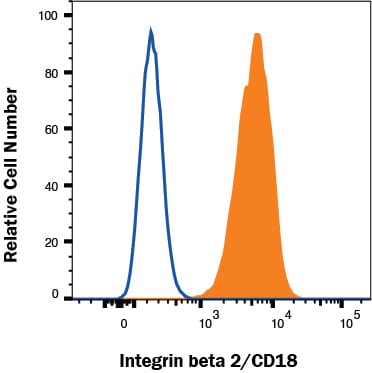
Detection of Integrin beta 2/CD18 in THP-1 cells by Flow Cytometry
THP-1 cells were stained with Mouse Anti-Human Integrin beta 2/CD18 PE‑conjugated Monoclonal Antibody (Catalog # FAB1730P, filled histogram) or isotype control antibody (Catalog # IC002P, open histogram). View our protocol for Staining Membrane-associated Proteins.Applications for Human Integrin beta 2/CD18 Antibody (212701) [PE]
Flow Cytometry
Sample: THP-1 human acute monocytic leukemia cell line
Spectra Viewer
Plan Your Experiments
Use our spectra viewer to interactively plan your experiments, assessing multiplexing options. View the excitation and emission spectra for our fluorescent dye range and other commonly used dyes.
Spectra Viewer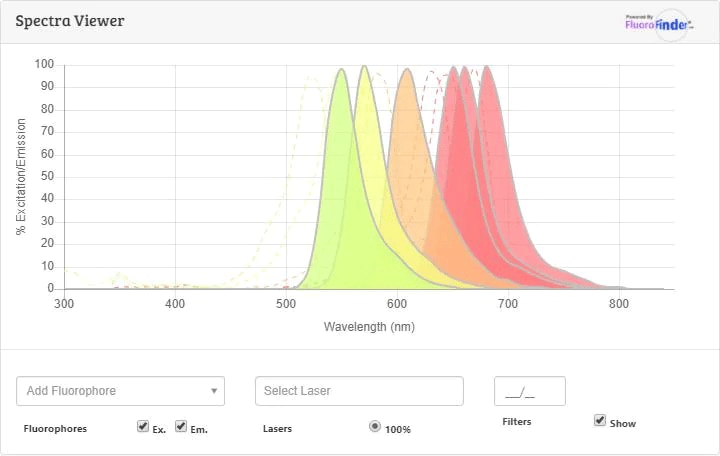
Flow Cytometry Panel Builder
Bio-Techne Knows Flow Cytometry
Save time and reduce costly mistakes by quickly finding compatible reagents using the Panel Builder Tool.
Advanced Features
- Spectra Viewer - Custom analysis of spectra from multiple fluorochromes
- Spillover Popups - Visualize the spectra of individual fluorochromes
- Antigen Density Selector - Match fluorochrome brightness with antigen density

Formulation, Preparation, and Storage
Purification
Formulation
Shipping
Stability & Storage
Background: Integrin beta 2/CD18
References
- Corbi, A.L. et al. (1987) EMBO J. 6:4023.
- Kishimoto, T.K. et al. (1987) Cell 48:681.
- Hynes, R.O. (2002) Cell 110:673.
- Arnaout, M.A. (1990) Blood 75:1037.
- Postigo, A.A. et al. (1991) J. Exp. Med. 174:1313.
- Beyer, M. et al. (2005) Respir. Res. 6:70.
- Nicolaou, F. et al. (2003) Blood 101:4033.
- Vorup-Jensen, T. et al. (2003) Proc. Natl. Acad. Sci. USA 100:1873.
- Bilsland, C.A.G. et al. (1994) J. Immunol. 152:4582.
- Pendu, R. et al. (2006) Blood 108:3746.
- Sadhu, C. et al. (2007) J. Leukoc. Biol. 81:1395.
- Schack, L. et al. (2009) J. Immunol. 182:6943.
- Choi, J. et al. (2005) Biochem. Biophys. Res. Commun. 331:557.
- Gang, J. et al. (2007) Mol. Cells 24:240.
- Vorup-Jensen, T. et al. (2007) J. Biol. Chem. 282:30869.
- Vorup-Jensen, T. et al. (2004) Proc. Natl. Acad. Sci. USA 102:1614.
- Kishimoto, T.K. et al. (1987) Cell 50:193.
Alternate Names
Gene Symbol
UniProt
Additional Integrin beta 2/CD18 Products
Product Documents for Human Integrin beta 2/CD18 Antibody (212701) [PE]
Certificate of Analysis
To download a Certificate of Analysis, please enter a lot or batch number in the search box below.
Note: Certificate of Analysis not available for kit components.
Product Specific Notices for Human Integrin beta 2/CD18 Antibody (212701) [PE]
For research use only
Citations for Human Integrin beta 2/CD18 Antibody (212701) [PE]
 Powered by Bioz
Customer Reviews for Human Integrin beta 2/CD18 Antibody (212701) [PE]
There are currently no reviews for this product. Be the first to review Human Integrin beta 2/CD18 Antibody (212701) [PE] and earn rewards!
Have you used Human Integrin beta 2/CD18 Antibody (212701) [PE]?
Submit a review and receive an Amazon gift card!
$25/€18/£15/$25CAN/¥2500 for a review with an image
$10/€7/£6/$10CAN/¥1110 for a review without an image
Submit a review
Protocols
Find general support by application which include: protocols, troubleshooting, illustrated assays, videos and webinars.
- 7-Amino Actinomycin D (7-AAD) Cell Viability Flow Cytometry Protocol
- Extracellular Membrane Flow Cytometry Protocol
- Flow Cytometry Protocol for Cell Surface Markers
- Flow Cytometry Protocol for Staining Membrane Associated Proteins
- Flow Cytometry Staining Protocols
- Flow Cytometry Troubleshooting Guide
- Intracellular Flow Cytometry Protocol Using Alcohol (Methanol)
- Intracellular Flow Cytometry Protocol Using Detergents
- Intracellular Nuclear Staining Flow Cytometry Protocol Using Detergents
- Intracellular Staining Flow Cytometry Protocol Using Alcohol Permeabilization
- Intracellular Staining Flow Cytometry Protocol Using Detergents to Permeabilize Cells
- Propidium Iodide Cell Viability Flow Cytometry Protocol
- Protocol for Liperfluo
- Protocol for the Characterization of Human Th22 Cells
- Protocol for the Characterization of Human Th9 Cells
- Protocol: Annexin V and PI Staining by Flow Cytometry
- Protocol: Annexin V and PI Staining for Apoptosis by Flow Cytometry
- Troubleshooting Guide: Fluorokine Flow Cytometry Kits
- View all Protocols, Troubleshooting, Illustrated assays and Webinars
Associated Pathways