
Non-T cell activation linker (NTAL), also known as linker for activation of B cells (LAB), is a transmembrane adaptor protein involved in immunoreceptor signaling. NTAL is expressed in lipid raft microdomains of B cells, mast cells, monocytes and NK cells. Rapid tyrosine phosphorylation of NTAL occurs upon BCR aggregation in B cells, Fc epsilon RI aggregation and Kit activation in mast cells, and Fc gamma RI aggregation in monocytes. Phosphorylated NTAL recruits signaling molecules such as Grb2, Gab1, and c-Cbl into receptor-signaling complexes. Defects in the NTAL gene may cause Williams-Beuren syndrome, a rare genetic disorder characterized by mild mental retardation, and abnormalities in the cardiovascular and musculo-skeletal systems.

Key Product Details
Species Reactivity
Human
Applications
Western Blot, Intracellular Staining by Flow Cytometry, CyTOF-ready
Label
Unconjugated
Antibody Source
Monoclonal Mouse IgG2B Clone # 440005
Loading...
Product Specifications
Immunogen
E. coli-derived recombinant human NTAL
Met1-Ala243
Accession # Q9GZY6
Met1-Ala243
Accession # Q9GZY6
Specificity
Detects human NTAL in direct ELISAs and Western blots.
Clonality
Monoclonal
Host
Mouse
Isotype
IgG2B
Scientific Data Images for Human NTAL Antibody (440005)
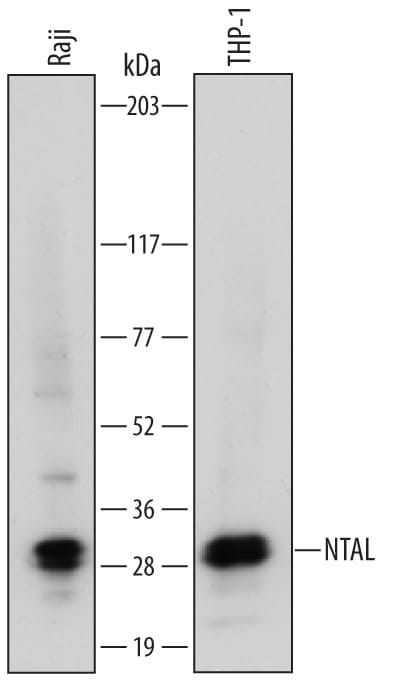
Detection of Human NTAL by Western Blot.
Western blot shows lysates of Raji human Burkitt's lymphoma cell line and THP-1 human acute monocytic leukemia cell line. PVDF Membrane was probed with 1 µg/mL of Mouse Anti-Human NTAL Monoclonal Antibody (Catalog # MAB4066) followed by HRP-conjugated Anti-Mouse IgG Secondary Antibody (Catalog # HAF007). A specific band was detected for NTAL at approximately 30 kDa (as indicated). This experiment was conducted under reducing conditions and using Immunoblot Buffer Group 1.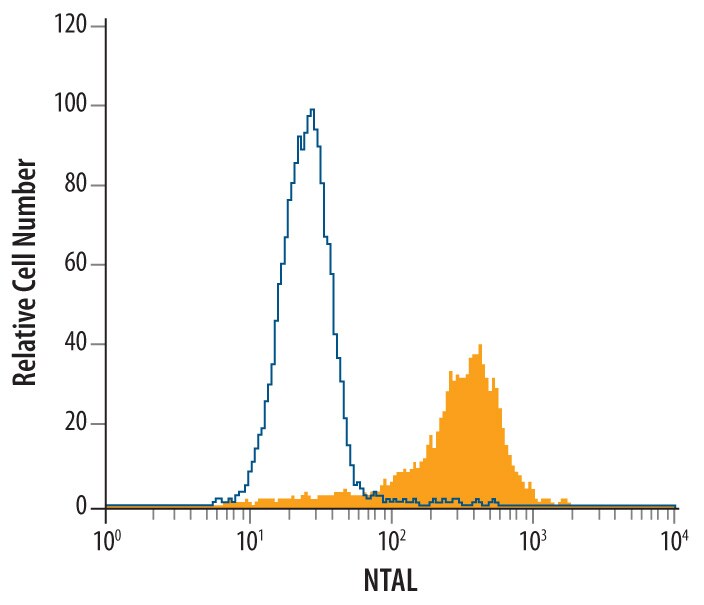
Detection of NTAL in THP-1 Human Cell Line by Flow Cytometry.
THP-1 human acute monocytic leukemia cell line was stained with Mouse Anti-Human NTAL Monoclonal Antibody (Catalog # MAB4066, filled histogram) or isotype control antibody (Catalog # MAB0041, open histogram), followed by Phycoerythrin-conjugated Anti-Mouse IgG Secondary Antibody (Catalog # F0102B). To facilitate intracellular staining, cells were fixed with paraformaldehyde and permeabilized with saponin.Applications for Human NTAL Antibody (440005)
Application
Recommended Usage
CyTOF-ready
Ready to be labeled using established conjugation methods. No BSA or other carrier proteins that could interfere with conjugation.
Intracellular Staining by Flow Cytometry
2.5 µg/106 cells
Sample: THP‑1 human acute monocytic leukemia cell line, fixed with paraformaldehyde and permeabilized with saponin
Sample: THP‑1 human acute monocytic leukemia cell line, fixed with paraformaldehyde and permeabilized with saponin
Western Blot
1 µg/mL
Sample: Raji human Burkitt's lymphoma cell line and THP‑1 human acute monocytic leukemia cell line
Sample: Raji human Burkitt's lymphoma cell line and THP‑1 human acute monocytic leukemia cell line
Flow Cytometry Panel Builder
Bio-Techne Knows Flow Cytometry
Save time and reduce costly mistakes by quickly finding compatible reagents using the Panel Builder Tool.
Advanced Features
- Spectra Viewer - Custom analysis of spectra from multiple fluorochromes
- Spillover Popups - Visualize the spectra of individual fluorochromes
- Antigen Density Selector - Match fluorochrome brightness with antigen density

Formulation, Preparation, and Storage
Purification
Protein A or G purified from hybridoma culture supernatant
Reconstitution
Reconstitute at 0.5 mg/mL in sterile PBS. For liquid material, refer to CoA for concentration.
Loading...
Formulation
Lyophilized from a 0.2 μm filtered solution in PBS with Trehalose. *Small pack size (SP) is supplied either lyophilized or as a 0.2 µm filtered solution in PBS.
Shipping
Lyophilized product is shipped at ambient temperature. Liquid small pack size (-SP) is shipped with polar packs. Upon receipt, store immediately at the temperature recommended below.
Stability & Storage
Use a manual defrost freezer and avoid repeated freeze-thaw cycles.
- 12 months from date of receipt, -20 to -70 °C as supplied.
- 1 month, 2 to 8 °C under sterile conditions after reconstitution.
- 6 months, -20 to -70 °C under sterile conditions after reconstitution.
Calculators
Background: NTAL
Long Name
Non-T Cell Activation Linker
Alternate Names
LAB, WBSCR15, WBSCR5
Gene Symbol
LAT2
UniProt
Additional NTAL Products
Product Documents for Human NTAL Antibody (440005)
Certificate of Analysis
To download a Certificate of Analysis, please enter a lot or batch number in the search box below.
Note: Certificate of Analysis not available for kit components.
Product Specific Notices for Human NTAL Antibody (440005)
For research use only
Customer Reviews for Human NTAL Antibody (440005)
There are currently no reviews for this product. Be the first to review Human NTAL Antibody (440005) and earn rewards!
Have you used Human NTAL Antibody (440005)?
Submit a review and receive an Amazon gift card!
$25/€18/£15/$25CAN/¥2500 for a review with an image
$10/€7/£6/$10CAN/¥1110 for a review without an image
Submit a review
Protocols
Find general support by application which include: protocols, troubleshooting, illustrated assays, videos and webinars.
- 7-Amino Actinomycin D (7-AAD) Cell Viability Flow Cytometry Protocol
- Cellular Response to Hypoxia Protocols
- Extracellular Membrane Flow Cytometry Protocol
- Flow Cytometry Protocol for Cell Surface Markers
- Flow Cytometry Protocol for Staining Membrane Associated Proteins
- Flow Cytometry Staining Protocols
- Flow Cytometry Troubleshooting Guide
- Intracellular Flow Cytometry Protocol Using Alcohol (Methanol)
- Intracellular Flow Cytometry Protocol Using Detergents
- Intracellular Nuclear Staining Flow Cytometry Protocol Using Detergents
- Intracellular Staining Flow Cytometry Protocol Using Alcohol Permeabilization
- Intracellular Staining Flow Cytometry Protocol Using Detergents to Permeabilize Cells
- Propidium Iodide Cell Viability Flow Cytometry Protocol
- Protocol for Liperfluo
- Protocol for the Characterization of Human Th22 Cells
- Protocol for the Characterization of Human Th9 Cells
- Protocol: Annexin V and PI Staining by Flow Cytometry
- Protocol: Annexin V and PI Staining for Apoptosis by Flow Cytometry
- R&D Systems Quality Control Western Blot Protocol
- Troubleshooting Guide: Fluorokine Flow Cytometry Kits
- Troubleshooting Guide: Western Blot Figures
- Western Blot Conditions
- Western Blot Protocol
- Western Blot Protocol for Cell Lysates
- Western Blot Troubleshooting
- Western Blot Troubleshooting Guide
- View all Protocols, Troubleshooting, Illustrated assays and Webinars
Loading...