
SALL1 (Sall-like Protein 1) is a member of the zinc finger Spalt-like protein family. It acts as a potential transcription repressor and may play a role in kidney development. Mutations have been shown to cause Townes-Brocks syndrome, an inherited disorder characterized by multiple birth defects including renal, ear, anal, and limb abnormalities.
Human SALL1 aa 258-499 Antibody (K9814)
R&D Systems | Catalog # PP-K9814-00

Scientific images may be resized, cropped, or adjusted for brightness or contrast for presentation purposes. These updates are limited to presentation and do not affect the underlying scientific interpretation of the data. Where available, additional source data may be provided upon request.
Discontinued Product
PP-K9814-00 has been discontinued.
An alternative/replacement product is available:
PP-K9814-0C. View all SALL1 products.
Key Product Details
Species Reactivity
Validated:
Human
Cited:
Human, Mouse, Primate - Macaca fascicularis (Crab-eating Monkey or Cynomolgus Macaque)
Applications
Validated:
Immunohistochemistry, Western Blot, Immunoprecipitation
Cited:
Immunohistochemistry, Western Blot, Immunocytochemistry, Chromatin Immunoprecipitation (ChIP), Functional Assay
Label
Unconjugated
Antibody Source
Monoclonal Mouse IgG2A Clone # K9814
Loading...
Product Specifications
Immunogen
Recombinant human SALL1
Clonality
Monoclonal
Host
Mouse
Isotype
IgG2A
Scientific Data Images for Human SALL1 aa 258-499 Antibody (K9814)
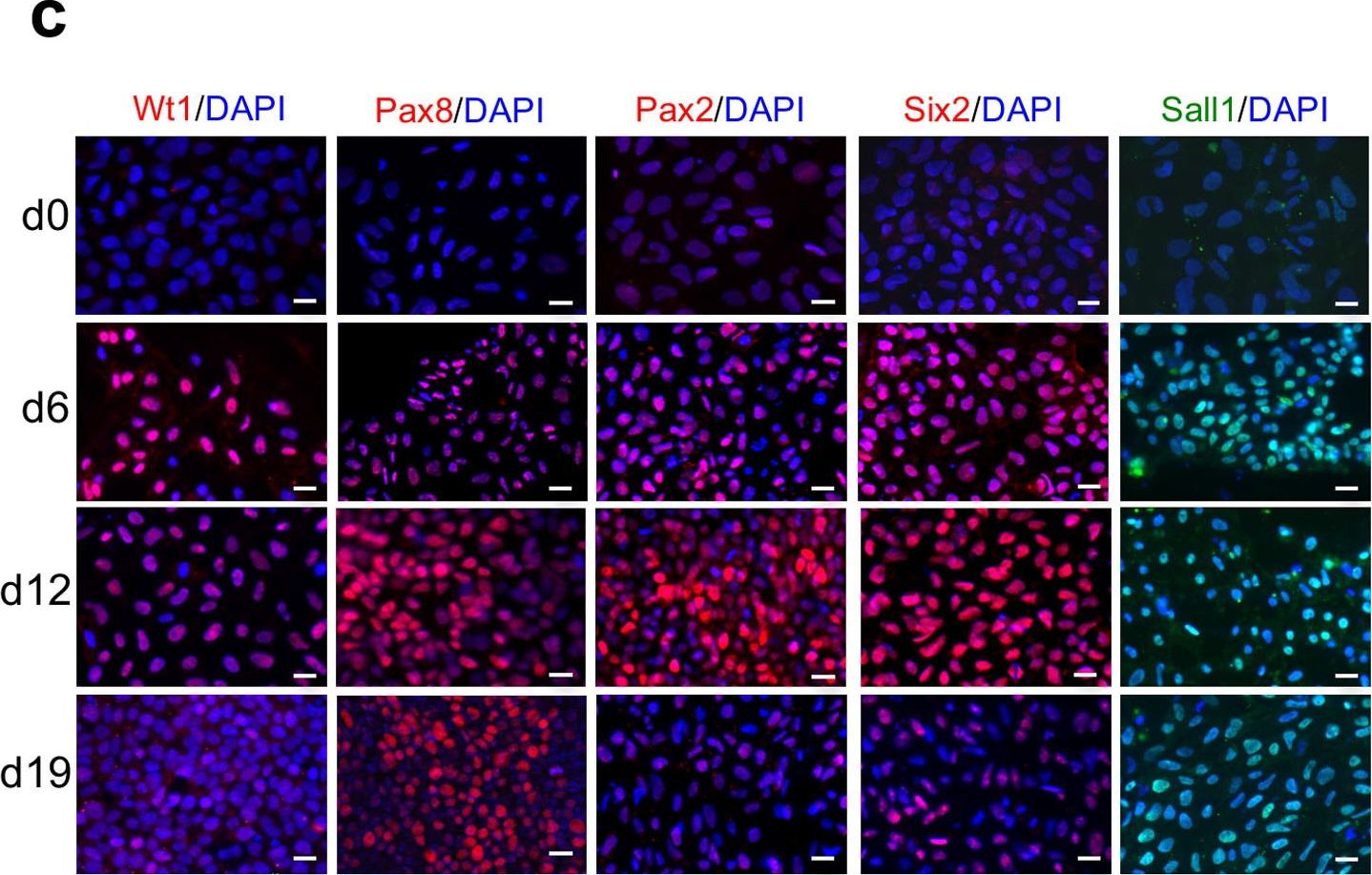
Detection of Human SALL1 by Immunocytochemistry/Immunofluorescence
Stepwise differentiation of human iPSCs towards renal progenitor cells (RPCs).(a) Schematic description of the two-stage protocol applied to iPSC-renal commitment. (b, c, d, e) Immunofluorescence of iPSCs (derived from retroviral transfected dermal fibroblasts) exposed to differentiating media. (b) The pluripotency markers SSEA4, TRA-1-81, Nanog, ME marker T(Bry) and IM marker Osr1. (c) IM and MM marker expression as Wt1, Pax8, Pax2, Six2 and Sall1. (d) Renal progenitor markers CD133, CD24, NCAM, glomerular epithelial marker Claudin1 and proximal tubular epithelial markers AQP1, GGT1. (e) Markers identifying endodermal AFP, ectodermal Pax6, and cardiac mesodermal Nkx2.5 derivation. Nuclei are stained with DAPI (blue). Scale bars: 20 μm (b, c, d, e). Image collected and cropped by CiteAb from the following publication (https://www.nature.com/articles/srep08826), licensed under a CC-BY license. Not internally tested by R&D Systems.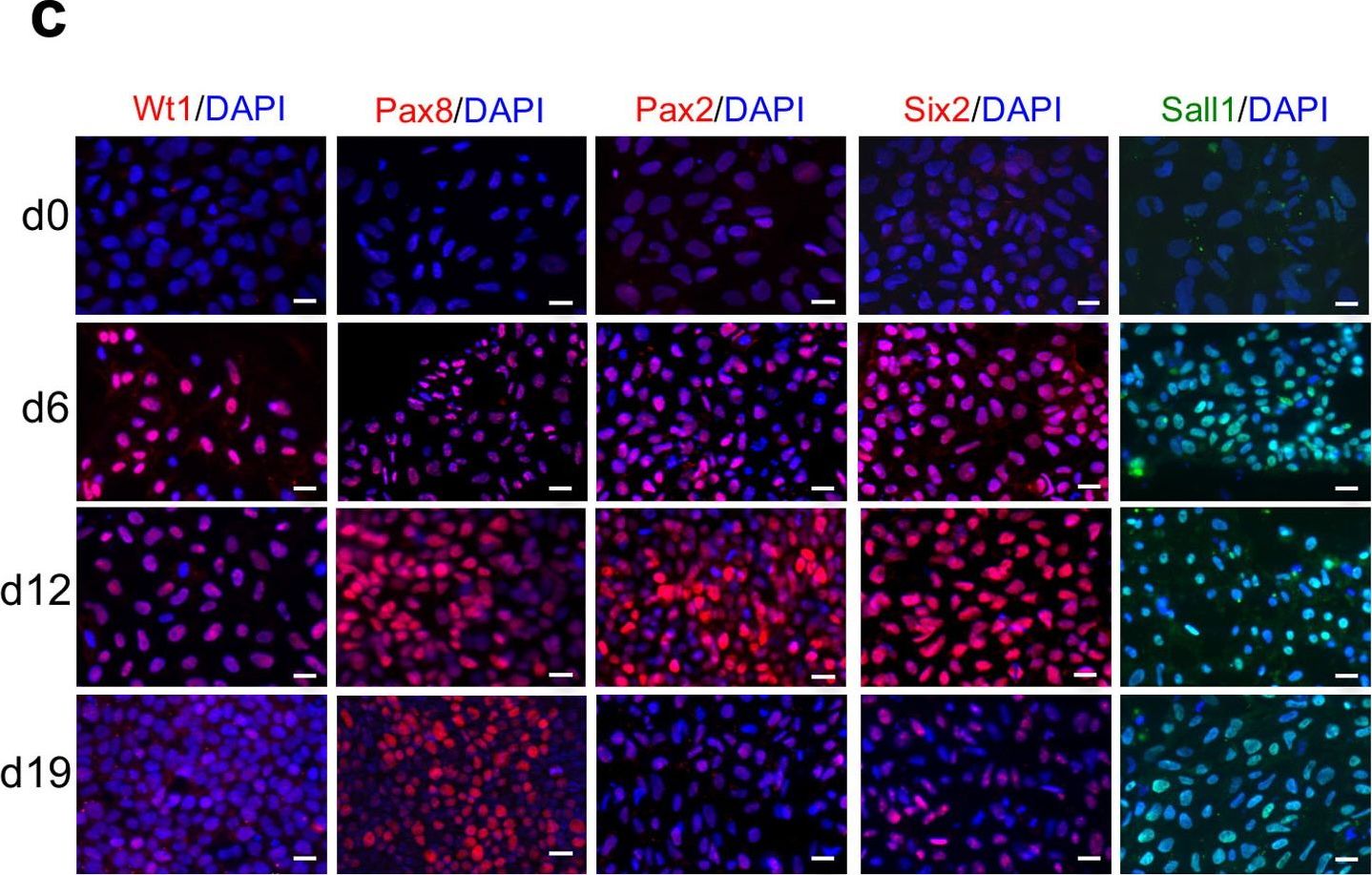
Detection of Human SALL1 by Immunocytochemistry/ Immunofluorescence
Stepwise differentiation of human iPSCs towards renal progenitor cells (RPCs).(a) Schematic description of the two-stage protocol applied to iPSC-renal commitment. (b, c, d, e) Immunofluorescence of iPSCs (derived from retroviral transfected dermal fibroblasts) exposed to differentiating media. (b) The pluripotency markers SSEA4, TRA-1-81, Nanog, ME marker T(Bry) and IM marker Osr1. (c) IM and MM marker expression as Wt1, Pax8, Pax2, Six2 and Sall1. (d) Renal progenitor markers CD133, CD24, NCAM, glomerular epithelial marker Claudin1 and proximal tubular epithelial markers AQP1, GGT1. (e) Markers identifying endodermal AFP, ectodermal Pax6, and cardiac mesodermal Nkx2.5 derivation. Nuclei are stained with DAPI (blue). Scale bars: 20 μm (b, c, d, e). Image collected and cropped by CiteAb from the following open publication (https://pubmed.ncbi.nlm.nih.gov/25744951), licensed under a CC-BY license. Not internally tested by R&D Systems.Applications for Human SALL1 aa 258-499 Antibody (K9814)
Application
Recommended Usage
Immunohistochemistry
Optimal dilutions of this antibody should be experimentally determined.
Immunoprecipitation
Optimal dilutions of this antibody should be experimentally determined.
Western Blot
Optimal dilutions of this antibody should be experimentally determined.
Formulation, Preparation, and Storage
Formulation
A liquid formulation in physiologic saline with 0.1% NaN<sub>3</sub>.
Shipping
The product is shipped with dry ice or equivalent. Upon receipt, store it immediately at the temperature recommended below.
Stability & Storage
Store the unopened product at -70 °C. Use a manual defrost freezer and avoid repeated freeze-thaw cycles. Do not use past expiration date.
Background: SALL1
Long Name
Sal-like 1
Alternate Names
HSal1, sal (Drosophila)-like 1, SAL1, Sal-1, sal-like 1 (Drosophila), sal-like protein 1, Spalt-like transcription factor 1, Zinc finger protein 794, Zinc finger protein SALL1, Zinc finger protein Spalt-1, ZNF794TBS
Entrez Gene IDs
6299 (Human)
Gene Symbol
SALL1
Additional SALL1 Products
Product Documents for Human SALL1 aa 258-499 Antibody (K9814)
Certificate of Analysis
To download a Certificate of Analysis, please enter a lot or batch number in the search box below.
Note: Certificate of Analysis not available for kit components.
Product Specific Notices for Human SALL1 aa 258-499 Antibody (K9814)
For research use only
Related Research Areas
Citations for Human SALL1 aa 258-499 Antibody (K9814)
 Powered by Bioz
Customer Reviews for Human SALL1 aa 258-499 Antibody (K9814)
There are currently no reviews for this product. Be the first to review Human SALL1 aa 258-499 Antibody (K9814) and earn rewards!
Have you used Human SALL1 aa 258-499 Antibody (K9814)?
Submit a review and receive an Amazon gift card!
$25/€18/£15/$25CAN/¥2500 for a review with an image
$10/€7/£6/$10CAN/¥1110 for a review without an image
Submit a review
Protocols
Find general support by application which include: protocols, troubleshooting, illustrated assays, videos and webinars.
- Antigen Retrieval Protocol (PIER)
- Antigen Retrieval for Frozen Sections Protocol
- Appropriate Fixation of IHC/ICC Samples
- Cellular Response to Hypoxia Protocols
- Chromogenic IHC Staining of Formalin-Fixed Paraffin-Embedded (FFPE) Tissue Protocol
- Chromogenic Immunohistochemistry Staining of Frozen Tissue
- ClariTSA™ Fluorophore Kits
- Detection & Visualization of Antibody Binding
- Fluorescent IHC Staining of Frozen Tissue Protocol
- Graphic Protocol for Heat-induced Epitope Retrieval
- Graphic Protocol for the Preparation and Fluorescent IHC Staining of Frozen Tissue Sections
- Graphic Protocol for the Preparation and Fluorescent IHC Staining of Paraffin-embedded Tissue Sections
- Graphic Protocol for the Preparation of Gelatin-coated Slides for Histological Tissue Sections
- IHC Sample Preparation (Frozen sections vs Paraffin)
- Immunofluorescent IHC Staining of Formalin-Fixed Paraffin-Embedded (FFPE) Tissue Protocol
- Immunohistochemistry (IHC) and Immunocytochemistry (ICC) Protocols
- Immunohistochemistry Frozen Troubleshooting
- Immunohistochemistry Paraffin Troubleshooting
- Immunoprecipitation Protocol
- Preparing Samples for IHC/ICC Experiments
- Preventing Non-Specific Staining (Non-Specific Binding)
- Primary Antibody Selection & Optimization
- Protocol for Heat-Induced Epitope Retrieval (HIER)
- Protocol for Making a 4% Formaldehyde Solution in PBS
- Protocol for VisUCyte™ HRP Polymer Detection Reagent
- Protocol for the Preparation & Fixation of Cells on Coverslips
- Protocol for the Preparation and Chromogenic IHC Staining of Frozen Tissue Sections
- Protocol for the Preparation and Chromogenic IHC Staining of Frozen Tissue Sections - Graphic
- Protocol for the Preparation and Chromogenic IHC Staining of Paraffin-embedded Tissue Sections
- Protocol for the Preparation and Chromogenic IHC Staining of Paraffin-embedded Tissue Sections - Graphic
- Protocol for the Preparation and Fluorescent IHC Staining of Frozen Tissue Sections
- Protocol for the Preparation and Fluorescent IHC Staining of Paraffin-embedded Tissue Sections
- Protocol for the Preparation of Gelatin-coated Slides for Histological Tissue Sections
- R&D Systems Quality Control Western Blot Protocol
- TUNEL and Active Caspase-3 Detection by IHC/ICC Protocol
- The Importance of IHC/ICC Controls
- Troubleshooting Guide: Immunohistochemistry
- Troubleshooting Guide: Western Blot Figures
- Western Blot Conditions
- Western Blot Protocol
- Western Blot Protocol for Cell Lysates
- Western Blot Troubleshooting
- Western Blot Troubleshooting Guide
- View all Protocols, Troubleshooting, Illustrated assays and Webinars
Loading...