
Thrombospondin-2 (TSP-2) is a 150 kDa calcium-binding protein that modulates cellular interactions with extracellular matrix. Thrombospondin-1 and -2 constitute subgroup A thrombospondin family members and form disulfide-linked homotrimers, whereas Thrombospondin-3, -4, and -5/COMP constitute subgroup B and form homopentamers (1‑4). The human TSP-2 cDNA encodes a 1172 amino acid (aa) precursor that includes an 18 aa signal sequence followed by an N-terminal heparin‑binding domain, an oligomerization motif, one vWF-C domain, three TSP type-1 repeats, three EGF-like repeats, seven TSP type-3 repeats, and a lectin-like TSP C‑terminal domain (5). Human TSP-2 shares 88-90% aa sequence identity with bovine, mouse, and rat TSP-2. Within the TSP type-3 repeats and TSP C‑terminal domain, human TSP-2 shares 80% aa sequence identity with human TSP-1 and approximately 60% aa sequence identity with human TSP-3, -4, and -5/COMP. TSP-2 regulates collagen matrix formation by altering fibroblast behavior during development and in areas of tissue remodeling in the adult (6, 7). Trimerization of TSP-2 is required for the calcium-dependent cell attachment and spreading functions, while the heparin‑binding domain is responsible for the destabilization of focal adhesion sites (8‑10). The heparin‑binding domain also mediates binding to Integrins alpha 3 beta 1 and alpha 6 beta 1 on microvascular endothelial cells (EC) and Integrin alpha 4 beta 1 on large blood vessel EC (11, 12). A fragment of TSP-2 (heparin‑binding domain, oligomerization motif, and vWF-C domain) promotes EC survival, proliferation, and chemotaxis (11). Inclusion of the three TSP type-1 domains results in a molecule that inhibits VEGF-induced EC migration and vascular tube formation (13, 14). In vivo, full length TSP-2 blocks tumor angiogenesis and induces vascular EC apoptosis (13, 15). HPRG functions as an apparent decoy receptor by preventing interaction of TSP-2 with CD36 on macrophages and microvasculature EC (14). TSP-2 also binds MMP-2 and facilitates MMP-2 clearance by the scavenger receptor LRP (16).
Human Thrombospondin-2 Antibody (230927)
R&D Systems | Catalog # MAB16351


Scientific images may be resized, cropped, or adjusted for brightness or contrast for presentation purposes. These updates are limited to presentation and do not affect the underlying scientific interpretation of the data. Where available, additional source data may be provided upon request.
Key Product Details
Species Reactivity
Applications
Label
Antibody Source
Product Specifications
Immunogen
Gly19-Ile1172
Accession # P35442
Specificity
Clonality
Host
Isotype
Scientific Data Images for Human Thrombospondin-2 Antibody (230927)
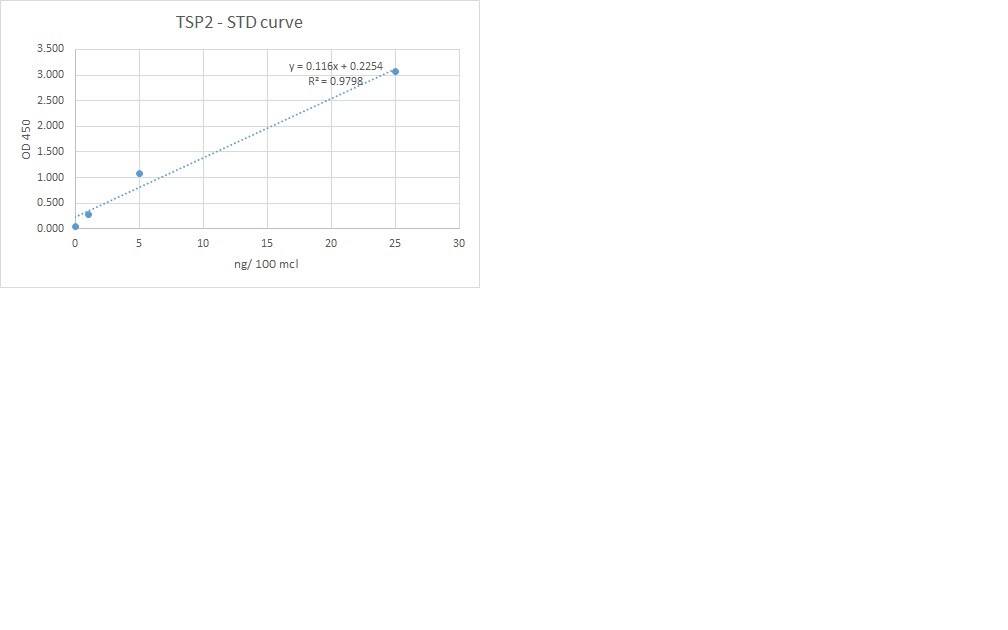
Human Thrombospondin-2 ELISA Standard Curve
Recombinant Human Thrombospondin‑2 (Catalog # 1635-T2) was serially diluted and captured by Mouse Anti-Human Thrombospondin‑2 Monoclonal Antibody (Catalog # MAB16351) coated on a Clear Polystyrene Microplate (Catalog # DY990). Goat Anti-Human Thrombospondin‑2 Antigen Affinity-purified Polyclonal Antibody (Catalog # AF1635) was biotinylated and incubated with the protein captured on the plate. Detection of the standard curve was achieved by incubating Streptavidin-HRP (Catalog # DY998)Applications for Human Thrombospondin-2 Antibody (230927)
Human Thrombospondin-2 Sandwich Immunoassay
Reviewed Applications
Read 1 review rated 5 using MAB16351 in the following applications:
Formulation, Preparation, and Storage
Purification
Reconstitution
Reconstitute at 0.5 mg/mL in sterile PBS. For liquid material, refer to CoA for concentration.
Formulation
Shipping
Stability & Storage
- 12 months from date of receipt, -20 to -70 °C as supplied.
- 1 month, 2 to 8 °C under sterile conditions after reconstitution.
- 6 months, -20 to -70 °C under sterile conditions after reconstitution.
Calculators
Background: Thrombospondin-2
References
- Elzie, C.A. and J.E. Murphy-Ullrich (2004) Int. J. Biochem. Cell Biol. 36:1090.
- Armstrong, L.C. and P. Bornstein (2003) Matrix Biol. 22:63.
- Murphy-Ullrich, J.E. (2001) J. Clin. Invest. 107:785.
- Bornstein, P. and E.H. Sage (2002) Curr. Opin. Cell Biol. 14:608.
- LaBell, T.L. and P.H. Byers (1993) Genomics 17:225.
- Kyriakides, T.R. et al. (1998) J. Histochem. Cytochem. 46:1007.
- Kyriakides, T.R. et al. (1998) J. Cell Biol. 140:419.
- Anilkumar, N. et al. (2002) J. Cell Sci. 115:2357.
- Misenheimer, T.M. et al. (2003) Biochemistry 42:5125.
- Murphy-Ullrich, J.E. et al. (1993) J. Biol. Chem. 268:26784.
- Calzada, M.J. et al. (2004) Circ. Res. 94:462.
- Calzada, M.J. et al. (2003) J. Biol. Chem. 278:40679.
- Noh, Y-H. et al. (2003) J. Invest. Dermatol. 121:1536.
- Simantov, R. et al. (2005) Matrix Biol. 24:27.
- Streit, M. et al. (1999) Proc. Natl. Acad. Sci. 96:14888.
- Yang, Z. et al. (2001) J. Biol. Chem. 276:8403.
Alternate Names
Entrez Gene IDs
Gene Symbol
UniProt
Additional Thrombospondin-2 Products
Product Documents for Human Thrombospondin-2 Antibody (230927)
Certificate of Analysis
To download a Certificate of Analysis, please enter a lot or batch number in the search box below.
Note: Certificate of Analysis not available for kit components.
Product Specific Notices for Human Thrombospondin-2 Antibody (230927)
For research use only
Related Research Areas
Citations for Human Thrombospondin-2 Antibody (230927)
 Powered by Bioz
Customer Reviews for Human Thrombospondin-2 Antibody (230927) (1)
Have you used Human Thrombospondin-2 Antibody (230927)?
Submit a review and receive an Amazon gift card!
$25/€18/£15/$25CAN/¥2500 for a review with an image
$10/€7/£6/$10CAN/¥1110 for a review without an image
Submit a review
Customer Images
-
Application: ELISASample Tested: Serum and PlasmaSpecies: HumanVerified Customer | Posted 09/23/2019we used this antibody for developing a sandwich ELISA in combination with pAb (cat.AF1635) ans protein (Cat. 1636-T2). This combination works well for detecting human TSP2 in serum samples.

There are no reviews that match your criteria.
Associated Pathways
