
The gene for TNF-related weak inducer of apoptosis receptor (TWEAK R) was originally identified as a fibroblast growth factor-inducible immediate-early response gene Fn14 in mouse NIH 3T3 fibroblasts (1, 2). Human TWEAK R cDNA encodes a 129 amino acid (aa) residue type I transmembrane protein with a 27 aa signal peptide, a 53 aa extracellular domain, a 21 aa transmembrane domain and a 28 aa cytoplasmic domain (1‑3). Human and mouse TWEAK R share 82% aa sequence identity. TWEAK R is the smallest member of the TNF receptor superfamily and contains only one cysteine-rich region in its extracellular domain. The TWEAK R cytoplasmic domain conatins one TRAF binding motif which binds TRAFs 1, 2, and 3. TWEAK R binds its ligand TWEAK/TNFSF12 with high affinity to initiate a signal transduction cascade that depending upon the cell type, may lead to a variety of cellular responses including cell death, cell proliferation, and angiogenesis (2‑6). In new born mice, TWEAK R is highly expressed in all tissues examined (heart, intestine, kidney, liver, lung and skin) (1). In adult mice, high TWEAK R expression levels are found in the heart and ovary, while lower expression levels are detected in the lung, kidney, skin. Elevated levels of TWEAK R mRNA were found in human or mouse hepatocellular carcinoma specimens, in regenerating mouse liver and in injured rat arteries (2, 3).
Human TWEAK R/TNFRSF12 Antibody
R&D Systems | Catalog # AF1199

Scientific images may be resized, cropped, or adjusted for brightness or contrast for presentation purposes. These updates are limited to presentation and do not affect the underlying scientific interpretation of the data. Where available, additional source data may be provided upon request.
Key Product Details
Species Reactivity
Validated:
Cited:
Applications
Validated:
Cited:
Label
Antibody Source
Product Specifications
Immunogen
Glu28-Trp79
Accession # Q9NP84
Specificity
Clonality
Host
Isotype
Endotoxin Level
Scientific Data Images for Human TWEAK R/TNFRSF12 Antibody
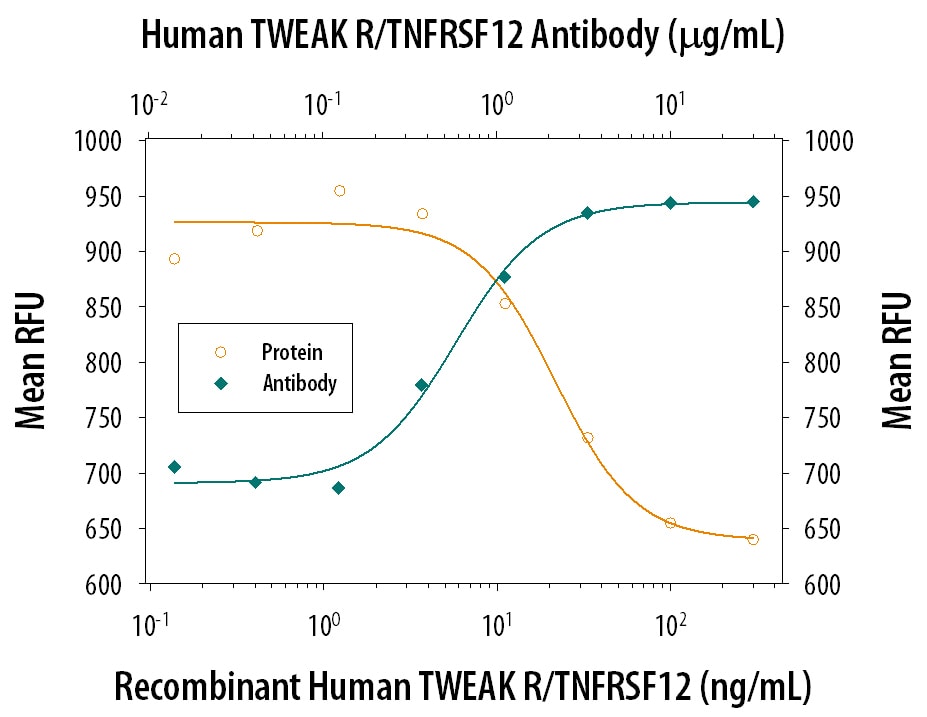
TWEAK R/TNFRSF12 Inhibition of TWEAK/TNFSF12-depend-ent Cell Proliferation and Neutralization by Human TWEAK R/TNFRSF12 Anti-body.
Recombinant Human TWEAK R/TNFRSF12 Fc Chimera (Catalog # 1199-TW) inhibits Recombinant Human TWEAK/TNFSF12 (Catalog # 1090-TW) induced proliferation in HUVEC human umbilical vein endothelial cells in a dose-dependent manner (orange line). Inhibition of Recombinant Human TWEAK/TNFSF12 (20 ng/mL) activity elicited by Recombinant Human TWEAK R/TNFRSF12 Fc Chimera (30 ng/mL) is neutralized (green line) by increasing concentrations of Goat Anti-Human TWEAK R/TNFRSF12 Antigen Affinity-purified Polyclonal Antibody (Catalog # AF1199). The ND50 is typically 0.3-1.2 µg/mL.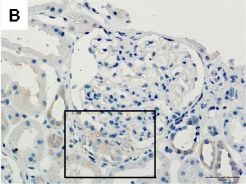
Detection of Human TWEAK R/TNFRSF12 by Immunohistochemistry-Paraffin
Expression of TWEAK and Fn14 in renal biopsies from IgAN patients was examine. Immunohistochemistry for both TWEAK (A, B) and Fn14 (D, E) were detected in glomerular crescents (the areas delineated by the squares). In the controls [renal biopsies from patients with minimal change disease (C, F)], there was very slight staining for TWEAK and Fn14 in glomeruli, while intense staining was observed in renal tubular cells. Scale bar = 50 μm. Image collected and cropped by CiteAb from the following open publication (https://pubmed.ncbi.nlm.nih.gov/25885587), licensed under a CC-BY license. Not internally tested by R&D Systems.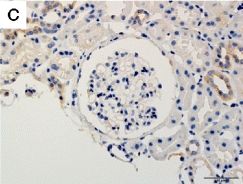
Detection of Human TWEAK R/TNFRSF12 by Immunohistochemistry-Paraffin
Expression of TWEAK and Fn14 in renal biopsies from IgAN patients was examine. Immunohistochemistry for both TWEAK (A, B) and Fn14 (D, E) were detected in glomerular crescents (the areas delineated by the squares). In the controls [renal biopsies from patients with minimal change disease (C, F)], there was very slight staining for TWEAK and Fn14 in glomeruli, while intense staining was observed in renal tubular cells. Scale bar = 50 μm. Image collected and cropped by CiteAb from the following open publication (https://pubmed.ncbi.nlm.nih.gov/25885587), licensed under a CC-BY license. Not internally tested by R&D Systems.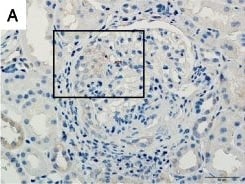
Detection of Human TWEAK R/TNFRSF12 by Immunohistochemistry-Paraffin
Expression of TWEAK and Fn14 in renal biopsies from IgAN patients was examine. Immunohistochemistry for both TWEAK (A, B) and Fn14 (D, E) were detected in glomerular crescents (the areas delineated by the squares). In the controls [renal biopsies from patients with minimal change disease (C, F)], there was very slight staining for TWEAK and Fn14 in glomeruli, while intense staining was observed in renal tubular cells. Scale bar = 50 μm. Image collected and cropped by CiteAb from the following open publication (https://pubmed.ncbi.nlm.nih.gov/25885587), licensed under a CC-BY license. Not internally tested by R&D Systems.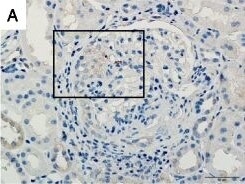
Detection of Human TWEAK R/TNFRSF12 by Immunohistochemistry-Paraffin
Expression of TWEAK and Fn14 in renal biopsies from IgAN patients was examine. Immunohistochemistry for both TWEAK (A, B) and Fn14 (D, E) were detected in glomerular crescents (the areas delineated by the squares). In the controls [renal biopsies from patients with minimal change disease (C, F)], there was very slight staining for TWEAK and Fn14 in glomeruli, while intense staining was observed in renal tubular cells. Scale bar = 50 μm. Image collected and cropped by CiteAb from the following open publication (https://pubmed.ncbi.nlm.nih.gov/25885587), licensed under a CC-BY license. Not internally tested by R&D Systems.Applications for Human TWEAK R/TNFRSF12 Antibody
Immunohistochemistry
Sample: Immersion fixed paraffin-embedded sections of human liver cancer tissue
Western Blot
Sample: Recombinant Human TWEAK R/TNFRSF12 Fc Chimera (Catalog # 1199-TW)
Neutralization
Formulation, Preparation, and Storage
Purification
Reconstitution
Reconstitute at 0.2 mg/mL in sterile PBS. For liquid material, refer to CoA for concentration.
Formulation
Shipping
Stability & Storage
- 12 months from date of receipt, -20 to -70 °C as supplied.
- 1 month, 2 to 8 °C under sterile conditions after reconstitution.
- 6 months, -20 to -70 °C under sterile conditions after reconstitution.
Calculators
Background: TWEAK R/TNFRSF12
References
- Meighan-Mantha, R. et al. (1999) J. Biol. Chem. 274:33166.
- Feng, S. et al. (2000) Am J. Pathol. 156:1253.
- Wiley, S. et al. (2001) Immunity 15:837.
- Schneider, P. et al. (1999) Eur. J. Immunol. 29:1785.
- Nakayama, M. et al. (2002) J. Immunol. 168:734.
- Lynch, C.N. et al. (1999) J. Biol. Chem. 274:8455.
Long Name
Alternate Names
Gene Symbol
UniProt
Additional TWEAK R/TNFRSF12 Products
Product Documents for Human TWEAK R/TNFRSF12 Antibody
Certificate of Analysis
To download a Certificate of Analysis, please enter a lot or batch number in the search box below.
Note: Certificate of Analysis not available for kit components.
Product Specific Notices for Human TWEAK R/TNFRSF12 Antibody
For research use only
Related Research Areas
Citations for Human TWEAK R/TNFRSF12 Antibody
 Powered by Bioz
Customer Reviews for Human TWEAK R/TNFRSF12 Antibody
There are currently no reviews for this product. Be the first to review Human TWEAK R/TNFRSF12 Antibody and earn rewards!
Have you used Human TWEAK R/TNFRSF12 Antibody?
Submit a review and receive an Amazon gift card!
$25/€18/£15/$25CAN/¥2500 for a review with an image
$10/€7/£6/$10CAN/¥1110 for a review without an image
Submit a review
Protocols
Find general support by application which include: protocols, troubleshooting, illustrated assays, videos and webinars.
- Antigen Retrieval Protocol (PIER)
- Antigen Retrieval for Frozen Sections Protocol
- Appropriate Fixation of IHC/ICC Samples
- Cellular Response to Hypoxia Protocols
- Chromogenic IHC Staining of Formalin-Fixed Paraffin-Embedded (FFPE) Tissue Protocol
- Chromogenic Immunohistochemistry Staining of Frozen Tissue
- ClariTSA™ Fluorophore Kits
- Detection & Visualization of Antibody Binding
- Fluorescent IHC Staining of Frozen Tissue Protocol
- Graphic Protocol for Heat-induced Epitope Retrieval
- Graphic Protocol for the Preparation and Fluorescent IHC Staining of Frozen Tissue Sections
- Graphic Protocol for the Preparation and Fluorescent IHC Staining of Paraffin-embedded Tissue Sections
- Graphic Protocol for the Preparation of Gelatin-coated Slides for Histological Tissue Sections
- IHC Sample Preparation (Frozen sections vs Paraffin)
- Immunofluorescent IHC Staining of Formalin-Fixed Paraffin-Embedded (FFPE) Tissue Protocol
- Immunohistochemistry (IHC) and Immunocytochemistry (ICC) Protocols
- Immunohistochemistry Frozen Troubleshooting
- Immunohistochemistry Paraffin Troubleshooting
- Preparing Samples for IHC/ICC Experiments
- Preventing Non-Specific Staining (Non-Specific Binding)
- Primary Antibody Selection & Optimization
- Protocol for Heat-Induced Epitope Retrieval (HIER)
- Protocol for Making a 4% Formaldehyde Solution in PBS
- Protocol for VisUCyte™ HRP Polymer Detection Reagent
- Protocol for the Preparation & Fixation of Cells on Coverslips
- Protocol for the Preparation and Chromogenic IHC Staining of Frozen Tissue Sections
- Protocol for the Preparation and Chromogenic IHC Staining of Frozen Tissue Sections - Graphic
- Protocol for the Preparation and Chromogenic IHC Staining of Paraffin-embedded Tissue Sections
- Protocol for the Preparation and Chromogenic IHC Staining of Paraffin-embedded Tissue Sections - Graphic
- Protocol for the Preparation and Fluorescent IHC Staining of Frozen Tissue Sections
- Protocol for the Preparation and Fluorescent IHC Staining of Paraffin-embedded Tissue Sections
- Protocol for the Preparation of Gelatin-coated Slides for Histological Tissue Sections
- R&D Systems Quality Control Western Blot Protocol
- TUNEL and Active Caspase-3 Detection by IHC/ICC Protocol
- The Importance of IHC/ICC Controls
- Troubleshooting Guide: Immunohistochemistry
- Troubleshooting Guide: Western Blot Figures
- Western Blot Conditions
- Western Blot Protocol
- Western Blot Protocol for Cell Lysates
- Western Blot Troubleshooting
- Western Blot Troubleshooting Guide
- View all Protocols, Troubleshooting, Illustrated assays and Webinars
Associated Pathways

