
CLEC4F (C-type lectin domain; family 4, member F; also known as the Kupffer cell receptor and fucose receptor) is an 80 kDa, type II transmembrane glycoprotein member of the C-type lectin superfamily (1‑3). Mature mouse CLEC4F consists of a 42 amino acid (aa) cytoplasmic domain, a 27 aa transmembrane segment, and a 479 aa extracellular domain (ECD) that contains an extended stalk region plus one carbohydrate recognition domain (4, 5). Within the ECD, mouse CLEC4F shares 48% and 79% aa sequence identity with human and rat CLEC4F, respectively. The stalk region of CLEC4F is a coiled coil domain that mediates homotrimer formation (6, 7). CLEC4F is expressed on Kupffer cells in the liver, but not on macrophages in other tissues (8). CLEC4F preferentially binds galactose and N‑acetylgalactosamine in a calcium-dependent manner (6, 9, 10). Its activity at neutral, but not at acidic pH, suggests a capacity to internalize and release ligands into the endosomal system (11).

Scientific images may be resized, cropped, or adjusted for brightness or contrast for presentation purposes. These updates are limited to presentation and do not affect the underlying scientific interpretation of the data. Where available, additional source data may be provided upon request.
Key Product Details
Species Reactivity
Validated:
Cited:
Applications
Validated:
Cited:
Label
Antibody Source
Product Specifications
Immunogen
Ala65-Gly548
Accession # P70194
Specificity
Clonality
Host
Isotype
Scientific Data Images for Mouse CLEC4F/CLECSF13 Antibody
CLEC4F/CLECSF13 in Mouse Liver.
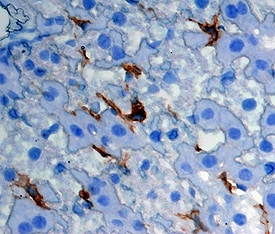
CLEC4F/CLECSF13 was detected in perfusion fixed frozen sections of mouse liver using Goat Anti-Mouse CLEC4F/CLECSF13 Antigen Affinity-purified Polyclonal Antibody (Catalog # AF2784) at 5 µg/mL overnight at 4 °C. Tissue was stained using the Anti-Goat HRP-DAB Cell & Tissue Staining Kit (brown; Catalog # CTS008) and counterstained with hematoxylin (blue). Specific staining was localized to Kupffer cells. View our protocol for Chromogenic IHC Staining of Frozen Tissue Sections.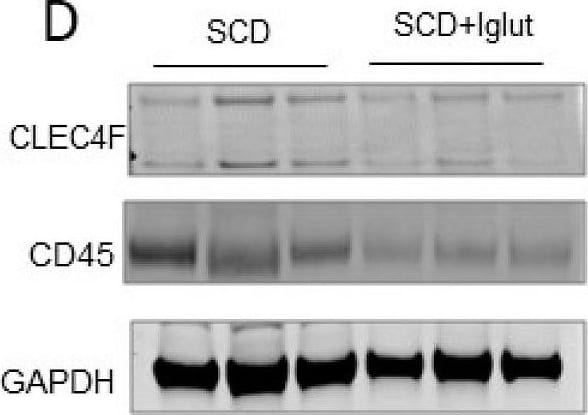
Detection of Mouse CLEC4F/CLECSF13 by Western Blot
L-glutamine treatment does not ameliorate ischemic injury in SCD mouse liver. (A) Quantitative liver intravital (qLIM) imaging of three different fields of view of SCD mice at baseline and post-L-glutamine administration injected with TXR-dextran. Dotted circle shows loss of blood flow in SCD liver which was comparable in L-glutamine-treated SCD mouse liver. (B) Quantification of the total area (%) of liver with loss of blood flow in SCD mice at baseline and post-L-glutamine treatment. (C) Representative IF images show enhanced CLEC4F and F4/80 expression in SCD liver which was not seen after L-glutamine administration. (D) Western Blot for CLEC4F and CD45 antibodies exhibits increased expression in the liver of SCD mice compared to L-glutamine-treated SCD mouse liver. (E) qRT-PCR analysis exhibits reduced mRNA expression of markers of inflammatory cells (including F4/80, Cd45, CLEC4F, and IL1 beta ) in L-glutamine-treated SCD liver compared to SCD liver at baseline. * denotes p < 0.05, NS, Not significant. Image collected and cropped by CiteAb from the following open publication (https://pubmed.ncbi.nlm.nih.gov/37760853), licensed under a CC-BY license. Not internally tested by R&D Systems.Applications for Mouse CLEC4F/CLECSF13 Antibody
Immunohistochemistry
Sample: Perfusion fixed frozen sections of mouse liver
Western Blot
Sample: Recombinant Mouse CLEC4F/CLECSF13 (Catalog # 2784-CL)
Reviewed Applications
Read 2 reviews rated 5 using AF2784 in the following applications:
Formulation, Preparation, and Storage
Purification
Reconstitution
Reconstitute at 0.2 mg/mL in sterile PBS. For liquid material, refer to CoA for concentration.
Formulation
Shipping
Stability & Storage
- 12 months from date of receipt, -20 to -70 °C as supplied.
- 1 month, 2 to 8 °C under sterile conditions after reconstitution.
- 6 months, -20 to -70 °C under sterile conditions after reconstitution.
Calculators
Background: CLEC4F/CLECSF13
References
- Zelensky, A.N. and J.E. Gready (2005) FEBS J. 272:6179.
- Bilzer, M. et al. (2006) Liver Int. 26:1175.
- Kuiper, J. et al. (1994) Biochem. J. 299:285.
- Accession # P70194.
- Hoyle, G.W. and R.L. Hill (1988) J. Biol. Chem. 263:7487.
- Fadden, A.J. et al. (2003) Glycobiology 13:529.
- Beavil, A.J. et al. (1992) Proc. Natl. Acad. Sci. 89:753.
- Haltiwanger, R.S. et al. (1986) J. Biol. Chem. 261:7433.
- Coombs, P.J. et al. (2006) Glycobiology 16:1C.
- Biessen, E.A.L. et al. (1994) Biochem. J. 299:291.
- Lehrman, M.A. et al. (1986) J. Biol. Chem. 261:7426.
Long Name
Alternate Names
Gene Symbol
UniProt
Additional CLEC4F/CLECSF13 Products
Product Documents for Mouse CLEC4F/CLECSF13 Antibody
Certificate of Analysis
To download a Certificate of Analysis, please enter a lot or batch number in the search box below.
Note: Certificate of Analysis not available for kit components.
Product Specific Notices for Mouse CLEC4F/CLECSF13 Antibody
For research use only
Related Research Areas
Citations for Mouse CLEC4F/CLECSF13 Antibody
 Powered by Bioz
Customer Reviews for Mouse CLEC4F/CLECSF13 Antibody (2)
Have you used Mouse CLEC4F/CLECSF13 Antibody?
Submit a review and receive an Amazon gift card!
$25/€18/£15/$25CAN/¥2500 for a review with an image
$10/€7/£6/$10CAN/¥1110 for a review without an image
Submit a review
Customer Images
-
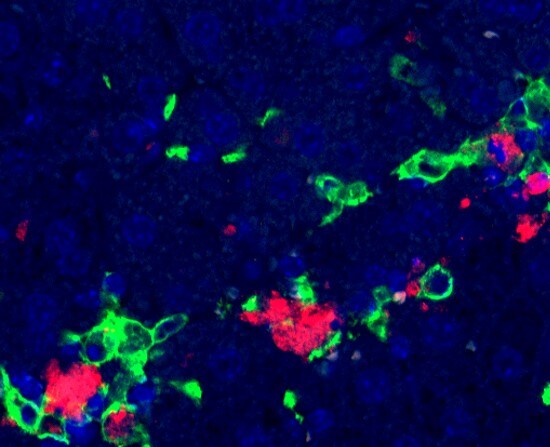
Application: Immunocytochemistry/ImmunofluorescenceSample Tested: Liver tissueSpecies: MouseVerified Customer | Posted 12/19/2020green color: clec4f

-
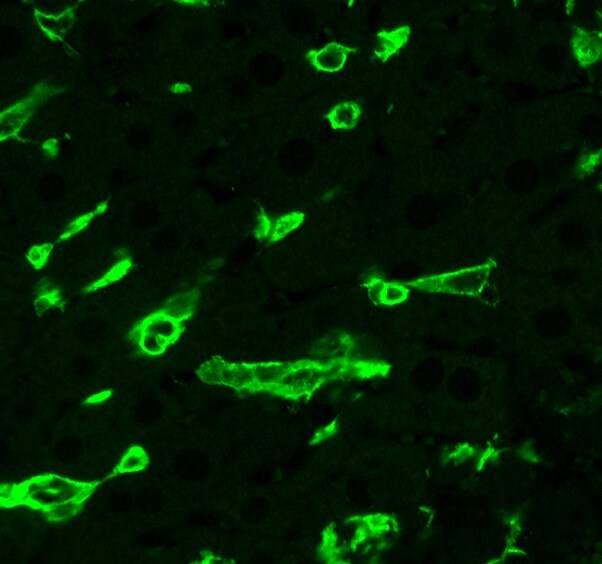
Application: Immunocytochemistry/ImmunofluorescenceSample Tested: Liver tissueSpecies: MouseVerified Customer | Posted 09/28/2020The antibody works very well for IF staining in mouse liver either paraffin and frozen sections.
There are no reviews that match your criteria.
Protocols
Find general support by application which include: protocols, troubleshooting, illustrated assays, videos and webinars.
- Antigen Retrieval Protocol (PIER)
- Antigen Retrieval for Frozen Sections Protocol
- Appropriate Fixation of IHC/ICC Samples
- Cellular Response to Hypoxia Protocols
- Chromogenic IHC Staining of Formalin-Fixed Paraffin-Embedded (FFPE) Tissue Protocol
- Chromogenic Immunohistochemistry Staining of Frozen Tissue
- ClariTSA™ Fluorophore Kits
- Detection & Visualization of Antibody Binding
- Fluorescent IHC Staining of Frozen Tissue Protocol
- Graphic Protocol for Heat-induced Epitope Retrieval
- Graphic Protocol for the Preparation and Fluorescent IHC Staining of Frozen Tissue Sections
- Graphic Protocol for the Preparation and Fluorescent IHC Staining of Paraffin-embedded Tissue Sections
- Graphic Protocol for the Preparation of Gelatin-coated Slides for Histological Tissue Sections
- IHC Sample Preparation (Frozen sections vs Paraffin)
- Immunofluorescent IHC Staining of Formalin-Fixed Paraffin-Embedded (FFPE) Tissue Protocol
- Immunohistochemistry (IHC) and Immunocytochemistry (ICC) Protocols
- Immunohistochemistry Frozen Troubleshooting
- Immunohistochemistry Paraffin Troubleshooting
- Preparing Samples for IHC/ICC Experiments
- Preventing Non-Specific Staining (Non-Specific Binding)
- Primary Antibody Selection & Optimization
- Protocol for Heat-Induced Epitope Retrieval (HIER)
- Protocol for Making a 4% Formaldehyde Solution in PBS
- Protocol for VisUCyte™ HRP Polymer Detection Reagent
- Protocol for the Preparation & Fixation of Cells on Coverslips
- Protocol for the Preparation and Chromogenic IHC Staining of Frozen Tissue Sections
- Protocol for the Preparation and Chromogenic IHC Staining of Frozen Tissue Sections - Graphic
- Protocol for the Preparation and Chromogenic IHC Staining of Paraffin-embedded Tissue Sections
- Protocol for the Preparation and Chromogenic IHC Staining of Paraffin-embedded Tissue Sections - Graphic
- Protocol for the Preparation and Fluorescent IHC Staining of Frozen Tissue Sections
- Protocol for the Preparation and Fluorescent IHC Staining of Paraffin-embedded Tissue Sections
- Protocol for the Preparation of Gelatin-coated Slides for Histological Tissue Sections
- R&D Systems Quality Control Western Blot Protocol
- TUNEL and Active Caspase-3 Detection by IHC/ICC Protocol
- The Importance of IHC/ICC Controls
- Troubleshooting Guide: Immunohistochemistry
- Troubleshooting Guide: Western Blot Figures
- Western Blot Conditions
- Western Blot Protocol
- Western Blot Protocol for Cell Lysates
- Western Blot Troubleshooting
- Western Blot Troubleshooting Guide
- View all Protocols, Troubleshooting, Illustrated assays and Webinars