
CTLA-4 and CD28, together with their ligands B7-1 and B7-2, constitute one of the dominant costimulatory pathways that regulate T and B cell responses. CTLA-4 and CD28 are structurally homologous molecules that are members of the immunoglobulin (Ig) gene superfamily. Both CTLA-4 and CD28 are composed of a single Ig V‑like extracellular domain, a transmembrane domain and an intracellular domain. CTLA-4 and CD28 are both expressed on the cell surface as disulfide-linked homodimers or as monomers. The genes encoding these two molecules are closely linked on human chromosome 2. CTLA-4 was originally identified as a gene that was specifically expressed by cytotoxic T lymphocytes. However, CTLA-4 transcripts have since been found in both Th1 and Th2, and CD4+ and CD8+ T cell clones. Whereas, CD28 expression is constitutive on the surfaces of 95% of CD4+ T cells and 50% of CD8+ T cells and is down regulated upon T cell activation, CTLA-4 expression is upregulated rapidly following T cell activation and peaks approximately 24 hours following activation. Although both CTLA-4 and CD28 can bind to the same ligands, CTLA-4 binds to B7-1 and B7-2 with 20-100-fold higher affinity than CD28. The physiological role of CTLA-4 in T cell costimulation is currently being studied. Recombinant human or mouse CTLA-4/Fc chimera preparations produced at R&D Systems have been shown to bind both B7-1 and B7-2 with high affinity and to inhibit CD28 signalling competitively.
Mouse CTLA-4 Antibody (63828)
R&D Systems | Catalog # MAB434

Key Product Details
Species Reactivity
Validated:
Cited:
Applications
Validated:
Cited:
Label
Antibody Source
Product Specifications
Immunogen
Ala36-Phe161
Accession # XP_001479180
Specificity
Clonality
Host
Isotype
Endotoxin Level
Scientific Data Images for Mouse CTLA-4 Antibody (63828)
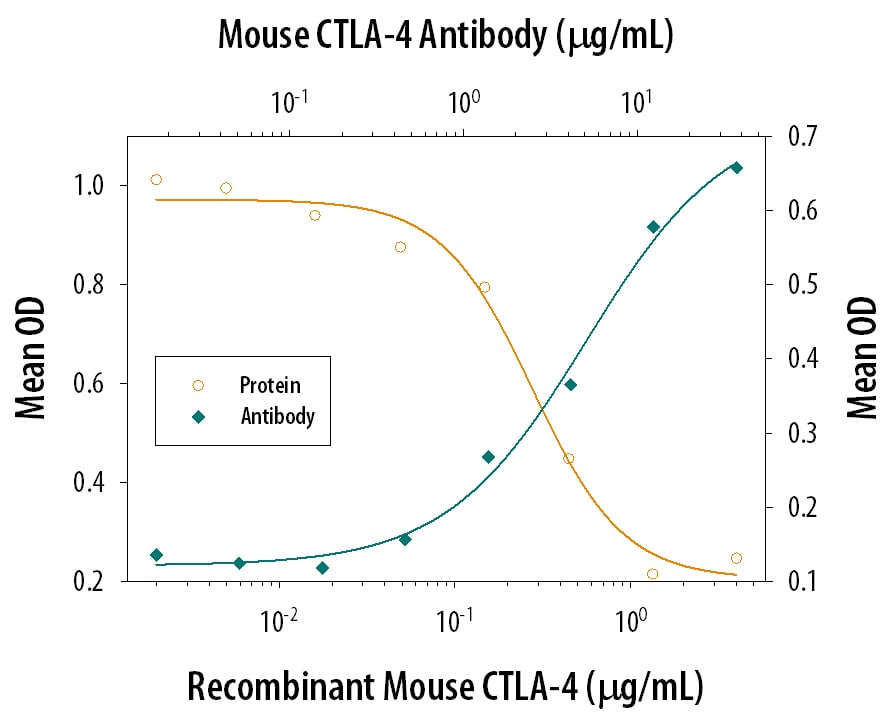
CTLA‑4 Inhibition of B7‑1/CD80-induced IL‑2 Secretion and Neutralization by Mouse CTLA‑4 Antibody.
Recombinant Mouse CTLA‑4 Fc Chimera (Catalog # 434-CT) inhibits Recombinant Human B7‑1/CD80 Fc Chimera (Catalog # 10133-B1) induced IL‑2 secretion in the Jurkat human acute T cell leukemia cell line in a dose-dependent manner (orange line), as measured by the Human IL‑2 Quantikine ELISA Kit (Catalog # D2050). Inhibition of Recombinant Human B7‑1/CD80 Fc Chimera (3 µg/mL) activity elicited by Recombinant Mouse CTLA‑4 Fc Chimera (1 µg/mL) is neutralized (green line) by increasing concentrations of Mouse CTLA‑4 Monoclonal Antibody (Catalog # MAB434). The ND50 is typically 2.5-10 µg/mL in the presence of PHA (10 µg/mL).Applications for Mouse CTLA-4 Antibody (63828)
CyTOF-ready
Flow Cytometry
Sample: Mouse splenocytes treated with ConA
Western Blot
Sample: Recombinant Mouse CTLA‑4 Fc Chimera (Catalog # 434-CT) under non-reducing conditions only
Neutralization
Flow Cytometry Panel Builder
Bio-Techne Knows Flow Cytometry
Save time and reduce costly mistakes by quickly finding compatible reagents using the Panel Builder Tool.
Advanced Features
- Spectra Viewer - Custom analysis of spectra from multiple fluorochromes
- Spillover Popups - Visualize the spectra of individual fluorochromes
- Antigen Density Selector - Match fluorochrome brightness with antigen density

Formulation, Preparation, and Storage
Purification
Reconstitution
Reconstitute at 0.5 mg/mL in sterile PBS. For liquid material, refer to CoA for concentration.
Formulation
Shipping
Stability & Storage
- 12 months from date of receipt, -20 to -70 °C as supplied.
- 1 month, 2 to 8 °C under sterile conditions after reconstitution.
- 6 months, -20 to -70 °C under sterile conditions after reconstitution.
Calculators
Background: CTLA-4
References
- Lenschow, D.J. et al. (1996) Annu. Rev. Immunol. 14:233.
- Hathcock, K.S. and R.J. Hodes (1996) Advances in Immunol. 62:131.
- Ward, S.G. (1996) Biochem. J. 318:361.
Long Name
Alternate Names
Gene Symbol
UniProt
Additional CTLA-4 Products
Product Documents for Mouse CTLA-4 Antibody (63828)
Certificate of Analysis
To download a Certificate of Analysis, please enter a lot or batch number in the search box below.
Note: Certificate of Analysis not available for kit components.
Product Specific Notices for Mouse CTLA-4 Antibody (63828)
For research use only
Citations for Mouse CTLA-4 Antibody (63828)
 Powered by Bioz
Customer Reviews for Mouse CTLA-4 Antibody (63828)
There are currently no reviews for this product. Be the first to review Mouse CTLA-4 Antibody (63828) and earn rewards!
Have you used Mouse CTLA-4 Antibody (63828)?
Submit a review and receive an Amazon gift card!
$25/€18/£15/$25CAN/¥2500 for a review with an image
$10/€7/£6/$10CAN/¥1110 for a review without an image
Submit a review
Protocols
Find general support by application which include: protocols, troubleshooting, illustrated assays, videos and webinars.
- 7-Amino Actinomycin D (7-AAD) Cell Viability Flow Cytometry Protocol
- Cellular Response to Hypoxia Protocols
- Extracellular Membrane Flow Cytometry Protocol
- Flow Cytometry Protocol for Cell Surface Markers
- Flow Cytometry Protocol for Staining Membrane Associated Proteins
- Flow Cytometry Staining Protocols
- Flow Cytometry Troubleshooting Guide
- Intracellular Flow Cytometry Protocol Using Alcohol (Methanol)
- Intracellular Flow Cytometry Protocol Using Detergents
- Intracellular Nuclear Staining Flow Cytometry Protocol Using Detergents
- Intracellular Staining Flow Cytometry Protocol Using Alcohol Permeabilization
- Intracellular Staining Flow Cytometry Protocol Using Detergents to Permeabilize Cells
- Propidium Iodide Cell Viability Flow Cytometry Protocol
- Protocol for Liperfluo
- Protocol for the Characterization of Human Th22 Cells
- Protocol for the Characterization of Human Th9 Cells
- Protocol: Annexin V and PI Staining by Flow Cytometry
- Protocol: Annexin V and PI Staining for Apoptosis by Flow Cytometry
- R&D Systems Quality Control Western Blot Protocol
- Troubleshooting Guide: Fluorokine Flow Cytometry Kits
- Troubleshooting Guide: Western Blot Figures
- Western Blot Conditions
- Western Blot Protocol
- Western Blot Protocol for Cell Lysates
- Western Blot Troubleshooting
- Western Blot Troubleshooting Guide
- View all Protocols, Troubleshooting, Illustrated assays and Webinars