Mouse Frizzled‑8 Alexa Fluor™ Plus 680‑conjugated Antibody

R&D Systems | Catalog # AF112AFP680

R&D Systems

Key Product Details

Species Reactivity

Mouse

Applications

Immunohistochemistry, Western Blot

Label

Alexa Fluor Plus 680 (Excitation = 687 nm, Emission = 704 nm)

Antibody Source

Polyclonal Goat IgG
Loading...

Product Specifications

Specificity

Detects mouse Frizzled-8 in direct ELISAs and Western blots. In direct ELISAs, approximately 5% cross-reactivity with recombinant mouse (rm) Frizzled-9 is observed and less than 1% cross-reactivity with rmFrizzled-1, rmFrizzled-2, rmFrizzled-3, rmFrizzled-4, rmFrizzled-6, and rmFrizzled‑7 is observed.

Clonality

Polyclonal

Host

Goat

Isotype

IgG

Applications for Mouse Frizzled‑8 Alexa Fluor™ Plus 680‑conjugated Antibody

Application
Recommended Usage

Immunohistochemistry

Optimal dilution of this antibody should be experimentally determined.

Western Blot

Optimal dilution of this antibody should be experimentally determined.

Formulation, Preparation, and Storage

Formulation

Supplied 0.2 mg/mL in a saline solution containing BSA and Sodium Azide.

Shipping

The product is shipped with polar packs. Upon receipt, store it immediately at the temperature recommended below.

Stability & Storage

Protect from light. Do not freeze. 12 months from date of receipt, 2 to 8 °C as supplied

Background: Frizzled-8

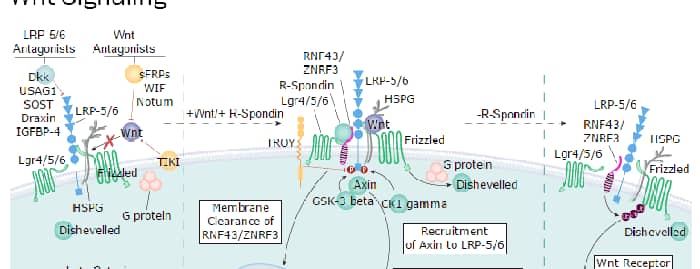
Wnt signaling is involved in a variety of developmental processes including cell fate determination, cell polarity, tissue patterning and control of cell proliferation. Members of the Frizzled family of proteins serve as receptors for the Wnt signaling pathway. The founding member of this family was identified in Drosophilia based on its role in tissue polarity in the adult cuticle and named for the disorganized appearance of bristle hairs on the mutant. Mouse Frizzled-8 (mFrz-8) was originally cloned in a PCR screen to identify additional Frizzled family members in vertebrates. There are nine murine Frizzled genes and 10 human Frizzled genes identified to date. The predicted structure of Frizzled proteins is similar among all family members, containing a divergent N-terminal signal peptide, a highly conserved extracellular cysteine-rich domain, a seven-pass transmembrane region, and a variable-length C-terminal tail. The most conserved regions of the Frizzled proteins are the extracellular cysteine-rich domain (CRD) which spans approximately 120 amino acid residues and contains 10 invariant cysteines, and the seven transmembrane domains. Mouse Frizzled-8 is 685 amino acid residues long and shows 95% and 82% amino acid identity to human and Xenopus Frizzled-8, respectively. Like other family members, Frizzled-8 has a complex expression pattern in the mouse embryo. It is expressed in the neural tube, brain, eye, somites, gut, and bronchial arches.

One of the best-characterized Wnt signal transduction pathways is the canonical Wnt/ beta -catenin pathway. It is involved in diverse biological mechanisms such as dorsal/ventral development in Xenopus embryos and mammalian tumor formation, acting via stabilization of beta -catenin. Frizzled-8 is implicated in this pathway based on its ability to bind Wnt ligands that stimulate beta -catenin stabilization and to influence the formation of secondary axes in Xenopus embryos. The mFrz-8 CRD has been demonstrated to bind cell surface Xenopus Wnt-8 (XWnt-8) protein, indicating that this region is sufficient for binding ligand. In addition, the CRD portion of Frizzled-8 has potent antagonizing activity of Wnt signaling as assayed by inhibition of secondary axes induced by Xwnt-8 mRNA. The crystal structure of mFrz-8 CRD exhibits a dimer interface that is also present in sFRP-3, and suggests that CRD dimerization may be important for Wnt signaling.

References

  1. Wang, Y. et al. (1996) J. Biol. Chem. 271:4468.
  2. Borello, U. et al. (1999) Mech. Dev. 89:173.
  3. Hsieh, J-C. et al. (1999) Proc. Natl. Acad. Sci. USA 96:3546.
  4. Dann, C. et al. (2001) Nature 412:86.
  5. Itoh, K. et al. (1998) Mech. Dev. 74:145.
  6. Deardorff, M. et al. (1998) Development 125:2687.

Alternate Names

Frizzled8, FZD8

Entrez Gene IDs

8325 (Human); 14370 (Mouse)

Gene Symbol

FZD8

UniProt

Additional Frizzled-8 Products

Product Documents for Mouse Frizzled‑8 Alexa Fluor™ Plus 680‑conjugated Antibody

Certificate of Analysis

To download a Certificate of Analysis, please enter a lot or batch number in the search box below.

Note: Certificate of Analysis not available for kit components.

Product Specific Notices for Mouse Frizzled‑8 Alexa Fluor™ Plus 680‑conjugated Antibody


This product is provided under an intellectual property license from Life Technologies Corporation. The transfer of this product is conditioned on the buyer using the purchased product solely in research conducted by the buyer, excluding contract research or any fee for service research, and the buyer must not (1) use this product or its components for (a) diagnostic, therapeutic or prophylactic purposes; (b) testing, analysis or screening services, or information in return for compensation on a per-test basis; or (c) manufacturing or quality assurance or quality control, and/or (2) sell or transfer this product or its components for resale, whether or not resold for use in research. For information on purchasing a license to this product for purposes other than as described above, contact Life Technologies Corporation, 5781 Van Allen Way, Carlsbad, CA 92008 USA or outlicensing@thermofisher.com.

For research use only

Related Research Areas

Customer Reviews

There are currently no reviews for this product. Be the first to review Mouse Frizzled‑8 Alexa Fluor™ Plus 680‑conjugated Antibody and earn rewards!

Have you used Mouse Frizzled‑8 Alexa Fluor™ Plus 680‑conjugated Antibody?

Submit a review and receive an Amazon gift card!

$25/€18/£15/$25CAN/¥2500 Yen for a review with an image

$10/€7/£6/$10CAN/¥1110 Yen for a review without an image

Submit a review
Amazon Gift Card

Protocols

Find general support by application which include: protocols, troubleshooting, illustrated assays, videos and webinars.

FAQs

No product specific FAQs exist for this product.

View all FAQs for Antibodies