
MTSS1 Antibody - BSA Free
Novus Biologicals | Catalog # NBP2-24716

![Western Blot: MTSS1 Antibody [NBP2-24716]](https://resources.rndsystems.com/images/products/MTSS1-Antibody-Western-Blot-NBP2-24716-img0005.jpg "Western Blot: MTSS1 Antibody [NBP2-24716]")
Scientific images may be resized, cropped, or adjusted for brightness or contrast for presentation purposes. These updates are limited to presentation and do not affect the underlying scientific interpretation of the data. Where available, additional source data may be provided upon request.
Key Product Details
Species Reactivity
Validated:
Cited:
Predicted:
Applications
Validated:
Cited:
Label
Antibody Source
Format
Product Specifications
Immunogen
Reactivity Notes
Clonality
Host
Isotype
Scientific Data Images for MTSS1 Antibody - BSA Free
Western Blot: MTSS1 Antibody [NBP2-24716]
Western Blot: MTSS1 Antibody [NBP2-24716] - Analysis of MTSS1 in human testis lysate in the 1) absence and 2) presence of immunizing peptide, 3) mouse and 4) rat testis lysate using NBP2-24716 at 2 ug/ml, 4 ug/ml and 2 ug/ml, respectively.![Immunohistochemistry-Paraffin: MTSS1 Antibody [NBP2-24716]](https://resources.rndsystems.com/images/products/MTSS1-Antibody-Immunohistochemistry-Paraffin-NBP2-24716-img0004.jpg "Immunohistochemistry-Paraffin: MTSS1 Antibody [NBP2-24716]")
Immunohistochemistry-Paraffin: MTSS1 Antibody [NBP2-24716]
Immunohistochemistry-Paraffin: MTSS1 Antibody [NBP2-24716] - Analysis of human colon using this antibody at 10 ug/ml.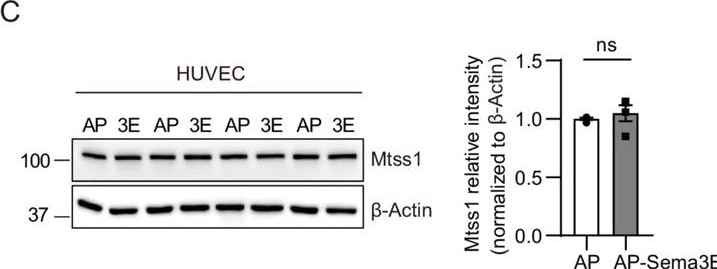
Western Blot: MTSS1 Antibody - BSA Free [NBP2-24716] -
No Mtss1 was found in endothelial cells at E14.5, and no vascular defects were observed in Mtss1-conditional knockout (KO) mice.(A) Fluorescence in situ hybridization for Plxnd1 mRNA (green) and Mtss1 mRNA (red) in the brain and dorsal trunk at E14.5. White dotted boxes are shown in the inset image on the bottom. Scale bars, 100 μm for brain, 50 μm for dorsal trunk. (B) 3D vascular reconstruction analysis images after CD31 immunostaining and tissue clearing obtained using multifunctional fast confocal microscopy Dragonfly 502w. (C) Western blotting to analyze Mtss1 expression after AP-Sema3E (2 nM) treatment in human umbilical vein endothelial cells (HUVECs) or human cortical microvessel endothelial cells (HCMEC/D3). Error bars, mean +/- SEM; ns p>0.05 by Mann‒Whitney test; AP, n = 4, AP-Sema3E, n = 4 for HUVECs, ns p>0.05 by Student’s t-test; AP, n = 4, AP-Sema3E, n = 4 for HCMEC/D3s in four dependent experiments.Figure 8—figure supplement 1—source data 1.Western blots shown in Figure 8—figure supplement 1C.Western blots shown in Figure 8—figure supplement 1C. Image collected and cropped by CiteAb from the following open publication (https://elifesciences.org/articles/96891), licensed under a CC-BY license. Not internally tested by Novus Biologicals.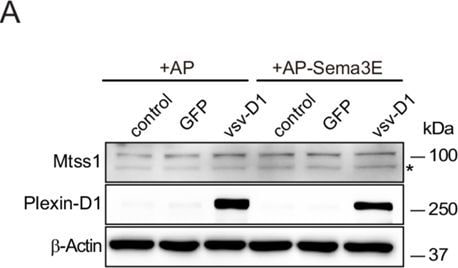
Western Blot: MTSS1 Antibody - BSA Free [NBP2-24716] -
Expression of Mtss1 induces I-BAR domain-dependent morphological changes in COS7 cells, generating protrusions.(A) Western blot images showing that weakly expression of endogenous Mtss1 was not altered by overexpression of Plexin-D1 with or without Sema3E in COS7 cells. Asterisk indicates nonspecific band. (B) Quantification of the band intensity in (A). Error bars, mean +/- SEM; ns p>0.05 by two-way ANOVA with Bonferroni’s post hoc correction for multiple comparisons; n = 3. (C) Schematics describing the full-length construct of Mtss1-myc and its deletion mutant constructs (Mtss1 delta I-BAR-myc, Mtss1 delta WH2-myc, and I-BAR-myc). (D) Immunocytochemistry images taken after overexpression of each construct. Constructs show the I-BAR domain leading to diverse cell protrusion morphologies. Some of the protrusions were excessively spiked or thin and long (arrowheads). Overexpression of the I-BAR domain only (I-BAR-myc) can induce extreme protrusion structures. Scale bar, 20 μm.Figure 3—figure supplement 1—source data 1.Western blots shown in Figure 3—figure supplement 1A.Western blots shown in Figure 3—figure supplement 1A. Image collected and cropped by CiteAb from the following open publication (https://elifesciences.org/articles/96891), licensed under a CC-BY license. Not internally tested by Novus Biologicals.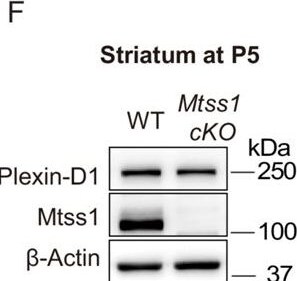
Western Blot: MTSS1 Antibody - BSA Free [NBP2-24716] -
The absence of Mtss1 does not affect medium spiny neuron (MSN) survival, dendritic arborization, and Plexin-D1 expression during striatonigral pathway development.(A) Immunohistochemistry staining for cleaved caspase 3 (CC3) in the striatum of wild-type (WT) or Mtss1 conditional knockout (cKO) mice. The white dotted boxes on the left images are shown in the inset images on the right at a better resolution. Scale bar, 25 μm. (B) Quantification of cell death by the number of CC3-positive cells in a 1 mm2 area covering the dorsal part of the striatum in WT or Mtss1 cKO mice. Error bars, mean +/- SEM; ns p>0.05 by Mann‒Whitney test; WT, n = 20; Mtss1 cKO mice, n = 20 (five sections/mouse). (C) Representative images of Golgi staining at low (top panels) and high (bottom panels) magnification. Scale bars, 100 μm. Sholl analysis of dendritic morphology (D) and dendritic length (E) performed by using Neurolucida360 in 3D analysis. Error bars, mean +/- SEM; ns p>0.05 by Student’s t-test; WT, n = 12, and Mtss1 cKO mice, n = 15, from three mice. (F, G) Western blot images and quantification of Plexin-D1 expression in the striatum of WT or Mtss1 cKO mice at P5. Error bars, mean +/- SEM; *p<0.05 by Student’s t-test; WT mice, n = 3, and Mtss1 cKO mice, n = 4. (H) Plexin-D1 expression in MSNs obtained from the striatum of WT or Mtss1 cKO mice at P0 and measured at DIV6 in culture. (I) Quantification of the western blots shown in (H). Error bars, mean +/- SEM; *p<0.05, by Student’s t-test; n = 3 for WT, n = 3 for KO in three independent experiments.Figure 7—figure supplement 3—source data 1.Raw uncropped western blot & gel images.Western blots shown in Figure 7—figure supplement 3F and H.Raw uncropped western blot & gel images.Western blots shown in Figure 7—figure supplement 3F and H. Image collected and cropped by CiteAb from the following open publication (https://elifesciences.org/articles/96891), licensed under a CC-BY license. Not internally tested by Novus Biologicals.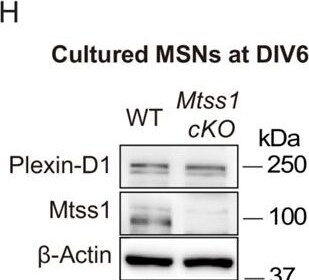
Western Blot: MTSS1 Antibody - BSA Free [NBP2-24716] -
The absence of Mtss1 does not affect medium spiny neuron (MSN) survival, dendritic arborization, and Plexin-D1 expression during striatonigral pathway development.(A) Immunohistochemistry staining for cleaved caspase 3 (CC3) in the striatum of wild-type (WT) or Mtss1 conditional knockout (cKO) mice. The white dotted boxes on the left images are shown in the inset images on the right at a better resolution. Scale bar, 25 μm. (B) Quantification of cell death by the number of CC3-positive cells in a 1 mm2 area covering the dorsal part of the striatum in WT or Mtss1 cKO mice. Error bars, mean +/- SEM; ns p>0.05 by Mann‒Whitney test; WT, n = 20; Mtss1 cKO mice, n = 20 (five sections/mouse). (C) Representative images of Golgi staining at low (top panels) and high (bottom panels) magnification. Scale bars, 100 μm. Sholl analysis of dendritic morphology (D) and dendritic length (E) performed by using Neurolucida360 in 3D analysis. Error bars, mean +/- SEM; ns p>0.05 by Student’s t-test; WT, n = 12, and Mtss1 cKO mice, n = 15, from three mice. (F, G) Western blot images and quantification of Plexin-D1 expression in the striatum of WT or Mtss1 cKO mice at P5. Error bars, mean +/- SEM; *p<0.05 by Student’s t-test; WT mice, n = 3, and Mtss1 cKO mice, n = 4. (H) Plexin-D1 expression in MSNs obtained from the striatum of WT or Mtss1 cKO mice at P0 and measured at DIV6 in culture. (I) Quantification of the western blots shown in (H). Error bars, mean +/- SEM; *p<0.05, by Student’s t-test; n = 3 for WT, n = 3 for KO in three independent experiments.Figure 7—figure supplement 3—source data 1.Raw uncropped western blot & gel images.Western blots shown in Figure 7—figure supplement 3F and H.Raw uncropped western blot & gel images.Western blots shown in Figure 7—figure supplement 3F and H. Image collected and cropped by CiteAb from the following open publication (https://elifesciences.org/articles/96891), licensed under a CC-BY license. Not internally tested by Novus Biologicals.Applications for MTSS1 Antibody - BSA Free
Immunocytochemistry/ Immunofluorescence
Immunohistochemistry-Paraffin
Western Blot
Formulation, Preparation, and Storage
Purification
Formulation
Format
Preservative
Concentration
Shipping
Stability & Storage
Background: MTSS1
Alternate Names
Gene Symbol
UniProt
Additional MTSS1 Products
Product Documents for MTSS1 Antibody - BSA Free
Certificate of Analysis
To download a Certificate of Analysis, please enter a lot or batch number in the search box below.
Product Specific Notices for MTSS1 Antibody - BSA Free
This product is for research use only and is not approved for use in humans or in clinical diagnosis. Primary Antibodies are guaranteed for 1 year from date of receipt.
Citations for MTSS1 Antibody - BSA Free
 Powered by Bioz
Customer Reviews for MTSS1 Antibody - BSA Free
There are currently no reviews for this product. Be the first to review MTSS1 Antibody - BSA Free and earn rewards!
Have you used MTSS1 Antibody - BSA Free?
Submit a review and receive an Amazon gift card!
$25/€18/£15/$25CAN/¥2500 for a review with an image
$10/€7/£6/$10CAN/¥1110 for a review without an image
Submit a review
Protocols
Find general support by application which include: protocols, troubleshooting, illustrated assays, videos and webinars.
- Antigen Retrieval Protocol (PIER)
- Antigen Retrieval for Frozen Sections Protocol
- Appropriate Fixation of IHC/ICC Samples
- Cellular Response to Hypoxia Protocols
- Chromogenic IHC Staining of Formalin-Fixed Paraffin-Embedded (FFPE) Tissue Protocol
- Chromogenic Immunohistochemistry Staining of Frozen Tissue
- ClariTSA™ Fluorophore Kits
- Detection & Visualization of Antibody Binding
- Fluorescent IHC Staining of Frozen Tissue Protocol
- Graphic Protocol for Heat-induced Epitope Retrieval
- Graphic Protocol for the Preparation and Fluorescent IHC Staining of Frozen Tissue Sections
- Graphic Protocol for the Preparation and Fluorescent IHC Staining of Paraffin-embedded Tissue Sections
- Graphic Protocol for the Preparation of Gelatin-coated Slides for Histological Tissue Sections
- ICC Cell Smear Protocol for Suspension Cells
- ICC Immunocytochemistry Protocol Videos
- ICC for Adherent Cells
- IHC Sample Preparation (Frozen sections vs Paraffin)
- Immunocytochemistry (ICC) Protocol
- Immunocytochemistry Troubleshooting
- Immunofluorescence of Organoids Embedded in Cultrex Basement Membrane Extract
- Immunofluorescent IHC Staining of Formalin-Fixed Paraffin-Embedded (FFPE) Tissue Protocol
- Immunohistochemistry (IHC) and Immunocytochemistry (ICC) Protocols
- Immunohistochemistry Frozen Troubleshooting
- Immunohistochemistry Paraffin Troubleshooting
- Preparing Samples for IHC/ICC Experiments
- Preventing Non-Specific Staining (Non-Specific Binding)
- Primary Antibody Selection & Optimization
- Protocol for Heat-Induced Epitope Retrieval (HIER)
- Protocol for Making a 4% Formaldehyde Solution in PBS
- Protocol for VisUCyte™ HRP Polymer Detection Reagent
- Protocol for the Fluorescent ICC Staining of Cell Smears - Graphic
- Protocol for the Fluorescent ICC Staining of Cultured Cells on Coverslips - Graphic
- Protocol for the Preparation & Fixation of Cells on Coverslips
- Protocol for the Preparation and Chromogenic IHC Staining of Frozen Tissue Sections
- Protocol for the Preparation and Chromogenic IHC Staining of Frozen Tissue Sections - Graphic
- Protocol for the Preparation and Chromogenic IHC Staining of Paraffin-embedded Tissue Sections
- Protocol for the Preparation and Chromogenic IHC Staining of Paraffin-embedded Tissue Sections - Graphic
- Protocol for the Preparation and Fluorescent ICC Staining of Cells on Coverslips
- Protocol for the Preparation and Fluorescent ICC Staining of Non-adherent Cells
- Protocol for the Preparation and Fluorescent ICC Staining of Stem Cells on Coverslips
- Protocol for the Preparation and Fluorescent IHC Staining of Frozen Tissue Sections
- Protocol for the Preparation and Fluorescent IHC Staining of Paraffin-embedded Tissue Sections
- Protocol for the Preparation of Gelatin-coated Slides for Histological Tissue Sections
- Protocol for the Preparation of a Cell Smear for Non-adherent Cell ICC - Graphic
- R&D Systems Quality Control Western Blot Protocol
- TUNEL and Active Caspase-3 Detection by IHC/ICC Protocol
- The Importance of IHC/ICC Controls
- Troubleshooting Guide: Immunohistochemistry
- Troubleshooting Guide: Western Blot Figures
- Western Blot Conditions
- Western Blot Protocol
- Western Blot Protocol for Cell Lysates
- Western Blot Troubleshooting
- Western Blot Troubleshooting Guide
- View all Protocols, Troubleshooting, Illustrated assays and Webinars