
YTHDF3 Antibody - BSA Free
Novus Biologicals | Catalog # NBP2-94636

![Western Blot: YTHDF3 AntibodyBSA Free [NBP2-94636]](https://resources.rndsystems.com/images/products/YTHDF3-Antibody-Western-Blot-NBP2-94636-img0004.jpg "Western Blot: YTHDF3 AntibodyBSA Free [NBP2-94636]")
Scientific images may be resized, cropped, or adjusted for brightness or contrast for presentation purposes. These updates are limited to presentation and do not affect the underlying scientific interpretation of the data. Where available, additional source data may be provided upon request.
Key Product Details
Species Reactivity
Validated:
Cited:
Applications
Validated:
Cited:
Label
Antibody Source
Format
Product Specifications
Immunogen
Clonality
Host
Isotype
Theoretical MW
Disclaimer note: The observed molecular weight of the protein may vary from the listed predicted molecular weight due to post translational modifications, post translation cleavages, relative charges, and other experimental factors.
Scientific Data Images for YTHDF3 Antibody - BSA Free
Western Blot: YTHDF3 AntibodyBSA Free [NBP2-94636]
Western Blot: YTHDF3 Antibody [NBP2-94636] - Western blot analysis of extracts of HepG2 cells, using YTHDF3 antibody (NBP2-94636) at 1:1000 dilution. Secondary antibody: HRP Goat Anti-Rabbit IgG (H+L) at 1:10000 dilution. Lysates/proteins: 25ug per lane. Blocking buffer: 3% nonfat dry milk in TBST. Detection: ECL Basic Kit. Exposure time: 90s.![Immunohistochemistry-Paraffin: YTHDF3 Antibody - BSA Free [NBP2-94636]](https://resources.rndsystems.com/images/products/YTHDF3-Antibody-Immunohistochemistry-Paraffin-NBP2-94636-img0003.jpg "Immunohistochemistry-Paraffin: YTHDF3 Antibody - BSA Free [NBP2-94636]")
Immunohistochemistry-Paraffin: YTHDF3 Antibody - BSA Free [NBP2-94636]
Immunohistochemistry-Paraffin: YTHDF3 Antibody [NBP2-94636] - Immunohistochemistry of paraffin-embedded rat brain using YTHDF3 Rabbit pAb (NBP2-94636) at dilution of 1:500 (40x lens). Perform high pressure antigen retrieval with 10 mM citrate buffer pH 6.0 before commencing with IHC staining protocol.![Western Blot: YTHDF3 AntibodyBSA Free [NBP2-94636]](https://resources.rndsystems.com/images/products/YTHDF3%20Antibody-Western%20Blot-NBP2-94636-img0005.jpg "Western Blot: YTHDF3 AntibodyBSA Free [NBP2-94636]")
Western Blot: YTHDF3 AntibodyBSA Free [NBP2-94636]
Western Blot: YTHDF3 Antibody [NBP2-94636] - Western blot analysis of extracts of Mouse liver, using YTHDF3 antibody (NBP2-94636) at 1:1000 dilution. Secondary antibody: HRP Goat Anti-Rabbit IgG (H+L) at 1:10000 dilution. Lysates/proteins: 25ug per lane. Blocking buffer: 3% nonfat dry milk in TBST. Detection: ECL Basic Kit. Exposure time: 90s.![Immunohistochemistry-Paraffin: YTHDF3 Antibody - BSA Free [NBP2-94636]](https://resources.rndsystems.com/images/products/YTHDF3-Antibody-Immunohistochemistry-Paraffin-NBP2-94636-img0002.jpg "Immunohistochemistry-Paraffin: YTHDF3 Antibody - BSA Free [NBP2-94636]")
Immunohistochemistry-Paraffin: YTHDF3 Antibody - BSA Free [NBP2-94636]
Immunohistochemistry-Paraffin: YTHDF3 Antibody [NBP2-94636] - Immunohistochemistry of paraffin-embedded mouse brain using YTHDF3 Rabbit pAb (NBP2-94636) at dilution of 1:500 (40x lens). Perform high pressure antigen retrieval with 10 mM citrate buffer pH 6.0 before commencing with IHC staining protocol.![Immunoprecipitation: YTHDF3 Antibody - BSA Free [NBP2-94636]](https://resources.rndsystems.com/images/products/YTHDF3-Antibody-Immunoprecipitation-NBP2-94636-img0001.jpg "Immunoprecipitation: YTHDF3 Antibody - BSA Free [NBP2-94636]")
Immunoprecipitation: YTHDF3 Antibody - BSA Free [NBP2-94636]
Immunoprecipitation: YTHDF3 Antibody [NBP2-94636] - Immunoprecipitation analysis of 300ug extracts of HT-1080 cells using 3ug YTHDF3 antibody (NBP2-94636). Western blot was performed from the immunoprecipitate using YTHDF3 antibody (NBP2-94636) at a dilution of 1:1000.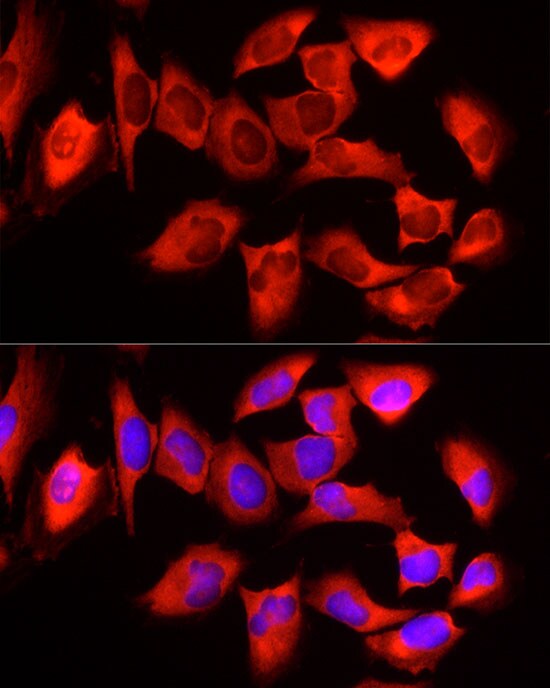
Immunocytochemistry/ Immunofluorescence: YTHDF3 Antibody - BSA Free [YTHDF3] -
Immunocytochemistry/ Immunofluorescence: YTHDF3 Antibody - BSA Free [YTHDF3] - Immunofluorescence analysis of HeLa cells using YTHDF3 Rabbit pAb at dilution of 1:50 (40x lens). Secondary antibody: Cy3 Goat Anti-Rabbit IgG (H+L) at 1:500 dilution. Blue: DAPI for nuclear staining.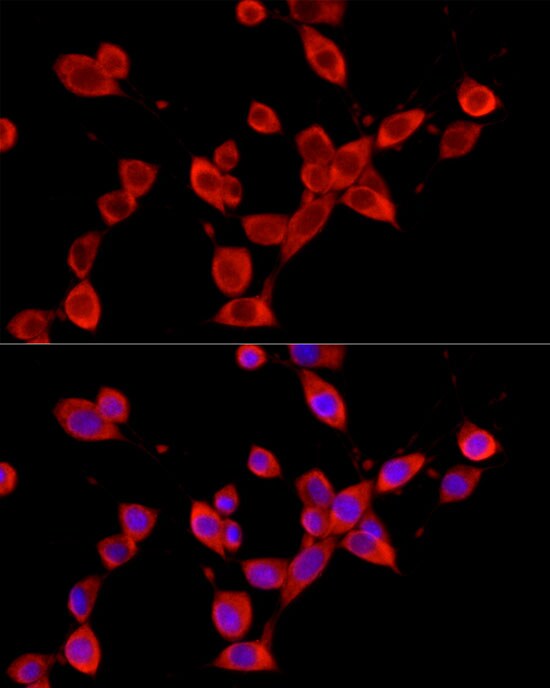
Immunocytochemistry/ Immunofluorescence: YTHDF3 Antibody - BSA Free [YTHDF3] -
Immunocytochemistry/ Immunofluorescence: YTHDF3 Antibody - BSA Free [YTHDF3] - Immunofluorescence analysis of NIH/3T3 cells using YTHDF3 Rabbit pAb at dilution of 1:50 (40x lens). Secondary antibody: Cy3 Goat Anti-Rabbit IgG (H+L) at 1:500 dilution. Blue: DAPI for nuclear staining.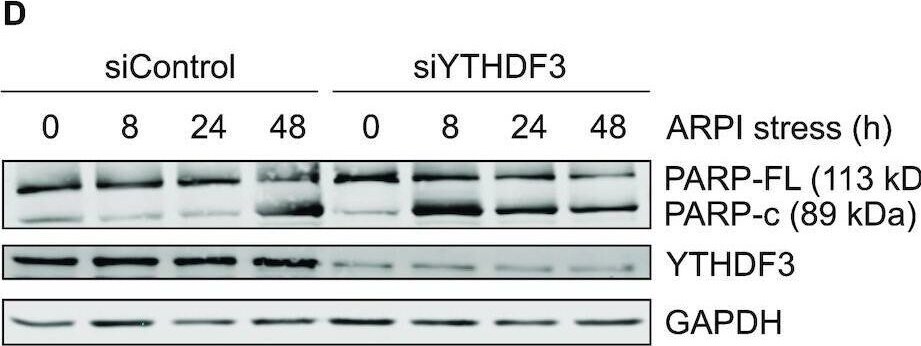
Western Blot: YTHDF3 Antibody - BSA Free [NBP2-94636] -
G3BP1 and YTHDF3 are cytoprotective proteins. (A) ARPI stress induced SG formation is reversible. LNCaP cells were unstressed, ARPI stressed or rescued from treatment. The cells were then stained with anti-G3BP1 and anti-YTHDF3 antibodies to reveal the SGs. Quantification of SGs is shown on the right-side panel. Note that ARPI stress- induced SG formation was reversed when treatment was withdrawn. (B) ARPI stress induced reduction in AR protein was restored to steady state level following stress removal. (C–F) KD of G3BP1 or YTHDF3 reduced cell survival in LNCaP cells. LNCaP cells transfected with siControl, siG3BP1 or siYTHDF3 were unstressed or treated with ARPI stress for 8, 24 and 48 h. The cell lysates were subjected to Western blotting for the indicated antibodies. Note that ARPI stress enhanced PARP cleavage in siG3BP1 (C) and siYTHDF3 (D) cells compared to control cells (8 h treatment). The above cells were subjected to IF using antibodies against activated BAX (2D2), an indicator of apoptosis (E). BAX positive cells are indicated by arrowheads. (F) Quantification of BAX activation. Note that acute ARPI stress strongly activated BAX in siG3BP1 and siYTHDF3 cells compared to control cells (8 h treatment). The results are an average of three independent experiments with ***P < 0.001. Scale 10 μm. Image collected and cropped by CiteAb from the following open publication (https://pubmed.ncbi.nlm.nih.gov/34939643), licensed under a CC-BY license. Not internally tested by Novus Biologicals.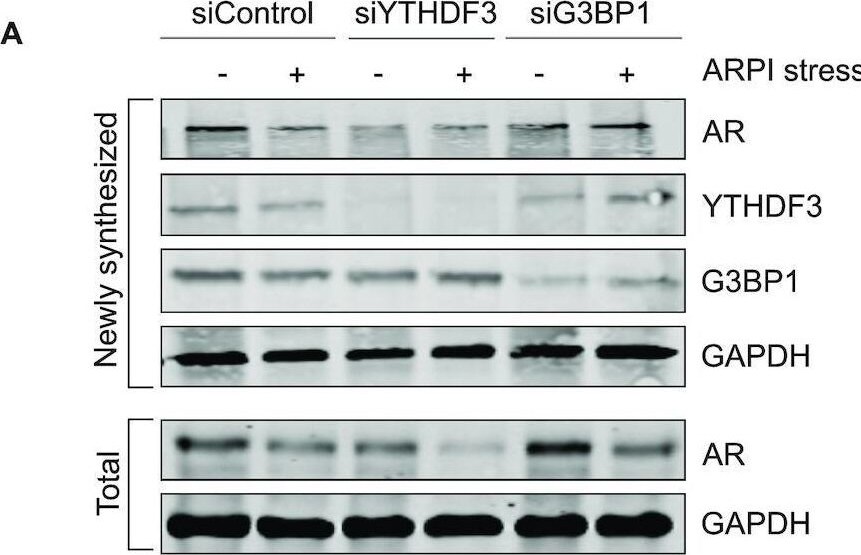
Western Blot: YTHDF3 Antibody - BSA Free [NBP2-94636] -
YTHDF3 translationally regulates AR mRNA. (A) Knockdown (KD) of G3BP1 did not affect rate of synthesis of AR protein, while KD of YTHDF3 reduced the rate of synthesis of AR protein as measured by Click chemistry (see Methods for details). (B) KD of YTHDF3 reduced the level of AR mRNA in the PSs. (C) KD of YTHDF3 did not affect the total mRNA level of AR. (D) YTHDF3 binds to AR mRNA in the PSs. (E) m6A-modified AR mRNA is reduced in the PSs after ARPI stress. Results are presented as an average of 3 independent experiments with ***P < 0.001, **P < 0.01, n.s., non-significant. (F) Model illustrating the regulation of AR mRNA during ARPI stress. Under the unstressed condition, AR mRNA is present as two fractions. m6A-modified translatable AR mRNA fraction, regulated by METTL3, is associated with YTHDF3 in the PSs, and m6A-unmodified untranslatable AR mRNA fraction is associated with G3BP1 in the non-PS fraction. When the cells are exposed to ARPI stress, PSs disassemble, and the m6A-modified AR mRNA and associated YTHDF3 is redistributed from the PSs to SGs to form the AR mRNA-YTHDF3 cluster. At the same time, G3BP1 associated m6A-unmodified AR mRNA also redistributes from the non-PS fraction to SGs to form the AR mRNA-G3BP1 cluster. Thus, these two ribonucleoprotein (RNP) clusters, AR mRNA-YTHDF3 and AR mRNA-G3BP1, co-exist in the SG. Image collected and cropped by CiteAb from the following open publication (https://pubmed.ncbi.nlm.nih.gov/34939643), licensed under a CC-BY license. Not internally tested by Novus Biologicals.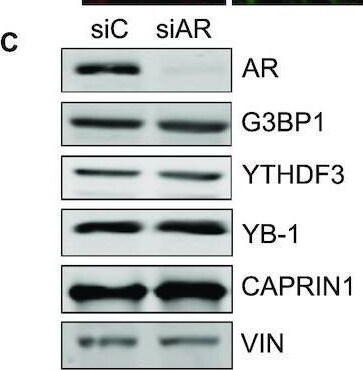
Western Blot: YTHDF3 Antibody - BSA Free [NBP2-94636] -
AR mRNA supports SG formation in response to ARPI stress treatment. (A) AR knockdown (KD) using siRNAs delayed the formation of SGs. LNCaP cells were transfected with siControl or siAR siRNAs, -/+ ARPI stress for different time points (30 min, 60 min and 75 min), and stained with anti-YTHDF3 and anti-G3BP1 antibodies to analyse SGs. Note that SG formation is significantly delayed at 30 and 60 min, while this effect is gradually lost at 75 min of treatment. (B) Quantification of SGs. (C) KD of AR did not affect the level of different SG proteins. (D) Treatment with AR degrader, ARD-61, did not affect the level of SGs in response to ARPI stress. (E) Quantification of SGs. ARD-61 treatment reduced the level of AR protein as revealed by Western blot (F) without affecting the level of AR mRNA as revealed by qRT-PCR (G). The results are an average of three independent experiments with **P < 0.01. n.s., non-significant. Scale 10 μm. Image collected and cropped by CiteAb from the following open publication (https://pubmed.ncbi.nlm.nih.gov/34939643), licensed under a CC-BY license. Not internally tested by Novus Biologicals.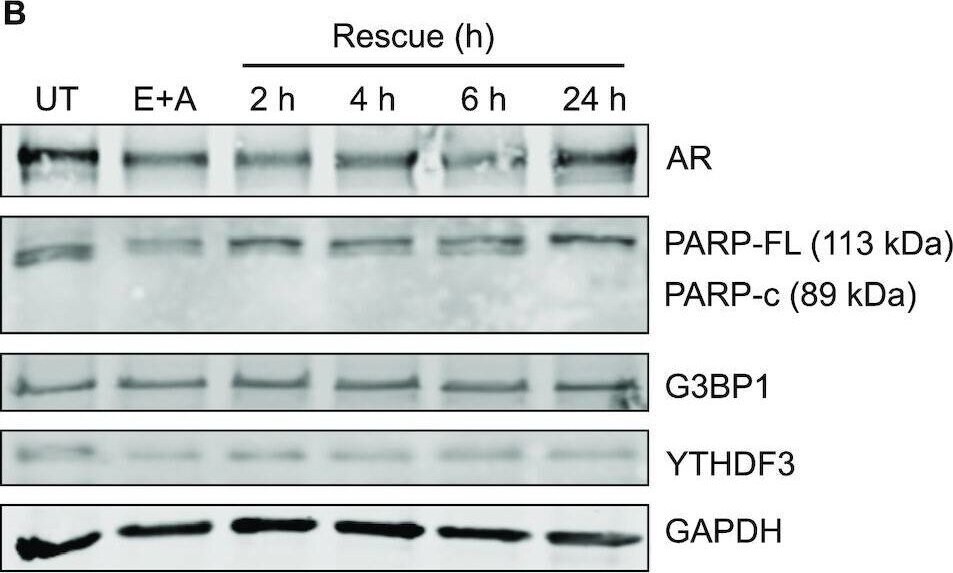
Western Blot: YTHDF3 Antibody - BSA Free [NBP2-94636] -
G3BP1 and YTHDF3 are cytoprotective proteins. (A) ARPI stress induced SG formation is reversible. LNCaP cells were unstressed, ARPI stressed or rescued from treatment. The cells were then stained with anti-G3BP1 and anti-YTHDF3 antibodies to reveal the SGs. Quantification of SGs is shown on the right-side panel. Note that ARPI stress- induced SG formation was reversed when treatment was withdrawn. (B) ARPI stress induced reduction in AR protein was restored to steady state level following stress removal. (C–F) KD of G3BP1 or YTHDF3 reduced cell survival in LNCaP cells. LNCaP cells transfected with siControl, siG3BP1 or siYTHDF3 were unstressed or treated with ARPI stress for 8, 24 and 48 h. The cell lysates were subjected to Western blotting for the indicated antibodies. Note that ARPI stress enhanced PARP cleavage in siG3BP1 (C) and siYTHDF3 (D) cells compared to control cells (8 h treatment). The above cells were subjected to IF using antibodies against activated BAX (2D2), an indicator of apoptosis (E). BAX positive cells are indicated by arrowheads. (F) Quantification of BAX activation. Note that acute ARPI stress strongly activated BAX in siG3BP1 and siYTHDF3 cells compared to control cells (8 h treatment). The results are an average of three independent experiments with ***P < 0.001. Scale 10 μm. Image collected and cropped by CiteAb from the following open publication (https://pubmed.ncbi.nlm.nih.gov/34939643), licensed under a CC-BY license. Not internally tested by Novus Biologicals.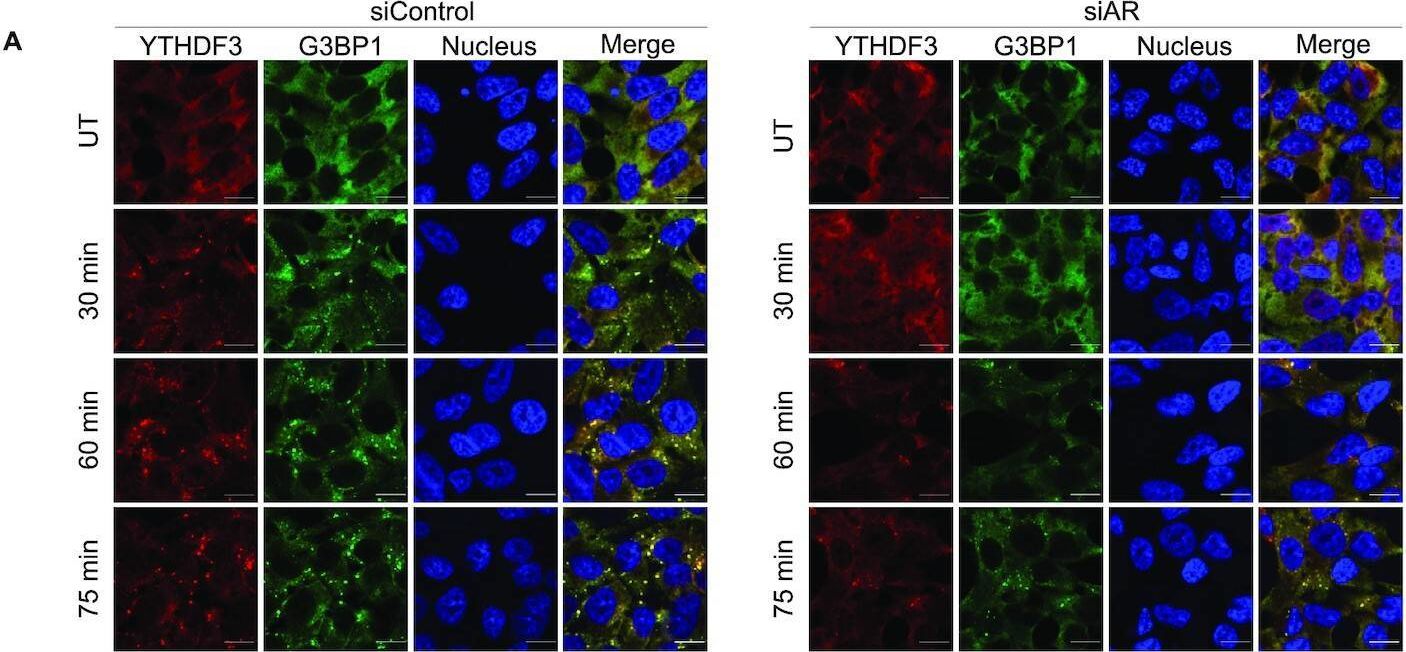
Immunocytochemistry/ Immunofluorescence: YTHDF3 Antibody - BSA Free [NBP2-94636] -
AR mRNA supports SG formation in response to ARPI stress treatment. (A) AR knockdown (KD) using siRNAs delayed the formation of SGs. LNCaP cells were transfected with siControl or siAR siRNAs, -/+ ARPI stress for different time points (30 min, 60 min and 75 min), and stained with anti-YTHDF3 and anti-G3BP1 antibodies to analyse SGs. Note that SG formation is significantly delayed at 30 and 60 min, while this effect is gradually lost at 75 min of treatment. (B) Quantification of SGs. (C) KD of AR did not affect the level of different SG proteins. (D) Treatment with AR degrader, ARD-61, did not affect the level of SGs in response to ARPI stress. (E) Quantification of SGs. ARD-61 treatment reduced the level of AR protein as revealed by Western blot (F) without affecting the level of AR mRNA as revealed by qRT-PCR (G). The results are an average of three independent experiments with **P < 0.01. n.s., non-significant. Scale 10 μm. Image collected and cropped by CiteAb from the following open publication (https://pubmed.ncbi.nlm.nih.gov/34939643), licensed under a CC-BY license. Not internally tested by Novus Biologicals.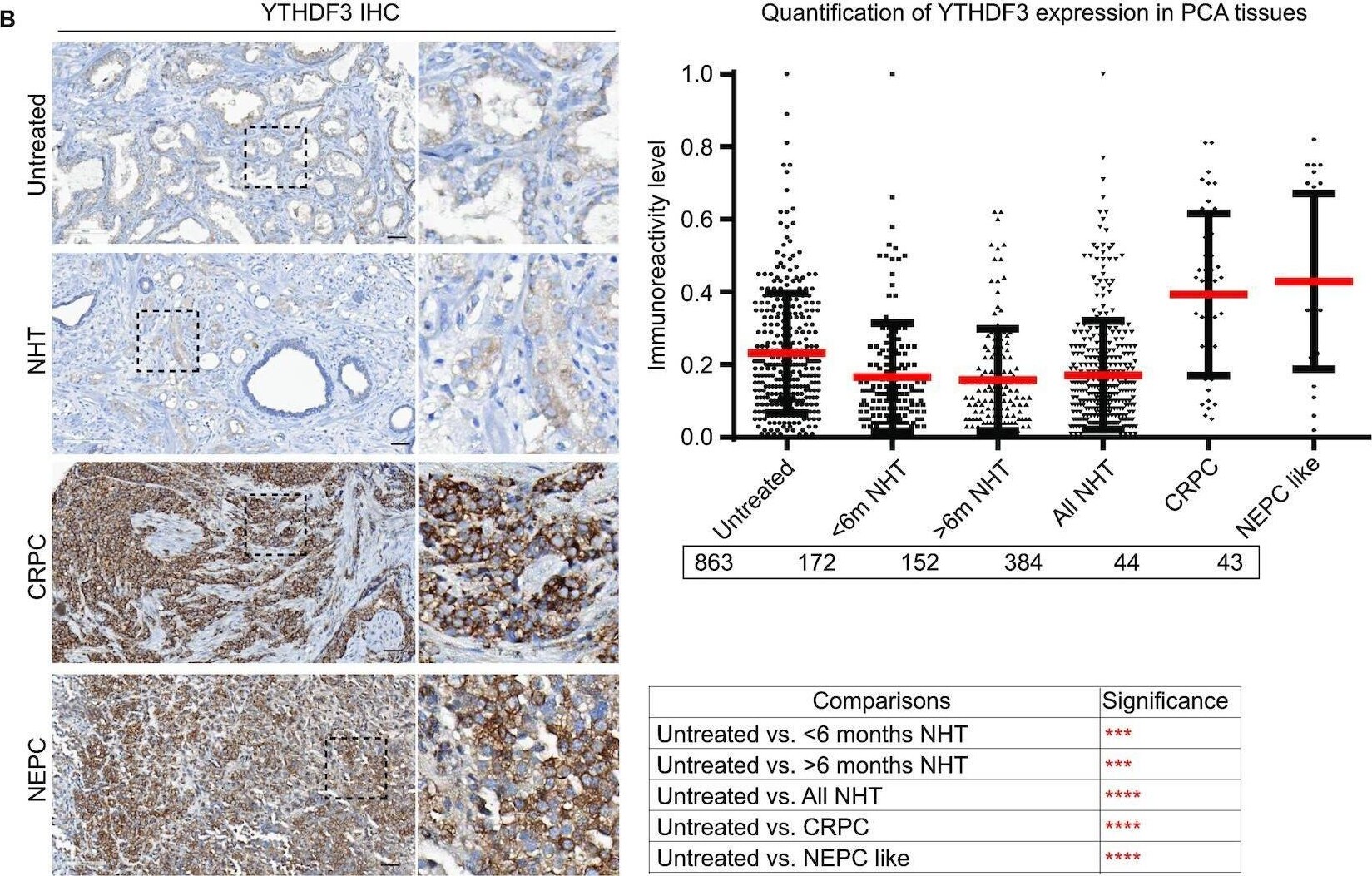
Immunohistochemistry: YTHDF3 Antibody - BSA Free [NBP2-94636] -
Immunohistochemistry (IHC) analysis of G3BP1 and YTHDF3 in PCA TMAs. PCA tissue microarrays (TMAs) were stained with anti-G3BP1 (A) and anti-YTHDF3 (B) antibodies. A part of the image is enlarged and shown. Quantification of staining is shown on the right-side panels. Statistics of quantification data is presented below respective graphs. Note that G3BP1 expression is increased in ARPI stressed, CRPC and NEPC tissues, while YTHDF3 expression is enhanced in CRPC and NEPC tissues. NHT: neoadjuvant hormonal therapy; CRPC: castration resistant PCA; NEPC: neuroendocrine PCA. Image collected and cropped by CiteAb from the following open publication (https://pubmed.ncbi.nlm.nih.gov/34939643), licensed under a CC-BY license. Not internally tested by Novus Biologicals.Applications for YTHDF3 Antibody - BSA Free
Immunocytochemistry/ Immunofluorescence
Immunohistochemistry
Immunoprecipitation
Western Blot
Formulation, Preparation, and Storage
Purification
Formulation
Format
Preservative
Concentration
Shipping
Stability & Storage
Background: YTHDF3
Alternate Names
Gene Symbol
Additional YTHDF3 Products
Product Documents for YTHDF3 Antibody - BSA Free
Certificate of Analysis
To download a Certificate of Analysis, please enter a lot or batch number in the search box below.
Product Specific Notices for YTHDF3 Antibody - BSA Free
This product is for research use only and is not approved for use in humans or in clinical diagnosis. Primary Antibodies are guaranteed for 1 year from date of receipt.
Citations for YTHDF3 Antibody - BSA Free
 Powered by Bioz
Customer Reviews for YTHDF3 Antibody - BSA Free
There are currently no reviews for this product. Be the first to review YTHDF3 Antibody - BSA Free and earn rewards!
Have you used YTHDF3 Antibody - BSA Free?
Submit a review and receive an Amazon gift card!
$25/€18/£15/$25CAN/¥2500 for a review with an image
$10/€7/£6/$10CAN/¥1110 for a review without an image
Submit a review
Protocols
Find general support by application which include: protocols, troubleshooting, illustrated assays, videos and webinars.
- Antigen Retrieval Protocol (PIER)
- Antigen Retrieval for Frozen Sections Protocol
- Appropriate Fixation of IHC/ICC Samples
- Cellular Response to Hypoxia Protocols
- Chromogenic IHC Staining of Formalin-Fixed Paraffin-Embedded (FFPE) Tissue Protocol
- Chromogenic Immunohistochemistry Staining of Frozen Tissue
- ClariTSA™ Fluorophore Kits
- Detection & Visualization of Antibody Binding
- Fluorescent IHC Staining of Frozen Tissue Protocol
- Graphic Protocol for Heat-induced Epitope Retrieval
- Graphic Protocol for the Preparation and Fluorescent IHC Staining of Frozen Tissue Sections
- Graphic Protocol for the Preparation and Fluorescent IHC Staining of Paraffin-embedded Tissue Sections
- Graphic Protocol for the Preparation of Gelatin-coated Slides for Histological Tissue Sections
- ICC Cell Smear Protocol for Suspension Cells
- ICC Immunocytochemistry Protocol Videos
- ICC for Adherent Cells
- IHC Sample Preparation (Frozen sections vs Paraffin)
- Immunocytochemistry (ICC) Protocol
- Immunocytochemistry Troubleshooting
- Immunofluorescence of Organoids Embedded in Cultrex Basement Membrane Extract
- Immunofluorescent IHC Staining of Formalin-Fixed Paraffin-Embedded (FFPE) Tissue Protocol
- Immunohistochemistry (IHC) and Immunocytochemistry (ICC) Protocols
- Immunohistochemistry Frozen Troubleshooting
- Immunohistochemistry Paraffin Troubleshooting
- Immunoprecipitation Protocol
- Preparing Samples for IHC/ICC Experiments
- Preventing Non-Specific Staining (Non-Specific Binding)
- Primary Antibody Selection & Optimization
- Protocol for Heat-Induced Epitope Retrieval (HIER)
- Protocol for Making a 4% Formaldehyde Solution in PBS
- Protocol for VisUCyte™ HRP Polymer Detection Reagent
- Protocol for the Fluorescent ICC Staining of Cell Smears - Graphic
- Protocol for the Fluorescent ICC Staining of Cultured Cells on Coverslips - Graphic
- Protocol for the Preparation & Fixation of Cells on Coverslips
- Protocol for the Preparation and Chromogenic IHC Staining of Frozen Tissue Sections
- Protocol for the Preparation and Chromogenic IHC Staining of Frozen Tissue Sections - Graphic
- Protocol for the Preparation and Chromogenic IHC Staining of Paraffin-embedded Tissue Sections
- Protocol for the Preparation and Chromogenic IHC Staining of Paraffin-embedded Tissue Sections - Graphic
- Protocol for the Preparation and Fluorescent ICC Staining of Cells on Coverslips
- Protocol for the Preparation and Fluorescent ICC Staining of Non-adherent Cells
- Protocol for the Preparation and Fluorescent ICC Staining of Stem Cells on Coverslips
- Protocol for the Preparation and Fluorescent IHC Staining of Frozen Tissue Sections
- Protocol for the Preparation and Fluorescent IHC Staining of Paraffin-embedded Tissue Sections
- Protocol for the Preparation of Gelatin-coated Slides for Histological Tissue Sections
- Protocol for the Preparation of a Cell Smear for Non-adherent Cell ICC - Graphic
- R&D Systems Quality Control Western Blot Protocol
- TUNEL and Active Caspase-3 Detection by IHC/ICC Protocol
- The Importance of IHC/ICC Controls
- Troubleshooting Guide: Immunohistochemistry
- Troubleshooting Guide: Western Blot Figures
- Western Blot Conditions
- Western Blot Protocol
- Western Blot Protocol for Cell Lysates
- Western Blot Troubleshooting
- Western Blot Troubleshooting Guide
- View all Protocols, Troubleshooting, Illustrated assays and Webinars