
Neuroscience Research with Simple Western
Simple Western technology is transforming the way neuroscientists analyze proteins, enabling precise and efficient results from small, limited sample sizes like brain regions, cerebrospinal fluid, or even single neurons. With its fully automated platform, Simple Western delivers highly sensitive protein quantitation, making it an invaluable tool for studying molecular changes in neuronal signaling, neurodegenerative diseases, and synaptic protein dynamics. Researchers can easily detect low-abundance proteins, post-translational modifications, and biomarkers linked to neurological conditions—all with exceptional reproducibility and minimal sample input.

The advantages of Simple Western Technology in neuroscience research
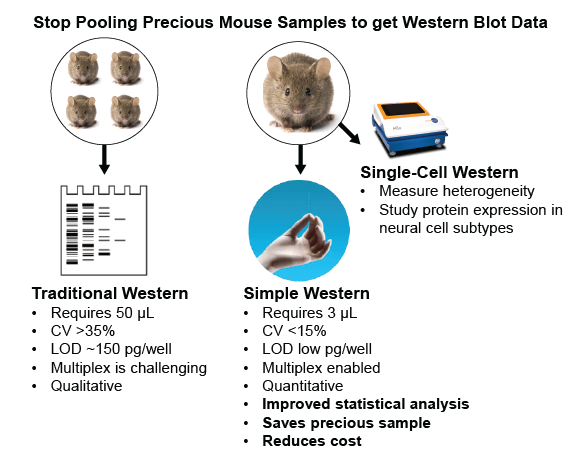
Getting the Most Data from Precious Samples
Some of the most prevalent and least understood diseases are those that affect the nervous system. Simple Western is winning the race to discovery in neuroscience research and development with high sensitivity multiplex protein assays at unprecedented speeds. Get the most data out of your precious sample. Simple Western Technology requires only 3 µL of sample while offering pg-level sensitivity, so there is no longer any need to pool samples like mouse tissue, achieving single-animal statistical data. Simple Western also ups the data point count on laser capture microdissection (LCM) samples.
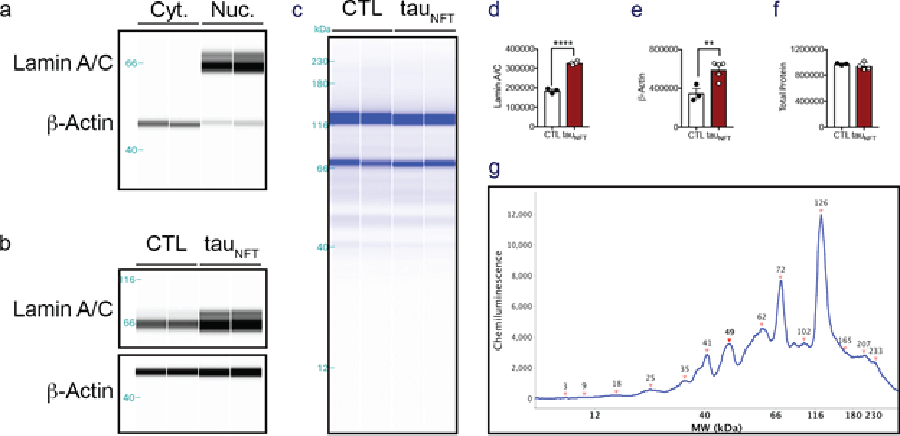
Normalizing data on small sample volumes
To get the most data out of precious samples like brain homogenate, Simple Western eliminates the arduous strip and re-probe procedure by offering RePlex™, which efficiently removes the antibodies from the first round of probing for a second round of probing with fresh antibodies. The second round may also be used for Total Protein Detection, so you can normalize your data with confidence.
Right Figure: Total protein concentration was used as the internal loading control for protein quantification in tau transgenic mice. (A-B) Simple Western analysis of brain homogenate from tau transgenic mice using antibodies against Lamin A/C and b-Actin. (C) Simple Western Total Protein assay detects total protein in each brain homogenate sample. (D) Quantification of Lamin A/C, (E) b-Actin and (F) total protein concentration. (G) Representative electropherogram generated from the Simple Western Total Protein assay. Figure adapted with permission from Musi et al. (2018) Aging Cell.
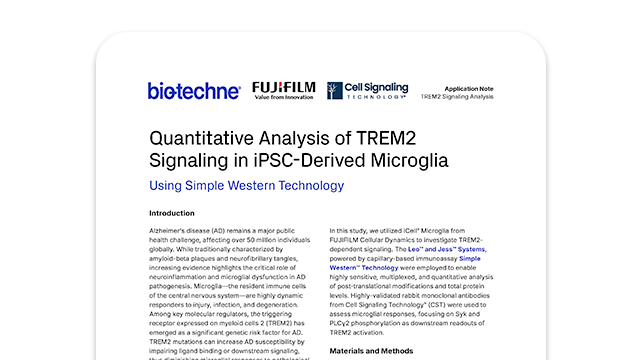
Quantitative Analysis of TREM2 Signaling in iPSC-Derived Microglia Using Simple Western Technology
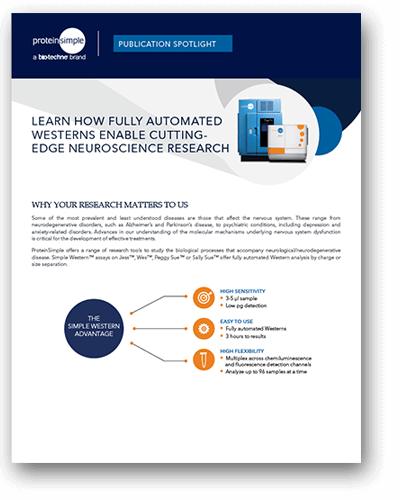
Simple Western has led to ground-breaking neuroscience research published in premier scientific journals.
Investigating IL-10 modulation of microglial cytokine secretion using Luminex Assays, Simple Plex and Simple Western technologies.

Analyzing laser capture microdissection (LCM) samples with Simple Western
Webinar
Simple Western Capillary Immunoassays- Elucidating intracellular signaling in Alzheimer's diesase
Webinar
Interrogating Cell Signaling Pathways in iPSC-Derived Microglia to Understand Alzheimer's Pathology

Nicolas G. Bazan, MD, PhD
Director, LSUHSC Neuroscience Center of Excellence
“It saves so much time! It takes away so much of the pipetting and manipulation error. You just load your samples and wait for results, and in the meantime, you can dedicate yourself to other activities.”

Muhumad Noor Alfarizal Kamarudin
Research Fellow, Brain Research Institute Monash Sunway
“Jess allows me to reduce the preparation time, save on reagents, samples, and antibodies, while allowing easier optimization of target proteins/antibodies. Jess’s ability to detect multiple proteins per sample further saves time compared to conventional Western blot.”

Miranda Orr, PhD
Postdoctoral Fellow, University of Texas HSC
"The rapid, reproducible results on small amounts of tissue/cell lysates have allowed me to generate a more thorough data set on additional proteins, samples, conditions and brain regions all in the same amount, or even less time, as traditional Western blot. This technology has made it possible for small research labs to compete with the pace that research is conducted in large labs or companies."

Victor Luna, PhD
Assistant Professor, Alzheimer’s Center at Temple University
"Simple Western has and will continue to enable us to find novel synaptic targets that could potentially mitigate anxiety-like symptoms related to late-life depression and Alzheimer’s disease."

Tatiana Rosado Rosenstock, PhD
Principal Scientist, Sygnature Discovery
"Jess is faster and more reliable in terms of quantification and allows us to use low sample volumes, for example, difficult-to-obtain samples such as iPSC-derived neurons."