
2A Peptide Antibody (3H4) [Allophycocyanin]
Novus Biologicals | Catalog # NBP2-59627APC
Recombinant Monoclonal Antibody

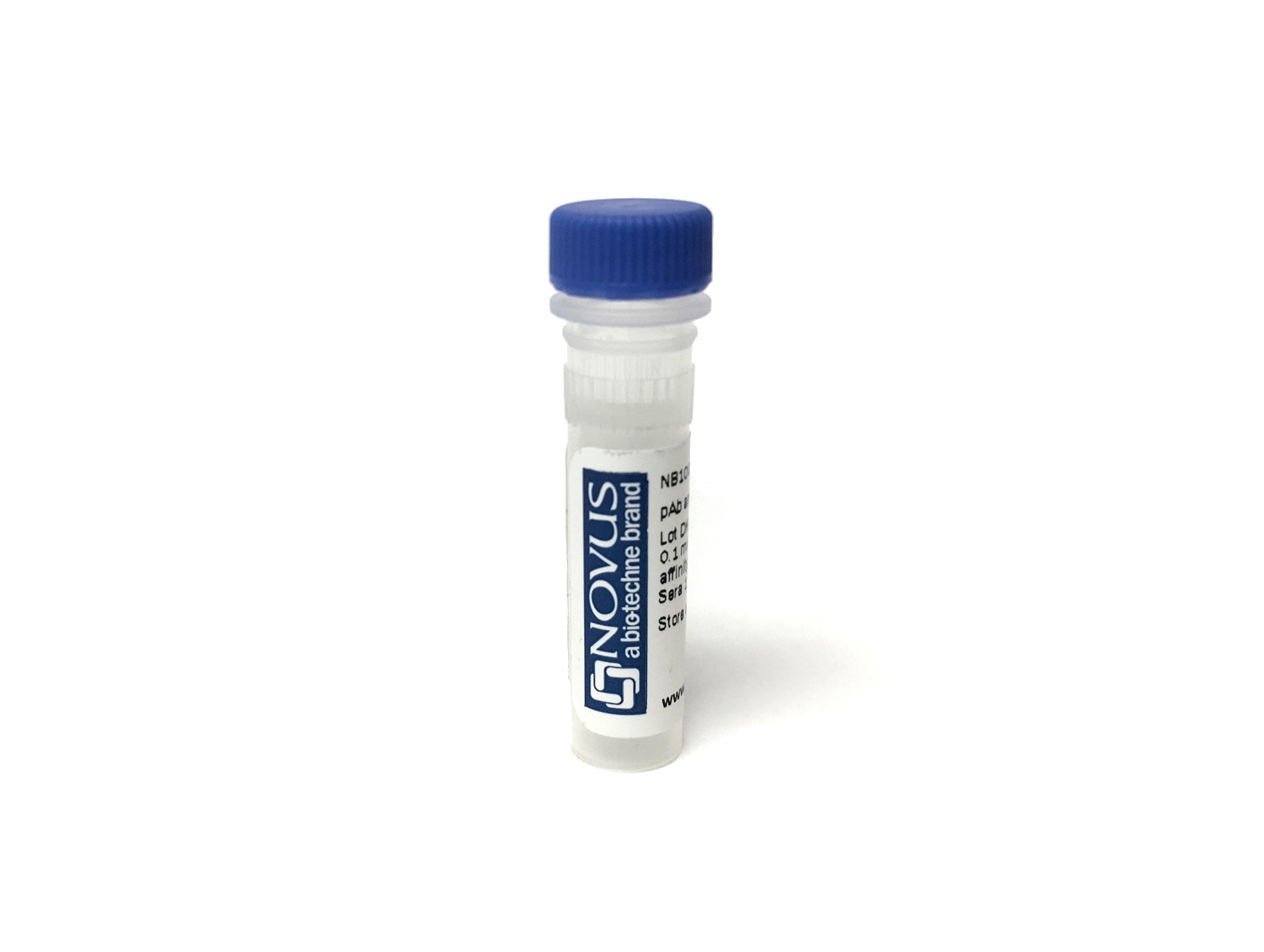
Key Product Details
Species Reactivity
Non-species specific
Applications
Western Blot, Immunocytochemistry/ Immunofluorescence, Immunoprecipitation
Label
Allophycocyanin (Excitation = 620-650 nm, Emission = 660-670 nm)
Antibody Source
Monoclonal Mouse IgG1 kappa Clone # 3H4
Loading...
Product Specifications
Immunogen
This 2A Peptide Antibody (3H4) was developed against KLH-coupled synthetic peptide corresponding to 2A peptide of Thosea asigna virus (CGDVEENPG)
Specificity
This 2A Peptide Antibody (3H4) peptide antibody is specific for T2A and P2A tagged proteins. Specificity to F2A and E2A proteins has not been tested.
Clonality
Monoclonal
Host
Mouse
Isotype
IgG1 kappa
Description
This conjugate is made on demand and is not held in inventory. Each order represents a unique lot. All conjugates are generated using validated conjugation protocols and meet strict degree of labeling (F/P) specifications; additional information is available upon request. The antibody concentration is provided on the individual product label.
For specialized conjugation needs, like large quantities, specific concentrations, and defined F/P ratios, bulk and custom antibody conjugation services are available.
For specialized conjugation needs, like large quantities, specific concentrations, and defined F/P ratios, bulk and custom antibody conjugation services are available.
Applications for 2A Peptide Antibody (3H4) [Allophycocyanin]
Application
Recommended Usage
Immunocytochemistry/ Immunofluorescence
Optimal dilutions of this antibody should be experimentally determined.
Immunoprecipitation
Optimal dilutions of this antibody should be experimentally determined.
Western Blot
Optimal dilutions of this antibody should be experimentally determined.
Application Notes
Optimal dilution of this antibody should be experimentally determined. Use in flow cytometry reported in PMID: 36356599 and customer review. Novus does not validate this product in flow cytometry and is unable to guarantee its performance. Recommended applications are based on validated applications from the unconjugated base product NBP2-59627. This conjugated antibody is not kept in inventory and is made to order using validated conjugation protocols.
Formulation, Preparation, and Storage
Purification
Protein G purified
Formulation
PBS
Preservative
0.05% Sodium Azide
Concentration
Please see the vial label for concentration. If unlisted please contact technical services.
Shipping
The product is shipped with polar packs. Upon receipt, store it immediately at the temperature recommended below.
Stability & Storage
Store at 4C in the dark.
Background: 2A Peptide
Developed for genetic engineering, 2A cleavage has been shown to function in a wide range of eukaryotic cells, and in vivo (3). The 2A peptide is inserted between the coding sequences of at least two genes, enabling the simultaneous expression of multiple proteins from a single plasmid construct. Four variants of 2A peptides have been used in gene expression systems including FMDV 2A (F2A), equine rhinitis A virus 2A (E2A), porcine teschovirus-1 2A (P2A) or Thoseaasigna virus 2A (T2A). Compared to other multi-gene co-expression systems such as IRES, 2A peptides results in stoichiometric expression of different proteins. However, cleaving efficiency and protein expression using the different 2A peptides varies, requiring optimization of polycistronic constructs for experiments.
References
1. Liu Z, Chen O, Wall J, Zheng M, Zhou Y, Wang L, Vaseghi H, Qian L, Liu J. (2017). Systematic comparison of 2A peptides for cloning multi-genes in a polycistronic vector. Scientific Reports. 7. 10.1038/s41598-017-02460-2.
2. Luke GA, Escuin H, Felipe PD, Ryan MD. (2009) 2A to the Fore - Research, Technology and Applications, Biotechnology and Genetic Engineering Reviews. 26(1): 223-260.
3. Markus BM, Bell GW, Lorenzi HA, Lourido S. (2019) Optimizing Systems for Cas9 Expression in Toxoplasma gondii. mSphere. 4(3): e00386-19.
Alternate Names
2A cleavage peptide, 2A peptide, 2A Peptide Antibody, 2A peptide tag, 2A sequence, 2A-like peptide, antibody for 2A-containing recombinant proteins, FMDV 2A-peptide, FMDV 2A-peptide antibody, MDV 2A-peptide, P2A peptide, P2A tagged proteins, peptide 2A sequences, self-cleaving 2A peptide, T2A peptide, T2A tagged proteins, Thosea asigna virus 2A, Thosea asigna virus 2A antibody
Additional 2A Peptide Products
Product Documents for 2A Peptide Antibody (3H4) [Allophycocyanin]
Certificate of Analysis
To download a Certificate of Analysis, please enter a lot or batch number in the search box below.
Product Specific Notices for 2A Peptide Antibody (3H4) [Allophycocyanin]
This product is for research use only and is not approved for use in humans or in clinical diagnosis. Primary Antibodies are guaranteed for 1 year from date of receipt.
Customer Reviews for 2A Peptide Antibody (3H4) [Allophycocyanin]
There are currently no reviews for this product. Be the first to review 2A Peptide Antibody (3H4) [Allophycocyanin] and earn rewards!
Have you used 2A Peptide Antibody (3H4) [Allophycocyanin]?
Submit a review and receive an Amazon gift card!
$25/€18/£15/$25CAN/¥2500 for a review with an image
$10/€7/£6/$10CAN/¥1110 for a review without an image
Submit a review
Protocols
Find general support by application which include: protocols, troubleshooting, illustrated assays, videos and webinars.
- Appropriate Fixation of IHC/ICC Samples
- Cellular Response to Hypoxia Protocols
- ClariTSA™ Fluorophore Kits
- Detection & Visualization of Antibody Binding
- ICC Cell Smear Protocol for Suspension Cells
- ICC Immunocytochemistry Protocol Videos
- ICC for Adherent Cells
- Immunocytochemistry (ICC) Protocol
- Immunocytochemistry Troubleshooting
- Immunofluorescence of Organoids Embedded in Cultrex Basement Membrane Extract
- Immunohistochemistry (IHC) and Immunocytochemistry (ICC) Protocols
- Immunoprecipitation Protocol
- Preparing Samples for IHC/ICC Experiments
- Preventing Non-Specific Staining (Non-Specific Binding)
- Primary Antibody Selection & Optimization
- Protocol for VisUCyte™ HRP Polymer Detection Reagent
- Protocol for the Fluorescent ICC Staining of Cell Smears - Graphic
- Protocol for the Fluorescent ICC Staining of Cultured Cells on Coverslips - Graphic
- Protocol for the Preparation and Fluorescent ICC Staining of Cells on Coverslips
- Protocol for the Preparation and Fluorescent ICC Staining of Non-adherent Cells
- Protocol for the Preparation and Fluorescent ICC Staining of Stem Cells on Coverslips
- Protocol for the Preparation of a Cell Smear for Non-adherent Cell ICC - Graphic
- R&D Systems Quality Control Western Blot Protocol
- TUNEL and Active Caspase-3 Detection by IHC/ICC Protocol
- The Importance of IHC/ICC Controls
- Troubleshooting Guide: Western Blot Figures
- Western Blot Conditions
- Western Blot Protocol
- Western Blot Protocol for Cell Lysates
- Western Blot Troubleshooting
- Western Blot Troubleshooting Guide
- View all Protocols, Troubleshooting, Illustrated assays and Webinars
Loading...