
Annexin V Antibody (03) - Azide and BSA Free
Novus Biologicals | Catalog # NBP3-30742

Key Product Details
Species Reactivity
Applications
Label
Antibody Source
Format
Product Specifications
Immunogen
Clonality
Host
Isotype
Scientific Data Images for Annexin V Antibody (03) - Azide and BSA Free
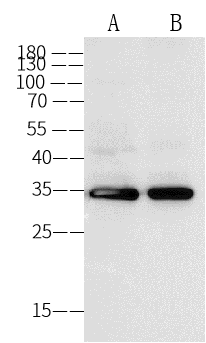
Western Blot: Annexin V Antibody (03) [NBP3-30742] -
Western Blot: Annexin V Antibody (03) [NBP3-30742] - NBP3-30742 at 1:500 dilution Lane A: HepG2 Whole Cell Lysate Lane A: Hela Whole Cell Lysate Lysates/proteins at 30 ug per lane. Secondary Goat Anti-Mouse IgG (H+L)/HRP at 1/10000 dilution Developed using the ECL technique. Performed under reducing conditions. Predicted band size:35 kDa Observed band size:35 kDaApplications for Annexin V Antibody (03) - Azide and BSA Free
ELISA
Western Blot
Formulation, Preparation, and Storage
Purification
Formulation
Format
Preservative
Concentration
Shipping
Stability & Storage
Background: Annexin V
Additional Annexin V Products
Product Documents for Annexin V Antibody (03) - Azide and BSA Free
Certificate of Analysis
To download a Certificate of Analysis, please enter a lot or batch number in the search box below.
Product Specific Notices for Annexin V Antibody (03) - Azide and BSA Free
This product is for research use only and is not approved for use in humans or in clinical diagnosis. Primary Antibodies are guaranteed for 1 year from date of receipt.
Related Research Areas
Customer Reviews for Annexin V Antibody (03) - Azide and BSA Free
There are currently no reviews for this product. Be the first to review Annexin V Antibody (03) - Azide and BSA Free and earn rewards!
Have you used Annexin V Antibody (03) - Azide and BSA Free?
Submit a review and receive an Amazon gift card!
$25/€18/£15/$25CAN/¥2500 Yen for a review with an image
$10/€7/£6/$10CAN/¥1110 Yen for a review without an image
Submit a review
Protocols
Find general support by application which include: protocols, troubleshooting, illustrated assays, videos and webinars.
- Cellular Response to Hypoxia Protocols
- ELISA Sample Preparation & Collection Guide
- ELISA Troubleshooting Guide
- How to Run an R&D Systems DuoSet ELISA
- How to Run an R&D Systems Quantikine ELISA
- How to Run an R&D Systems Quantikine™ QuicKit™ ELISA
- Quantikine HS ELISA Kit Assay Principle, Alkaline Phosphatase
- Quantikine HS ELISA Kit Principle, Streptavidin-HRP Polymer
- R&D Systems Quality Control Western Blot Protocol
- Sandwich ELISA (Colorimetric) – Biotin/Streptavidin Detection Protocol
- Sandwich ELISA (Colorimetric) – Direct Detection Protocol
- Troubleshooting Guide: ELISA
- Troubleshooting Guide: Western Blot Figures
- Western Blot Conditions
- Western Blot Protocol
- Western Blot Protocol for Cell Lysates
- Western Blot Troubleshooting
- Western Blot Troubleshooting Guide
- View all Protocols, Troubleshooting, Illustrated assays and Webinars
FAQs for Annexin V Antibody (03) - Azide and BSA Free
-
Q: I am studying apoptosis in adherent cells. Can I trypsinize the cells when using Annexin V-FITC to stain the cells?
A: Adherent cells undergoing apoptosis automatically detach from the plate and may not require trypsinization. If there are attached cells, they may be trypsinized without affecting phosphatidylserine (PS).
-
Q: I do not have access to flow cytometer in my building. Can I stain for Annexin V and propidium iodide (PI), fix the cells, then analyze them in a different facility?
A: Fixing the cells can affect cell permeability, enhancing the uptake of Annexin V and PI intracellularly. As a result, the profile of fixed cells may be different from unfixed cells, and the use of appropriate controls is recommended.
-
Q: I am studying apoptosis in adherent cells. Can I trypsinize the cells when using Annexin V-FITC to stain the cells?
A: Adherent cells undergoing apoptosis automatically detach from the plate and may not require trypsinization. If there are attached cells, they may be trypsinized without affecting phosphatidylserine (PS).
-
Q: I do not have access to flow cytometer in my building. Can I stain for Annexin V and propidium iodide (PI), fix the cells, then analyze them in a different facility?
A: Fixing the cells can affect cell permeability, enhancing the uptake of Annexin V and PI intracellularly. As a result, the profile of fixed cells may be different from unfixed cells, and the use of appropriate controls is recommended.