CD28 Antibody (2946A) [DyLight 405]
Novus Biologicals | Catalog # FAB3422E
Recombinant Monoclonal Antibody

Key Product Details
Species Reactivity
Human
Applications
Flow Cytometry
Label
DyLight 405 (Excitation = 400 nm, Emission = 420 nm)
Antibody Source
Recombinant Monoclonal Rabbit IgG Clone # 2946A
Loading...
Product Specifications
Immunogen
S. frugiperda insect ovarian cell line Sf21-derived recombinant human CD28
Asn19-Pro152
Accession # P10747
Asn19-Pro152
Accession # P10747
Specificity
Detects human CD28 in direct ELISA.
Clonality
Monoclonal
Host
Rabbit
Isotype
IgG
Description
This conjugate is made on demand and is not held in inventory. Each order represents a unique lot. All conjugates are generated using validated conjugation protocols and meet strict degree of labeling (F/P) specifications; additional information is available upon request. The antibody concentration is provided on the individual product label.
For specialized conjugation needs, like large quantities, specific concentrations, and defined F/P ratios, bulk and custom antibody conjugation services are available.
For specialized conjugation needs, like large quantities, specific concentrations, and defined F/P ratios, bulk and custom antibody conjugation services are available.
Applications for CD28 Antibody (2946A) [DyLight 405]
Application
Recommended Usage
Flow Cytometry
Optimal dilutions of this antibody should be experimentally determined.
Application Notes
Recommended applications are based on validated applications from the unconjugated base product MAB3422. This conjugated antibody is not kept in inventory and is made to order using validated conjugation protocols.
Spectra Viewer
Plan Your Experiments
Use our spectra viewer to interactively plan your experiments, assessing multiplexing options. View the excitation and emission spectra for our fluorescent dye range and other commonly used dyes.
Spectra Viewer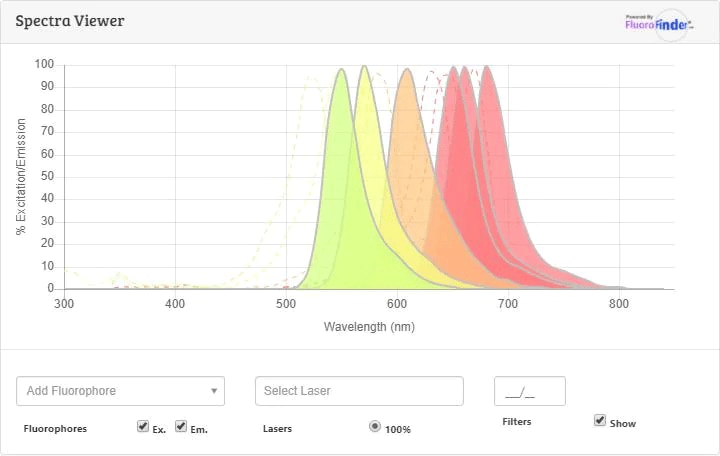
Flow Cytometry Panel Builder
Bio-Techne Knows Flow Cytometry
Save time and reduce costly mistakes by quickly finding compatible reagents using the Panel Builder Tool.
Advanced Features
- Spectra Viewer - Custom analysis of spectra from multiple fluorochromes
- Spillover Popups - Visualize the spectra of individual fluorochromes
- Antigen Density Selector - Match fluorochrome brightness with antigen density

Formulation, Preparation, and Storage
Purification
Protein A or G purified from cell culture supernatant
Formulation
50mM Sodium Borate
Preservative
0.05% Sodium Azide
Concentration
Please see the vial label for concentration. If unlisted please contact technical services.
Shipping
The product is shipped with polar packs. Upon receipt, store it immediately at the temperature recommended below.
Stability & Storage
Store at 4C in the dark.
Background: CD28
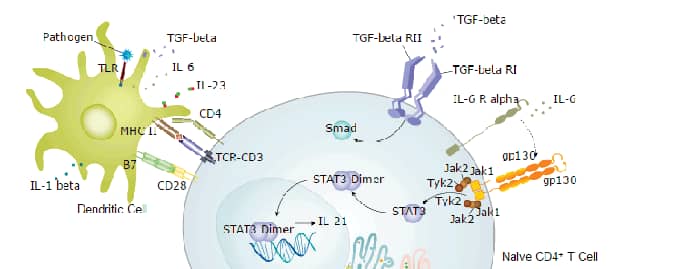
CD28 is the prototypical and best-characterized costimulatory molecule on T cells (4). Its signals are critical for optimal naive T cell activation, cytokine production, proliferation, and survival (4). In order to sustain T cell activation, CD28 will consolidate immunological synapse formation, increase cell cycle progression through upregulated D-cyclin expression, and aid in T cell survival by in inducing the expression of the anti-apoptotic protein Bcl-XL (5). CD28 is constitutively expressed on naive and central memory CD4+ and CD8+ cells (5). CD28 deficiency has a large impact on T cell responses including activation, proliferation, immunoglobulin (Ig) class-switching, and germinal center (GC) formation (6). CD28 is a critical regulator of autoimmune diseases and tolerance to solid organ transplants in human patients (6). The CD28 pathway plays a central role in immune responses against pathogens, autoimmune diseases, and graft rejection (7). CD28 engagement via antibodies augments the proliferation of T cells in response to immobilized anti-CD3 antibodies (8). Additionally, antibody engagement of CD28 can supply costimulation to T cells encountering APCs deficient in costimulatory ligands, such as CD80 and CD86, and prevents the resultant anergic state that otherwise occurs in the absence of costimulatory signaling (8).
References
1. Esensten, J. H., Helou, Y. A., Chopra, G., Weiss, A., & Bluestone, J. A. (2016). CD28 Costimulation: From Mechanism to Therapy. Immunity, 44(5), 973-988. https://doi.org/10.1016/j.immuni.2016.04.020
2. Carreno, B. M., & Collins, M. (2002). The B7 family of ligands and its receptors: new pathways for costimulation and inhibition of immune responses. Annual review of immunology, 20, 29-53. https://doi.org/10.1146/annurev.immunol.20.091101.091806
3. Ward S. G. (1996). CD28: a signaling perspective. The Biochemical journal, 318 (Pt 2), 361-377. https://doi.org/10.1042/bj3180361
4. Zhang, R., Huynh, A., Whitcher, G., Chang, J., Maltzman, J. S., & Turka, L. A. (2013). An obligate cell-intrinsic function for CD28 in Tregs. The Journal of clinical investigation, 123(2), 580-593. https://doi.org/10.1172/JCI65013
5. Evans, E. J., Esnouf, R. M., Manso-Sancho, R., Gilbert, R. J., James, J. R., Yu, C., Fennelly, J. A., Vowles, C., Hanke, T., Walse, B., Hunig, T., Sorensen, P., Stuart, D. I., & Davis, S. J. (2005). Crystal structure of a soluble CD28-Fab complex. Nature immunology, 6(3), 271-279. https://doi.org/10.1038/ni1170
6. Bour-Jordan, H., & Blueston, J. A. (2002). CD28 function: a balance of costimulatory and regulatory signals. Journal of clinical immunology, 22(1), 1-7. https://doi.org/10.1023/a:1014256417651
7. Krummel, M. F., & Allison, J. P. (1995). CD28 and CTLA-4 have opposing effects on the response of T cells to stimulation. The Journal of experimental medicine, 182(2), 459-465. https://doi.org/10.1084/jem.182.2.459
8. Luhder, F., Huang, Y., Dennehy, K. M., Guntermann, C., Muller, I., Winkler, E., Kerkau, T., Ikemizu, S., Davis, S. J., Hanke, T., & Hunig, T. (2003). Topological requirements and signaling properties of T cell-activating, anti-CD28 antibody superagonists. The Journal of experimental medicine, 197(8), 955-966. https://doi.org/10.1084/jem.20021024
Alternate Names
CD28
Additional CD28 Products
Product Documents for CD28 Antibody (2946A) [DyLight 405]
Certificate of Analysis
To download a Certificate of Analysis, please enter a lot or batch number in the search box below.
Product Specific Notices for CD28 Antibody (2946A) [DyLight 405]
DyLight (R) is a trademark of Thermo Fisher Scientific Inc. and its subsidiaries.
This product is for research use only and is not approved for use in humans or in clinical diagnosis. Primary Antibodies are guaranteed for 1 year from date of receipt.
Customer Reviews for CD28 Antibody (2946A) [DyLight 405]
There are currently no reviews for this product. Be the first to review CD28 Antibody (2946A) [DyLight 405] and earn rewards!
Have you used CD28 Antibody (2946A) [DyLight 405]?
Submit a review and receive an Amazon gift card!
$25/€18/£15/$25CAN/¥2500 for a review with an image
$10/€7/£6/$10CAN/¥1110 for a review without an image
Submit a review
Protocols
Find general support by application which include: protocols, troubleshooting, illustrated assays, videos and webinars.
- 7-Amino Actinomycin D (7-AAD) Cell Viability Flow Cytometry Protocol
- Extracellular Membrane Flow Cytometry Protocol
- Flow Cytometry Protocol for Cell Surface Markers
- Flow Cytometry Protocol for Staining Membrane Associated Proteins
- Flow Cytometry Staining Protocols
- Flow Cytometry Troubleshooting Guide
- Intracellular Flow Cytometry Protocol Using Alcohol (Methanol)
- Intracellular Flow Cytometry Protocol Using Detergents
- Intracellular Nuclear Staining Flow Cytometry Protocol Using Detergents
- Intracellular Staining Flow Cytometry Protocol Using Alcohol Permeabilization
- Intracellular Staining Flow Cytometry Protocol Using Detergents to Permeabilize Cells
- Propidium Iodide Cell Viability Flow Cytometry Protocol
- Protocol for Liperfluo
- Protocol for the Characterization of Human Th22 Cells
- Protocol for the Characterization of Human Th9 Cells
- Protocol: Annexin V and PI Staining by Flow Cytometry
- Protocol: Annexin V and PI Staining for Apoptosis by Flow Cytometry
- Troubleshooting Guide: Fluorokine Flow Cytometry Kits
- View all Protocols, Troubleshooting, Illustrated assays and Webinars