
CGRP1 Antibody (4901) - Azide Free
Novus Biologicals | Catalog # NBP2-88945

Scientific images may be resized, cropped, or adjusted for brightness or contrast for presentation purposes. These updates are limited to presentation and do not affect the underlying scientific interpretation of the data. Where available, additional source data may be provided upon request.
Loading...
Key Product Details
Species Reactivity
Human, Rat
Applications
Immunocytochemistry/ Immunofluorescence, Western Blot (Negative)
Label
Unconjugated
Antibody Source
Monoclonal Mouse IgG2A Clone # 4901
Format
Azide Free
Loading...
Product Specifications
Immunogen
Purified rat alpha-CGRP. Accession # P01256
Reactivity Notes
Tested in Human and Rat. Expected reactivity to most mammals.
Specificity
Specific for Calcitonin Gene Related Peptide. Also recognizes rat beta-CGRP and human alpha-CGRP (10-fold less sensitivity compared to rat alpha-CGRP). Suggested positive controls are dorsal root ganglia, pancreas and gut.
Clonality
Monoclonal
Host
Mouse
Isotype
IgG2A
Theoretical MW
0 kDa.
Disclaimer note: The observed molecular weight of the protein may vary from the listed predicted molecular weight due to post translational modifications, post translation cleavages, relative charges, and other experimental factors.
Disclaimer note: The observed molecular weight of the protein may vary from the listed predicted molecular weight due to post translational modifications, post translation cleavages, relative charges, and other experimental factors.
Scientific Data Images for CGRP1 Antibody (4901) - Azide Free
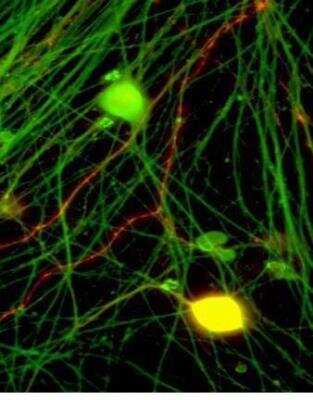
Immunocytochemistry/ Immunofluorescence: CGRP1 Antibody (4901) [NBP2-88945]
Immunocytochemistry/Immunofluorescence: CGRP Antibody (4901) [NBP2-88945] - Immunostaining of CGRP (red) in cryopreserved DRG neurons grown on coverslips. 40xmag. Green staining is PGP9.5. Yellow staining is the colocalization of CGRP and PGP9.5. Cells were obtained photo was provided courtesy of QBMCellScience.Applications for CGRP1 Antibody (4901) - Azide Free
Application
Recommended Usage
Immunocytochemistry/ Immunofluorescence
1:50-1:100
Application Notes
This antibody is an excellent tool for immunohistochemistry and for multiple labeling immunofluorescence of peripheral tissue like stomach, intestine, pancreas, sensory ganglia, and all the regions of the body that are innervated by primary afferent neurons as well as central nervous tissue.
Formulation, Preparation, and Storage
Purification
Protein G purified
Formulation
10 mM HEPES (pH 7.5), 0.15 M NaCl, 0.1 mg/mL BSA, 50% Glycerol
Format
Azide Free
Preservative
No Preservative
Concentration
Please see the vial label for concentration. If unlisted please contact technical services.
Shipping
The product is shipped with polar packs. Upon receipt, store it immediately at the temperature recommended below.
Stability & Storage
Store at -20C. Avoid freeze-thaw cycles.
Background: CGRP1
Signaling of CGRP and its receptor are involved in vasodilation, neurogenic inflammation, and peripheral sensitization of nociceptors, all of which relate to migraine pathophysiology (2-3). Studies have found that CGRP is both released during migraines and can also induce migraines (3-5). Under normal conditions CGRP levels are typical and neurotransmission is relative; however, migraine triggers including light and sound can increase CGRP levels, enhance neurotransmission, and alter the pain and sensory aversions associated with migraines (2). Given its role, CGRP and its receptor have been the target of many migraine therapeutics including small molecule agonists called gepants and monoclonal antibodies (3-5). Ubrogepant and Rimegepant, two small molecule CGRP receptor agonists, have been FDA approved while another agonist, Atogepant, is ongoing in clinical trials (3,5). Additionally, four monoclonal antibodies against either CGRP or its receptor that are used to block signaling have been FDA approved: Eptinezumab, Fremanezumab, Galcanezumab, and Erenumab (3-5).
References
1. Russell, F. A., King, R., Smillie, S. J., Kodji, X., & Brain, S. D. (2014). Calcitonin gene-related peptide: physiology and pathophysiology. Physiological reviews, 94(4), 1099-1142. https://doi.org/10.1152/physrev.00034.2013
2. Russo A. F. (2015). Calcitonin gene-related peptide (CGRP): a new target for migraine. Annual review of pharmacology and toxicology, 55, 533-552. https://doi.org/10.1146/annurev-pharmtox-010814-124701
3. Wattiez, A. S., Sowers, L. P., & Russo, A. F. (2020). Calcitonin gene-related peptide (CGRP): role in migraine pathophysiology and therapeutic targeting. Expert opinion on therapeutic targets, 24(2), 91-100. https://doi.org/10.1080/14728222.2020.1724285
4. Deen, M., Correnti, E., Kamm, K., Kelderman, T., Papetti, L., Rubio-Beltran, E., Vigneri, S., Edvinsson, L., Maassen Van Den Brink, A., & European Headache Federation School of Advanced Studies (EHF-SAS) (2017). Blocking CGRP in migraine patients - a review of pros and cons. The journal of headache and pain, 18(1), 96. https://doi.org/10.1186/s10194-017-0807-1
5. de Vries, T., Villal0n, C. M., & MaassenVanDenBrink, A. (2020). Pharmacological treatment of migraine: CGRP and 5-HT beyond the triptans. Pharmacology & therapeutics, 211, 107528. https://doi.org/10.1016/j.pharmthera.2020.107528
Long Name
Calcitonin Gene Related Peptide I
Alternate Names
a-CGRP, alpha-CGRP, CGRP 1, CGRP alpha, CGRP I
Gene Symbol
CALCA
Additional CGRP1 Products
Product Documents for CGRP1 Antibody (4901) - Azide Free
Certificate of Analysis
To download a Certificate of Analysis, please enter a lot or batch number in the search box below.
Product Specific Notices for CGRP1 Antibody (4901) - Azide Free
This product is for research use only and is not approved for use in humans or in clinical diagnosis. Primary Antibodies are guaranteed for 1 year from date of receipt.
Citations for CGRP1 Antibody (4901) - Azide Free
 Powered by Bioz
Customer Reviews for CGRP1 Antibody (4901) - Azide Free
There are currently no reviews for this product. Be the first to review CGRP1 Antibody (4901) - Azide Free and earn rewards!
Have you used CGRP1 Antibody (4901) - Azide Free?
Submit a review and receive an Amazon gift card!
$25/€18/£15/$25CAN/¥2500 for a review with an image
$10/€7/£6/$10CAN/¥1110 for a review without an image
Submit a review
Protocols
Find general support by application which include: protocols, troubleshooting, illustrated assays, videos and webinars.
- Appropriate Fixation of IHC/ICC Samples
- Cellular Response to Hypoxia Protocols
- ClariTSA™ Fluorophore Kits
- Detection & Visualization of Antibody Binding
- ICC Cell Smear Protocol for Suspension Cells
- ICC Immunocytochemistry Protocol Videos
- ICC for Adherent Cells
- Immunocytochemistry (ICC) Protocol
- Immunocytochemistry Troubleshooting
- Immunofluorescence of Organoids Embedded in Cultrex Basement Membrane Extract
- Immunohistochemistry (IHC) and Immunocytochemistry (ICC) Protocols
- Preparing Samples for IHC/ICC Experiments
- Preventing Non-Specific Staining (Non-Specific Binding)
- Primary Antibody Selection & Optimization
- Protocol for VisUCyte™ HRP Polymer Detection Reagent
- Protocol for the Fluorescent ICC Staining of Cell Smears - Graphic
- Protocol for the Fluorescent ICC Staining of Cultured Cells on Coverslips - Graphic
- Protocol for the Preparation and Fluorescent ICC Staining of Cells on Coverslips
- Protocol for the Preparation and Fluorescent ICC Staining of Non-adherent Cells
- Protocol for the Preparation and Fluorescent ICC Staining of Stem Cells on Coverslips
- Protocol for the Preparation of a Cell Smear for Non-adherent Cell ICC - Graphic
- TUNEL and Active Caspase-3 Detection by IHC/ICC Protocol
- The Importance of IHC/ICC Controls
- View all Protocols, Troubleshooting, Illustrated assays and Webinars
Loading...