
Chikungunya Virus E3 Antibody (HL2476) - Azide and BSA Free
Novus Biologicals | Catalog # NBP3-25407
Recombinant Monoclonal Antibody

Loading...
Key Product Details
Species Reactivity
Virus
Applications
Western Blot, Immunocytochemistry/ Immunofluorescence
Label
Unconjugated
Antibody Source
Recombinant Monoclonal Rabbit IgG Clone # HL2476 expressed in HEK293
Format
Azide and BSA Free
Loading...
Product Specifications
Immunogen
Full length Chikungunya Virus E3 recombinant protein
Reactivity Notes
Chikungunya Virus
Clonality
Monoclonal
Host
Rabbit
Isotype
IgG
Scientific Data Images for Chikungunya Virus E3 Antibody (HL2476) - Azide and BSA Free
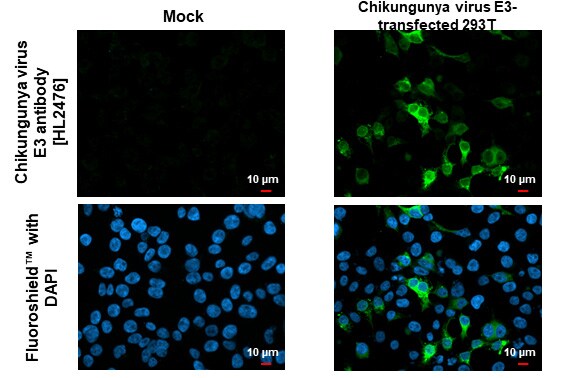
Immunocytochemistry/Immunofluorescence: Chikungunya Virus E3 Antibody (HL2476) - Azide and BSA Free [NBP3-25407] -
Immunocytochemistry/Immunofluorescence: Chikungunya Virus E3 Antibody (HL2476) - Azide and BSA Free [NBP3-25407] - Chikungunya virus E3 antibody [HL2476] detects Chikungunya virus E3 protein by immunofluorescent analysis. Sample: Mock and transfected 293T cells were fixed in 4% paraformaldehyde at RT for 15 min. Green: Chikungunya virus E3 stained by Chikungunya virus E3 antibody [HL2476] (NBP3-25407) diluted at 1:500. Blue: Fluoroshield with DAPI.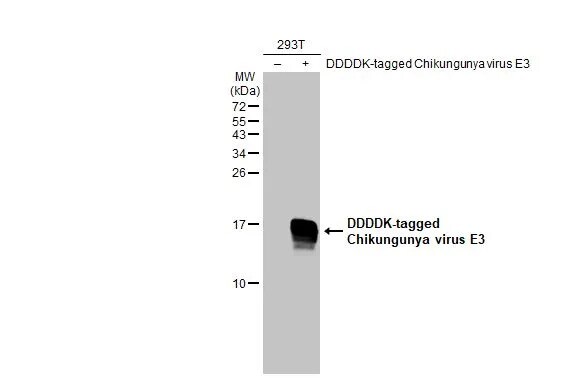
Western Blot: Chikungunya Virus E3 Antibody (HL2476) - Azide and BSA Free [NBP3-25407] -
Western Blot: Chikungunya Virus E3 Antibody (HL2476) - Azide and BSA Free [NBP3-25407] - Non-transfected (-) and transfected (+) 293T whole cell extracts (30 ug) were separated by 15% SDS-PAGE, and the membrane was blotted with Chikungunya virus E3 antibody [HL2476] (NBP3-25407) diluted at 1:1000. The HRP-conjugated anti-rabbit IgG antibody was used to detect the primary antibody.Applications for Chikungunya Virus E3 Antibody (HL2476) - Azide and BSA Free
Application
Recommended Usage
Immunocytochemistry/ Immunofluorescence
-Assay dependent
Western Blot
1:500-1:3000
Formulation, Preparation, and Storage
Purification
Protein A purified
Formulation
PBS
Format
Azide and BSA Free
Preservative
No Preservative
Concentration
Concentrations vary lot to lot. See vial label for concentration. If unlisted please contact technical services.
Shipping
The product is shipped with polar packs. Upon receipt, store it immediately at the temperature recommended below.
Stability & Storage
Store at 4C short term. Aliquot and store at -20C long term. Avoid freeze-thaw cycles.
Background: Chikungunya Virus E3
Although analysis suggests CHIKV originated in Africa over 500 years ago, first infections weren't reported until the 1950s (1-3). CHIKV has evolved three distinct genotypes, or strains, based on location, termed West African (WA), East/Central/Southern African (ECSA), and Asian (2-3). The WA strain has been most closely associated with enzootic transmission whereas the ECSA strain contributes more to urban epidemics (2). Nonhuman primates are the primary reservoir for the viral host with transmission occurring via mosquitos biting and infecting humans (1-3). Upon acute infection, the virus replicates in cells including fibroblasts and macrophages resulting in innate immune response in infected tissues characterized by infiltrating cells like macrophages, monocytes, natural killer (NK) cells, and lymphocytes (2,3). Infection results in increased production of proinflammatory cytokines such as interferon alpha (IFN-alpha) and interleukin 6 (IL-6), chemokines, and growth factors (2,3). Physical manifestations of infection are high fever, polyarthralgia, headache, arthritis, and rash (1-3). CHIKV symptoms can be confused with other infections like those from dengue fever and Zika virus (1-3). There are no specific antivirals or vaccines for CHIKV, but rather symptoms are treated with antipyretics and non-steroidal anti-inflammatory drugs (NSAIDs) (2,3). While in vitro culture models and in vivo rodent and non-human primate models have been used to study CHIKV pathogenesis and advance our knowledge of the disease, the specific cellular mechanisms are not fully understood (3).
References
1. Vu DM, Jungkind D, Angelle Desiree LaBeaud. Chikungunya Virus. Clin Lab Med. 2017;37(2):371-382. https://doi.org/10.1016/j.cll.2017.01.008
2. Silva LA, Dermody TS. Chikungunya virus: epidemiology, replication, disease mechanisms, and prospective intervention strategies. J Clin Invest. 2017;127(3):737-749. https://doi.org/10.1172/JCI84417
3. Ganesan VK, Duan B, Reid SP. Chikungunya Virus: Pathophysiology, Mechanism, and Modeling. Viruses. 2017;9(12):368. Published 2017 Dec 1. https://doi.org/10.3390/v9120368
Alternate Names
Assembly protein E3, E3 glycoprotein, Envelope protein E3
Additional Chikungunya Virus E3 Products
Product Documents for Chikungunya Virus E3 Antibody (HL2476) - Azide and BSA Free
Certificate of Analysis
To download a Certificate of Analysis, please enter a lot or batch number in the search box below.
Product Specific Notices for Chikungunya Virus E3 Antibody (HL2476) - Azide and BSA Free
This product is for research use only and is not approved for use in humans or in clinical diagnosis. Primary Antibodies are guaranteed for 1 year from date of receipt.
Customer Reviews for Chikungunya Virus E3 Antibody (HL2476) - Azide and BSA Free
There are currently no reviews for this product. Be the first to review Chikungunya Virus E3 Antibody (HL2476) - Azide and BSA Free and earn rewards!
Have you used Chikungunya Virus E3 Antibody (HL2476) - Azide and BSA Free?
Submit a review and receive an Amazon gift card!
$25/€18/£15/$25CAN/¥2500 Yen for a review with an image
$10/€7/£6/$10CAN/¥1110 Yen for a review without an image
Submit a review
Protocols
Find general support by application which include: protocols, troubleshooting, illustrated assays, videos and webinars.
- Appropriate Fixation of IHC/ICC Samples
- Cellular Response to Hypoxia Protocols
- ClariTSA™ Fluorophore Kits
- Detection & Visualization of Antibody Binding
- ICC Cell Smear Protocol for Suspension Cells
- ICC Immunocytochemistry Protocol Videos
- ICC for Adherent Cells
- Immunocytochemistry (ICC) Protocol
- Immunocytochemistry Troubleshooting
- Immunofluorescence of Organoids Embedded in Cultrex Basement Membrane Extract
- Immunohistochemistry (IHC) and Immunocytochemistry (ICC) Protocols
- Preparing Samples for IHC/ICC Experiments
- Preventing Non-Specific Staining (Non-Specific Binding)
- Primary Antibody Selection & Optimization
- Protocol for VisUCyte™ HRP Polymer Detection Reagent
- Protocol for the Fluorescent ICC Staining of Cell Smears - Graphic
- Protocol for the Fluorescent ICC Staining of Cultured Cells on Coverslips - Graphic
- Protocol for the Preparation and Fluorescent ICC Staining of Cells on Coverslips
- Protocol for the Preparation and Fluorescent ICC Staining of Non-adherent Cells
- Protocol for the Preparation and Fluorescent ICC Staining of Stem Cells on Coverslips
- Protocol for the Preparation of a Cell Smear for Non-adherent Cell ICC - Graphic
- R&D Systems Quality Control Western Blot Protocol
- TUNEL and Active Caspase-3 Detection by IHC/ICC Protocol
- The Importance of IHC/ICC Controls
- Troubleshooting Guide: Western Blot Figures
- Western Blot Conditions
- Western Blot Protocol
- Western Blot Protocol for Cell Lysates
- Western Blot Troubleshooting
- Western Blot Troubleshooting Guide
- View all Protocols, Troubleshooting, Illustrated assays and Webinars
Loading...