
Complement C3 Antibody (JF10-30)
Novus Biologicals | Catalog # NBP2-66994
Recombinant Monoclonal Antibody

![Immunocytochemistry/ Immunofluorescence: Complement C3 Antibody (JF10-30) [NBP2-66994]](https://resources.rndsystems.com/images/products/Complement-C3-Antibody-JF10-30-Immunocytochemistry-Immunofluorescence-NBP2-66994-img0002.jpg "Immunocytochemistry/ Immunofluorescence: Complement C3 Antibody (JF10-30) [NBP2-66994]")
Scientific images may be resized, cropped, or adjusted for brightness or contrast for presentation purposes. These updates are limited to presentation and do not affect the underlying scientific interpretation of the data. Where available, additional source data may be provided upon request.
Loading...
Key Product Details
Species Reactivity
Validated:
Human, Mouse, Rat
Cited:
Mouse
Applications
Validated:
Immunohistochemistry-Paraffin, Western Blot, Flow Cytometry, Immunocytochemistry/ Immunofluorescence
Cited:
Immunohistochemistry-Paraffin
Label
Unconjugated
Antibody Source
Recombinant Monoclonal Rabbit IgG Clone # JF10-30 expressed in HEK293
Loading...
Product Specifications
Immunogen
Synthetic peptide within Human Complement C3 aa 1,210-1,248 / 1,663. (SwissProt: P01024 Human; SwissProt: P01027 Mouse)
Localization
Secreted.
Specificity
Can detect the following chains: Complement C3 alpha chain, Complement C3b alpha, Complement C3dg, and Complement C3d
Clonality
Monoclonal
Host
Rabbit
Isotype
IgG
Theoretical MW
187 kDa.
Disclaimer note: The observed molecular weight of the protein may vary from the listed predicted molecular weight due to post translational modifications, post translation cleavages, relative charges, and other experimental factors.
Disclaimer note: The observed molecular weight of the protein may vary from the listed predicted molecular weight due to post translational modifications, post translation cleavages, relative charges, and other experimental factors.
Scientific Data Images for Complement C3 Antibody (JF10-30)
Immunocytochemistry/ Immunofluorescence: Complement C3 Antibody (JF10-30) [NBP2-66994]
Immunocytochemistry/Immunofluorescence: Complement C3 Antibody (JF10-30) [NBP2-66994] - Staining C3 in NIH/3T3 cells (red). The nuclear counter stain is DAPI (blue). Cells were fixed in paraformaldehyde, permeabilised with 0.25% Triton X-100, PBS.![Flow Cytometry: Complement C3 Antibody (JF10-30) [NBP2-66994]](https://resources.rndsystems.com/images/products/Complement-C3-Antibody-JF10-30-Flow-Cytometry-NBP2-66994-img0001.jpg "Flow Cytometry: Complement C3 Antibody (JF10-30) [NBP2-66994]")
Flow Cytometry: Complement C3 Antibody (JF10-30) [NBP2-66994]
Flow Cytometry: Complement C3 Antibody (JF10-30) [NBP2-66994] - Analysis of HepG2 cells with C3 antibody at 1:50 dilution (red) compared with an unlabelled control (cells without incubation with primary antibody; black). Alexa Fluor 488-conjugated goat anti rabbit IgG was used as the secondary antibody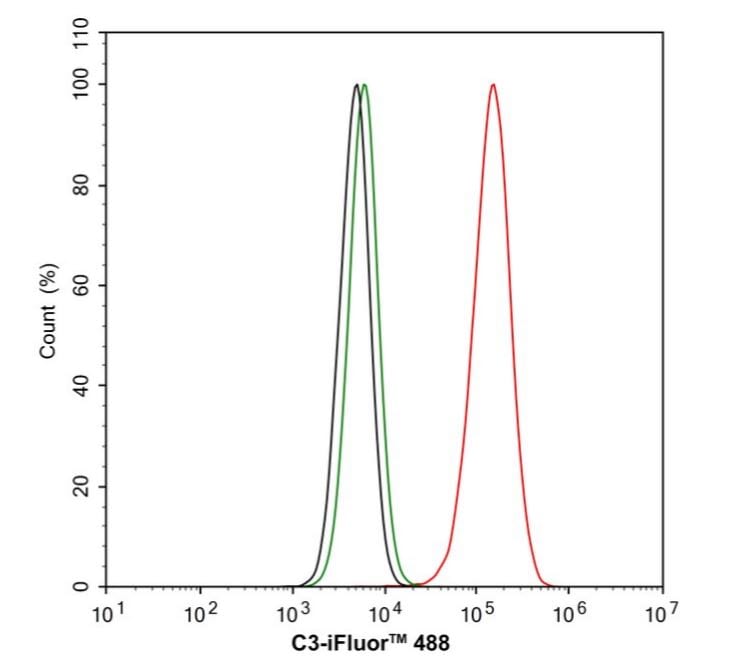
Flow Cytometry: Complement C3 Antibody (JF10-30) [NBP2-66994] -
Flow Cytometry: Complement C3 Antibody (JF10-30) [NBP2-66994] - Cells were fixed and permeabilized. Then stained with the primary antibody (1μg/mL) (red) compared with Rabbit IgG Isotype Control (green). After incubation of the primary antibody at +4c for an hour, the cells were stained with a iFluor™ 488 conjugate-Goat anti-Rabbit IgG Secondary antibody (HA1121) at 1/1,000 dilution for 30 minutes at +4 c. Unlabelled sample was used as a control (cells without incubation with primary antibody; black).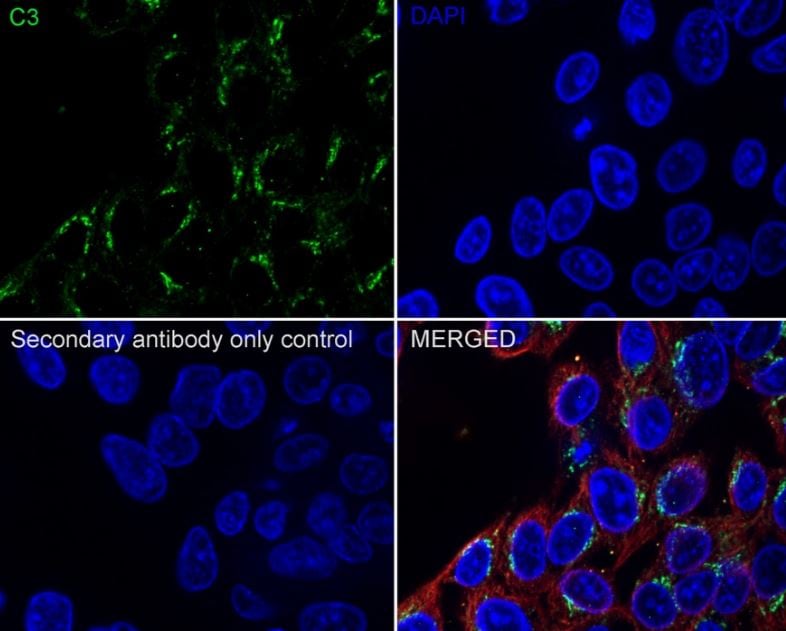
Immunocytochemistry/Immunofluorescence: Complement C3 Antibody (JF10-30) [NBP2-66994] -
Immunocytochemistry/Immunofluorescence: Complement C3 Antibody (JF10-30) [NBP2-66994] -Cells were fixed in 100% precooled methanol for 5 minutes at room temperature, then blocked with 1% BSA in 10% negative goat serum for 1 hour at room temperature. Cells were then incubated with Rabbit anti-C3 antibody at 1/100 dilution in 1% BSA in PBST overnight at 4 ℃. Goat Anti-Rabbit IgG H&L (iFluor™ 488, was used as the secondary antibody at 1/1,000 dilution. PBS instead of the primary antibody was used as the secondary antibody only control. Nuclear DNA was labelled in blue with DAPI.Beta tubulin (M1305-2, red) was stained at 1/100 dilution overnight at +4 c. Goat Anti-Mouse IgG H&L (iFluor™ ) was used as the secondary antibody at 1/1,000 dilution.Applications for Complement C3 Antibody (JF10-30)
Application
Recommended Usage
Flow Cytometry
1:50-1:100
Immunocytochemistry/ Immunofluorescence
1:50-1:100
Immunohistochemistry-Paraffin
Reported in scientific literature (PMID: 31578522)
Western Blot
1:1000
Flow Cytometry Panel Builder
Bio-Techne Knows Flow Cytometry
Save time and reduce costly mistakes by quickly finding compatible reagents using the Panel Builder Tool.
Advanced Features
- Spectra Viewer - Custom analysis of spectra from multiple fluorochromes
- Spillover Popups - Visualize the spectra of individual fluorochromes
- Antigen Density Selector - Match fluorochrome brightness with antigen density

Formulation, Preparation, and Storage
Purification
Protein A purified
Formulation
TBS (pH7.4), 0.05% BSA, 40% Glycerol
Preservative
0.05% Sodium Azide
Concentration
1 mg/ml
Shipping
The product is shipped with polar packs. Upon receipt, store it immediately at the temperature recommended below.
Stability & Storage
Store at 4C short term. Aliquot and store at -20C long term. Avoid freeze-thaw cycles.
Background: Complement C3
Both elevated levels and reduced levels of Complement C3 has been implicated in diseases pathologies (6). Deficiency in Complement proteins can result in autoimmune disorders including systemic lupus erythematosus, which is more often associated with C1 or C4 deficiency and only rarely with C3 deficiency (6). However, C3 deficiency typically results in increased risk of recurrent bacterial infections and glomerulonephritis, characterized by inflammation of the filtering glomeruli in the kidneys (6). Additionally, elevated levels of C3a and C4a is seen in patients with antiphospholipid antibody syndrome (6). Serum levels of C3 are also higher in rheumatoid arthritis cases (6). The complement system has become a target for drugs and therapeutics aimed at modulating innate immunity (7). For instance, compstatin is a peptide that binds to C3, inhibiting convertase activity and cleavage and can be used to treat diseases associated with uncontrolled C3 activation (7). C3-inhibitors and other complement inhibitors are a promising drug candidate for treatment of many diseases (7).
References
1. Mathern, D. R., & Heeger, P. S. (2015). Molecules Great and Small: The Complement System. Clinical Journal of the American Society of Nephrology: CJASN. https://doi.org/10.2215/CJN.06230614
2. Merle, N. S., Church, S. E., Fremeaux-Bacchi, V., & Roumenina, L. T. (2015). Complement System Part I - Molecular Mechanisms of Activation and Regulation. Frontiers in Immunology. https://doi.org/10.3389/fimmu.2015.00262
3. Ricklin, D., Reis, E. S., Mastellos, D. C., Gros, P., & Lambris, J. D. (2016). Complement component C3 - The "Swiss Army Knife" of innate immunity and host defense. Immunological Reviews. https://doi.org/10.1111/imr.12500
4. Merle, N. S., Noe, R., Halbwachs-Mecarelli, L., Fremeaux-Bacchi, V., & Roumenina, L. T. (2015). Complement System Part II: Role in Immunity. Frontiers in Immunology. https://doi.org/10.3389/fimmu.2015.00257
5. Sahu, A., & Lambris, J. D. (2001). Structure and biology of complement protein C3, a connecting link between innate and acquired immunity. Immunological Reviews. https://doi.org/10.1034/j.1600-065x.2001.1800103.x
6. Vignesh, P., Rawat, A., Sharma, M., & Singh, S. (2017). Complement in autoimmune diseases. Clinica Chimica Acta; International Journal of Clinical Chemistry. https://doi.org/10.1016/j.cca.2016.12.017
7. Mastellos, D. C., Yancopoulou, D., Kokkinos, P., Huber-Lang, M., Hajishengallis, G., Biglarnia, A. R., Lupu, F., Nilsson, B., Risitano, A. M., Ricklin, D., & Lambris, J. D. (2015). Compstatin: a C3-targeted complement inhibitor reaching its prime for bedside intervention. European Journal of Clinical Investigation. https://doi.org/10.1111/eci.12419
Alternate Names
Acylation Stimulating Protein, acylation-stimulating protein cleavage product, AHUS5, ARMD9, ASP, C3, C3 and PZP-like alpha-2-macroglobulin domain-containing protein 1, C3a, C3a anaphylatoxin, C3adesArg, C3b, C3bc, C3-beta-c, complement C3, Complement C3 alpha chain, Complement C3 beta chain, Complement C3b alpha' chain, Complement C3c alpha' chain fragment 1, Complement C3c alpha' chain fragment 2, Complement C3d fragment, Complement C3dg fragment, Complement C3f fragment, Complement C3g fragment, complement component 3, complement component C3, complement component C3a, complement component C3b, CPAMD1, EC 3.4.21.43, epididymis secretory sperm binding protein Li 62p, HEL-S-62p, prepro-C3
Gene Symbol
C3
Additional Complement C3 Products
Product Documents for Complement C3 Antibody (JF10-30)
Certificate of Analysis
To download a Certificate of Analysis, please enter a lot or batch number in the search box below.
Product Specific Notices for Complement C3 Antibody (JF10-30)
This product is for research use only and is not approved for use in humans or in clinical diagnosis. Primary Antibodies are guaranteed for 1 year from date of receipt.
Citations for Complement C3 Antibody (JF10-30)
 Powered by Bioz
Customer Reviews for Complement C3 Antibody (JF10-30)
There are currently no reviews for this product. Be the first to review Complement C3 Antibody (JF10-30) and earn rewards!
Have you used Complement C3 Antibody (JF10-30)?
Submit a review and receive an Amazon gift card!
$25/€18/£15/$25CAN/¥2500 for a review with an image
$10/€7/£6/$10CAN/¥1110 for a review without an image
Submit a review
Protocols
Find general support by application which include: protocols, troubleshooting, illustrated assays, videos and webinars.
- 7-Amino Actinomycin D (7-AAD) Cell Viability Flow Cytometry Protocol
- Antigen Retrieval Protocol (PIER)
- Antigen Retrieval for Frozen Sections Protocol
- Appropriate Fixation of IHC/ICC Samples
- Cellular Response to Hypoxia Protocols
- Chromogenic IHC Staining of Formalin-Fixed Paraffin-Embedded (FFPE) Tissue Protocol
- Chromogenic Immunohistochemistry Staining of Frozen Tissue
- ClariTSA™ Fluorophore Kits
- Detection & Visualization of Antibody Binding
- Extracellular Membrane Flow Cytometry Protocol
- Flow Cytometry Protocol for Cell Surface Markers
- Flow Cytometry Protocol for Staining Membrane Associated Proteins
- Flow Cytometry Staining Protocols
- Flow Cytometry Troubleshooting Guide
- Fluorescent IHC Staining of Frozen Tissue Protocol
- Graphic Protocol for Heat-induced Epitope Retrieval
- Graphic Protocol for the Preparation and Fluorescent IHC Staining of Frozen Tissue Sections
- Graphic Protocol for the Preparation and Fluorescent IHC Staining of Paraffin-embedded Tissue Sections
- Graphic Protocol for the Preparation of Gelatin-coated Slides for Histological Tissue Sections
- ICC Cell Smear Protocol for Suspension Cells
- ICC Immunocytochemistry Protocol Videos
- ICC for Adherent Cells
- IHC Sample Preparation (Frozen sections vs Paraffin)
- Immunocytochemistry (ICC) Protocol
- Immunocytochemistry Troubleshooting
- Immunofluorescence of Organoids Embedded in Cultrex Basement Membrane Extract
- Immunofluorescent IHC Staining of Formalin-Fixed Paraffin-Embedded (FFPE) Tissue Protocol
- Immunohistochemistry (IHC) and Immunocytochemistry (ICC) Protocols
- Immunohistochemistry Frozen Troubleshooting
- Immunohistochemistry Paraffin Troubleshooting
- Intracellular Flow Cytometry Protocol Using Alcohol (Methanol)
- Intracellular Flow Cytometry Protocol Using Detergents
- Intracellular Nuclear Staining Flow Cytometry Protocol Using Detergents
- Intracellular Staining Flow Cytometry Protocol Using Alcohol Permeabilization
- Intracellular Staining Flow Cytometry Protocol Using Detergents to Permeabilize Cells
- Preparing Samples for IHC/ICC Experiments
- Preventing Non-Specific Staining (Non-Specific Binding)
- Primary Antibody Selection & Optimization
- Propidium Iodide Cell Viability Flow Cytometry Protocol
- Protocol for Heat-Induced Epitope Retrieval (HIER)
- Protocol for Liperfluo
- Protocol for Making a 4% Formaldehyde Solution in PBS
- Protocol for VisUCyte™ HRP Polymer Detection Reagent
- Protocol for the Characterization of Human Th22 Cells
- Protocol for the Characterization of Human Th9 Cells
- Protocol for the Fluorescent ICC Staining of Cell Smears - Graphic
- Protocol for the Fluorescent ICC Staining of Cultured Cells on Coverslips - Graphic
- Protocol for the Preparation & Fixation of Cells on Coverslips
- Protocol for the Preparation and Chromogenic IHC Staining of Frozen Tissue Sections
- Protocol for the Preparation and Chromogenic IHC Staining of Frozen Tissue Sections - Graphic
- Protocol for the Preparation and Chromogenic IHC Staining of Paraffin-embedded Tissue Sections
- Protocol for the Preparation and Chromogenic IHC Staining of Paraffin-embedded Tissue Sections - Graphic
- Protocol for the Preparation and Fluorescent ICC Staining of Cells on Coverslips
- Protocol for the Preparation and Fluorescent ICC Staining of Non-adherent Cells
- Protocol for the Preparation and Fluorescent ICC Staining of Stem Cells on Coverslips
- Protocol for the Preparation and Fluorescent IHC Staining of Frozen Tissue Sections
- Protocol for the Preparation and Fluorescent IHC Staining of Paraffin-embedded Tissue Sections
- Protocol for the Preparation of Gelatin-coated Slides for Histological Tissue Sections
- Protocol for the Preparation of a Cell Smear for Non-adherent Cell ICC - Graphic
- Protocol: Annexin V and PI Staining by Flow Cytometry
- Protocol: Annexin V and PI Staining for Apoptosis by Flow Cytometry
- R&D Systems Quality Control Western Blot Protocol
- TUNEL and Active Caspase-3 Detection by IHC/ICC Protocol
- The Importance of IHC/ICC Controls
- Troubleshooting Guide: Fluorokine Flow Cytometry Kits
- Troubleshooting Guide: Immunohistochemistry
- Troubleshooting Guide: Western Blot Figures
- Western Blot Conditions
- Western Blot Protocol
- Western Blot Protocol for Cell Lysates
- Western Blot Troubleshooting
- Western Blot Troubleshooting Guide
- View all Protocols, Troubleshooting, Illustrated assays and Webinars
FAQs for Complement C3 Antibody (JF10-30)
Showing
1
-
1 of
1 FAQ
Showing All
-
Q: I am trying to establish a method to measure mice C3 levels by nephelometry. I would be most grateful if you could provide me with some help, regarding the choice of the Ab. I totally understand that since such a method has never been tried, I do not expect any guaranties.
A: We have never performed nephelometry in our lab, and do not have a protocol or advice to provide about this application. However, it seems to me that you should choose an antibody that is capable of recognizing its target in its folded conformation. Therefore, I would suggest trying an antibody that has been validated for ICC or IHC.
Loading...