
CRISPR-Cas9 Antibody
Novus Biologicals | Catalog # NBP2-52717

![Western Blot: CRISPR-Cas9 Antibody [NBP2-52717]](https://resources.rndsystems.com/images/products/CRISPR-Cas9-Antibody-Western-Blot-NBP2-52717-img0002.jpg "Western Blot: CRISPR-Cas9 Antibody [NBP2-52717]")
Scientific images may be resized, cropped, or adjusted for brightness or contrast for presentation purposes. These updates are limited to presentation and do not affect the underlying scientific interpretation of the data. Where available, additional source data may be provided upon request.
Loading...
Key Product Details
Validated by
Biological Validation
Species Reactivity
Bacteria
Applications
Multiplex Immunofluorescence, Western Blot, Immunoprecipitation, COMET
Label
Unconjugated
Antibody Source
Polyclonal Rabbit IgG
Loading...
Product Specifications
Immunogen
This CRISPR-Cas9 antibody was raised against CAS9 synthetic peptide within S. Pyogenes enzyme cas9 (Used in CRISPR/Cas9 Genome Editing system).
Reactivity Notes
Streptococcus Pyogenes
Clonality
Polyclonal
Host
Rabbit
Isotype
IgG
Theoretical MW
158.4 kDa.
Disclaimer note: The observed molecular weight of the protein may vary from the listed predicted molecular weight due to post translational modifications, post translation cleavages, relative charges, and other experimental factors.
Disclaimer note: The observed molecular weight of the protein may vary from the listed predicted molecular weight due to post translational modifications, post translation cleavages, relative charges, and other experimental factors.
Scientific Data Images for CRISPR-Cas9 Antibody
Western Blot: CRISPR-Cas9 Antibody [NBP2-52717]
Western Blot: CRISPR-Cas9 Antibody [NBP2-52717] - HEK293T were transfected with either WT CAS9 plasmid, CAS9 nickase plasmid or control vector. Equivalent amount of each cell lysates (10ug per lane) were immunoblotted with (1:2000). Theoretical molecular weight ~158 kDa.![Western Blot: CRISPR-Cas9 Antibody [NBP2-52717]](https://resources.rndsystems.com/images/products/CRISPR-Cas9-Antibody-Western-Blot-NBP2-52717-img0007.jpg "Western Blot: CRISPR-Cas9 Antibody [NBP2-52717]")
![Immunoprecipitation: CRISPR-Cas9 Antibody [NBP2-52717]](https://resources.rndsystems.com/images/products/CRISPR-Cas9-Antibody-Immunoprecipitation-NBP2-52717-img0006.jpg "Immunoprecipitation: CRISPR-Cas9 Antibody [NBP2-52717]")
Immunoprecipitation: CRISPR-Cas9 Antibody [NBP2-52717]
Immunoprecipitation: CRISPR-Cas9 Antibody [NBP2-52717] - HEK293T were transfected with either WT CAS9 plasmid, CAS9 nickase plasmid (GE100019), or negative control vector (PS100001). Input: 10ug total cell lysates; WB was performed (1:2000). IP: 100ug of cell lysates were precipitated with 20ug of NBP2-52717 or control antibody, and 5ug Protein G Beads. Mouse anti-DDK monoclonal antibody was used in WB to detect the immuno-precipitated Cas9 (as Cas9 is Myc-DDK tagged)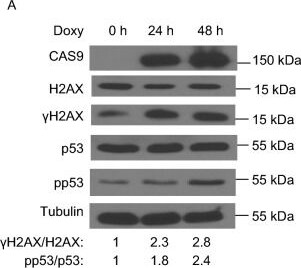
Western Blot: CRISPR-Cas9 Antibody [NBP2-52717] -
Western Blot: CRISPR-Cas9 Antibody [NBP2-52717] - The expression of CAS9 in hiPSCs & hESCs promotes DNA DSB damage. (A) The inducible expression of CAS9 promotes DNA DSB damage responses in hiPSCs after 2 µg/mL Doxy treatment. The relative levels of the phosphorylation of p53 & H2AX are indicated at the bottom. Consistent data were obtained from two independent experiments. (B) The impact of expression levels of CAS9 on DNA DSB damage in hESCs. At the same lentiviral titers, the expression levels of CAS9 in hESCs transduced by standard lentiviral vector are higher than those transduced by the inducible lentiviral vector after 2 µg/mL Doxy treatment. Much lower expression levels of CAS9 can also promote DNA DSB damage in hESCs after the treatment with lower dosages of Doxy. The relative levels of the phosphorylation of p53 & H2AX are indicated at the bottom Image collected & cropped by CiteAb from the following publication (https://pubmed.ncbi.nlm.nih.gov/32170574), licensed under a CC-BY license. Not internally tested by Novus Biologicals.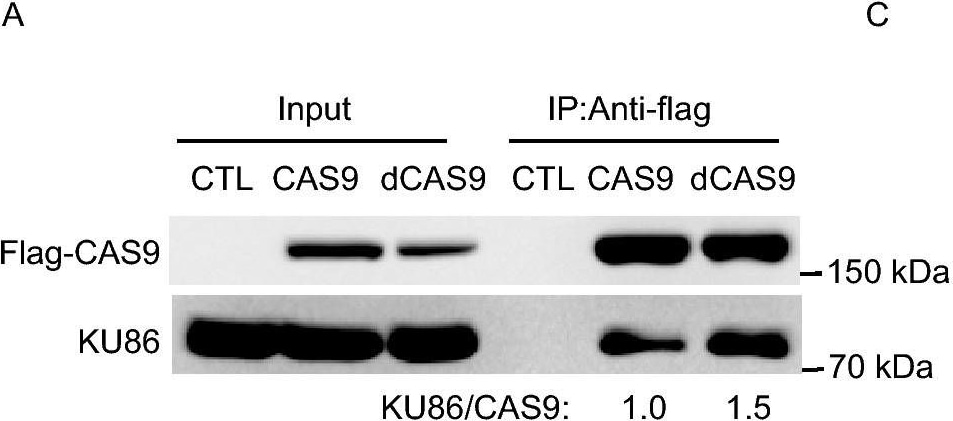
Western Blot: CRISPR-Cas9 Antibody [NBP2-52717] -
Western Blot: CRISPR-Cas9 Antibody [NBP2-52717] - dCAS9 & Cpf1 impair NHEJ & induce genetic mutations. (A) Co-immunoprecipitation assay confirmed the interaction between dCAS9 & KU86. (B) Comet assay analysis of DNA damage in hESCs expressing dCAS9 or treated with doxorubicin. CTL, human fibroblasts with lentiviral empty vector were treated with 2 µg/mL doxycycline for three days; Doxy, Dox, Doxy + Dox, human fibroblasts with lentiviral CAS9 inducible expression vector were treated with 2 µg/mL doxycycline for 3 days or 0.5 µmol/L Dox for 2 h or 2 µg/mL doxycycline for three days + 0.5 µmol/L Dox for 2 h, respectively. Tail length was analyzed using Image J software. Data are represented as mean ± SD. *P < 0.05, **P < 0.01, ***P < 0.001. (C) The expression of dCAS9 induces mutation of endogenous HPRT gene. WT, WT hESCs; CTL, CAS9, dCAS9, hESCs with empty expression vector, CAS9 inducible expression vector. Cells with dCAS9 inducible expression vector were treated with 2 µg/mL doxycycline for 3 days before HAT treatment. n = 3. Data are presented as mean value ± SD. **P < 0.01, ***P < 0.001. (D) The expression of Cpf1 increased the levels of gamma H2AX. (E) Cpf1 interacts with KU86 as confirmed by Co-immunoprecipitation. Protein extract of Flag-tagged Cpf1 was immunoprecipitated with anti-Flag antibody & the presence of Cpf1 & KU86 in the immunoprecipitate was examined by Western blot Image collected & cropped by CiteAb from the following publication (https://pubmed.ncbi.nlm.nih.gov/32170574), licensed under a CC-BY license. Not internally tested by Novus Biologicals.
Western Blot: CRISPR-Cas9 Antibody [NBP2-52717] -
Western Blot: CRISPR-Cas9 Antibody [NBP2-52717] - Both CAS9 & XCAS9 impair NHEJ & induce genetic mutations. (A & B) Expression of CAS9 & XCAS9 impairs NHEJ. Traffic Light Reporter system was established in 293 cells harboring the CAS9 & XCAS9 inducible expression vectors. After the induction of CAS9 & XCAS9 expression with 2 µg/mL doxycycline for 3 days (left panel), the efficiency of NHEJ (mcherry) & HDR (GFP) was analyzed by flow cytometry (middle panel). Statistic analysis of the efficiency of NHEJ (left panel of A) & HDR (B) is presented. n = 3. Data are presented as mean values ± SD. *P < 0.05, **P < 0.01, ***P < 0.001. ns, non-significant. (C) The expression of CAS9 in hESCs induces genomic mutations at the endogenous HPRT locus. After hESCs harboring CAS9 inducible expression vector were selected with HAT medium for 5 days, they were treated with 2 µg/mL doxycycline for CAS9 expression for various time periods, & subsequently, treated with 5 µg/mL 6-TG or mock treated for 4 days. Mutational rate is calculated as the ratio of colony number in 6-TG treated samples versus untreated controls. n = 3. Data are presented as mean values ± SD. ***P < 0.001. (D) XCAS9 interacts with KU86. Protein extracts from 293FT cells expressing Flag-tagged CAS9 or XCAS9 were immunoprecipitated with anti-Flag antibody. The immune precipitates were analyzed for the presence of CAS9, XCAS9 & KU86. The relative ratio of KU86 versus CAS9 or XCAS9 is indicated. (E) The expression of XCAS9 increases the number of gamma H2AX foci in hESCs. hESCs harboring XCAS9 inducible expression vector were treated with or without 2 µg/mL doxycycline for 3 days. n = 20. Scale bar, 10 µm. Data are presented as mean values ± SD. ***P < 0.01 Image collected & cropped by CiteAb from the following publication (https://pubmed.ncbi.nlm.nih.gov/32170574), licensed under a CC-BY license. Not internally tested by Novus Biologicals.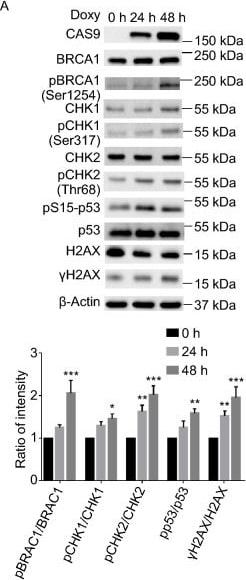
Western Blot: CRISPR-Cas9 Antibody [NBP2-52717] -
Western Blot: CRISPR-Cas9 Antibody [NBP2-52717] - The expression of CAS9 in human fibroblasts promotes DNA DSB damage & activates DNA damage response pathways. (A) The expression of CAS9 in human fibroblasts activates DNA damage responses. The expression of CAS9 was induced with 2 µg/mL Doxy treatment. The relative levels of phosphorylation of BRCA1, CHK1, CHK2 & p53 are indicated at the bottom. n = 3. Data are presented as mean value ± SD. *P < 0.05, **P < 0.01, ***P < 0.001. (B) The expression of CAS9 increased the number of gamma H2AX foci in human fibroblasts. CTL or CAS9, human fibroblasts with CAS9 inducible expression cassette plated on chamber slides were treated with or without 2 µg/mL doxycycline for 3 days. The expression of CAS9 & gamma H2AX foci was revealed by immunoflourescence analysis. Representative images are shown. Scale bar, 10 µm. Unpaired t test. n = 20. Data are presented as mean values ± SD. ***P < 0.001. (C) CAS9 induces DNA DSB damage in human fibroblasts. CTL, human fibroblasts with lentiviral empty vector were treated with 2 µg/mL doxycycline for three days; Doxy, Dox, Doxy + Dox, human fibroblasts with lentiviral CAS9 inducible expression vector were treated with 2 µg/mL doxycycline for 3 days or 0.5 µmol/L Dox for 2 h or 2 µg/mL doxycycline for three days + 0.5 µmol/L Dox for 2 h, respectively. Representative images are shown. n = 40. Unpaired t test. Data are presented as mean value ± SD. **P < 0.01 Image collected & cropped by CiteAb from the following publication (https://pubmed.ncbi.nlm.nih.gov/32170574), licensed under a CC-BY license. Not internally tested by Novus Biologicals.Applications for CRISPR-Cas9 Antibody
Application
Recommended Usage
Western Blot
1:500
Formulation, Preparation, and Storage
Purification
Immunogen affinity purified
Formulation
PBS (pH 7.3), 1.0% BSA and 50% Glycerol
Preservative
0.02% Sodium Azide
Concentration
1 mg/ml
Shipping
The product is shipped with polar packs. Upon receipt, store it immediately at the temperature recommended below.
Stability & Storage
Store at -20C. Avoid freeze-thaw cycles.
Background: CRISPR-Cas9
Using CRISPR-Cas9 technology, double-stranded DNA breaks may be induced within specific targeted genome sequences (target DNA; protospacer) for insertion or removal of DNA sequences for gene editing applications. To target a specific loci, a gRNA that will bind to a specific target sequence of DNA within a genome is created. The gRNA will recognize the DNA sequence, and the Cas9 enzyme will cleave the DNA at the targeted location. Once the targeted DNA is removed by Cas9, the cell's own DNA repair mechanism is used to insert or remove a DNA sequence for genomic editing.
Cas9 detection is used to confirm and evaluate CRISPR Cas9 gRNA transfection efficiency. Western blot analysis of CRISPR-Cas9 gRNA transfected cell lysates with Cas9 antibodies identifies the protein having a theoretical molecular weight of 160kDa. Broad areas of research are benefiting from CRISPR-Cas9 based gene editing tools including studies of basic immunity functions, genetic screening and disease treatment (2). Ethical concerns have led to many countries making it illegal to manipulate human germline cells or perform embryo genome editing.
References
1. Oakes, B. L., Fellmann, C., Rishi, H., Taylor, K. L., Ren, S. M., Nadler, D. C.,... Savage, D. F. (2019). CRISPR-Cas9 Circular Permutants as Programmable Scaffolds for Genome Modification. Cell, 176(1-2), 254-267.e216. doi:10.1016/j.cell.2018.11.052
2. Chiou, S. H., Winters, I. P., Wang, J., Naranjo, S., Dudgeon, C., Tamburini, F. B.,... Winslow, M. M. (2015). Pancreatic cancer modeling using retrograde viral vector delivery and in vivo CRISPR/Cas9-mediated somatic genome editing. Genes Dev, 29(14), 1576-1585. doi:10.1101/gad.264861.115
Long Name
CRISPR-associated Protein 9
Alternate Names
Cas9, CRISPR-associated endonuclease Cas9/Csn1, CRISPR-Cas9/Csn1, CRISPR/Cas9, csn1, SPy_1046, SPy1046, SpyCas9, CRISPR-associated protein 9 nuclease
Additional CRISPR-Cas9 Products
Product Documents for CRISPR-Cas9 Antibody
Certificate of Analysis
To download a Certificate of Analysis, please enter a lot or batch number in the search box below.
Product Specific Notices for CRISPR-Cas9 Antibody
This product is for research use only and is not approved for use in humans or in clinical diagnosis. Primary Antibodies are guaranteed for 1 year from date of receipt.
Citations for CRISPR-Cas9 Antibody
 Powered by Bioz
Customer Reviews for CRISPR-Cas9 Antibody
There are currently no reviews for this product. Be the first to review CRISPR-Cas9 Antibody and earn rewards!
Have you used CRISPR-Cas9 Antibody?
Submit a review and receive an Amazon gift card!
$25/€18/£15/$25CAN/¥2500 for a review with an image
$10/€7/£6/$10CAN/¥1110 for a review without an image
Submit a review
Protocols
Find general support by application which include: protocols, troubleshooting, illustrated assays, videos and webinars.
- Cellular Response to Hypoxia Protocols
- Immunoprecipitation Protocol
- R&D Systems Quality Control Western Blot Protocol
- Troubleshooting Guide: Western Blot Figures
- Western Blot Conditions
- Western Blot Protocol
- Western Blot Protocol for Cell Lysates
- Western Blot Troubleshooting
- Western Blot Troubleshooting Guide
- View all Protocols, Troubleshooting, Illustrated assays and Webinars
Loading...