
Collagens comprise a large family of insoluble extracellular glycoproteins that are essential components of connective tissues such as tendons, ligaments, cartilage, bone and skin. The mature polypeptides are secreted as coiled, left-handed helices that subsequently assemble into rope-like collagen fibers. Collagen I is a fibril-forming collagen that requires N- and C- terminal processing. Collagen IV is a network forming collagen whose C-terminus forms dimers and N-terminus forms tetramers.
Cultrex Collagen I Cell Invasion Assay
R&D Systems | Catalog # 3457-096-K
24-well and 96-well kits that assess chemotaxis, cell migration, and/or cell invasion through a Collagen I matrix.

Discontinued Product
3457-096-K has been discontinued.
View all Collagen I products.
Key Product Details
Features
The Cultrex Collagen I Cell Invasion Assay provides a tool for assessing cell invasion through Collagen I.
Species
Multi-Species
Product Summary for Cultrex Collagen I Cell Invasion Assay
Why Use Cultrex Collagen I Cell Invasion Assay?
Since different cell lines and different treatments can result in a wide range of invasive potentials, the permissiveness of each cell line to invade through Collagen I may be optimized to fit each experiment by adjusting the coating concentration. The Cultrex Collagen I Cell Invasion Assays are provided as either a single 96 well plate providing capacity for large screening experiments or as 24 individual inserts providing flexibility for smaller studies.
Loading...
Product Specifications
Cell Culture Testing
Tested to support EMT-induced cell invasion and migration using A549 human lung carcinoma cell lines.
Scientific Data Images for Cultrex Collagen I Cell Invasion Assay
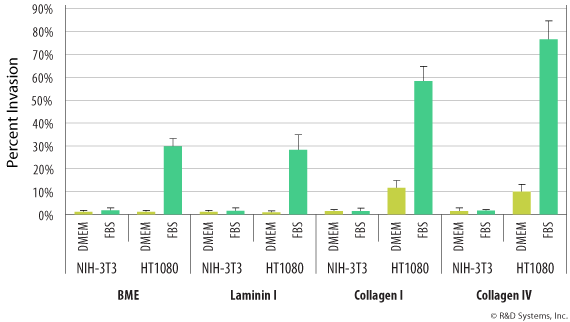
FBS Stimulates Migration of NIH-3T3 and HT1080 Cells.
The NIH-3T3 mouse embryonic fibroblast cell line and the HT1080 human fibrosarcoma cell line were treated with 10% fetal bovine serum (FBS). The migration of untreated (yellow bars) and treated (green bars) NIH-3T3 and HT1080 cells against different extracellular matrix components, including Cultrex BME, Laminin I, Collagen I, Collagen IV, were quantified using the Cultrex Cell Invasion Assay Kits (Catalog # 3455-096-K, 3456-096-K, 3457-096-K, 3458-096-K, respectively). Data from four experiments was quantified for both non-invasive (NIH-3T3) and invasive (HT1080) cell types.Formulation, Preparation, and Storage
Shipping
The product is shipped with dry ice or equivalent. Upon receipt, store it immediately at the temperature recommended on the product label.
Storage
Store the unopened product at 2 - 8 °C. Do not use past expiration date.
Background: Collagen I
Alternate Names
Alpha-1 type I collagen, alpha1(I) procollagen, CAFYD, COL1A1, Collagen 1, collagen alpha 1 chain type I, collagen alpha-1(I) chain, collagen alpha-1(I) chain preproprotein, collagen of skin, tendon and bone, alpha-1 chain, collagen, type I, alpha 1, EDSARTH1, EDSC, OI1, OI2, OI3, OI4, pro-alpha-1 collagen type 1, type I proalpha 1, Type I Procollagen Alpha 1 Chain
Additional Collagen I Products
Product Documents for Cultrex Collagen I Cell Invasion Assay
Certificate of Analysis
To download a Certificate of Analysis, please enter a lot or batch number in the search box below.
Note: Certificate of Analysis not available for kit components.
Citations for Cultrex Collagen I Cell Invasion Assay
 Powered by Bioz
Customer Reviews for Cultrex Collagen I Cell Invasion Assay
There are currently no reviews for this product. Be the first to review Cultrex Collagen I Cell Invasion Assay and earn rewards!
Have you used Cultrex Collagen I Cell Invasion Assay?
Submit a review and receive an Amazon gift card!
$25/€18/£15/$25CAN/¥2500 for a review with an image
$10/€7/£6/$10CAN/¥1110 for a review without an image
Submit a review
FAQs for Cultrex Collagen I Cell Invasion Assay
Showing
1
-
3 of
3 FAQs
Showing All
-
Q: In the Cell Invasion Assay protocol, how would you recommend aspirating off the coating solution from the top chamber as described in step 7?
A: This is best done manually with a pipette, not a vacuum. The collagen gel must remain in the well, therefore care should be taken to avoid disturbing the gel during aspiration.
-
Q: The kit comes with both black and clear microplates. Do I need to use both?
A: The entire assay may be conducted in either the clear or black assay plate (provided in3455-096-01), if desired. The black assay plate provides increased sensitivity and reduced background for plate readers that read from the top. The clear assay plate provides compatibility for plate readers that read from the bottom. Some researchers have used the clear assay plate for the invasion step and the black assay plate for detection (top read).
-
Q: Will the gel be removed when aspirating the top layer?
A: No, the gel must remain in the well. Refer to step 7 of the Cell Invasion Assay protocol - only the solution will be removed. It is best to manually remove the solution with a pipette instead of using a vacuum.
-
Q: In the Cell Invasion Assay protocol, how would you recommend aspirating off the coating solution from the top chamber as described in step 7?
A: This is best done manually with a pipette, not a vacuum. The collagen gel must remain in the well, therefore care should be taken to avoid disturbing the gel during aspiration.
-
Q: The kit comes with both black and clear microplates. Do I need to use both?
A: The entire assay may be conducted in either the clear or black assay plate (provided in3455-096-01), if desired. The black assay plate provides increased sensitivity and reduced background for plate readers that read from the top. The clear assay plate provides compatibility for plate readers that read from the bottom. Some researchers have used the clear assay plate for the invasion step and the black assay plate for detection (top read).
-
Q: Will the gel be removed when aspirating the top layer?
A: No, the gel must remain in the well. Refer to step 7 of the Cell Invasion Assay protocol - only the solution will be removed. It is best to manually remove the solution with a pipette instead of using a vacuum.
-
Q: In the Cell Invasion Assay protocol, how would you recommend aspirating off the coating solution from the top chamber as described in step 7?
A: This is best done manually with a pipette, not a vacuum. The collagen gel must remain in the well, therefore care should be taken to avoid disturbing the gel during aspiration.
-
Q: The kit comes with both black and clear microplates. Do I need to use both?
A: The entire assay may be conducted in either the clear or black assay plate (provided in3455-096-01), if desired. The black assay plate provides increased sensitivity and reduced background for plate readers that read from the top. The clear assay plate provides compatibility for plate readers that read from the bottom. Some researchers have used the clear assay plate for the invasion step and the black assay plate for detection (top read).
-
Q: Will the gel be removed when aspirating the top layer?
A: No, the gel must remain in the well. Refer to step 7 of the Cell Invasion Assay protocol - only the solution will be removed. It is best to manually remove the solution with a pipette instead of using a vacuum.
Loading...