
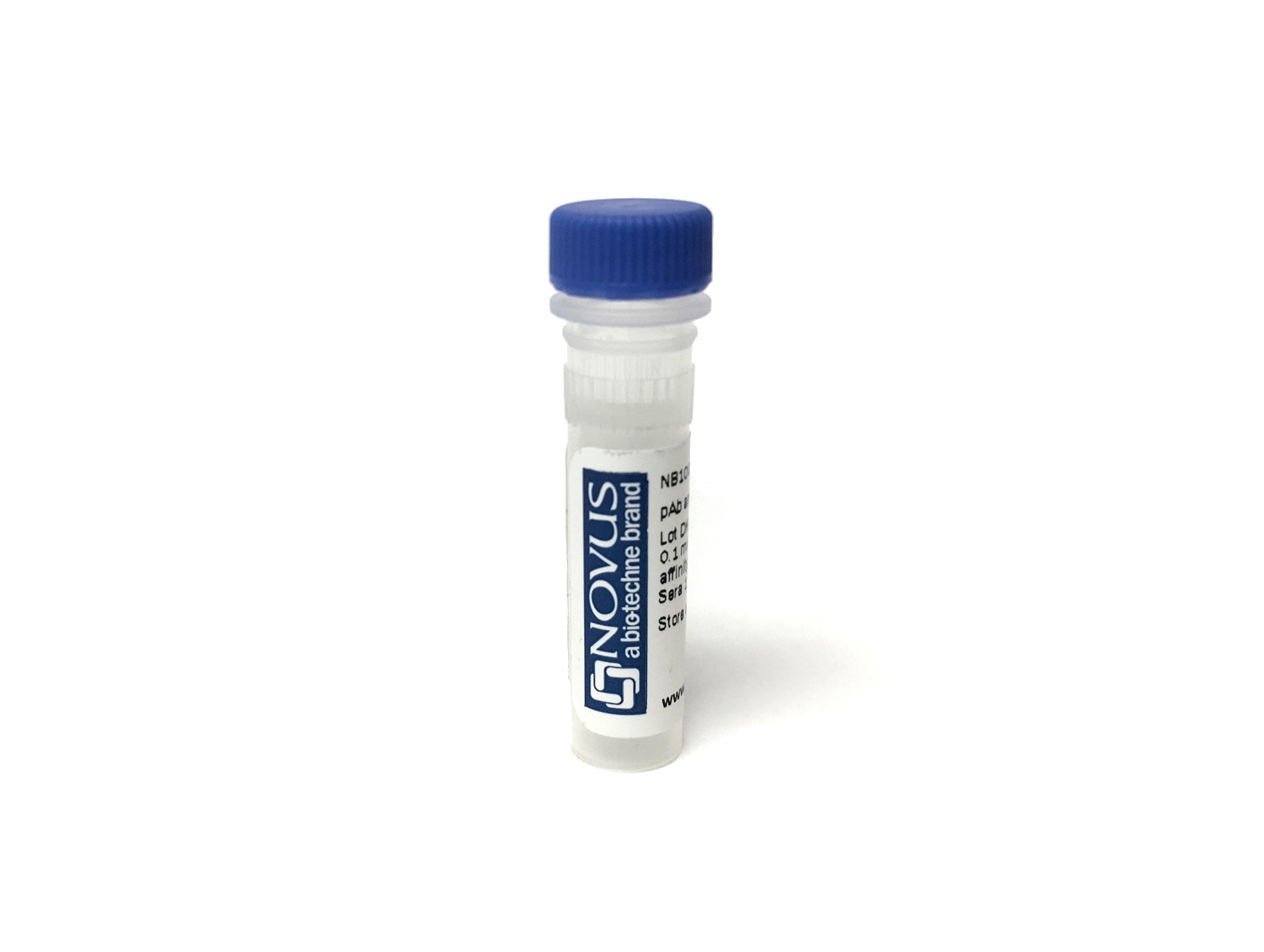
DYKDDDDK Epitope Tag Antibody [DyLight 650]
Novus Biologicals | Catalog # NB600-345C

Key Product Details
Species Reactivity
Epitope Tag
Applications
Immunohistochemistry, ELISA
Label
DyLight 650 (Excitation = 652 nm, Emission = 672 nm)
Antibody Source
Polyclonal Rabbit IgG
Loading...
Product Specifications
Immunogen
To produce DYKDDDDK Epitope Tag Antibody, Rabbits were immunized with ECS enterokinase cleavage site (xxxDDDDK) conjugated to KLH. Antibody was isolated by affinity chromatography using the peptide immobilized on solid support.
Specificity
DYKDDDDK Epitope Tag Antibody reacts with FLAG.
Clonality
Polyclonal
Host
Rabbit
Isotype
IgG
Theoretical MW
1.01 kDa.
Disclaimer note: The observed molecular weight of the protein may vary from the listed predicted molecular weight due to post translational modifications, post translation cleavages, relative charges, and other experimental factors.
Disclaimer note: The observed molecular weight of the protein may vary from the listed predicted molecular weight due to post translational modifications, post translation cleavages, relative charges, and other experimental factors.
Description
This conjugate is made on demand and is not held in inventory. Each order represents a unique lot. All conjugates are generated using validated conjugation protocols and meet strict degree of labeling (F/P) specifications; additional information is available upon request. The antibody concentration is provided on the individual product label.
For specialized conjugation needs, like large quantities, specific concentrations, and defined F/P ratios, bulk and custom antibody conjugation services are available.
For specialized conjugation needs, like large quantities, specific concentrations, and defined F/P ratios, bulk and custom antibody conjugation services are available.
Applications for DYKDDDDK Epitope Tag Antibody [DyLight 650]
Application
Recommended Usage
ELISA
Optimal dilutions of this antibody should be experimentally determined.
Immunohistochemistry
Optimal dilutions of this antibody should be experimentally determined.
Application Notes
Recommended applications are based on validated applications from the unconjugated base product NB600-345. This conjugated antibody is not kept in inventory and is made to order using validated conjugation protocols.
Formulation, Preparation, and Storage
Purification
Immunogen affinity purified
Formulation
50mM Sodium Borate
Preservative
0.05% Sodium Azide
Concentration
Please see the vial label for concentration. If unlisted please contact technical services.
Shipping
The product is shipped with polar packs. Upon receipt, store it immediately at the temperature recommended below.
Stability & Storage
Store at 4C in the dark.
Background: DYKDDDDK Epitope Tag
The epitope tag, DYKDDDDK, is comprised of an eight amino acid sequence derived from the gene-10 product from bacteriophage T7 and contains an enterokinase-cleavage site (1). Its hydrophilic nature and short peptide sequence reduce possible interference with protein expression, post-translational modifications, protein interactions, and protein function (2). The DYKDDDDK (FLAG(R)) epitope tag can either be fused to the N-terminus, C-terminus, or placed at an internal position of the target protein, facilitating characterization of the protein of interest using immunodetection methods. Compared to the standard DYKDDDDK epitope tag antibody, the rat monoclonal DYKDDDDK Epitope Tag antibody (clone L5) is 2-8 times more sensitive (3).
References
1. Brizzard BL, Chubet RG, Vizard DL. (1994) Immunoaffinity purification of (FLAG(R)) epitope-tagged bacterial alkaline phosphatase using a novel monoclonal antibody and peptide elution. Biotechniques. 16(4):730-5. PMID: 8024796
2. Einhauer A, Jungbauer A. (2001) The (FLAG(R)) peptide, a versatile fusion tag for the purification of recombinant proteins. J Biochem Biophys Methods. 49(1-3):455-65. PMID: 11694294
3. Park SH, Cheong C, Idoyaga J, Kim JY, Choi JH, Do Y, Lee H, Jo JH, Oh YS, Im W, Steinman RM, Park CG. (2008) Generation and application of new rat monoclonal antibodies against synthetic DYKDDDDK Epitope Tag (FLAG(R)) and OLLAS tags for improved immunodetection. J Immunol Methods. 331(1-2):27-38. PMID: 18054954
FLAG(R) is a trademark of Sigma-Aldrich.
Alternate Names
FLAG Tag
Additional DYKDDDDK Epitope Tag Products
Product Documents for DYKDDDDK Epitope Tag Antibody [DyLight 650]
Certificate of Analysis
To download a Certificate of Analysis, please enter a lot or batch number in the search box below.
Product Specific Notices for DYKDDDDK Epitope Tag Antibody [DyLight 650]
FLAG(R) and ANTI-FLAG(R) are registered trademarks of Sigma-Aldrich Co. LLC.
DyLight (R) is a trademark of Thermo Fisher Scientific Inc. and its subsidiaries.
This product is for research use only and is not approved for use in humans or in clinical diagnosis. Primary Antibodies are guaranteed for 1 year from date of receipt.
Customer Reviews for DYKDDDDK Epitope Tag Antibody [DyLight 650]
There are currently no reviews for this product. Be the first to review DYKDDDDK Epitope Tag Antibody [DyLight 650] and earn rewards!
Have you used DYKDDDDK Epitope Tag Antibody [DyLight 650]?
Submit a review and receive an Amazon gift card!
$25/€18/£15/$25CAN/¥2500 for a review with an image
$10/€7/£6/$10CAN/¥1110 for a review without an image
Submit a review
Protocols
Find general support by application which include: protocols, troubleshooting, illustrated assays, videos and webinars.
- Antigen Retrieval Protocol (PIER)
- Antigen Retrieval for Frozen Sections Protocol
- Appropriate Fixation of IHC/ICC Samples
- Cellular Response to Hypoxia Protocols
- Chromogenic IHC Staining of Formalin-Fixed Paraffin-Embedded (FFPE) Tissue Protocol
- Chromogenic Immunohistochemistry Staining of Frozen Tissue
- ClariTSA™ Fluorophore Kits
- Detection & Visualization of Antibody Binding
- ELISA Sample Preparation & Collection Guide
- ELISA Troubleshooting Guide
- Fluorescent IHC Staining of Frozen Tissue Protocol
- Graphic Protocol for Heat-induced Epitope Retrieval
- Graphic Protocol for the Preparation and Fluorescent IHC Staining of Frozen Tissue Sections
- Graphic Protocol for the Preparation and Fluorescent IHC Staining of Paraffin-embedded Tissue Sections
- Graphic Protocol for the Preparation of Gelatin-coated Slides for Histological Tissue Sections
- How to Run an R&D Systems DuoSet ELISA
- How to Run an R&D Systems Quantikine ELISA
- How to Run an R&D Systems Quantikine™ QuicKit™ ELISA
- IHC Sample Preparation (Frozen sections vs Paraffin)
- Immunofluorescent IHC Staining of Formalin-Fixed Paraffin-Embedded (FFPE) Tissue Protocol
- Immunohistochemistry (IHC) and Immunocytochemistry (ICC) Protocols
- Immunohistochemistry Frozen Troubleshooting
- Immunohistochemistry Paraffin Troubleshooting
- Preparing Samples for IHC/ICC Experiments
- Preventing Non-Specific Staining (Non-Specific Binding)
- Primary Antibody Selection & Optimization
- Protocol for Heat-Induced Epitope Retrieval (HIER)
- Protocol for Making a 4% Formaldehyde Solution in PBS
- Protocol for VisUCyte™ HRP Polymer Detection Reagent
- Protocol for the Preparation & Fixation of Cells on Coverslips
- Protocol for the Preparation and Chromogenic IHC Staining of Frozen Tissue Sections
- Protocol for the Preparation and Chromogenic IHC Staining of Frozen Tissue Sections - Graphic
- Protocol for the Preparation and Chromogenic IHC Staining of Paraffin-embedded Tissue Sections
- Protocol for the Preparation and Chromogenic IHC Staining of Paraffin-embedded Tissue Sections - Graphic
- Protocol for the Preparation and Fluorescent IHC Staining of Frozen Tissue Sections
- Protocol for the Preparation and Fluorescent IHC Staining of Paraffin-embedded Tissue Sections
- Protocol for the Preparation of Gelatin-coated Slides for Histological Tissue Sections
- Quantikine HS ELISA Kit Assay Principle, Alkaline Phosphatase
- Quantikine HS ELISA Kit Principle, Streptavidin-HRP Polymer
- Sandwich ELISA (Colorimetric) – Biotin/Streptavidin Detection Protocol
- Sandwich ELISA (Colorimetric) – Direct Detection Protocol
- TUNEL and Active Caspase-3 Detection by IHC/ICC Protocol
- The Importance of IHC/ICC Controls
- Troubleshooting Guide: ELISA
- Troubleshooting Guide: Immunohistochemistry
- View all Protocols, Troubleshooting, Illustrated assays and Webinars
FAQs for DYKDDDDK Epitope Tag Antibody [DyLight 650]
Showing
1
-
5 of
5 FAQs
Showing All
-
Q: Are the FLAG Tag antibodies validated in Simple Western?
A: Yes, we offer 3 FLAG Tag antibodies that have been tested in Simple Western: NBP1-71705, NBP1-97410, and MAB8529.
-
Q: Do FLAG Tag antibodies comes in lyophilized form?
A: The following FLAG Tag antibodies come in lyophilized form: NBP1-97393, NBP1-97401, NBP1-97399, NBP1-97400, and NBP1-97402.
-
Q: What the theoretical molecular weight for FLAG Tag antibodies?
A: The TMW for DYKDDDDK epitope FLAG Tag is approximately 1.01 kDa.
-
Q: Will FLAG Tag antibodies detect internal FLAG tags? My FLAG sequence is sandwiched between two other protein sequences.
A: If you are applying your sample(s) to SDS-PAGE, under reducing condition and follow by Western Blot, DYKDDDDK epitope tag antibodies should be able to detect the tag region located internally. However, it depends on the property of your chimeric protein and if your tag is in the hydrophobic or hydrophilic region. Although DYKDDDDK is very hydrophilic, it may not be exposed to the surface if embedded deeply inside the protein with a high content of hydrophobic amino acids with or without covalently-linked modifications such as lipid moieties.
-
Q: Will FLAG Tag antibodies recognize FLAG at the C-terminal end?
A: Yes, FLAG Tag antibodies can recognize FLAG-tag at both the N- or C-terminal.
-
Q: Are the FLAG Tag antibodies validated in Simple Western?
A: Yes, we offer 3 FLAG Tag antibodies that have been tested in Simple Western: NBP1-71705, NBP1-97410, and MAB8529.
-
Q: Do FLAG Tag antibodies comes in lyophilized form?
A: The following FLAG Tag antibodies come in lyophilized form: NBP1-97393, NBP1-97401, NBP1-97399, NBP1-97400, and NBP1-97402.
-
Q: What the theoretical molecular weight for FLAG Tag antibodies?
A: The TMW for DYKDDDDK epitope FLAG Tag is approximately 1.01 kDa.
-
Q: Will FLAG Tag antibodies detect internal FLAG tags? My FLAG sequence is sandwiched between two other protein sequences.
A: If you are applying your sample(s) to SDS-PAGE, under reducing condition and follow by Western Blot, DYKDDDDK epitope tag antibodies should be able to detect the tag region located internally. However, it depends on the property of your chimeric protein and if your tag is in the hydrophobic or hydrophilic region. Although DYKDDDDK is very hydrophilic, it may not be exposed to the surface if embedded deeply inside the protein with a high content of hydrophobic amino acids with or without covalently-linked modifications such as lipid moieties.
-
Q: Will FLAG Tag antibodies recognize FLAG at the C-terminal end?
A: Yes, FLAG Tag antibodies can recognize FLAG-tag at both the N- or C-terminal.
-
Q: Are the FLAG Tag antibodies validated in Simple Western?
A: Yes, we offer 3 FLAG Tag antibodies that have been tested in Simple Western: NBP1-71705, NBP1-97410, and MAB8529.
-
Q: Do FLAG Tag antibodies comes in lyophilized form?
A: The following FLAG Tag antibodies come in lyophilized form: NBP1-97393, NBP1-97401, NBP1-97399, NBP1-97400, and NBP1-97402.
-
Q: What the theoretical molecular weight for FLAG Tag antibodies?
A: The TMW for DYKDDDDK epitope FLAG Tag is approximately 1.01 kDa.
-
Q: Will FLAG Tag antibodies detect internal FLAG tags? My FLAG sequence is sandwiched between two other protein sequences.
A: If you are applying your sample(s) to SDS-PAGE, under reducing condition and follow by Western Blot, DYKDDDDK epitope tag antibodies should be able to detect the tag region located internally. However, it depends on the property of your chimeric protein and if your tag is in the hydrophobic or hydrophilic region. Although DYKDDDDK is very hydrophilic, it may not be exposed to the surface if embedded deeply inside the protein with a high content of hydrophobic amino acids with or without covalently-linked modifications such as lipid moieties.
-
Q: Will FLAG Tag antibodies recognize FLAG at the C-terminal end?
A: Yes, FLAG Tag antibodies can recognize FLAG-tag at both the N- or C-terminal.
-
Q: Are the FLAG Tag antibodies validated in Simple Western?
A: Yes, we offer 3 FLAG Tag antibodies that have been tested in Simple Western: NBP1-71705, NBP1-97410, and MAB8529.
-
Q: Do FLAG Tag antibodies comes in lyophilized form?
A: The following FLAG Tag antibodies come in lyophilized form: NBP1-97393, NBP1-97401, NBP1-97399, NBP1-97400, and NBP1-97402.
-
Q: What the theoretical molecular weight for FLAG Tag antibodies?
A: The TMW for DYKDDDDK epitope FLAG Tag is approximately 1.01 kDa.
-
Q: Will FLAG Tag antibodies detect internal FLAG tags? My FLAG sequence is sandwiched between two other protein sequences.
A: If you are applying your sample(s) to SDS-PAGE, under reducing condition and follow by Western Blot, DYKDDDDK epitope tag antibodies should be able to detect the tag region located internally. However, it depends on the property of your chimeric protein and if your tag is in the hydrophobic or hydrophilic region. Although DYKDDDDK is very hydrophilic, it may not be exposed to the surface if embedded deeply inside the protein with a high content of hydrophobic amino acids with or without covalently-linked modifications such as lipid moieties.
-
Q: Will FLAG Tag antibodies recognize FLAG at the C-terminal end?
A: Yes, FLAG Tag antibodies can recognize FLAG-tag at both the N- or C-terminal.
-
Q: Are the FLAG Tag antibodies validated in Simple Western?
A: Yes, we offer 3 FLAG Tag antibodies that have been tested in Simple Western: NBP1-71705, NBP1-97410, and MAB8529.
-
Q: Do FLAG Tag antibodies comes in lyophilized form?
A: The following FLAG Tag antibodies come in lyophilized form: NBP1-97393, NBP1-97401, NBP1-97399, NBP1-97400, and NBP1-97402.
-
Q: What the theoretical molecular weight for FLAG Tag antibodies?
A: The TMW for DYKDDDDK epitope FLAG Tag is approximately 1.01 kDa.
-
Q: Will FLAG Tag antibodies detect internal FLAG tags? My FLAG sequence is sandwiched between two other protein sequences.
A: If you are applying your sample(s) to SDS-PAGE, under reducing condition and follow by Western Blot, DYKDDDDK epitope tag antibodies should be able to detect the tag region located internally. However, it depends on the property of your chimeric protein and if your tag is in the hydrophobic or hydrophilic region. Although DYKDDDDK is very hydrophilic, it may not be exposed to the surface if embedded deeply inside the protein with a high content of hydrophobic amino acids with or without covalently-linked modifications such as lipid moieties.
-
Q: Will FLAG Tag antibodies recognize FLAG at the C-terminal end?
A: Yes, FLAG Tag antibodies can recognize FLAG-tag at both the N- or C-terminal.
Loading...