
EI24 Antibody - BSA Free
Novus Biologicals | Catalog # NBP2-13949

![Western Blot: EI24 Antibody [NBP2-13949]](https://resources.rndsystems.com/images/products/EI24-Antibody-Western-Blot-NBP2-13949-img0006.jpg "Western Blot: EI24 Antibody [NBP2-13949]")
Loading...
Key Product Details
Species Reactivity
Validated:
Human
Cited:
Human
Predicted:
Mouse (95%), Rat (96%). Backed by our 100% Guarantee.
Applications
Validated:
Immunohistochemistry, Immunohistochemistry-Paraffin, Western Blot
Cited:
Immunocytochemistry/ Immunofluorescence
Label
Unconjugated
Antibody Source
Polyclonal Rabbit IgG
Format
BSA Free
Loading...
Product Specifications
Immunogen
This antibody was developed against a recombinant protein corresponding to the amino acids: GIKDSIWGICTISKLDARIQQKREEQRRRRASSVLAQRRAQSIERKQESEPRIVSRI
Clonality
Polyclonal
Host
Rabbit
Isotype
IgG
Scientific Data Images for EI24 Antibody - BSA Free
Western Blot: EI24 Antibody [NBP2-13949]
Western Blot: EI24 Antibody [NBP2-13949] - Analysis in human cell line HEL.![Immunohistochemistry-Paraffin: EI24 Antibody [NBP2-13949]](https://resources.rndsystems.com/images/products/EI24-Antibody-Immunohistochemistry-Paraffin-NBP2-13949-img0007.jpg "Immunohistochemistry-Paraffin: EI24 Antibody [NBP2-13949]")
Immunohistochemistry-Paraffin: EI24 Antibody [NBP2-13949]
Immunohistochemistry-Paraffin: EI24 Antibody [NBP2-13949] - Staining of human liver shows strong cytoplasmic granular positivity in hepatocytes.![Immunohistochemistry-Paraffin: EI24 Antibody [NBP2-13949]](https://resources.rndsystems.com/images/products/EI24-Antibody-Immunohistochemistry-Paraffin-NBP2-13949-img0008.jpg "Immunohistochemistry-Paraffin: EI24 Antibody [NBP2-13949]")
Immunohistochemistry-Paraffin: EI24 Antibody [NBP2-13949]
Immunohistochemistry-Paraffin: EI24 Antibody [NBP2-13949] - Staining of human parathyroid gland shows strong cytoplasmic granular positivity in glandular cells.![Immunohistochemistry-Paraffin: EI24 Antibody [NBP2-13949]](https://resources.rndsystems.com/images/products/EI24-Antibody-Immunohistochemistry-Paraffin-NBP2-13949-img0009.jpg "Immunohistochemistry-Paraffin: EI24 Antibody [NBP2-13949]")
Immunohistochemistry-Paraffin: EI24 Antibody [NBP2-13949]
Immunohistochemistry-Paraffin: EI24 Antibody [NBP2-13949] - Staining of human prostate shows strong cytoplasmic positivity in smooth muscle cells.![Immunohistochemistry-Paraffin: EI24 Antibody [NBP2-13949]](https://resources.rndsystems.com/images/products/EI24-Antibody-Immunohistochemistry-Paraffin-NBP2-13949-img0010.jpg "Immunohistochemistry-Paraffin: EI24 Antibody [NBP2-13949]")
Immunohistochemistry-Paraffin: EI24 Antibody [NBP2-13949]
Immunohistochemistry-Paraffin: EI24 Antibody [NBP2-13949] - Staining of human pancreas shows strong cytoplasmic granular positivity in exocrine glandular cells.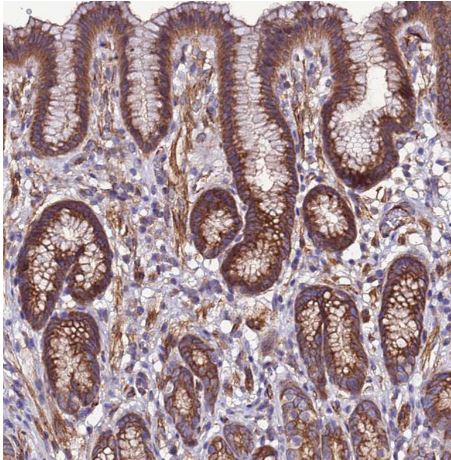
Immunohistochemistry-Paraffin: EI24 Antibody [NBP2-13949] -
Immunohistochemistry-Paraffin: EI24 Antibody [NBP2-13949] -Staining of human stomach shows strong cytoplasmic granular positivity in glandular cells.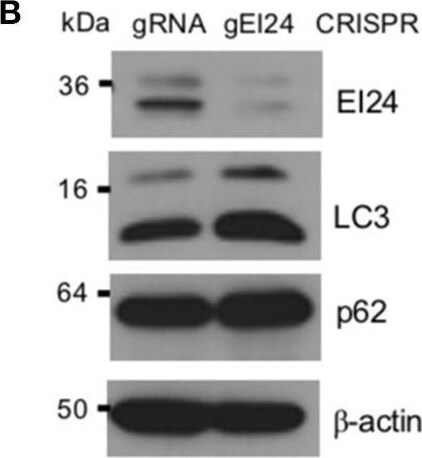
Western Blot: EI24 Antibody [NBP2-13949] -
Western Blot: EI24 Antibody [NBP2-13949] - Loss of EI24 expression using CRISPR-Cas9 in MIA PaCa-2 cells decreased cell proliferation. MIA PaCa-2 cells were transfected with CRISPR-Cas9 control (gRNA) & EI24 gRNA (gEI24) using a lentiviral system. (A) After 48 h of incubation, EI24 protein expression was observed by immunofluorescence staining using an anti-EI24 antibody. (B) After 48 h of incubation, the EI24 protein level was observed by western blotting using an anti-EI24 antibody. Conversion of LC3-I to LC3-II & p62 accumulation were analyzed by western blotting using anti-LC3 & anti-p62 antibodies, respectively. Graphs represent the mean ± SEM of EI24, LC3-II, & p62 densitometry value to that of beta -actin (with gRNA values set to 1) from three independent experiments. Comparison were made using Student's t-test, *P < 0.05; **P < 0.01; ***P < 0.001. (C) After 24 h of incubation, cells were seeded into a 96-well plate (1,000 cells/well). Images acquired by the IncuCyte instrument at the indicated times were analyzed using the ZOOM 2016 program. Confluency was measured in triplicate wells for each sample. Values represent the means ± SEM (Student's t-test, *P < 0.05; **P < 0.01; ***P < 0.001). (D) Control & EI24 gRNA-transfected cells (5 × 10⁶) were injected into both flanks of Balb/c nude mice. Tumor volume was measured on the indicated days. The y-axes of these graphs represent the fold change in tumor size relative to the initial tumor size. Values represent means ± SEM. (Student's t-test, n.s., not significant, control gRNA mice, n = 5; EI24 gRNA mice, n = 4). Image collected & cropped by CiteAb from the following publication (https://pubmed.ncbi.nlm.nih.gov/31396480), licensed under a CC-BY license. Not internally tested by Novus Biologicals.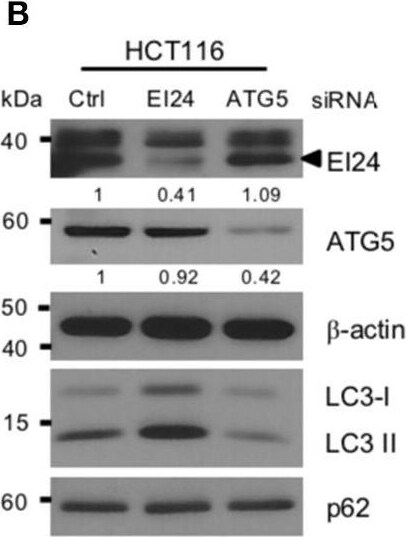
Western Blot: EI24 Antibody [NBP2-13949] -
Western Blot: EI24 Antibody [NBP2-13949] - Loss of EI24 expression in HCT116 cells impairs autophagy but not cell proliferation. HCT116 cells were transfected with 10 nM control siRNA (siCtrl) or siRNA targeting EI24 or ATG5. (A) The mRNA levels of EI24, ATG5, & GAPDH were analyzed by reverse-transcription PCR. (B) The protein levels of EI24 ATG5 & beta -actin were analyzed by western blotting. Representative data are shown. Values represent the ratio of the EI24 or ATG5 densitometry value to that of beta -actin (with siCtrl values set to 1). Conversion of LC3-I to LC3-II & p62 accumulation were analyzed by western blotting using anti-LC3 & anti-p62 antibodies, respectively. Graphs represent mean ± SEM of the LC3-II & p62 densitometry value to that of beta -actin (with siCtrl values set to 1) from three independent experiments. Comparison were made using Student's t-test, *P < 0.05; **P < 0.01. (C) After 24 h of transfection, cells were seeded into a 6-well plate & incubated for another 7 days. Cells were fixed & stained with crystal violet. (D) After 24 h of transfection, cells were seeded into a 96-well plate. Images acquired from the IncuCyte instrument at the indicated times were analyzed using the ZOOM 2016 program. Cell confluency was measured in triplicate wells for each sample. The plotted values represent means ± SEM. (E) Protein extracts from siRNA-transfected cells were analyzed for DNA fragmentation. The y-axes of the graphs indicate the extent of DNA fragmentation. Values plotted in the graphs represent means ± SEM (Student's t-test, n.s., not significant). Image collected & cropped by CiteAb from the following publication (https://pubmed.ncbi.nlm.nih.gov/31396480), licensed under a CC-BY license. Not internally tested by Novus Biologicals.Applications for EI24 Antibody - BSA Free
Application
Recommended Usage
Immunohistochemistry
1:50 - 1:200
Immunohistochemistry-Paraffin
1:50 - 1:200
Western Blot
0.04-0.4 ug/ml
Application Notes
For IHC-Paraffin, HIER pH 6 retrieval is recommended.
Formulation, Preparation, and Storage
Purification
Affinity purified
Formulation
PBS (pH 7.2) and 40% Glycerol
Format
BSA Free
Preservative
0.02% Sodium Azide
Concentration
Concentrations vary lot to lot. See vial label for concentration. If unlisted please contact technical services.
Shipping
The product is shipped with polar packs. Upon receipt, store it immediately at the temperature recommended below.
Stability & Storage
Store at 4C short term. Aliquot and store at -20C long term. Avoid freeze-thaw cycles.
Background: EI24
Alternate Names
EPG4, etoposide induced 2.4 mRNA, p53-induced gene 8 protein, PIG8etoposide-induced protein 2.4 homolog, TP53I8, tumor protein p53 inducible protein 8
Gene Symbol
EI24
Additional EI24 Products
Product Documents for EI24 Antibody - BSA Free
Certificate of Analysis
To download a Certificate of Analysis, please enter a lot or batch number in the search box below.
Product Specific Notices for EI24 Antibody - BSA Free
This product is for research use only and is not approved for use in humans or in clinical diagnosis. Primary Antibodies are guaranteed for 1 year from date of receipt.
Citations for EI24 Antibody - BSA Free
 Powered by Bioz
Customer Reviews for EI24 Antibody - BSA Free
There are currently no reviews for this product. Be the first to review EI24 Antibody - BSA Free and earn rewards!
Have you used EI24 Antibody - BSA Free?
Submit a review and receive an Amazon gift card!
$25/€18/£15/$25CAN/¥2500 for a review with an image
$10/€7/£6/$10CAN/¥1110 for a review without an image
Submit a review
Protocols
Find general support by application which include: protocols, troubleshooting, illustrated assays, videos and webinars.
- Antigen Retrieval Protocol (PIER)
- Antigen Retrieval for Frozen Sections Protocol
- Appropriate Fixation of IHC/ICC Samples
- Cellular Response to Hypoxia Protocols
- Chromogenic IHC Staining of Formalin-Fixed Paraffin-Embedded (FFPE) Tissue Protocol
- Chromogenic Immunohistochemistry Staining of Frozen Tissue
- ClariTSA™ Fluorophore Kits
- Detection & Visualization of Antibody Binding
- Fluorescent IHC Staining of Frozen Tissue Protocol
- Graphic Protocol for Heat-induced Epitope Retrieval
- Graphic Protocol for the Preparation and Fluorescent IHC Staining of Frozen Tissue Sections
- Graphic Protocol for the Preparation and Fluorescent IHC Staining of Paraffin-embedded Tissue Sections
- Graphic Protocol for the Preparation of Gelatin-coated Slides for Histological Tissue Sections
- IHC Sample Preparation (Frozen sections vs Paraffin)
- Immunofluorescent IHC Staining of Formalin-Fixed Paraffin-Embedded (FFPE) Tissue Protocol
- Immunohistochemistry (IHC) and Immunocytochemistry (ICC) Protocols
- Immunohistochemistry Frozen Troubleshooting
- Immunohistochemistry Paraffin Troubleshooting
- Preparing Samples for IHC/ICC Experiments
- Preventing Non-Specific Staining (Non-Specific Binding)
- Primary Antibody Selection & Optimization
- Protocol for Heat-Induced Epitope Retrieval (HIER)
- Protocol for Making a 4% Formaldehyde Solution in PBS
- Protocol for VisUCyte™ HRP Polymer Detection Reagent
- Protocol for the Preparation & Fixation of Cells on Coverslips
- Protocol for the Preparation and Chromogenic IHC Staining of Frozen Tissue Sections
- Protocol for the Preparation and Chromogenic IHC Staining of Frozen Tissue Sections - Graphic
- Protocol for the Preparation and Chromogenic IHC Staining of Paraffin-embedded Tissue Sections
- Protocol for the Preparation and Chromogenic IHC Staining of Paraffin-embedded Tissue Sections - Graphic
- Protocol for the Preparation and Fluorescent IHC Staining of Frozen Tissue Sections
- Protocol for the Preparation and Fluorescent IHC Staining of Paraffin-embedded Tissue Sections
- Protocol for the Preparation of Gelatin-coated Slides for Histological Tissue Sections
- R&D Systems Quality Control Western Blot Protocol
- TUNEL and Active Caspase-3 Detection by IHC/ICC Protocol
- The Importance of IHC/ICC Controls
- Troubleshooting Guide: Immunohistochemistry
- Troubleshooting Guide: Western Blot Figures
- Western Blot Conditions
- Western Blot Protocol
- Western Blot Protocol for Cell Lysates
- Western Blot Troubleshooting
- Western Blot Troubleshooting Guide
- View all Protocols, Troubleshooting, Illustrated assays and Webinars
Loading...