

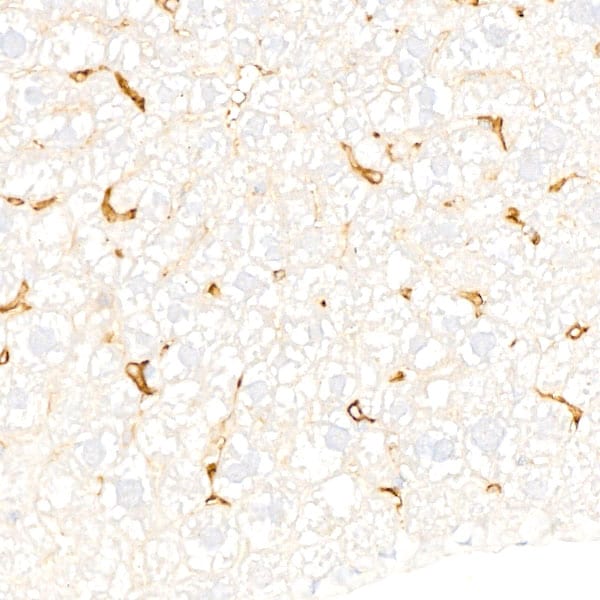
Scientific images may be resized, cropped, or adjusted for brightness or contrast for presentation purposes. These updates are limited to presentation and do not affect the underlying scientific interpretation of the data. Where available, additional source data may be provided upon request.
Loading...
Key Product Details
Species Reactivity
Mouse, Rat
Applications
Immunohistochemistry, Immunohistochemistry-Paraffin, ELISA
Label
Unconjugated
Antibody Source
Monoclonal Rabbit IgG Clone # 4J7L6
Loading...
Product Specifications
Immunogen
Recombinant fusion protein containing a sequence corresponding to amino acids 367-645 of mouse F4/80(NP_034260.1).
Sequence:
KRILFKCKEDLILQSEQIQQCQAVQGRDLGYASFCTLVNATFTILDNTCENKSAPVSLQSAATSVSLVLEQATTWFELSKEETSTLGTILLETVESTMLAALLIPSGNASQMIQTEYLDIESKVINEECKENESINLAARGDKMNVGCFIIKESVSTGAPGVAFVSFAHMESVLNERFFEDGQSFRKLRMNSRVVGGTVTGEKKEDFSKPIIYTLQHIQPKQKSERPICVSWNTDVEDGRWTPSGCEIVEASETHTVCSCNRMANLAIIMASGELTMEF
Sequence:
KRILFKCKEDLILQSEQIQQCQAVQGRDLGYASFCTLVNATFTILDNTCENKSAPVSLQSAATSVSLVLEQATTWFELSKEETSTLGTILLETVESTMLAALLIPSGNASQMIQTEYLDIESKVINEECKENESINLAARGDKMNVGCFIIKESVSTGAPGVAFVSFAHMESVLNERFFEDGQSFRKLRMNSRVVGGTVTGEKKEDFSKPIIYTLQHIQPKQKSERPICVSWNTDVEDGRWTPSGCEIVEASETHTVCSCNRMANLAIIMASGELTMEF
Clonality
Monoclonal
Host
Rabbit
Isotype
IgG
Theoretical MW
102 kDa.
Disclaimer note: The observed molecular weight of the protein may vary from the listed predicted molecular weight due to post translational modifications, post translation cleavages, relative charges, and other experimental factors.
Disclaimer note: The observed molecular weight of the protein may vary from the listed predicted molecular weight due to post translational modifications, post translation cleavages, relative charges, and other experimental factors.
Scientific Data Images for F4/80 Antibody (4J7L6)
Immunohistochemistry: F4/80 Antibody (4J7L6) [NBP3-33457] -
Immunohistochemistry: F4/80 Antibody (4J7L6) [NBP3-33457] - Immunohistochemistry analysis of paraffin-embedded Mouse spleen using F4/80 Rabbit mAb at dilution of 1:200 (40x lens). High pressure antigen retrieval performed with 0.01M Citrate Bufferr (pH 6.0) prior to IHC staining.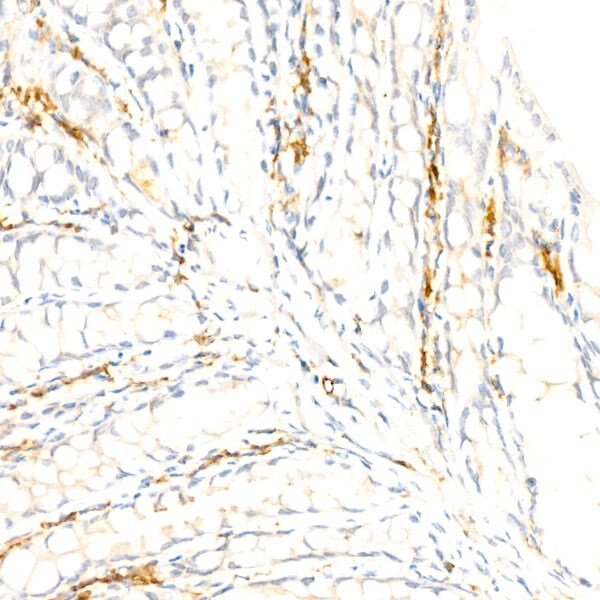
Immunohistochemistry: F4/80 Antibody (4J7L6) [NBP3-33457] -
Immunohistochemistry: F4/80 Antibody (4J7L6) [NBP3-33457] - Immunohistochemistry analysis of paraffin-embedded Mouse liver using F4/80 Rabbit mAb at dilution of 1:200 (40x lens). High pressure antigen retrieval performed with 0.01M Citrate Bufferr (pH 6.0) prior to IHC staining.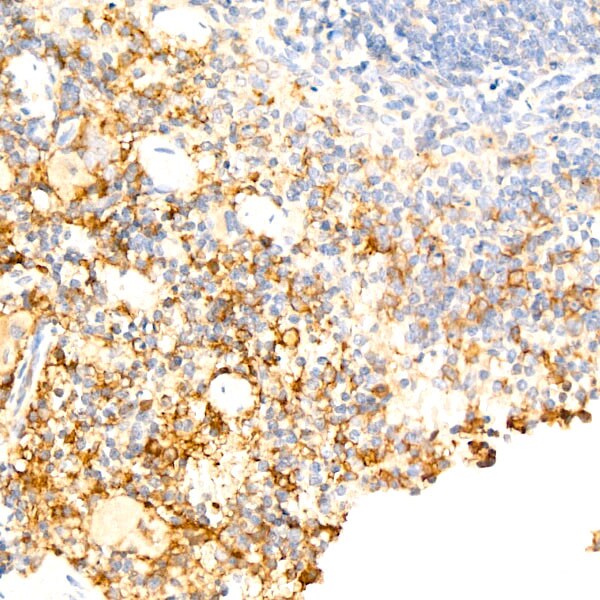
Immunohistochemistry: F4/80 Antibody (4J7L6) [NBP3-33457] -
Immunohistochemistry: F4/80 Antibody (4J7L6) [NBP3-33457] - Immunohistochemistry analysis of paraffin-embedded mouse spleen using F4/80 Rabbit mAb at dilution of 1:200 (40x lens).Perform high pressure antigen retrieval with 10 mM citrate buffer pH 6.0 before commencing with IHC staining protocol.Applications for F4/80 Antibody (4J7L6)
Application
Recommended Usage
ELISA
Recommended starting concentration is 1 ug/mL
Immunohistochemistry
1:300 - 1:1200
Immunohistochemistry-Paraffin
1:300 - 1:1200
Formulation, Preparation, and Storage
Purification
Affinity purified
Formulation
PBS (pH 7.3), 50% glycerol, 0.05% BSA
Preservative
0.02% Sodium Azide
Concentration
Please see the vial label for concentration. If unlisted please contact technical services.
Shipping
The product is shipped with polar packs. Upon receipt, store it immediately at the temperature recommended below.
Stability & Storage
Store at -20C. Avoid freeze-thaw cycles.
Background: F4/80
Depending on factors such as differentiation, activation, and location, the level of F4/80 expression can vary between cell-types (1,2). For example, peritoneal macrophages are subdivided based on morphology and expression with large peritoneal macrophages having high levels of F4/80 and small peritoneal macrophages having low F4/80 expression (1). Furthermore, splenic macrophages are classified based on location (red pulp, marginal zone, and white pulp) and F4/80 expression level varies within these populations as well; the red pulp macrophages have high levels of F4/80 and CD68 by comparison (1). Originally, the F4/80 monoclonal antibody was generated for a macrophage-specific surface antigen, however F4/80 staining is also observed in other hematopoietic cell populations, thus other immune cell markers should be used in conjunction with F4/80 to distinguish between different populations (1). Though the full extent of F4/80 ligands and biological functions remains elusive, studies have suggested that F4/80 is critical for macrophage-natural killer cell interaction and cytokine release (1,2). Additionally, a study of anterior chamber-associated immune deviation (ACAID) indicated a possible role for F4/80 in the generation of regulatory T cells (1,2).
References
1. Dos Anjos Cassado A. (2017). F4/80 as a Major Macrophage Marker: The Case of the Peritoneum and Spleen. Results and Problems in Cell Differentiation. https://doi.org/10.1007/978-3-319-54090-0_7
2. Hamann, J., Hsiao, C. C., Lee, C. S., Ravichandran, K. S., & Lin, H. H. (2016). Adhesion GPCRs as Modulators of Immune Cell Function. Handbook of Experimental Pharmacology. https://doi.org/10.1007/978-3-319-41523-9_15
Alternate Names
DD7A5-7, Gpf480, Ly71
Gene Symbol
Adgre1
Additional F4/80 Products
Product Documents for F4/80 Antibody (4J7L6)
Certificate of Analysis
To download a Certificate of Analysis, please enter a lot or batch number in the search box below.
Product Specific Notices for F4/80 Antibody (4J7L6)
This product is for research use only and is not approved for use in humans or in clinical diagnosis. Primary Antibodies are guaranteed for 1 year from date of receipt.
Related Research Areas
Customer Reviews for F4/80 Antibody (4J7L6)
There are currently no reviews for this product. Be the first to review F4/80 Antibody (4J7L6) and earn rewards!
Have you used F4/80 Antibody (4J7L6)?
Submit a review and receive an Amazon gift card!
$25/€18/£15/$25CAN/¥2500 for a review with an image
$10/€7/£6/$10CAN/¥1110 for a review without an image
Submit a review
Protocols
Find general support by application which include: protocols, troubleshooting, illustrated assays, videos and webinars.
- Antigen Retrieval Protocol (PIER)
- Antigen Retrieval for Frozen Sections Protocol
- Appropriate Fixation of IHC/ICC Samples
- Cellular Response to Hypoxia Protocols
- Chromogenic IHC Staining of Formalin-Fixed Paraffin-Embedded (FFPE) Tissue Protocol
- Chromogenic Immunohistochemistry Staining of Frozen Tissue
- ClariTSA™ Fluorophore Kits
- Detection & Visualization of Antibody Binding
- ELISA Sample Preparation & Collection Guide
- ELISA Troubleshooting Guide
- Fluorescent IHC Staining of Frozen Tissue Protocol
- Graphic Protocol for Heat-induced Epitope Retrieval
- Graphic Protocol for the Preparation and Fluorescent IHC Staining of Frozen Tissue Sections
- Graphic Protocol for the Preparation and Fluorescent IHC Staining of Paraffin-embedded Tissue Sections
- Graphic Protocol for the Preparation of Gelatin-coated Slides for Histological Tissue Sections
- How to Run an R&D Systems DuoSet ELISA
- How to Run an R&D Systems Quantikine ELISA
- How to Run an R&D Systems Quantikine™ QuicKit™ ELISA
- IHC Sample Preparation (Frozen sections vs Paraffin)
- Immunofluorescent IHC Staining of Formalin-Fixed Paraffin-Embedded (FFPE) Tissue Protocol
- Immunohistochemistry (IHC) and Immunocytochemistry (ICC) Protocols
- Immunohistochemistry Frozen Troubleshooting
- Immunohistochemistry Paraffin Troubleshooting
- Preparing Samples for IHC/ICC Experiments
- Preventing Non-Specific Staining (Non-Specific Binding)
- Primary Antibody Selection & Optimization
- Protocol for Heat-Induced Epitope Retrieval (HIER)
- Protocol for Making a 4% Formaldehyde Solution in PBS
- Protocol for VisUCyte™ HRP Polymer Detection Reagent
- Protocol for the Preparation & Fixation of Cells on Coverslips
- Protocol for the Preparation and Chromogenic IHC Staining of Frozen Tissue Sections
- Protocol for the Preparation and Chromogenic IHC Staining of Frozen Tissue Sections - Graphic
- Protocol for the Preparation and Chromogenic IHC Staining of Paraffin-embedded Tissue Sections
- Protocol for the Preparation and Chromogenic IHC Staining of Paraffin-embedded Tissue Sections - Graphic
- Protocol for the Preparation and Fluorescent IHC Staining of Frozen Tissue Sections
- Protocol for the Preparation and Fluorescent IHC Staining of Paraffin-embedded Tissue Sections
- Protocol for the Preparation of Gelatin-coated Slides for Histological Tissue Sections
- Quantikine HS ELISA Kit Assay Principle, Alkaline Phosphatase
- Quantikine HS ELISA Kit Principle, Streptavidin-HRP Polymer
- Sandwich ELISA (Colorimetric) – Biotin/Streptavidin Detection Protocol
- Sandwich ELISA (Colorimetric) – Direct Detection Protocol
- TUNEL and Active Caspase-3 Detection by IHC/ICC Protocol
- The Importance of IHC/ICC Controls
- Troubleshooting Guide: ELISA
- Troubleshooting Guide: Immunohistochemistry
- View all Protocols, Troubleshooting, Illustrated assays and Webinars
FAQs for F4/80 Antibody (4J7L6)
Showing
1
-
3 of
3 FAQs
Showing All
-
Q: Are the F4/80/EMR1 antibodies validated in Simple Western?
A: No, F4/80/EMR1 antibodies are not tested in Simple Western at this moment.
-
Q: Does F4/80/EMR1 antibodies come in lyophilized form?
A: Yes, we carry 2 F4/80 antibodies in lyophilized form: MAB5580 and NBP1-06975
-
Q: What is the theoretical molecular weight for F4/80/EMR1 antibodies?
A: The TMW of F4/80/EMR1 antibodies is approximately 160 kDa.
-
Q: Are the F4/80/EMR1 antibodies validated in Simple Western?
A: No, F4/80/EMR1 antibodies are not tested in Simple Western at this moment.
-
Q: Does F4/80/EMR1 antibodies come in lyophilized form?
A: Yes, we carry 2 F4/80 antibodies in lyophilized form: MAB5580 and NBP1-06975
-
Q: What is the theoretical molecular weight for F4/80/EMR1 antibodies?
A: The TMW of F4/80/EMR1 antibodies is approximately 160 kDa.
-
Q: Are the F4/80/EMR1 antibodies validated in Simple Western?
A: No, F4/80/EMR1 antibodies are not tested in Simple Western at this moment.
-
Q: Does F4/80/EMR1 antibodies come in lyophilized form?
A: Yes, we carry 2 F4/80 antibodies in lyophilized form: MAB5580 and NBP1-06975
-
Q: What is the theoretical molecular weight for F4/80/EMR1 antibodies?
A: The TMW of F4/80/EMR1 antibodies is approximately 160 kDa.
Loading...