
F4/80 Antibody (521204) [Janelia Fluor® 549]
Novus Biologicals | Catalog # FAB5580I

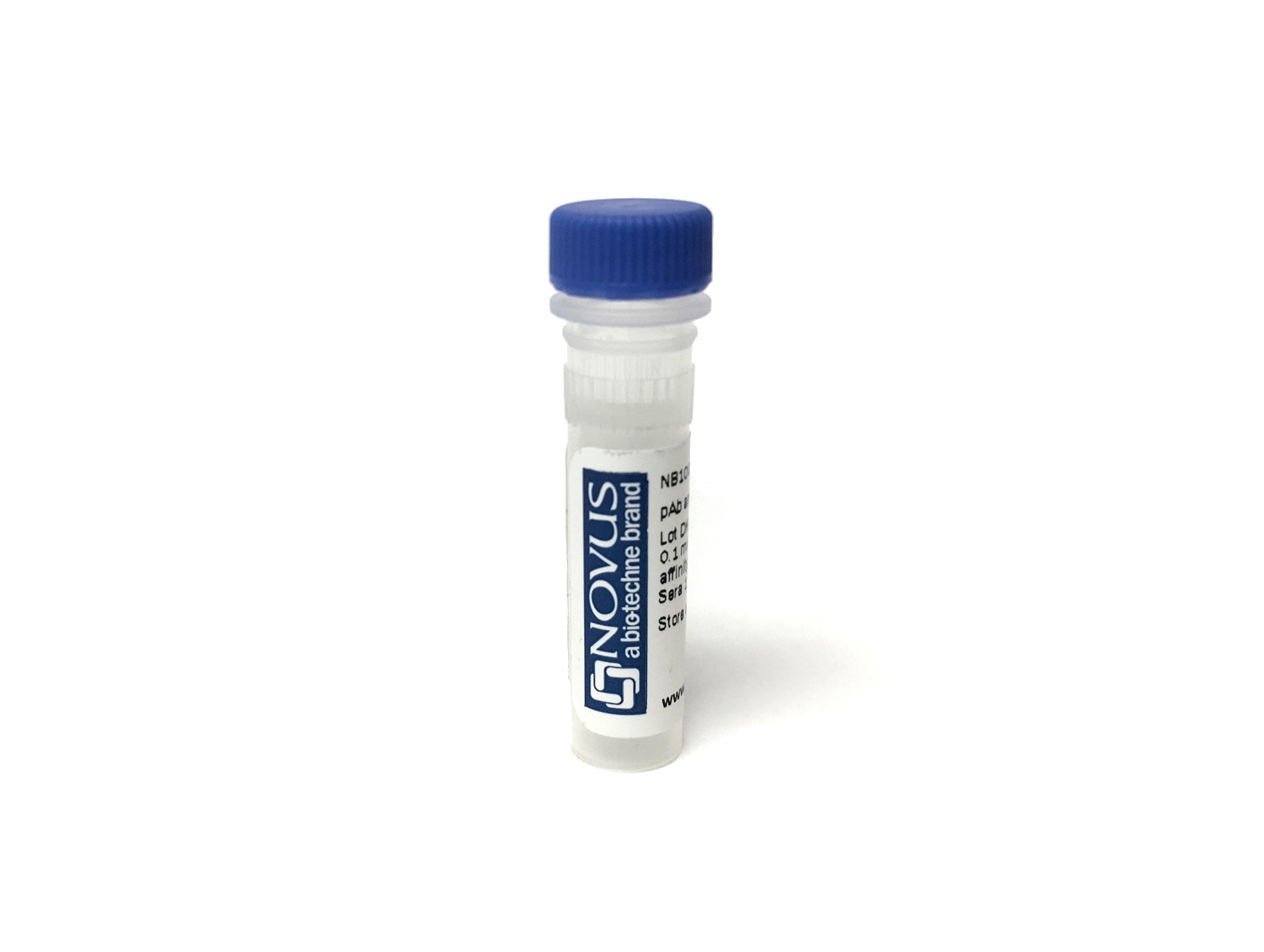
Key Product Details
Species Reactivity
Mouse
Applications
Flow Cytometry, Immunocytochemistry, CyTOF-ready
Label
Janelia Fluor 549
Antibody Source
Recombinant Monoclonal Rat IgG2A Clone # 521204
Loading...
Product Specifications
Immunogen
NS0 mouse myeloma cell line transfected with mouse F4/80/EMR1
Gln28-Gly931
Accession # Q61549
Gln28-Gly931
Accession # Q61549
Specificity
Detects mouse F4/80/EMR1.
Clonality
Monoclonal
Host
Rat
Isotype
IgG2A
Description
This conjugate is made on demand and is not held in inventory. Each order represents a unique lot. All conjugates are generated using validated conjugation protocols and meet strict degree of labeling (F/P) specifications; additional information is available upon request. The antibody concentration is provided on the individual product label.
For specialized conjugation needs, like large quantities, specific concentrations, and defined F/P ratios, bulk and custom antibody conjugation services are available.
For specialized conjugation needs, like large quantities, specific concentrations, and defined F/P ratios, bulk and custom antibody conjugation services are available.
Applications for F4/80 Antibody (521204) [Janelia Fluor® 549]
Application
Recommended Usage
CyTOF-ready
Optimal dilutions of this antibody should be experimentally determined.
Flow Cytometry
Optimal dilutions of this antibody should be experimentally determined.
Immunocytochemistry
Optimal dilutions of this antibody should be experimentally determined.
Application Notes
Recommended applications are based on validated applications from the unconjugated base product MAB5580. This conjugated antibody is not kept in inventory and is made to order using validated conjugation protocols.
Spectra Viewer
Plan Your Experiments
Use our spectra viewer to interactively plan your experiments, assessing multiplexing options. View the excitation and emission spectra for our fluorescent dye range and other commonly used dyes.
Spectra Viewer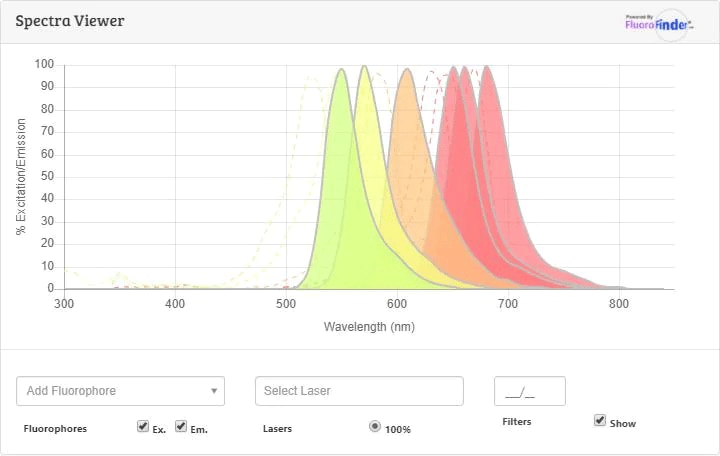
Flow Cytometry Panel Builder
Bio-Techne Knows Flow Cytometry
Save time and reduce costly mistakes by quickly finding compatible reagents using the Panel Builder Tool.
Advanced Features
- Spectra Viewer - Custom analysis of spectra from multiple fluorochromes
- Spillover Popups - Visualize the spectra of individual fluorochromes
- Antigen Density Selector - Match fluorochrome brightness with antigen density

Formulation, Preparation, and Storage
Purification
Protein A or G purified from hybridoma culture supernatant
Formulation
50mM Sodium Borate
Preservative
0.05% Sodium Azide
Concentration
Please see the vial label for concentration. If unlisted please contact technical services.
Shipping
The product is shipped with polar packs. Upon receipt, store it immediately at the temperature recommended below.
Stability & Storage
Store at 4C in the dark.
Background: F4/80
Depending on factors such as differentiation, activation, and location, the level of F4/80 expression can vary between cell-types (1,2). For example, peritoneal macrophages are subdivided based on morphology and expression with large peritoneal macrophages having high levels of F4/80 and small peritoneal macrophages having low F4/80 expression (1). Furthermore, splenic macrophages are classified based on location (red pulp, marginal zone, and white pulp) and F4/80 expression level varies within these populations as well; the red pulp macrophages have high levels of F4/80 and CD68 by comparison (1). Originally, the F4/80 monoclonal antibody was generated for a macrophage-specific surface antigen, however F4/80 staining is also observed in other hematopoietic cell populations, thus other immune cell markers should be used in conjunction with F4/80 to distinguish between different populations (1). Though the full extent of F4/80 ligands and biological functions remains elusive, studies have suggested that F4/80 is critical for macrophage-natural killer cell interaction and cytokine release (1,2). Additionally, a study of anterior chamber-associated immune deviation (ACAID) indicated a possible role for F4/80 in the generation of regulatory T cells (1,2).
References
1. Dos Anjos Cassado A. (2017). F4/80 as a Major Macrophage Marker: The Case of the Peritoneum and Spleen. Results and Problems in Cell Differentiation. https://doi.org/10.1007/978-3-319-54090-0_7
2. Hamann, J., Hsiao, C. C., Lee, C. S., Ravichandran, K. S., & Lin, H. H. (2016). Adhesion GPCRs as Modulators of Immune Cell Function. Handbook of Experimental Pharmacology. https://doi.org/10.1007/978-3-319-41523-9_15
Alternate Names
DD7A5-7, Gpf480, Ly71
Gene Symbol
Adgre1
Additional F4/80 Products
Product Documents for F4/80 Antibody (521204) [Janelia Fluor® 549]
Certificate of Analysis
To download a Certificate of Analysis, please enter a lot or batch number in the search box below.
Product Specific Notices for F4/80 Antibody (521204) [Janelia Fluor® 549]
Sold under license from the Howard Hughes Medical Institute, Janelia Research Campus.
This product is for research use only and is not approved for use in humans or in clinical diagnosis. Primary Antibodies are guaranteed for 1 year from date of receipt.
Related Research Areas
Customer Reviews for F4/80 Antibody (521204) [Janelia Fluor® 549]
There are currently no reviews for this product. Be the first to review F4/80 Antibody (521204) [Janelia Fluor® 549] and earn rewards!
Have you used F4/80 Antibody (521204) [Janelia Fluor® 549]?
Submit a review and receive an Amazon gift card!
$25/€18/£15/$25CAN/¥2500 for a review with an image
$10/€7/£6/$10CAN/¥1110 for a review without an image
Submit a review
Protocols
Find general support by application which include: protocols, troubleshooting, illustrated assays, videos and webinars.
- 7-Amino Actinomycin D (7-AAD) Cell Viability Flow Cytometry Protocol
- Appropriate Fixation of IHC/ICC Samples
- Cellular Response to Hypoxia Protocols
- ClariTSA™ Fluorophore Kits
- Detection & Visualization of Antibody Binding
- Extracellular Membrane Flow Cytometry Protocol
- Flow Cytometry Protocol for Cell Surface Markers
- Flow Cytometry Protocol for Staining Membrane Associated Proteins
- Flow Cytometry Staining Protocols
- Flow Cytometry Troubleshooting Guide
- ICC Cell Smear Protocol for Suspension Cells
- ICC Immunocytochemistry Protocol Videos
- ICC for Adherent Cells
- Immunocytochemistry (ICC) Protocol
- Immunocytochemistry Troubleshooting
- Immunofluorescence of Organoids Embedded in Cultrex Basement Membrane Extract
- Immunohistochemistry (IHC) and Immunocytochemistry (ICC) Protocols
- Intracellular Flow Cytometry Protocol Using Alcohol (Methanol)
- Intracellular Flow Cytometry Protocol Using Detergents
- Intracellular Nuclear Staining Flow Cytometry Protocol Using Detergents
- Intracellular Staining Flow Cytometry Protocol Using Alcohol Permeabilization
- Intracellular Staining Flow Cytometry Protocol Using Detergents to Permeabilize Cells
- Preparing Samples for IHC/ICC Experiments
- Preventing Non-Specific Staining (Non-Specific Binding)
- Primary Antibody Selection & Optimization
- Propidium Iodide Cell Viability Flow Cytometry Protocol
- Protocol for Liperfluo
- Protocol for VisUCyte™ HRP Polymer Detection Reagent
- Protocol for the Characterization of Human Th22 Cells
- Protocol for the Characterization of Human Th9 Cells
- Protocol for the Fluorescent ICC Staining of Cell Smears - Graphic
- Protocol for the Fluorescent ICC Staining of Cultured Cells on Coverslips - Graphic
- Protocol for the Preparation and Fluorescent ICC Staining of Cells on Coverslips
- Protocol for the Preparation and Fluorescent ICC Staining of Non-adherent Cells
- Protocol for the Preparation and Fluorescent ICC Staining of Stem Cells on Coverslips
- Protocol for the Preparation of a Cell Smear for Non-adherent Cell ICC - Graphic
- Protocol: Annexin V and PI Staining by Flow Cytometry
- Protocol: Annexin V and PI Staining for Apoptosis by Flow Cytometry
- TUNEL and Active Caspase-3 Detection by IHC/ICC Protocol
- The Importance of IHC/ICC Controls
- Troubleshooting Guide: Fluorokine Flow Cytometry Kits
- View all Protocols, Troubleshooting, Illustrated assays and Webinars
FAQs for F4/80 Antibody (521204) [Janelia Fluor® 549]
Showing
1
-
3 of
3 FAQs
Showing All
-
Q: Are the F4/80/EMR1 antibodies validated in Simple Western?
A: No, F4/80/EMR1 antibodies are not tested in Simple Western at this moment.
-
Q: Does F4/80/EMR1 antibodies come in lyophilized form?
A: Yes, we carry 2 F4/80 antibodies in lyophilized form: MAB5580 and NBP1-06975
-
Q: What is the theoretical molecular weight for F4/80/EMR1 antibodies?
A: The TMW of F4/80/EMR1 antibodies is approximately 160 kDa.
-
Q: Are the F4/80/EMR1 antibodies validated in Simple Western?
A: No, F4/80/EMR1 antibodies are not tested in Simple Western at this moment.
-
Q: Does F4/80/EMR1 antibodies come in lyophilized form?
A: Yes, we carry 2 F4/80 antibodies in lyophilized form: MAB5580 and NBP1-06975
-
Q: What is the theoretical molecular weight for F4/80/EMR1 antibodies?
A: The TMW of F4/80/EMR1 antibodies is approximately 160 kDa.
-
Q: Are the F4/80/EMR1 antibodies validated in Simple Western?
A: No, F4/80/EMR1 antibodies are not tested in Simple Western at this moment.
-
Q: Does F4/80/EMR1 antibodies come in lyophilized form?
A: Yes, we carry 2 F4/80 antibodies in lyophilized form: MAB5580 and NBP1-06975
-
Q: What is the theoretical molecular weight for F4/80/EMR1 antibodies?
A: The TMW of F4/80/EMR1 antibodies is approximately 160 kDa.
Loading...