
Human Leukocyte Antigen-F Associated Transcript 10 (FAT10), also known as Ubiquitin D (UBD), is a 165 amino acid (aa) member of the Ubiquitin-like family of proteins. Human FAT10 has a predicted molecular weight of 18.5 kDa and shares 69% aa sequence identity with mouse FAT10. Human FAT10 mRNA is expressed as a single transcript in lymphoblastoid lines and dendritic cells, but more than one mRNA transcript has been identified for murine FAT10. FAT10 can also be induced by IFN-gamma and TNF-alpha in some cell lines. Structurally, FAT10 consists of two Ubiquitin-like domains that are connected by a short linker. Like Ubiquitin, FAT10 has a C-terminal glycine residue that can be used to form isopeptide bonds with target proteins. FAT10-conjugated proteins are targeted to the proteasome where the 26S Proteasome subunit S5a/Angiocidin binds to FAT10 and enables subsequent degradation of the conjugated protein. In addition to S5a/Angiocidin, FAT10 has been shown to interact with Huntingtin, Ataxin-1, MAD2, and NUB1L. FAT10 has been implicated in a number of biological processes such as cell cycle control, antigen presentation, and cytokine response.
FAT10 Antibody (24GB2125)
Novus Biologicals | Catalog # NBP3-50617

Loading...
Key Product Details
Species Reactivity
Human, Mouse
Applications
Western Blot, Flow Cytometry, Immunocytochemistry/ Immunofluorescence
Label
Unconjugated
Antibody Source
Monoclonal Rabbit IgG Clone # 24GB2125
Loading...
Product Specifications
Immunogen
A synthesized peptide derived from human FAT10 (Uniprot: O15205)
Clonality
Monoclonal
Host
Rabbit
Isotype
IgG
Scientific Data Images for FAT10 Antibody (24GB2125)
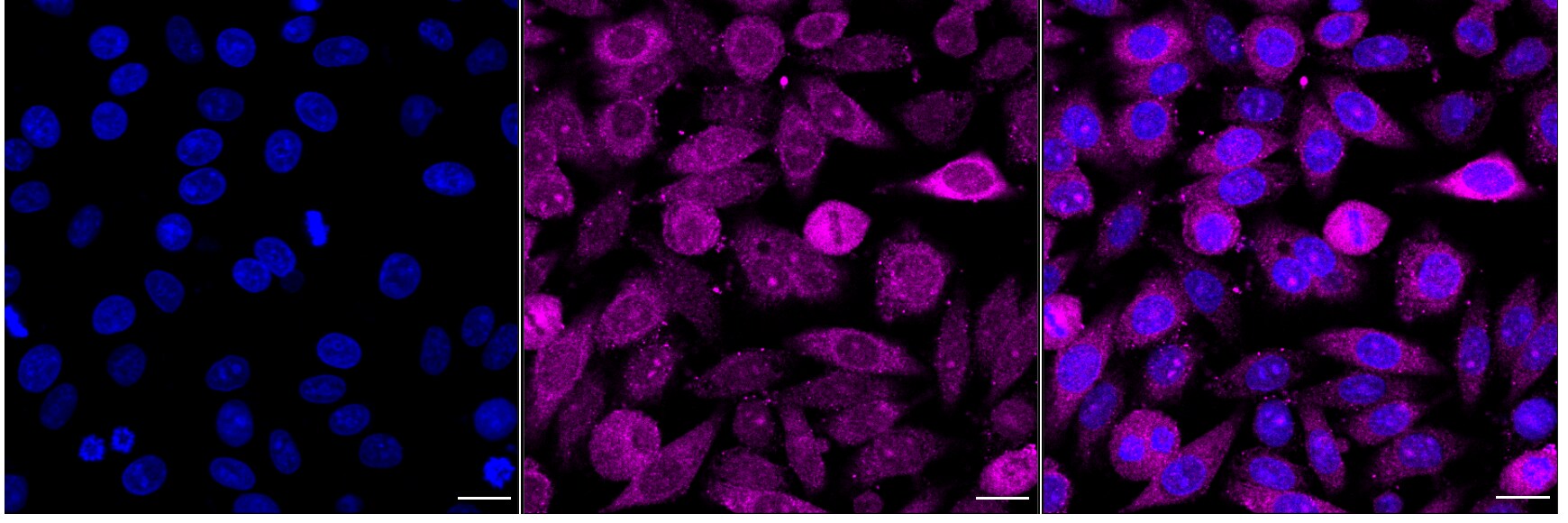
Immunocytochemistry/ Immunofluorescence: FAT10 Antibody (24GB2125)[NBP3-50617] -
Immunocytochemical staining of HepG2 cells with FAT10 antibody(1:1,000). Nuclei were stained blue with DAPI; FAT10 was stained magenta with Alexa Fluor(R) 647. Images were taken using Leica stellaris 5. Protein abundance based on laser Intensity and smart gain: Medium. Scale bar, 20 um.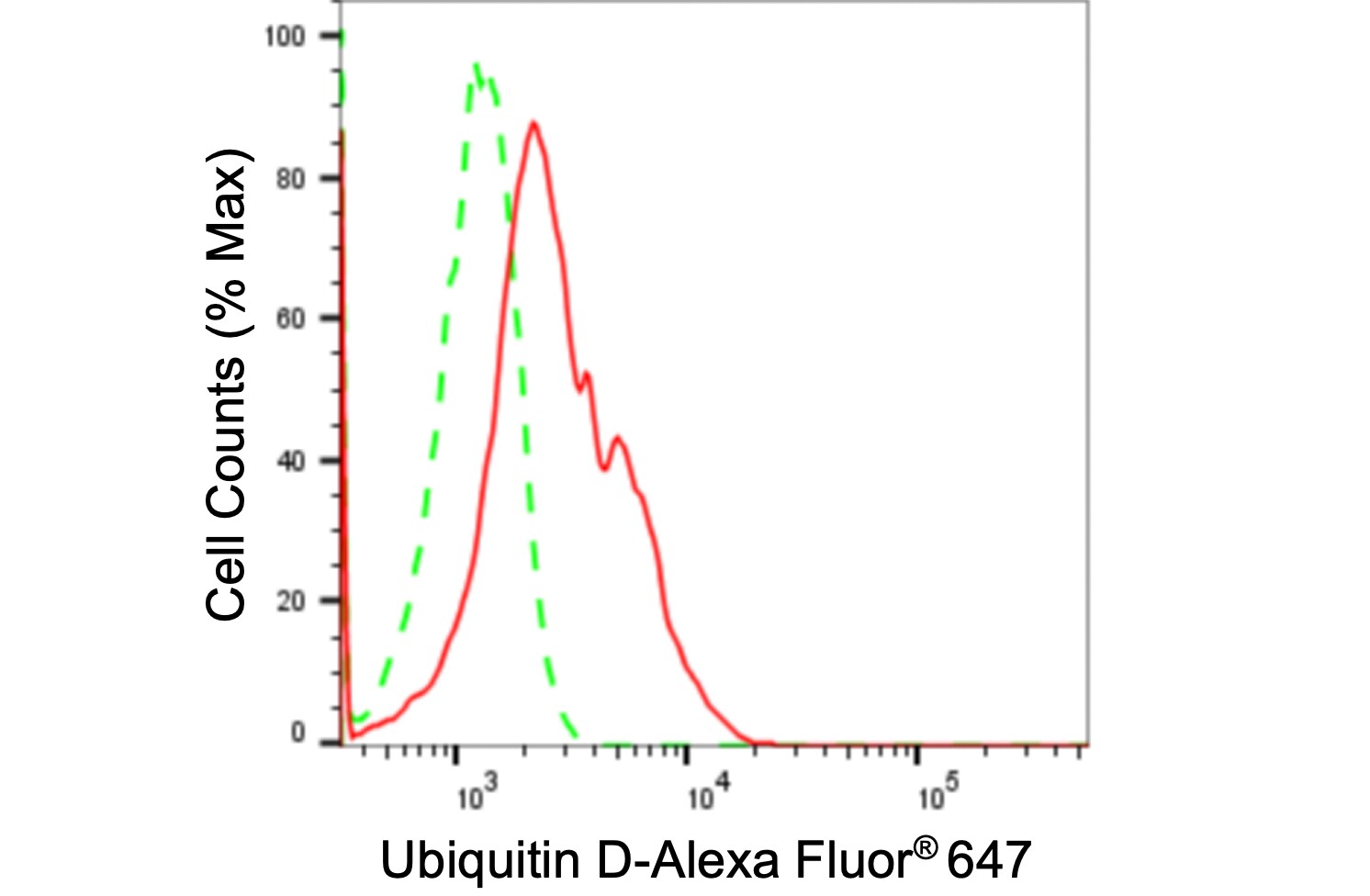
Flow Cytometry: FAT10 Antibody (24GB2125)[NBP3-50617] -
Flow cytometric analysis of FAT10expression in HepG2 cells using FAT10 antibody (1:2,000). Green, isotype control; red, Ubiquitin D.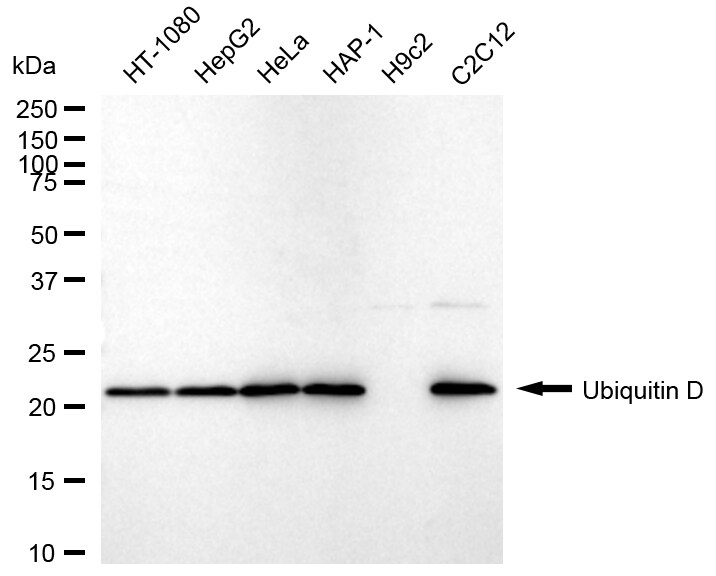
Western Blot: FAT10 Antibody (24GB2125)[NBP3-50617] -
Western blotting analysis using FAT10 antibody (1:5,000) and HRP-conjugated goat anti-rabbit secondary antibody (1:20,000) respectively. Image was developed using FeQ(TM) ECL Substrate Kit.Applications for FAT10 Antibody (24GB2125)
Application
Recommended Usage
Flow Cytometry
Optimal dilutions of this antibody should be experimentally determined.
Immunocytochemistry/ Immunofluorescence
Optimal dilutions of this antibody should be experimentally determined.
Western Blot
Optimal dilutions of this antibody should be experimentally determined.
Flow Cytometry Panel Builder
Bio-Techne Knows Flow Cytometry
Save time and reduce costly mistakes by quickly finding compatible reagents using the Panel Builder Tool.
Advanced Features
- Spectra Viewer - Custom analysis of spectra from multiple fluorochromes
- Spillover Popups - Visualize the spectra of individual fluorochromes
- Antigen Density Selector - Match fluorochrome brightness with antigen density

Formulation, Preparation, and Storage
Purification
Affinity purified
Formulation
PBS (pH 7.4), 50% glycerol
Preservative
0.02% Sodium Azide
Concentration
Please see the vial label for concentration. If unlisted please contact technical services.
Shipping
The product is shipped with polar packs. Upon receipt, store it immediately at the temperature recommended below.
Stability & Storage
Store at -20C. Avoid freeze-thaw cycles.
Background: FAT10
Alternate Names
UBD
Gene Symbol
UBD
Additional FAT10 Products
Product Documents for FAT10 Antibody (24GB2125)
Certificate of Analysis
To download a Certificate of Analysis, please enter a lot or batch number in the search box below.
Product Specific Notices for FAT10 Antibody (24GB2125)
This product is for research use only and is not approved for use in humans or in clinical diagnosis. Primary Antibodies are guaranteed for 1 year from date of receipt.
Related Research Areas
Customer Reviews for FAT10 Antibody (24GB2125)
There are currently no reviews for this product. Be the first to review FAT10 Antibody (24GB2125) and earn rewards!
Have you used FAT10 Antibody (24GB2125)?
Submit a review and receive an Amazon gift card!
$25/€18/£15/$25CAN/¥2500 for a review with an image
$10/€7/£6/$10CAN/¥1110 for a review without an image
Submit a review
Protocols
Find general support by application which include: protocols, troubleshooting, illustrated assays, videos and webinars.
- 7-Amino Actinomycin D (7-AAD) Cell Viability Flow Cytometry Protocol
- Appropriate Fixation of IHC/ICC Samples
- Cellular Response to Hypoxia Protocols
- ClariTSA™ Fluorophore Kits
- Detection & Visualization of Antibody Binding
- Extracellular Membrane Flow Cytometry Protocol
- Flow Cytometry Protocol for Cell Surface Markers
- Flow Cytometry Protocol for Staining Membrane Associated Proteins
- Flow Cytometry Staining Protocols
- Flow Cytometry Troubleshooting Guide
- ICC Cell Smear Protocol for Suspension Cells
- ICC Immunocytochemistry Protocol Videos
- ICC for Adherent Cells
- Immunocytochemistry (ICC) Protocol
- Immunocytochemistry Troubleshooting
- Immunofluorescence of Organoids Embedded in Cultrex Basement Membrane Extract
- Immunohistochemistry (IHC) and Immunocytochemistry (ICC) Protocols
- Intracellular Flow Cytometry Protocol Using Alcohol (Methanol)
- Intracellular Flow Cytometry Protocol Using Detergents
- Intracellular Nuclear Staining Flow Cytometry Protocol Using Detergents
- Intracellular Staining Flow Cytometry Protocol Using Alcohol Permeabilization
- Intracellular Staining Flow Cytometry Protocol Using Detergents to Permeabilize Cells
- Preparing Samples for IHC/ICC Experiments
- Preventing Non-Specific Staining (Non-Specific Binding)
- Primary Antibody Selection & Optimization
- Propidium Iodide Cell Viability Flow Cytometry Protocol
- Protocol for Liperfluo
- Protocol for VisUCyte™ HRP Polymer Detection Reagent
- Protocol for the Characterization of Human Th22 Cells
- Protocol for the Characterization of Human Th9 Cells
- Protocol for the Fluorescent ICC Staining of Cell Smears - Graphic
- Protocol for the Fluorescent ICC Staining of Cultured Cells on Coverslips - Graphic
- Protocol for the Preparation and Fluorescent ICC Staining of Cells on Coverslips
- Protocol for the Preparation and Fluorescent ICC Staining of Non-adherent Cells
- Protocol for the Preparation and Fluorescent ICC Staining of Stem Cells on Coverslips
- Protocol for the Preparation of a Cell Smear for Non-adherent Cell ICC - Graphic
- Protocol: Annexin V and PI Staining by Flow Cytometry
- Protocol: Annexin V and PI Staining for Apoptosis by Flow Cytometry
- R&D Systems Quality Control Western Blot Protocol
- TUNEL and Active Caspase-3 Detection by IHC/ICC Protocol
- The Importance of IHC/ICC Controls
- Troubleshooting Guide: Fluorokine Flow Cytometry Kits
- Troubleshooting Guide: Western Blot Figures
- Western Blot Conditions
- Western Blot Protocol
- Western Blot Protocol for Cell Lysates
- Western Blot Troubleshooting
- Western Blot Troubleshooting Guide
- View all Protocols, Troubleshooting, Illustrated assays and Webinars
Loading...