
FEN-1 Antibody (4E7) - Azide and BSA Free
Novus Biologicals | Catalog # NB100-150

![Western Blot: FEN-1 Antibody (4E7) [NB100-150]](https://resources.rndsystems.com/images/products/FEN-1-Antibody-4E7-Western-Blot-NB100-150-img0006.jpg "Western Blot: FEN-1 Antibody (4E7) [NB100-150]")
Scientific images may be resized, cropped, or adjusted for brightness or contrast for presentation purposes. These updates are limited to presentation and do not affect the underlying scientific interpretation of the data. Where available, additional source data may be provided upon request.
Key Product Details
Species Reactivity
Validated:
Cited:
Applications
Validated:
Cited:
Label
Antibody Source
Format
Product Specifications
Immunogen
Reactivity Notes
Localization
Specificity
Clonality
Host
Isotype
Theoretical MW
Disclaimer note: The observed molecular weight of the protein may vary from the listed predicted molecular weight due to post translational modifications, post translation cleavages, relative charges, and other experimental factors.
Scientific Data Images for FEN-1 Antibody (4E7) - Azide and BSA Free
Western Blot: FEN-1 Antibody (4E7) [NB100-150]
Western Blot: FEN-1 Antibody (4E7) [NB100-150] - Whole cell extract (30 ug) was separated by 12% SDS-PAGE, and the membrane was blotted with FEN1 antibody diluted at 1:500.![Immunocytochemistry/ Immunofluorescence: FEN-1 Antibody (4E7) [NB100-150]](https://resources.rndsystems.com/images/products/FEN-1-Antibody-4E7-Immunocytochemistry-Immunofluorescence-NB100-150-img0004.jpg "Immunocytochemistry/ Immunofluorescence: FEN-1 Antibody (4E7) [NB100-150]")
Immunocytochemistry/ Immunofluorescence: FEN-1 Antibody (4E7) [NB100-150]
Immunocytochemistry/Immunofluorescence: FEN-1 Antibody (4E7) [NB100-150] - Analysis of paraformaldehyde-fixed MCF7, using antibody at 1:200 dilution.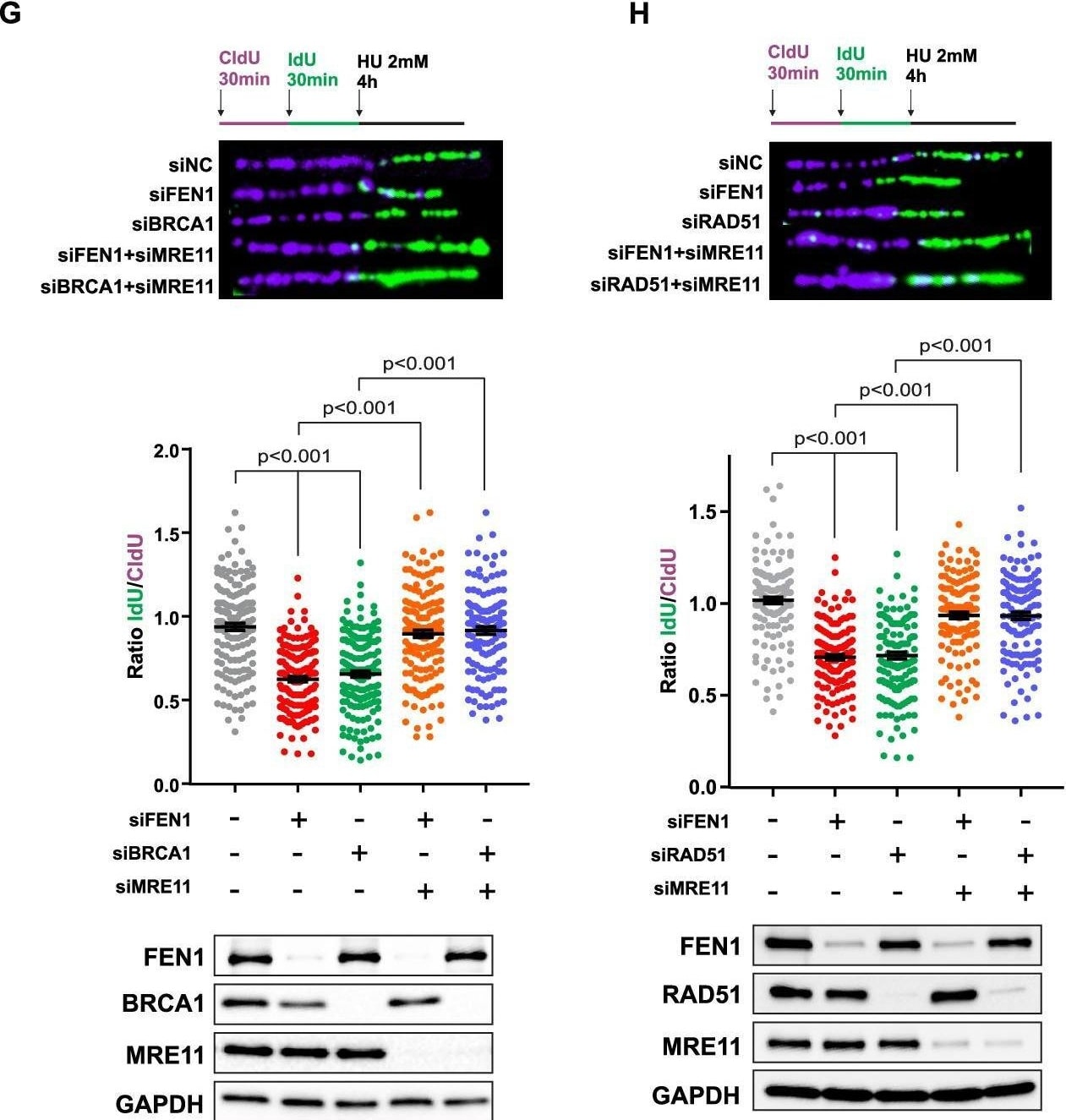
Western Blot: FEN-1 Antibody (4E7) - Azide and BSA Free [NB100-150] -
FEN1 Deficiency Resulted in Failure of RAD51-BRCA1 Assemble and Increased Fork Degradation. a Expression of FEN1, BRCA1 and RAD51 in glioma mice sample with or without FEN1 specific inhibitor sc-13 treatment. b Quantitation of FEN1, BRCA1 and RAD51 level. c, Correlation between FEN1 and BRCA1 protein expression in TCGA database. d Correlation between FEN1 and RAD51 protein expression in TCGA database. e M059K cells were transfected with control (siNC) or FEN1 siRNA (siFEN1) for 48 h followed with 2 mM HU treatment for 4 h. Immunofluorescence labeling was performed to detect foci of BRCA1 and RAD51. Quantitation of BRCA1 and RAD51 was presented from three independent replicates. Data are mean +/- s.d. f Detection of BRCA1-RAD51 interaction was carried out by PLA labeling in M059K cells transfected with siNC or siFEN1 followed with 2 mM HU for 4 h. Representative images are shown. Scale bars, 5 μm. The scatterplot displays quantification of the PLA signals per nucleus from at least 100 cells from three independent experiments. Data are mean +/- s.e.m. g-i Fork degradation was evaluated upon HU treatment in M059K cells transfected with the indicated siRNAs for 48 h. Representative images of CldU and IdU replication tracks and scatterplots of IdU/CldU-tract length ratios for individual replication forks are shown. Fibers evaluated from more than 150 counts from three independent experiments. Data are mean +/- s.e.m. A two-sided Mann–Whitney rank-sum test was used to determine if differences were significant. For, NS: not significant: P > 0.05 Image collected and cropped by CiteAb from the following open publication (https://pubmed.ncbi.nlm.nih.gov/35414100), licensed under a CC-BY license. Not internally tested by Novus Biologicals.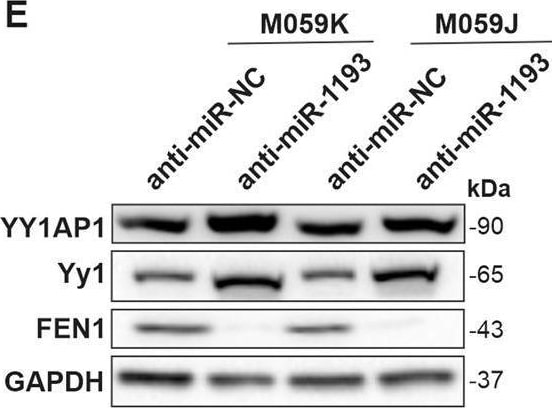
Western Blot: FEN-1 Antibody (4E7) - Azide and BSA Free [NB100-150] -
miR-1193 directly targets YY1AP1 and exhibits synthetic lethality with DNA-PKcs through the YY1-FEN1 pathway.a Predicted miR-1193 binding sequence in the 3′-UTR of YY1AP1 (wild-type YY1AP1-3′-UTR) and in a mutant containing seven altered nucleotides indicated in red (YY1AP1-3′-UTR-mut). b Luciferase activity of the reporter constructs containing the 3′UTR of YY1AP1 with the wild-type or mutated miR-1193 binding site in 293 T cells after co-transfection with the control or miR-1193 expression constructs. The mRNA levels of miR-1193 (c) and YY1AP1 (d) were measured by RT-qPCR in M059K or M059J cells transfected with anti-miR-NC or anti-miR-1193. U6 RNA was used as the internal control. e Protein expression levels of YY1AP1, YY1, and FEN1 in M059K and M059J cells transfected with anti-miR-NC or anti-miR-1193. GAPDH was used as the loading control. f Colony formation assay of M059K and M059J cells transfected with shNC and shFEN1 and cultured for 4 days. The expression levels of FEN1 and GAPDH are presented. g The viability of transfected M059K and M059J cells was measured with a CCK8 kit across a time course. h Cell proliferation was measured by an EdU analysis of FACS. i Apoptosis was measured by a TUNEL assay and quantified. j, k The percentage of cells in S-phase and apoptosis under each condition was quantified. The images are representative of three independent biological replicates. The data are presented as the mean +/- SD values, and the error bars represent data from triplicate biological experiments. *P < 0.05, **P < 0.01, ***P < 0.005. NS not significant: p > 0.05. Image collected and cropped by CiteAb from the following open publication (https://pubmed.ncbi.nlm.nih.gov/32732911), licensed under a CC-BY license. Not internally tested by Novus Biologicals.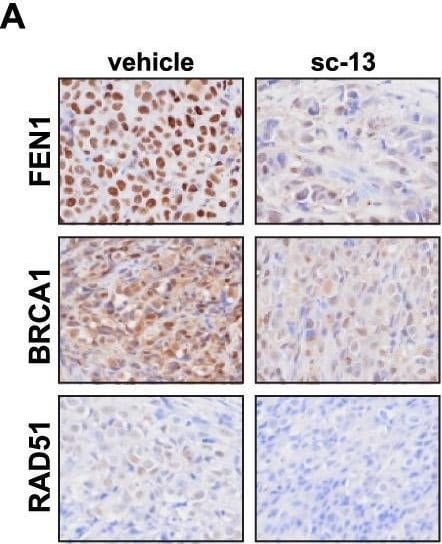
Immunohistochemistry: FEN-1 Antibody (4E7) - Azide and BSA Free [NB100-150] -
FEN1 Deficiency Resulted in Failure of RAD51-BRCA1 Assemble and Increased Fork Degradation. a Expression of FEN1, BRCA1 and RAD51 in glioma mice sample with or without FEN1 specific inhibitor sc-13 treatment. b Quantitation of FEN1, BRCA1 and RAD51 level. c, Correlation between FEN1 and BRCA1 protein expression in TCGA database. d Correlation between FEN1 and RAD51 protein expression in TCGA database. e M059K cells were transfected with control (siNC) or FEN1 siRNA (siFEN1) for 48 h followed with 2 mM HU treatment for 4 h. Immunofluorescence labeling was performed to detect foci of BRCA1 and RAD51. Quantitation of BRCA1 and RAD51 was presented from three independent replicates. Data are mean +/- s.d. f Detection of BRCA1-RAD51 interaction was carried out by PLA labeling in M059K cells transfected with siNC or siFEN1 followed with 2 mM HU for 4 h. Representative images are shown. Scale bars, 5 μm. The scatterplot displays quantification of the PLA signals per nucleus from at least 100 cells from three independent experiments. Data are mean +/- s.e.m. g-i Fork degradation was evaluated upon HU treatment in M059K cells transfected with the indicated siRNAs for 48 h. Representative images of CldU and IdU replication tracks and scatterplots of IdU/CldU-tract length ratios for individual replication forks are shown. Fibers evaluated from more than 150 counts from three independent experiments. Data are mean +/- s.e.m. A two-sided Mann–Whitney rank-sum test was used to determine if differences were significant. For, NS: not significant: P > 0.05 Image collected and cropped by CiteAb from the following open publication (https://pubmed.ncbi.nlm.nih.gov/35414100), licensed under a CC-BY license. Not internally tested by Novus Biologicals.Applications for FEN-1 Antibody (4E7) - Azide and BSA Free
Western Blot
See Simple Western Antibody Database for Simple Western validation: separated by Size
Formulation, Preparation, and Storage
Purification
Formulation
Format
Preservative
Concentration
Shipping
Stability & Storage
Background: FEN-1
Long Name
Alternate Names
Entrez Gene IDs
Gene Symbol
UniProt
Additional FEN-1 Products
Product Documents for FEN-1 Antibody (4E7) - Azide and BSA Free
Certificate of Analysis
To download a Certificate of Analysis, please enter a lot or batch number in the search box below.
Product Specific Notices for FEN-1 Antibody (4E7) - Azide and BSA Free
This product is for research use only and is not approved for use in humans or in clinical diagnosis. Primary Antibodies are guaranteed for 1 year from date of receipt.
Related Research Areas
Citations for FEN-1 Antibody (4E7) - Azide and BSA Free
 Powered by Bioz
Customer Reviews for FEN-1 Antibody (4E7) - Azide and BSA Free
There are currently no reviews for this product. Be the first to review FEN-1 Antibody (4E7) - Azide and BSA Free and earn rewards!
Have you used FEN-1 Antibody (4E7) - Azide and BSA Free?
Submit a review and receive an Amazon gift card!
$25/€18/£15/$25CAN/¥2500 for a review with an image
$10/€7/£6/$10CAN/¥1110 for a review without an image
Submit a review
Protocols
Find general support by application which include: protocols, troubleshooting, illustrated assays, videos and webinars.
- Appropriate Fixation of IHC/ICC Samples
- Cellular Response to Hypoxia Protocols
- ChIP Protocol Video
- Chromatin Immunoprecipitation (ChIP) Protocol
- Chromatin Immunoprecipitation Protocol
- ClariTSA™ Fluorophore Kits
- Detection & Visualization of Antibody Binding
- ICC Cell Smear Protocol for Suspension Cells
- ICC Immunocytochemistry Protocol Videos
- ICC for Adherent Cells
- Immunocytochemistry (ICC) Protocol
- Immunocytochemistry Troubleshooting
- Immunofluorescence of Organoids Embedded in Cultrex Basement Membrane Extract
- Immunohistochemistry (IHC) and Immunocytochemistry (ICC) Protocols
- Immunoprecipitation Protocol
- Preparing Samples for IHC/ICC Experiments
- Preventing Non-Specific Staining (Non-Specific Binding)
- Primary Antibody Selection & Optimization
- Protocol for VisUCyte™ HRP Polymer Detection Reagent
- Protocol for the Fluorescent ICC Staining of Cell Smears - Graphic
- Protocol for the Fluorescent ICC Staining of Cultured Cells on Coverslips - Graphic
- Protocol for the Preparation and Fluorescent ICC Staining of Cells on Coverslips
- Protocol for the Preparation and Fluorescent ICC Staining of Non-adherent Cells
- Protocol for the Preparation and Fluorescent ICC Staining of Stem Cells on Coverslips
- Protocol for the Preparation of a Cell Smear for Non-adherent Cell ICC - Graphic
- R&D Systems Quality Control Western Blot Protocol
- TUNEL and Active Caspase-3 Detection by IHC/ICC Protocol
- The Importance of IHC/ICC Controls
- Troubleshooting Guide: Western Blot Figures
- Western Blot Conditions
- Western Blot Protocol
- Western Blot Protocol for Cell Lysates
- Western Blot Troubleshooting
- Western Blot Troubleshooting Guide
- View all Protocols, Troubleshooting, Illustrated assays and Webinars