
FEN-1 Antibody - BSA Free
Novus Biologicals | Catalog # NB100-320

![Western Blot: FEN-1 Antibody [NB100-320]](https://resources.rndsystems.com/images/products/FEN-1-Antibody-Western-Blot-NB100-320-img0011.jpg "Western Blot: FEN-1 Antibody [NB100-320]")
Scientific images may be resized, cropped, or adjusted for brightness or contrast for presentation purposes. These updates are limited to presentation and do not affect the underlying scientific interpretation of the data. Where available, additional source data may be provided upon request.
Key Product Details
Validated by
Species Reactivity
Validated:
Cited:
Predicted:
Applications
Validated:
Cited:
Label
Antibody Source
Format
Product Specifications
Immunogen
Clonality
Host
Isotype
Theoretical MW
Disclaimer note: The observed molecular weight of the protein may vary from the listed predicted molecular weight due to post translational modifications, post translation cleavages, relative charges, and other experimental factors.
Scientific Data Images for FEN-1 Antibody - BSA Free
Western Blot: FEN-1 Antibody [NB100-320]
Western Blot: FEN-1 Antibody [NB100-320] - Detection of Human and Mouse Fen1 by Western Blot. Samples: Whole cell lysate (50 ug) from HeLa, 293T, and mouse NIH3T3 cells prepared using NETN lysis buffer. Antibody: Affinity purified rabbit anti-Fen1 antibody NB100-320 used for WB at 0.1 ug/ml. Detection: Chemiluminescence with an exposure time of 30 seconds.![Immunoprecipitation: FEN-1 Antibody [NB100-320]](https://resources.rndsystems.com/images/products/FEN-1-Antibody-Immunoprecipitation-NB100-320-img0007.jpg "Immunoprecipitation: FEN-1 Antibody [NB100-320]")
Immunoprecipitation: FEN-1 Antibody [NB100-320]
Immunoprecipitation: FEN-1 Antibody [NB100-320] - Whole cell lysate from HeLa cells (1 mg loaded), affinity purified rabbit antiFen1 antibody used for IP at 3 ug/mg lysate. Fen1 was also immunoprecipitated by rabbit anti-Fen1 antibody NB100-321, which recognizes a downstream epitope.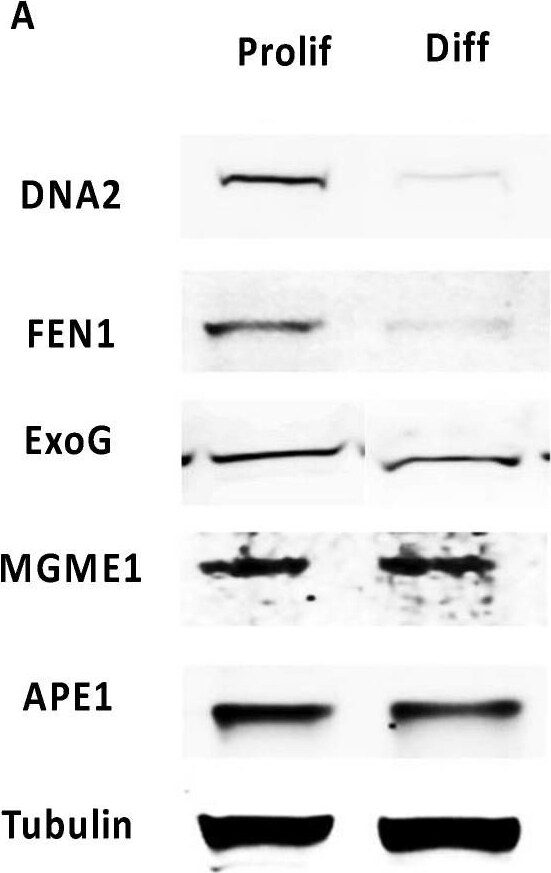
Western Blot: FEN-1 Antibody - BSA Free [NB100-320] -
Expression of nucleases upon differentiation. (A) Representative Western blots from whole-cell extracts from proliferating (Prolif) and terminally differentiated (Diff) CAD cells. (B) Quantification. The signals were normalized to that for tubulin as a loading control, with the Prolif levels set to 100%. * denotes p < 0.05 for Diff compared with Prolif., determined using Student’s t-test (n = 3). Image collected and cropped by CiteAb from the following open publication (https://pubmed.ncbi.nlm.nih.gov/37628896), licensed under a CC-BY license. Not internally tested by Novus Biologicals.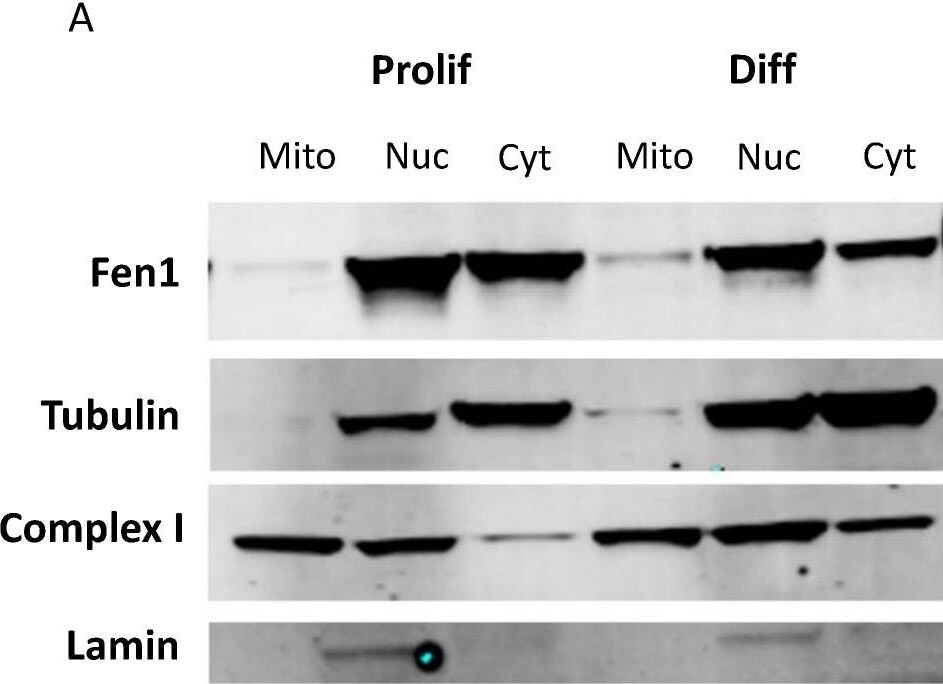
Western Blot: FEN-1 Antibody - BSA Free [NB100-320] -
Expression of Fen1 in the mitochondria of differentiated cells. (A) Representative Western blots for mitochondrial cell extracts of Prolif and Diff cells. (B) Fen1 protein signal was normalized to that for Complex 1 as a loading control for mitochondria, with laminin as a marker for the nucleus. Mitochondrial Fen1 levels were divided by whole-cell Fen1 levels to calculate mitochondrial Fen1 per cell. Error bars indicate the standard deviation (n = 3). Image collected and cropped by CiteAb from the following open publication (https://pubmed.ncbi.nlm.nih.gov/37628896), licensed under a CC-BY license. Not internally tested by Novus Biologicals.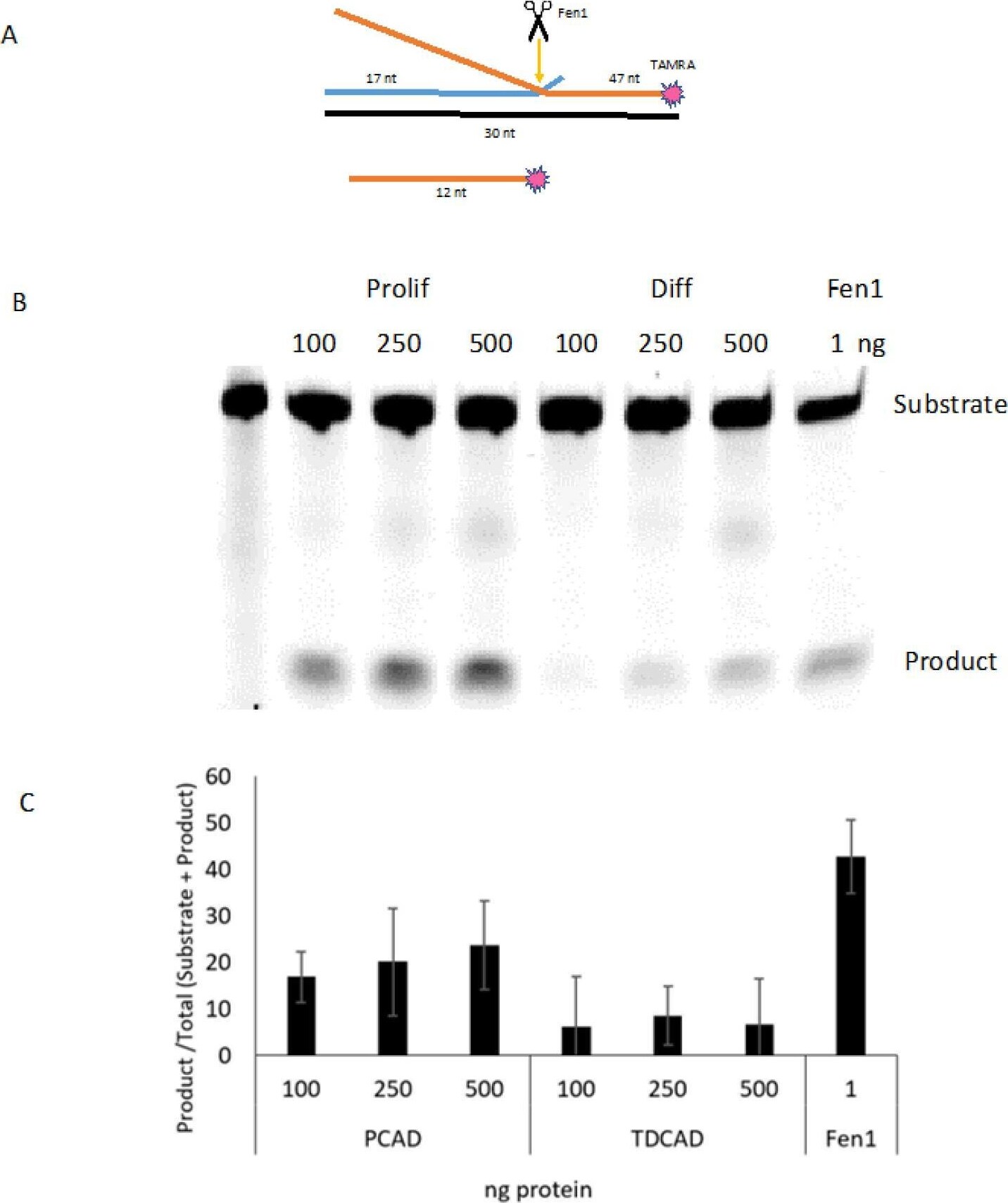
Western Blot: FEN-1 Antibody - BSA Free [NB100-320] -
Flap excision activity in proliferating and differentiated CAD cells. (A) Substrate for the flap endonuclease assay. The double-flap structure is optimal for Fen1 [27]; the target strand for that enzyme is labeled on its 5′ end the TAMRA fluor. The expected Fen1 product is shown. (B) Representative gel for the flap excision assay using whole-cell extracts from Prolif and Diff cells. Increasing amounts of extract were used for 1 pmol of substrate; Fen1 (51 nmol) was used as a positive control. The incubation was performed at 37 C for 30 min. (C) Quantification using Image J (version 2.0.0-rc-68/1.52i) (n = 3). Image collected and cropped by CiteAb from the following open publication (https://pubmed.ncbi.nlm.nih.gov/37628896), licensed under a CC-BY license. Not internally tested by Novus Biologicals.Applications for FEN-1 Antibody - BSA Free
Immunoprecipitation
Western Blot
Formulation, Preparation, and Storage
Purification
Formulation
Format
Preservative
Concentration
Shipping
Stability & Storage
Background: FEN-1
Long Name
Alternate Names
Entrez Gene IDs
Gene Symbol
UniProt
Additional FEN-1 Products
Product Documents for FEN-1 Antibody - BSA Free
Certificate of Analysis
To download a Certificate of Analysis, please enter a lot or batch number in the search box below.
Product Specific Notices for FEN-1 Antibody - BSA Free
This product is for research use only and is not approved for use in humans or in clinical diagnosis. Primary Antibodies are guaranteed for 1 year from date of receipt.
Related Research Areas
Citations for FEN-1 Antibody - BSA Free
 Powered by Bioz
Customer Reviews for FEN-1 Antibody - BSA Free
There are currently no reviews for this product. Be the first to review FEN-1 Antibody - BSA Free and earn rewards!
Have you used FEN-1 Antibody - BSA Free?
Submit a review and receive an Amazon gift card!
$25/€18/£15/$25CAN/¥2500 for a review with an image
$10/€7/£6/$10CAN/¥1110 for a review without an image
Submit a review
Protocols
Find general support by application which include: protocols, troubleshooting, illustrated assays, videos and webinars.
- Cellular Response to Hypoxia Protocols
- Immunoprecipitation Protocol
- R&D Systems Quality Control Western Blot Protocol
- Troubleshooting Guide: Western Blot Figures
- Western Blot Conditions
- Western Blot Protocol
- Western Blot Protocol for Cell Lysates
- Western Blot Troubleshooting
- Western Blot Troubleshooting Guide
- View all Protocols, Troubleshooting, Illustrated assays and Webinars