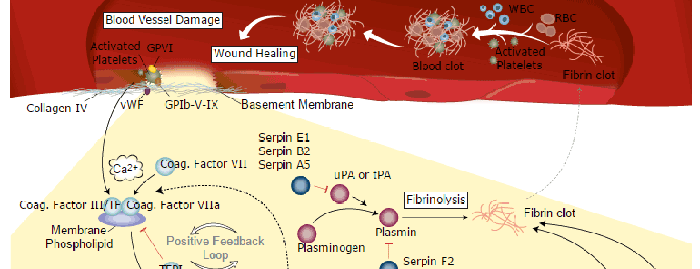
GPV (platelet glycoprotein V; designated CD42d) is an 83 kDa type I transmembrane (TM) glycoprotein of the leucine-rich repeat (LRR) family. It is expressed exclusively within the platelet / megakaryocyte lineage, where it noncovalently interacts with other platelet TM LRR proteins, GPIb alpha/beta and GPIX, at a ratio of one GPV to two of each other subunit. The GPI-V-IX complex tethers platelets to von Willebrand factor on the surface of injured endothelial cells. Absence of the complex results in Bernard-Soulier syndrome, a rare bleeding disorder. The human GPV cDNA encodes a 560 amino acid (aa) protein with a 16 aa signal sequence, a 507 aa extracellular domain (ECD) containing 15 LRR, a 21 aa TM sequence, and a short (16 aa) cytoplasmic tail that binds calmodulin in resting, but not activated platelets. The human GPV ECD shares 70%, 71% and 81% aa identity with mouse, rat and equine GPV, respectively. GPV can form soluble fragments of 80 kDa by ADAM10 or ADAM17 cleavage after P507, or 69 kDa by thrombin cleavage after R476. High circulating soluble GPV may be an indicator of platelet activation, but may also be caused by high doses of aspirin. The function of GPV is not entirely clear. Deletion of GPV in mice does not produce any obvious change to surface expression or function of GPIb and GPIX, but surface expression of GPV requires GPIb. Deletion studies also indicate that GPV may play a minor role in collagen adhesion, and may modify platelet aggregation in response to thrombin.
Glycoprotein V/CD42d Antibody [DyLight 350]
Novus Biologicals | Catalog # AF4249D

Key Product Details
Species Reactivity
Applications
Label
Antibody Source
Product Specifications
Immunogen
Gln17-Gly523
Accession # P40197
Specificity
Clonality
Host
Isotype
Description
For specialized conjugation needs, like large quantities, specific concentrations, and defined F/P ratios, bulk and custom antibody conjugation services are available.
Applications for Glycoprotein V/CD42d Antibody [DyLight 350]
CyTOF-ready
Flow Cytometry
Western Blot
Spectra Viewer
Plan Your Experiments
Use our spectra viewer to interactively plan your experiments, assessing multiplexing options. View the excitation and emission spectra for our fluorescent dye range and other commonly used dyes.
Spectra Viewer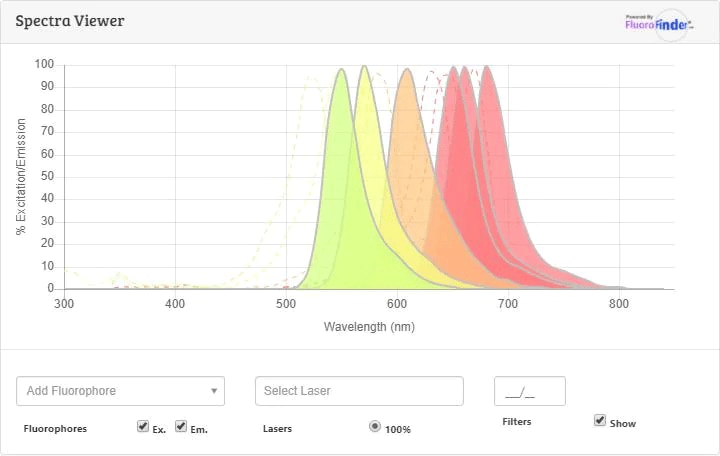
Flow Cytometry Panel Builder
Bio-Techne Knows Flow Cytometry
Save time and reduce costly mistakes by quickly finding compatible reagents using the Panel Builder Tool.
Advanced Features
- Spectra Viewer - Custom analysis of spectra from multiple fluorochromes
- Spillover Popups - Visualize the spectra of individual fluorochromes
- Antigen Density Selector - Match fluorochrome brightness with antigen density

Formulation, Preparation, and Storage
Purification
Formulation
Preservative
Concentration
Shipping
Stability & Storage
Background: Glycoprotein V/CD42d
Alternate Names
Gene Symbol
Additional Glycoprotein V/CD42d Products
Product Documents for Glycoprotein V/CD42d Antibody [DyLight 350]
Certificate of Analysis
To download a Certificate of Analysis, please enter a lot or batch number in the search box below.
Product Specific Notices for Glycoprotein V/CD42d Antibody [DyLight 350]
DyLight (R) is a trademark of Thermo Fisher Scientific Inc. and its subsidiaries.
This product is for research use only and is not approved for use in humans or in clinical diagnosis. Primary Antibodies are guaranteed for 1 year from date of receipt.
Related Research Areas
Customer Reviews for Glycoprotein V/CD42d Antibody [DyLight 350]
There are currently no reviews for this product. Be the first to review Glycoprotein V/CD42d Antibody [DyLight 350] and earn rewards!
Have you used Glycoprotein V/CD42d Antibody [DyLight 350]?
Submit a review and receive an Amazon gift card!
$25/€18/£15/$25CAN/¥2500 for a review with an image
$10/€7/£6/$10CAN/¥1110 for a review without an image
Submit a review
Protocols
Find general support by application which include: protocols, troubleshooting, illustrated assays, videos and webinars.
- 7-Amino Actinomycin D (7-AAD) Cell Viability Flow Cytometry Protocol
- Cellular Response to Hypoxia Protocols
- Extracellular Membrane Flow Cytometry Protocol
- Flow Cytometry Protocol for Cell Surface Markers
- Flow Cytometry Protocol for Staining Membrane Associated Proteins
- Flow Cytometry Staining Protocols
- Flow Cytometry Troubleshooting Guide
- Intracellular Flow Cytometry Protocol Using Alcohol (Methanol)
- Intracellular Flow Cytometry Protocol Using Detergents
- Intracellular Nuclear Staining Flow Cytometry Protocol Using Detergents
- Intracellular Staining Flow Cytometry Protocol Using Alcohol Permeabilization
- Intracellular Staining Flow Cytometry Protocol Using Detergents to Permeabilize Cells
- Propidium Iodide Cell Viability Flow Cytometry Protocol
- Protocol for Liperfluo
- Protocol for the Characterization of Human Th22 Cells
- Protocol for the Characterization of Human Th9 Cells
- Protocol: Annexin V and PI Staining by Flow Cytometry
- Protocol: Annexin V and PI Staining for Apoptosis by Flow Cytometry
- R&D Systems Quality Control Western Blot Protocol
- Troubleshooting Guide: Fluorokine Flow Cytometry Kits
- Troubleshooting Guide: Western Blot Figures
- Western Blot Conditions
- Western Blot Protocol
- Western Blot Protocol for Cell Lysates
- Western Blot Troubleshooting
- Western Blot Troubleshooting Guide
- View all Protocols, Troubleshooting, Illustrated assays and Webinars
Associated Pathways