Best Seller

Human CCL5/RANTES Quantikine ELISA Kit

R&D Systems | Catalog # DRN00B

R&D Systems
Loading...

Key Product Details

Assay Length

3.5 hours

Sample Type & Volume Required Per Well

Cell Culture Supernates (100 µL), Serum (100 µL), EDTA Plasma (100 µL), Heparin Plasma (100 µL), Citrate Plasma (100 µL), Urine (100 µL)

Sensitivity

6.6 pg/mL

Assay Range

31.2-2000 pg/mL (Cell Culture Supernates, Serum, EDTA Plasma, Heparin Plasma, Citrate Plasma, Urine)
Loading...

Product Summary for Human CCL5/RANTES Quantikine ELISA Kit

The Quantikine Human RANTES Immunoassay is a 3.5 hour solid phase ELISA designed to measure human RANTES levels in cell culture supernates, serum, plasma, and urine. It contains E. coli-derived recombinant human RANTES and antibodies raised against the recombinant factor. This immunoassay has been shown to accurately quantitate the recombinant factor. Results obtained using natural human RANTES showed linear curves that were parallel to the standard curves obtained using the Quantikine kit standards. These results indicate that this kit can be used to determine relative mass values of natural human RANTES.

Product Specifications

Measurement

Quantitative ELISA

Detection Method

Colorimetric - 450nm (TMB)

Conjugate

HRP

Species

Human

Specificity

Natural and recombinant human RANTES

Cross-reactivity

< 0.5% cross-reactivity observed with available related molecules. < 50% cross-species reactivity observed with species tested.

Interference

No significant interference observed with available related molecules.

Sample Values

Serum/Platelet-poor Plasma/Urine - Samples from apparently healthy volunteers were evaluated for the presence of human RANTES in this assay. No medical histories were available for the donors used in this study.

Sample TypeMean (pg/mL)% DetectableRange (pg/mL)
Serum (n=11)57,270100%23,117-77,354
Platelet-poor EDTA plasma (n=11)849100%262-1587
Platelet-poor heparin plasma (n=11)1340100%308-3527
Platelet-poor citrate plasma (n=11)467100%202-874
Urine (n=10)65680%ND-1540
ND=Non-detectable

Cell Culture Supernates - Humean peripheral blood mononuclear cells (1x10⁶ cells/mL) were cultured in RPMI supplemented with 10% fetal bovine serum, 50 μM beta -mercaptoethanol, 2 mM L-glutamine, 100 units/mL penicillin, and 100 μg/mL streptomycin sulfate. The cells were cultured stimulated with 10 μg/mL PHA for 1 and 5 days. Aliquots were removed and assayed for levels of human RANTES.

ConditionDay 1 (pg/mL)Day 5 (pg/mL)
Unstimulated cells375667
Stimulated cells 46602830

Note: Sample collection and handling procedures have a significant impact on measured RANTES levels. Refer to the Sample Collection and Storage section for the recommended sample collection procedures. 


Precision

Intra-Assay Precision (Precision within an assay) Three samples of known concentration were tested on one plate to assess intra-assay precision.

Inter-Assay Precision (Precision between assays) Three samples of known concentration were tested in separate assays to assess inter-assay precision.

Cell Culture Supernates, Serum, Urine

Intra-Assay Precision Inter-Assay Precision
Sample 1 2 3 1 2 3
n 20 20 20 20 20 20
Mean (pg/mL) 91.9 573 1120 92.0 511 1105
Standard Deviation 2.3 10.0 32.4 6.2 32.7 70.7
CV% 2.5 1.7 2.9 6.7 6.4 6.4

Citrate Plasma, EDTA Plasma, Heparin Plasma

Intra-Assay Precision Inter-Assay Precision
Sample 1 2 3 1 2 3
n 20 20 20 20 20 20
Mean (pg/mL) 108 599 1191 88.0 494 1063
Standard Deviation 3.9 14.3 41.5 9.1 43.1 89.6
CV% 3.6 2.4 3.5 10.3 8.7 8.4

Recovery for Human CCL5/RANTES Quantikine ELISA Kit

The recovery of RANTES spiked to levels throughout the range of the assay in various matrices was evaluated.

Sample Type Average % Recovery Range %
Cell Culture Media (n=4) 101 95-110
Platelet-poor Citrate Plasma (n=4) 99 93-105
Platelet-poor EDTA Plasma (n=4) 98 93-103
Platelet-poor Heparin Plasma (n=4) 99 93-105
Serum (n=5) 101 94-107
Urine (n=10) 102 88-114

Linearity

To assess the linearity of the assay, samples containing and/or spiked with high concentrations of RANTES were serially diluted with the appropriate Calibrator Diluent to produce samples with values within the dynamic range of the assay.

Human CCL5/RANTES ELISA Linearity

Scientific Data Images for Human CCL5/RANTES Quantikine ELISA Kit

Human CCL5/RANTES ELISA Platelet-Poor Plasma Standard Curve

Human CCL5/RANTES ELISA Platelet-Poor Plasma Standard Curve

Human CCL5/RANTES ELISA Cell Culture Supernates/Serum/Urine Standard Curve

Human CCL5/RANTES ELISA Cell Culture Supernates/Serum/Urine Standard Curve

Preparation and Storage

Shipping

The product is shipped at ambient temperature. Upon receipt, store it immediately at the temperature recommended below.

Stability & Storage

Store the unopened product at 2 - 8 °C. Do not use past expiration date.

Background: CCL5/RANTES

RANTES (Regulated upon Activation, Normal T cell Expressed and presumably Secreted), also known as CCL5, is a member of the "CC" subfamily of chemokines. It plays a primary role in the inflammatory immune response via its ability to chemoattract leukocytes and modulate their function. The cDNA for RANTES was initially discovered by subtractive hybridization as a T cell specific sequence (1, 2). Human RANTES cDNA encodes a highly basic 91 amino acid (aa) residue precursor polypeptide with a 23 aa hydrophobic signal peptide that is cleaved to generate the 68 aa mature protein (1, 2). Human RANTES exhibits approximately 85% homology with mouse RANTES at the deduced aa level (3, 4). 
RANTES is a potent chemoattractant for a number of different cell types including unstimulated CD4+/CD45RO+ memory T cells and stimulated CD4+ and CD8+ T cells with naive and memory phenotypes, NK cells, basophils, eosinophils, dendritic cells, mast cells, monocytes, and microglia (5-13). In addition to its effects on migration, RANTES can activate a number of cell types including T cells (14-16), monocytes (17), neutrophils (17), NK cells (7), dendritic cells (18), and astrocytes (19). T cell activation generally requires relatively high RANTES concentrations (~ 1 μM) and is dependent upon aggregation of the molecule and association with cell surface glycosaminoglycans (GAGs) (15-17). Whether this activity occurs in vivo remains unclear although in mice, intraperitoneally injected RANTES mutants that are unable to aggregate and/or bind GAG, are not capable of attracting leukocytes when compared to wild-type controls (20). Other in vivo studies show that RANTES knockout mice exhibit deficient recruitment of leukocytes to sites of acute inflammation (21). 
RANTES, is known to interact with four identified seven transmembrane G-protein coupled receptors: CCR1, CCR3, CCR4, and CCR5 (22-25). RANTES stimulation can initiate a variety of signaling cascades that are cell context dependent. For instance, in T-cells, RANTES can stimulate elevations of intracellular Ca2+ (26), and activation of focal adhesion kinase (FAK) (27), protein kinase A (28), PI3-kinase (14), Rho GTPase (29), and JAK/STAT signaling pathways (30). The cytomegalovirus protein US28 exhibits significant homology with CC chemokine receptors and is capable of binding RANTES (31). Membrane-spanning US28 can, depending on the context, signal in a constitutive manner (32), bind RANTES and initiate G-protein-mediated signaling cascades (33), or sequester RANTES and potentially alter inflammatory responses (34-36). 
The RANTES receptor CCR5 is also the primary co-receptor for R5 (M-tropic) variants of HIV-1 (37, 38). It has been demonstrated that RANTES, as well as the other CCR5 ligands, macrophage inflammatory protein (MIP)-1 alpha and MIP-1 beta, can competitively inhibit CCR5/HIV-1 interaction and suppress viral infection in vitro (39, 40). These effects apparently do not require fully intact signaling from the CCR5 receptor (41). Consequently, modified forms of RANTES and non-peptide compounds that block the interaction of HIV-1 with CCR5 show promise for future therapies (41-44). In contrast, several reports show that RANTES can enhance in vitro replication of X4 (T-tropic) variants of HIV-1 that use CXCR4 as a co-receptor rather than CCR5 (45, 46). This activity usually requires relatively high RANTES concentrations (~μM) and is dependent upon interaction with cell surface GAGs, oligomerization, and activation of tyrosine kinase and MAP kinase signaling cascades (46, 47).

Alternate Names

RANTES, SISd

Entrez Gene IDs

6352 (Human); 20304 (Mouse); 403522 (Canine); 493689 (Feline)

Gene Symbol

CCL5

Additional CCL5/RANTES Products

Product Documents for Human CCL5/RANTES Quantikine ELISA Kit

Certificate of Analysis

To download a Certificate of Analysis, please enter a lot or batch number in the search box below.

Note: Certificate of Analysis not available for kit components.

Product Specific Notices for Human CCL5/RANTES Quantikine ELISA Kit

For research use only

⚠ WARNING: This product can expose you to chemicals including N,N-Dimethylforamide, which is known to the State of California to cause cancer. For more information, go to www.P65Warnings.ca.gov.

Citations for Human CCL5/RANTES Quantikine ELISA Kit

Customer Reviews for Human CCL5/RANTES Quantikine ELISA Kit (5)

4.2 out of 5
5 Customer Ratings
5 Stars
40%
4 Stars
40%
3 Stars
20%
2 Stars
0%
1 Stars
0%

Have you used Human CCL5/RANTES Quantikine ELISA Kit?

Submit a review and receive an Amazon gift card!

$25/€18/£15/$25CAN/¥2500 Yen for a review with an image

$10/€7/£6/$10CAN/¥1110 Yen for a review without an image

Submit a review
Amazon Gift Card

Customer Images


Showing  1 - 5 of 5 reviews Showing All
Filter By:
  • Human CCL5/RANTES Quantikine ELISA Kit
    Name: Mitch Rechtzigel
    Sample Tested: Cell culture supernatant
    Verified Customer | Posted 04/24/2023
  • Human CCL5/RANTES Quantikine ELISA Kit
    Name: Anonymous
    Sample Tested: Serum
    Verified Customer | Posted 11/07/2022
  • Human CCL5/RANTES Quantikine ELISA Kit
    Name: Anonymous
    Sample Tested: Urine
    Verified Customer | Posted 04/26/2022
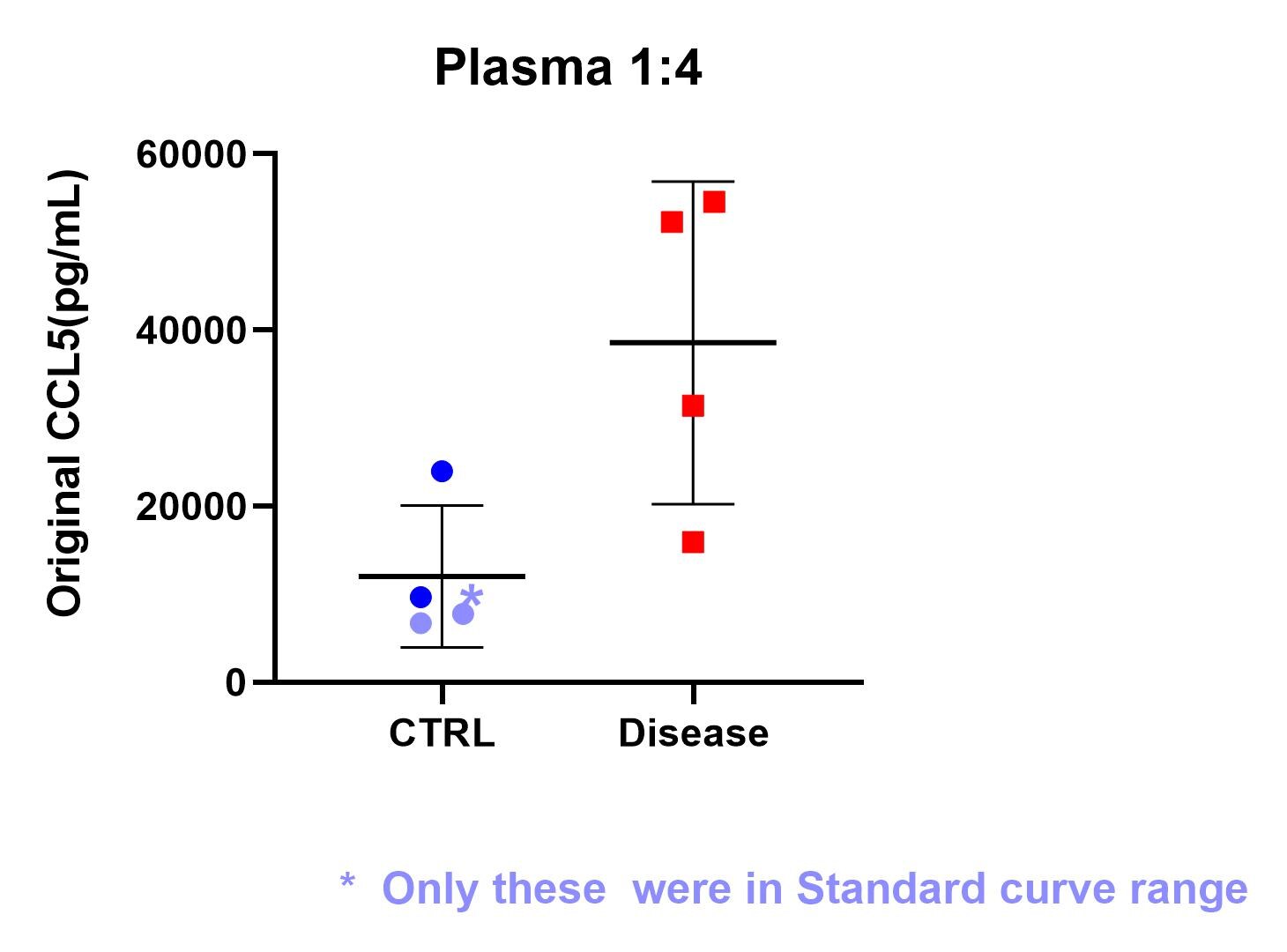
    Measured urine at 2-fold dilution and plasma at 4-fold dilution from healthy controls &amp; patients with disease. All urine samples were below the standard curve. Plasma samples were mostly above the standard curve and would need further dilution.
    Human CCL5/RANTES Quantikine ELISA Kit DRN00B
    Bio-Techne Response
    Thank you for reviewing our product. We are sorry to hear that this product did not perform as expected. We have been in touch with the customer to resolve this issue according to our Product Guarantee and to the customer’s satisfaction.
  • Human CCL5/RANTES Quantikine ELISA Kit
    Name: Anonymous
    Sample Tested: Brain Microvascular Endothelial Cells
    Verified Customer | Posted 03/21/2019
  • Human CCL5/RANTES Quantikine ELISA Kit
    Name: Balaji Mahender
    Sample Tested: EDTA Plasma, Citrate Plasma and Heparin Plasma
    Verified Customer | Posted 01/09/2018

There are no reviews that match your criteria.

Showing  1 - 5 of 5 reviews Showing All

FAQs for Human CCL5/RANTES Quantikine ELISA Kit

Showing  1 - 1 of 1 FAQ Showing All
  • Q: Can plasma be used as a sample in Human CCL5/RANTES Quantikine® ELISA kit (Catalog # DRN00B) if platelet-poor plasma is not available?  

    A: Platelet-poor plasma is the only type of plasma sample validated for Human CCL5/RANTES Quantikine® ELISA kit. CCL5/RANTES is present in platelet granules and is released upon platelet activation. 

Showing  1 - 1 of 1 FAQ Showing All
View all FAQs for ELISA Kits