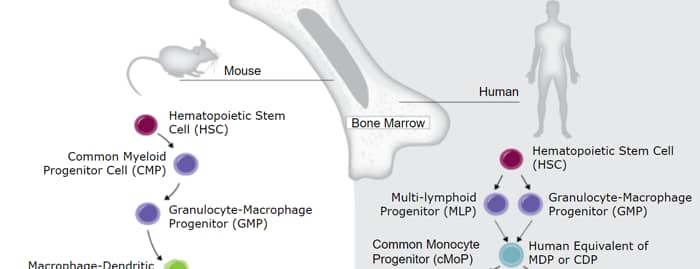
Langerin (also known as CD207) is a type II transmembrane glycoprotein which is member K of the C-type lectin domain family 4 (1). Langerin is used as a marker for Langerhans cells (LCs) which represent the immature dendritic cells in the epidermis (1, 2). LCs uniquely contain “tennis racket”-shaped endosomal recycling compartment subdomains with pentalamellar membranes termed Birbeck granules (1‑3). Langerin is necessary and sufficient for Birbeck granule formation (1). The 328 amino acid (aa) human langerin sequence contains a 43 aa cytoplasmic domain, a 21 aa transmembrane domain and a 264 aa extracellular domain (ECD) that contains a coiled-coil domain and a single C-type lectin domain. Trimerization greatly increases the lectin binding affinity (4). Langerin internalizes endogenous proteins such as type I procollagen. Internalization by LC is thought to lead to suppression of self reactions (4‑6). Langerin also mediates endocytosis of non‑peptide antigens containing mannose, N-acetyl glucosamine and fucose that are expressed by mycobacteria and fungae (4, 7). Some antigens, such as the M. leprae glycolipid arabinomycolate, are ultimately presented by human LC CD1a in cutaneous-draining lymph nodes (8). Langerin performs a barrier-like function to HIV-1 transmission due to its internalization of virus particles for destruction (9). A rare human polymorphism within the lectin domain, W264R, abolishes both carbohydrate recognition and Birbeck granule formation (10, 11). Genetic deletion of mouse langerin was not shown to have functional consequence other than abolishing Birbeck granule formation (12). Human langerin shares 68%, 62%, 71% aa identity with mouse, rat and bovine langerin ECD, respectively.
Human Langerin/CD207 Antibody (343828)
R&D Systems | Catalog # MAB2088


Scientific images may be resized, cropped, or adjusted for brightness or contrast for presentation purposes. These updates are limited to presentation and do not affect the underlying scientific interpretation of the data. Where available, additional source data may be provided upon request.
Key Product Details
Species Reactivity
Validated:
Cited:
Applications
Validated:
Cited:
Label
Antibody Source
Product Specifications
Immunogen
Tyr64-Pro328
Accession # Q9UJ71
Specificity
Clonality
Host
Isotype
Scientific Data Images for Human Langerin/CD207 Antibody (343828)
Detection of Langerin/CD207 in Human Immature Dentritic Cells by Flow Cytometry.
Human immature dentritic cells differentated from human peripheral blood mononuclear cell derived CD14+cells were treated with 20 ng/mL Recombinant Human IL-4 (Catalog # 204-IL) and 50 ng/mL Recombinant Human GM-CSF (Catalog # 215-GM) for 6-7 days and then stained with Mouse Anti-Human Langerin/CD207 Monoclonal Antibody (Catalog # MAB2088, filled histogram) or isotype control (Catalog # MAB002, open histogram), followed by Goat F(ab)2 Anti-Mouse IgG (H+L) Allophycocyanin (Catalog # F0101B). View our protocol for Staining Membrane-associated Proteins.Applications for Human Langerin/CD207 Antibody (343828)
CyTOF-ready
Flow Cytometry
Sample: Human immature dentritic cells differentated from human peripheral blood mononuclear cell derived CD14+ cells treated with 20 ng/mL Recombinant Human IL‑4 (Catalog # 204-IL) and 50 ng/mL Recombinant Human GM‑CSF (Catalog # 215-GM) for 6‑7 days
Western Blot
Sample: Recombinant Human Langerin/CD207 (Catalog # 2088-LN)
Flow Cytometry Panel Builder
Bio-Techne Knows Flow Cytometry
Save time and reduce costly mistakes by quickly finding compatible reagents using the Panel Builder Tool.
Advanced Features
- Spectra Viewer - Custom analysis of spectra from multiple fluorochromes
- Spillover Popups - Visualize the spectra of individual fluorochromes
- Antigen Density Selector - Match fluorochrome brightness with antigen density

Formulation, Preparation, and Storage
Purification
Reconstitution
Formulation
Shipping
Stability & Storage
- 12 months from date of receipt, -20 to -70 °C as supplied.
- 1 month, 2 to 8 °C under sterile conditions after reconstitution.
- 6 months, -20 to -70 °C under sterile conditions after reconstitution.
Calculators
Background: Langerin/CD207
References
- Valladeau, J. et al. (2000) Immunity 12:71.
- Valladeau, J. et al. (2003) Immunol. Res. 28:93.
- McDermott, R. et al. (2002) Mol. Biol. Cell 13:317.
- Stambach, N. S. and M. E. Taylor (2003) Glycobiology 13:401.
- Tada, Y. et al. (2006) J. Invest. Dermatol. 126:1549.
- Ritter, U. and A. Osterloh (2007) Med. Microbiol. Immunol. 196:51.
- Takahara, K. et al. (2003) Int. Immunol. 16:819.
- Hunger, R. E. et al. (2004) J. Clin. Invest. 113:701.
- De Witte, L. et al. (2007) Nat. Med. 13:367.
- Verdijk, P. et al. (2005) J. Invest. Dermatol. 124:714.
- Ward, E. M. et al. (2006) J. Biol. Chem. 281:15450.
- Kissenpfennig, A. et al. (2005) Mol. Cell. Biol. 25:88.
Alternate Names
Gene Symbol
UniProt
Additional Langerin/CD207 Products
Product Documents for Human Langerin/CD207 Antibody (343828)
Certificate of Analysis
To download a Certificate of Analysis, please enter a lot or batch number in the search box below.
Note: Certificate of Analysis not available for kit components.
Product Specific Notices for Human Langerin/CD207 Antibody (343828)
For research use only
Citations for Human Langerin/CD207 Antibody (343828)
 Powered by Bioz
Customer Reviews for Human Langerin/CD207 Antibody (343828)
There are currently no reviews for this product. Be the first to review Human Langerin/CD207 Antibody (343828) and earn rewards!
Have you used Human Langerin/CD207 Antibody (343828)?
Submit a review and receive an Amazon gift card!
$25/€18/£15/$25CAN/¥2500 for a review with an image
$10/€7/£6/$10CAN/¥1110 for a review without an image
Submit a review
Protocols
Find general support by application which include: protocols, troubleshooting, illustrated assays, videos and webinars.
- 7-Amino Actinomycin D (7-AAD) Cell Viability Flow Cytometry Protocol
- Cellular Response to Hypoxia Protocols
- Extracellular Membrane Flow Cytometry Protocol
- Flow Cytometry Protocol for Cell Surface Markers
- Flow Cytometry Protocol for Staining Membrane Associated Proteins
- Flow Cytometry Staining Protocols
- Flow Cytometry Troubleshooting Guide
- Intracellular Flow Cytometry Protocol Using Alcohol (Methanol)
- Intracellular Flow Cytometry Protocol Using Detergents
- Intracellular Nuclear Staining Flow Cytometry Protocol Using Detergents
- Intracellular Staining Flow Cytometry Protocol Using Alcohol Permeabilization
- Intracellular Staining Flow Cytometry Protocol Using Detergents to Permeabilize Cells
- Propidium Iodide Cell Viability Flow Cytometry Protocol
- Protocol for Liperfluo
- Protocol for the Characterization of Human Th22 Cells
- Protocol for the Characterization of Human Th9 Cells
- Protocol: Annexin V and PI Staining by Flow Cytometry
- Protocol: Annexin V and PI Staining for Apoptosis by Flow Cytometry
- R&D Systems Quality Control Western Blot Protocol
- Troubleshooting Guide: Fluorokine Flow Cytometry Kits
- Troubleshooting Guide: Western Blot Figures
- Western Blot Conditions
- Western Blot Protocol
- Western Blot Protocol for Cell Lysates
- Western Blot Troubleshooting
- Western Blot Troubleshooting Guide
- View all Protocols, Troubleshooting, Illustrated assays and Webinars
Associated Pathways