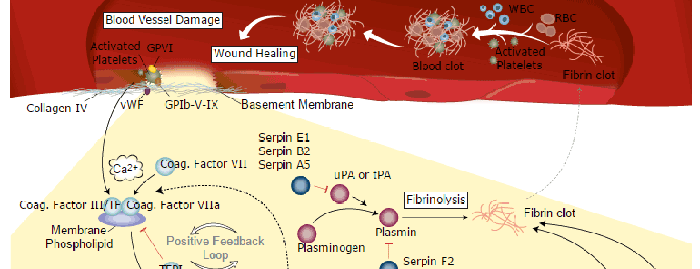
PLAT (Plasminogen activator; also tPA/Tissue Plasminogen Activator) is a 64-69 kDa extracellular glycoprotein that belongs to the peptidase S1 family of enzymes. It is secreted by diverse cell types such as fibroblasts, endothelial cells and astrocytes. Unlike many other serine proteases, PLAT/tPA circulates as an active proenzyme. Following clot formation, both tPA and its substrate, plasminogen, bind to clot fibrin. Here, tPA converts plasminogen to plasmin, an enzyme that subsequently degrades the fibrin matrix of the clot. Plasmin also cleaves local tPA, generating a disulfide-linked, two-chain tPA isoform whose activity is potentiated 5- to10-fold relative to the uncleaved form. tPa also cleaves PDGF-CC and activates MMP-9, suggesting an expanded role in vascular remodeling. Human PLAT/tPA is secreted as a 530 amino acid (aa) single chain polypeptide (aa 33-562). Depending upon its source, aa 33-35 or 33-38 may be removed in the circulation. PLAT contains one N-terminal fibronectin type I region (aa 39-81), an EGD-like domain (aa 82-120), a two kringle structures (127-208; 215-296) and a peptidase S1 domain (311-561). Plasmin cleaves PLAT/tPA between Arg310-Ile311, generating an active disulfide-linked heterodimeric molecule that contains chains of 35 kDa and 33 kDa, respectively. There are multiple isoform variants. One contains a three aa substitution for aa 1-40 coupled to a deletion of aa 79-208, a second shows a Gly substitution for aa 39-85, and a third possesses a 23 aa substitution for aa 269-562. Two additional isoforms shows a His substitution for aa 54-134, and a 25 aa substitution for aa 269-562, respectively. Over aa 36-562, human PLAT shares 81% aa sequence identity with mouse PLAT.
Human t-Plasminogen Activator/tPA Antibody [Alexa Fluor™ Plus 488]
R&D Systems | Catalog # AF7449AFP488

![Human t-Plasminogen Activator/tPA Antibody [Alexa Fluor™ Plus 488]](https://resources.rndsystems.com/images/icons/RnD-Default-Product-Image_Antibodies-Icon.svg "Human t-Plasminogen Activator/tPA Antibody [Alexa Fluor™ Plus 488]")
Key Product Details
Species Reactivity
Applications
Label
Antibody Source
Product Specifications
Immunogen
Specificity
Clonality
Host
Isotype
Applications for Human t-Plasminogen Activator/tPA Antibody [Alexa Fluor™ Plus 488]
Western Blot
Formulation, Preparation, and Storage
Formulation
Shipping
Stability & Storage
Background: t-Plasminogen Activator/tPA
Long Name
Alternate Names
Gene Symbol
UniProt
Additional t-Plasminogen Activator/tPA Products
Product Documents for Human t-Plasminogen Activator/tPA Antibody [Alexa Fluor™ Plus 488]
Certificate of Analysis
To download a Certificate of Analysis, please enter a lot or batch number in the search box below.
Note: Certificate of Analysis not available for kit components.
Product Specific Notices for Human t-Plasminogen Activator/tPA Antibody [Alexa Fluor™ Plus 488]
This conjugate is made on demand and is not held in inventory. Each order represents a unique lot. All conjugates are generated using validated conjugation protocols and meet strict degree of labeling (F/P) specifications; additional information is available upon request. The antibody concentration is provided on the individual product label.
Recommended applications are based on validated applications from the unconjugated base product AF7449.
For specialized conjugation needs, like large quantities, specific concentrations, and defined F/P ratios, bulk and custom antibody conjugation services are available.
This product is provided under an intellectual property license from Life Technologies Corporation. The transfer of this product is conditioned on the buyer using the purchased product solely in research conducted by the buyer, excluding contract research or any fee for service research, and the buyer must not (1) use this product or its components for (a) diagnostic, therapeutic or prophylactic purposes; (b) testing, analysis or screening services, or information in return for compensation on a per-test basis; or (c) manufacturing or quality assurance or quality control, and/or (2) sell or transfer this product or its components for resale, whether or not resold for use in research. For information on purchasing a license to this product for purposes other than as described above, contact Life Technologies Corporation, 5781 Van Allen Way, Carlsbad, CA 92008 USA or outlicensing@thermofisher.com.
For research use only
Customer Reviews
There are currently no reviews for this product. Be the first to review Human t-Plasminogen Activator/tPA Antibody [Alexa Fluor™ Plus 488] and earn rewards!
Have you used Human t-Plasminogen Activator/tPA Antibody [Alexa Fluor™ Plus 488]?
Submit a review and receive an Amazon gift card!
$25/€18/£15/$25CAN/¥2500 for a review with an image
$10/€7/£6/$10CAN/¥1110 for a review without an image
Submit a review
Protocols
Find general support by application which include: protocols, troubleshooting, illustrated assays, videos and webinars.
- Cellular Response to Hypoxia Protocols
- R&D Systems Quality Control Western Blot Protocol
- Troubleshooting Guide: Western Blot Figures
- Western Blot Conditions
- Western Blot Protocol
- Western Blot Protocol for Cell Lysates
- Western Blot Troubleshooting
- Western Blot Troubleshooting Guide
- View all Protocols, Troubleshooting, Illustrated assays and Webinars
Associated Pathways