
KA2/GRIK5/Glutamate Receptor KA2 Antibody - BSA Free
Novus Biologicals | Catalog # NBP1-80270

![Western Blot: KA2/GRIK5/Glutamate Receptor KA2 Antibody [NBP1-80270]](https://resources.rndsystems.com/images/products/KA2-GRIK5-Glutamate-Receptor-KA2-Antibody-Western-Blot-NBP1-80270-img0004.jpg "Western Blot: KA2/GRIK5/Glutamate Receptor KA2 Antibody [NBP1-80270]")
Scientific images may be resized, cropped, or adjusted for brightness or contrast for presentation purposes. These updates are limited to presentation and do not affect the underlying scientific interpretation of the data. Where available, additional source data may be provided upon request.
Key Product Details
Species Reactivity
Applications
Label
Antibody Source
Format
Product Specifications
Immunogen
Clonality
Host
Isotype
Description
Scientific Data Images for KA2/GRIK5/Glutamate Receptor KA2 Antibody - BSA Free
Western Blot: KA2/GRIK5/Glutamate Receptor KA2 Antibody [NBP1-80270]
Western Blot: KA2/GRIK5/Glutamate Receptor KA2 Antibody [NBP1-80270] - Jurkat cell lysate. Suggested Antibody Titration: 0.2 - 1 ug/mL.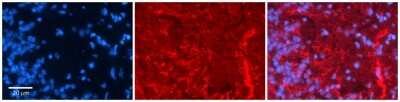
Immunohistochemistry-Paraffin: KA2/GRIK5/Glutamate Receptor KA2 Antibody [NBP1-80270] -
Immunohistochemistry-Paraffin: KA2/GRIK5/Glutamate Receptor KA2 Antibody [NBP1-80270] - FFPE Human Pineal Tissue. Primary antibody at 1:100.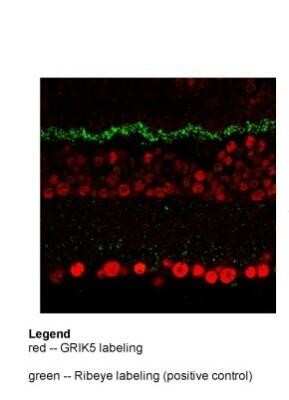
Immunohistochemistry: KA2/GRIK5/Glutamate Receptor KA2 Antibody [NBP1-80270] -
Immunohistochemistry: KA2/GRIK5/Glutamate Receptor KA2 Antibody [NBP1-80270] - Mouse Retina, 25 ug/mL.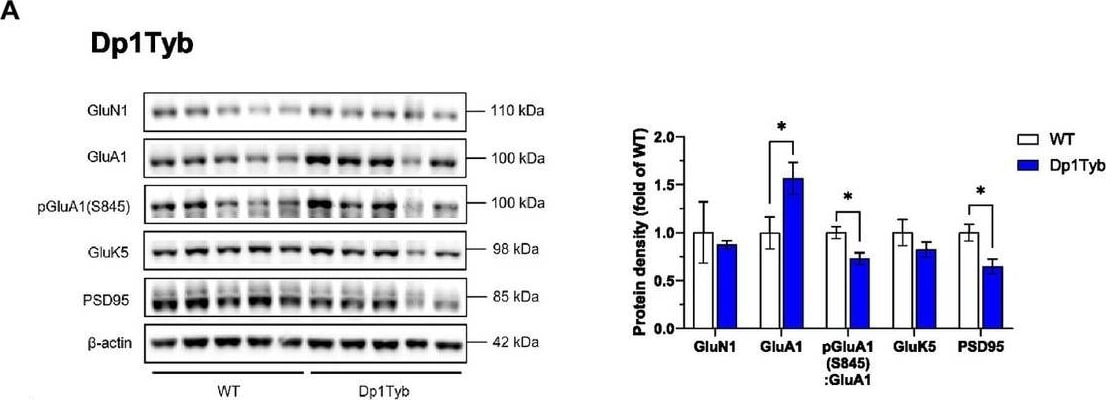
Western Blot: KA2/GRIK5/Glutamate Receptor KA2 Antibody - BSA Free [NBP1-80270] -
Altered abundance of glutamate receptor subunits in HPC synaptosomes from Dp1Tyb, Dp(17)3Yey, and Dp(10)2Yey male mice. (A–C) HPC synaptosomes from the indicated mouse strains were analyzed by immunoblotting for glutamate receptor subunits and PSD95. Example immunoblots are shown on the left and mean +/- SEM protein abundance on the right, normalized to beta -actin (or to GluA1 or GluN2B in case of phosphorylation levels of the respective receptor) and then to the mean signal in WT mice. Immunoblots show analysis of HPC synaptosome extracts from 2 to 5 mice of each genotype. Compared to WT littermates, mutant Dp1Tyb mice displayed lower hippocampal expression of GluA1, pGluA1(S845), and PSD95 (Student’s t-test, *p < 0.05) (A). Mutant Dp(10)2Yey mice displayed an age-dependent decrease in hippocampal expression of GluK5 and PSD95 compared to WT littermates (two-way ANOVA, *p < 0.05, **p < 0.001) (C). The decrease in GluK5 expression was not driven by age-dependent changes in the WT group as this comparison was not statistically significant (p > 0.05) (C). 21-month-old Dp1Tyb: n = 6 WT, 5 Dp1Tyb; 21-month-old Dp(17)3Yey: n = 9 WT, 12 Dp(17)3Yey; 14-month-old Dp(10)2Yey: n = 9 WT, 11 Dp(10)2Yey; 22-month-old Dp(10)2Yey: n = 6 WT, 10 Dp(10)2Yey. Image collected and cropped by CiteAb from the following open publication (https://www.frontiersin.org/articles/10.3389/fnbeh.2024.1428146/full), licensed under a CC-BY license. Not internally tested by Novus Biologicals.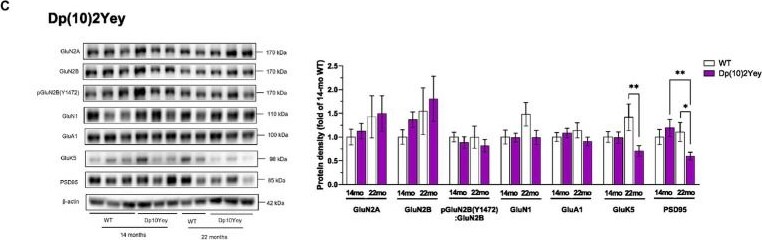
Western Blot: KA2/GRIK5/Glutamate Receptor KA2 Antibody - BSA Free [NBP1-80270] -
Altered abundance of glutamate receptor subunits in HPC synaptosomes from Dp1Tyb, Dp(17)3Yey, and Dp(10)2Yey male mice. (A–C) HPC synaptosomes from the indicated mouse strains were analyzed by immunoblotting for glutamate receptor subunits and PSD95. Example immunoblots are shown on the left and mean +/- SEM protein abundance on the right, normalized to beta -actin (or to GluA1 or GluN2B in case of phosphorylation levels of the respective receptor) and then to the mean signal in WT mice. Immunoblots show analysis of HPC synaptosome extracts from 2 to 5 mice of each genotype. Compared to WT littermates, mutant Dp1Tyb mice displayed lower hippocampal expression of GluA1, pGluA1(S845), and PSD95 (Student’s t-test, *p < 0.05) (A). Mutant Dp(10)2Yey mice displayed an age-dependent decrease in hippocampal expression of GluK5 and PSD95 compared to WT littermates (two-way ANOVA, *p < 0.05, **p < 0.001) (C). The decrease in GluK5 expression was not driven by age-dependent changes in the WT group as this comparison was not statistically significant (p > 0.05) (C). 21-month-old Dp1Tyb: n = 6 WT, 5 Dp1Tyb; 21-month-old Dp(17)3Yey: n = 9 WT, 12 Dp(17)3Yey; 14-month-old Dp(10)2Yey: n = 9 WT, 11 Dp(10)2Yey; 22-month-old Dp(10)2Yey: n = 6 WT, 10 Dp(10)2Yey. Image collected and cropped by CiteAb from the following open publication (https://www.frontiersin.org/articles/10.3389/fnbeh.2024.1428146/full), licensed under a CC-BY license. Not internally tested by Novus Biologicals.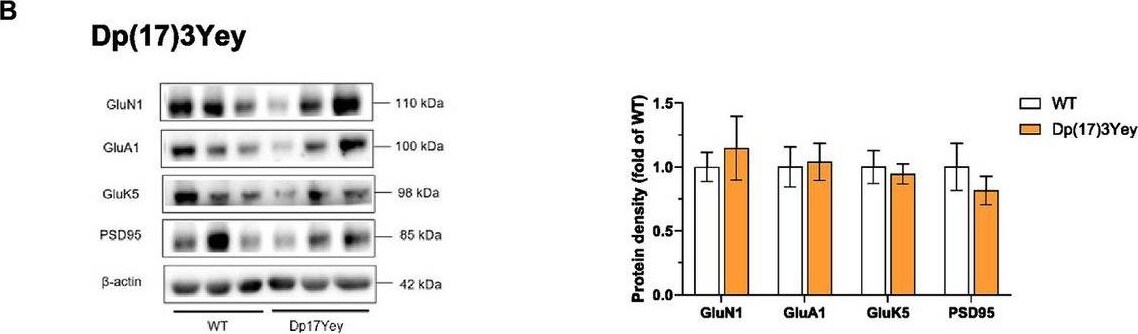
Western Blot: KA2/GRIK5/Glutamate Receptor KA2 Antibody - BSA Free [NBP1-80270] -
Altered abundance of glutamate receptor subunits in HPC synaptosomes from Dp1Tyb, Dp(17)3Yey, and Dp(10)2Yey male mice. (A–C) HPC synaptosomes from the indicated mouse strains were analyzed by immunoblotting for glutamate receptor subunits and PSD95. Example immunoblots are shown on the left and mean +/- SEM protein abundance on the right, normalized to beta -actin (or to GluA1 or GluN2B in case of phosphorylation levels of the respective receptor) and then to the mean signal in WT mice. Immunoblots show analysis of HPC synaptosome extracts from 2 to 5 mice of each genotype. Compared to WT littermates, mutant Dp1Tyb mice displayed lower hippocampal expression of GluA1, pGluA1(S845), and PSD95 (Student’s t-test, *p < 0.05) (A). Mutant Dp(10)2Yey mice displayed an age-dependent decrease in hippocampal expression of GluK5 and PSD95 compared to WT littermates (two-way ANOVA, *p < 0.05, **p < 0.001) (C). The decrease in GluK5 expression was not driven by age-dependent changes in the WT group as this comparison was not statistically significant (p > 0.05) (C). 21-month-old Dp1Tyb: n = 6 WT, 5 Dp1Tyb; 21-month-old Dp(17)3Yey: n = 9 WT, 12 Dp(17)3Yey; 14-month-old Dp(10)2Yey: n = 9 WT, 11 Dp(10)2Yey; 22-month-old Dp(10)2Yey: n = 6 WT, 10 Dp(10)2Yey. Image collected and cropped by CiteAb from the following open publication (https://www.frontiersin.org/articles/10.3389/fnbeh.2024.1428146/full), licensed under a CC-BY license. Not internally tested by Novus Biologicals.Applications for KA2/GRIK5/Glutamate Receptor KA2 Antibody - BSA Free
Immunohistochemistry
Western Blot
Formulation, Preparation, and Storage
Purification
Formulation
Format
Preservative
Concentration
Shipping
Stability & Storage
Background: KA2/GRIK5
Long Name
Alternate Names
Gene Symbol
UniProt
Additional KA2/GRIK5 Products
Product Documents for KA2/GRIK5/Glutamate Receptor KA2 Antibody - BSA Free
Certificate of Analysis
To download a Certificate of Analysis, please enter a lot or batch number in the search box below.
Product Specific Notices for KA2/GRIK5/Glutamate Receptor KA2 Antibody - BSA Free
This product is for research use only and is not approved for use in humans or in clinical diagnosis. Primary Antibodies are guaranteed for 1 year from date of receipt.
Related Research Areas
Citations for KA2/GRIK5/Glutamate Receptor KA2 Antibody - BSA Free
 Powered by Bioz
Customer Reviews for KA2/GRIK5/Glutamate Receptor KA2 Antibody - BSA Free
There are currently no reviews for this product. Be the first to review KA2/GRIK5/Glutamate Receptor KA2 Antibody - BSA Free and earn rewards!
Have you used KA2/GRIK5/Glutamate Receptor KA2 Antibody - BSA Free?
Submit a review and receive an Amazon gift card!
$25/€18/£15/$25CAN/¥2500 for a review with an image
$10/€7/£6/$10CAN/¥1110 for a review without an image
Submit a review
Protocols
Find general support by application which include: protocols, troubleshooting, illustrated assays, videos and webinars.
- Antigen Retrieval Protocol (PIER)
- Antigen Retrieval for Frozen Sections Protocol
- Appropriate Fixation of IHC/ICC Samples
- Cellular Response to Hypoxia Protocols
- Chromogenic IHC Staining of Formalin-Fixed Paraffin-Embedded (FFPE) Tissue Protocol
- Chromogenic Immunohistochemistry Staining of Frozen Tissue
- ClariTSA™ Fluorophore Kits
- Detection & Visualization of Antibody Binding
- Fluorescent IHC Staining of Frozen Tissue Protocol
- Graphic Protocol for Heat-induced Epitope Retrieval
- Graphic Protocol for the Preparation and Fluorescent IHC Staining of Frozen Tissue Sections
- Graphic Protocol for the Preparation and Fluorescent IHC Staining of Paraffin-embedded Tissue Sections
- Graphic Protocol for the Preparation of Gelatin-coated Slides for Histological Tissue Sections
- IHC Sample Preparation (Frozen sections vs Paraffin)
- Immunofluorescent IHC Staining of Formalin-Fixed Paraffin-Embedded (FFPE) Tissue Protocol
- Immunohistochemistry (IHC) and Immunocytochemistry (ICC) Protocols
- Immunohistochemistry Frozen Troubleshooting
- Immunohistochemistry Paraffin Troubleshooting
- Preparing Samples for IHC/ICC Experiments
- Preventing Non-Specific Staining (Non-Specific Binding)
- Primary Antibody Selection & Optimization
- Protocol for Heat-Induced Epitope Retrieval (HIER)
- Protocol for Making a 4% Formaldehyde Solution in PBS
- Protocol for VisUCyte™ HRP Polymer Detection Reagent
- Protocol for the Preparation & Fixation of Cells on Coverslips
- Protocol for the Preparation and Chromogenic IHC Staining of Frozen Tissue Sections
- Protocol for the Preparation and Chromogenic IHC Staining of Frozen Tissue Sections - Graphic
- Protocol for the Preparation and Chromogenic IHC Staining of Paraffin-embedded Tissue Sections
- Protocol for the Preparation and Chromogenic IHC Staining of Paraffin-embedded Tissue Sections - Graphic
- Protocol for the Preparation and Fluorescent IHC Staining of Frozen Tissue Sections
- Protocol for the Preparation and Fluorescent IHC Staining of Paraffin-embedded Tissue Sections
- Protocol for the Preparation of Gelatin-coated Slides for Histological Tissue Sections
- R&D Systems Quality Control Western Blot Protocol
- TUNEL and Active Caspase-3 Detection by IHC/ICC Protocol
- The Importance of IHC/ICC Controls
- Troubleshooting Guide: Immunohistochemistry
- Troubleshooting Guide: Western Blot Figures
- Western Blot Conditions
- Western Blot Protocol
- Western Blot Protocol for Cell Lysates
- Western Blot Troubleshooting
- Western Blot Troubleshooting Guide
- View all Protocols, Troubleshooting, Illustrated assays and Webinars