
Recombinant Human Ki67/MKI67 GST (N-Term) Protein
Novus Biologicals | Catalog # H00004288-Q01

Loading...
Key Product Details
Source
Wheat germ
Tag
GST (N-Term)
Applications
Western Blot, ELISA, Affinity Purification, Endotoxin Detection
Loading...
Product Specifications
Description
A recombinant protein with a N-terminal GST tag corresponding to the amino acid sequence 3157-3256 of Human Ki-67/MKI67
Source: Wheat Germ (in vitro)
Amino Acid Sequence: RSARQNESSQPKVAEESGGQKSAKVLMQNQKGKGEAGNSDSMCLRSRKTKSQPAASTLESKSVQRVTRSVKRCAENPKKAEDNVCVKKIRTRSHRDSEDI
Purity
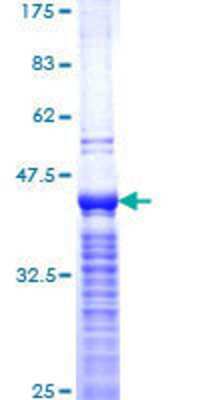
>80% by SDS-PAGE and Coomassie blue staining
Predicted Molecular Mass
36.74 kDa.
Disclaimer note: The observed molecular weight of the protein may vary from the listed predicted molecular weight due to post translational modifications, post translation cleavages, relative charges, and other experimental factors.
Disclaimer note: The observed molecular weight of the protein may vary from the listed predicted molecular weight due to post translational modifications, post translation cleavages, relative charges, and other experimental factors.
Activity
This protein was produced in an in vitro wheat germ expression system that should preserve correct conformational folding that is necessary for biological function. While it is possible that this protein could display some level of activity, the functionality of this protein has not been explicitly measured or validated.
Protein / Peptide Type
Recombinant Protein
Scientific Data Images for Recombinant Human Ki67/MKI67 GST (N-Term) Protein
Recombinant Human Ki67/MKI67 Protein [H00004288-Q01] - A specific band was detected for Ki67/MKI67 at approximately 36.74 kDa (as indicated). 12.5% SDS-PAGE Stained with Coomassie Blue.
Formulation, Preparation, and Storage
H00004288-Q01
| Preparation Method | in vitro wheat germ expression system |
| Formulation | 50 mM Tris-HCI, 10 mM reduced Glutathione, pH 8.0 in the elution buffer. |
| Preservative | No Preservative |
| Concentration | Please see the vial label for concentration. If unlisted please contact technical services. |
| Shipping | The product is shipped with dry ice or equivalent. Upon receipt, store it immediately at the temperature recommended below. |
| Stability & Storage | Store at -80C. Avoid freeze-thaw cycles. |
Background: Ki67/MKI67
Detection of Ki67 by immunostaining is commonly used as a proliferation marker in solid tumors, as well as certain hematological malignancies (3-5). The Ki67 index, which reports on positive Ki67 stained tumor cell nuclei, has been extensively studied as a prognostic biomarker in cancers such as breast cancer and cervical cancer.
References
1. Gerdes J, Schwab U, Lemke H, Stein H. (1983) Production of a mouse monoclonal antibody reactive with a human nuclear antigen associated with cell proliferation. Int J Cancer. 31:13-20. PMID: 6339421
2. Starborg M, Gell K, Brundell E and Hoog C. (1996) The murine Ki-67 cell proliferation antigen accumulates in the nucleolar and heterochromatic regions of interphase cells and at the periphery of the mitotic chromosomes in a process essential for cell cycle progression. J Cell Sci. 109:143-153. 1996
3. Karamitopoulou E, Perentes E, Tolnay M, Probst A. (1998) Prognostic significance of MIB-1, p53, and bcl-2 immunoreactivity in meningiomas. Hum Pathol. 29(2):140-5. PMID: 9490273
4. Geyer FC, Rodrigues DN, Weigelt B and Reis-Filho JS. (2012) Molecular classification of estrogen receptor-positive/luminal breast cancers. Adv Anat Pathol. 19(1):39-53. PMID: 22156833
5. Ikenberg H, Bergeron C, Schmidt D, Griesser H, Alameda F, Angeloni C, Bogers J, Dachez R, Denton K, Hariri J, Keller T, von Knebel Doeberitz M, Neumann HH, Puig-Tintore LM, Sideri M, Rehm S, Ridder R; PALMS Study Group. (2013) Screening for cervical cancer precursors with p16/Ki-67 dual-stained cytology: results of the PALMS study. J Natl Cancer Inst. 105(20):1550-7. PMID: 24096620
Long Name
Antigen Identified by Monoclonal Antibody Ki67
Alternate Names
Ki-67, KIA, MIB-1, MKI67, PPP1R105, TSG126
Gene Symbol
MKI67
Additional Ki67/MKI67 Products
Product Documents for Recombinant Human Ki67/MKI67 GST (N-Term) Protein
Certificate of Analysis
To download a Certificate of Analysis, please enter a lot or batch number in the search box below.
Product Specific Notices for Recombinant Human Ki67/MKI67 GST (N-Term) Protein
This product is produced by and distributed for Abnova, a company based in Taiwan.
This product is for research use only and is not approved for use in humans or in clinical diagnosis. This product is guaranteed for 1 year from date of receipt.
Related Research Areas
Customer Reviews for Recombinant Human Ki67/MKI67 GST (N-Term) Protein
There are currently no reviews for this product. Be the first to review Recombinant Human Ki67/MKI67 GST (N-Term) Protein and earn rewards!
Have you used Recombinant Human Ki67/MKI67 GST (N-Term) Protein?
Submit a review and receive an Amazon gift card!
$25/€18/£15/$25CAN/¥2500 for a review with an image
$10/€7/£6/$10CAN/¥1110 for a review without an image
Submit a review
Protocols
Find general support by application which include: protocols, troubleshooting, illustrated assays, videos and webinars.
- Cellular Response to Hypoxia Protocols
- ELISA Sample Preparation & Collection Guide
- ELISA Troubleshooting Guide
- How to Run an R&D Systems DuoSet ELISA
- How to Run an R&D Systems Quantikine ELISA
- How to Run an R&D Systems Quantikine™ QuicKit™ ELISA
- Quantikine HS ELISA Kit Assay Principle, Alkaline Phosphatase
- Quantikine HS ELISA Kit Principle, Streptavidin-HRP Polymer
- R&D Systems Quality Control Western Blot Protocol
- Sandwich ELISA (Colorimetric) – Biotin/Streptavidin Detection Protocol
- Sandwich ELISA (Colorimetric) – Direct Detection Protocol
- Troubleshooting Guide: ELISA
- Troubleshooting Guide: Western Blot Figures
- Western Blot Conditions
- Western Blot Protocol
- Western Blot Protocol for Cell Lysates
- Western Blot Troubleshooting
- Western Blot Troubleshooting Guide
- View all Protocols, Troubleshooting, Illustrated assays and Webinars
FAQs for Recombinant Human Ki67/MKI67 GST (N-Term) Protein
Showing
1
-
4 of
4 FAQs
Showing All
-
Q: Can I know the species of GST tag of Ki67 Partial Recombinant Protein (H00004288-Q01).
A: H00004288-Q01 is human protein that was expressed in a wheat germ system.
-
Q: I recently purchased Ki67 Partial Recombinant Protein (H00004288-Q01) from your company. The protein will be used screening of RNA pool. It is very crucial to screen in advance against GST epitope tag protein before Ki67 screening. So I wish to buy GST Epitope tag protein with is the same as GST tag of Ki67. Please let me know the product name among the GST tag proteins in your catalog.
A:
We distribute H00004288-Q01 for Abnova, a company based in Taiwan, and are not involved in the development of this product. Abnova considers the sequence of the GST tag that they use for their recombinant proteins proprietary, but we do sell a number of GST epitope tag proteins.
-
Q: Whats the concentration of this Ki67/MKI67 Antibody?
A: The concentration is lot specific available upon request.
-
Q: Whats the concentration of this Ki67/MKI67 Antibody?
A: Optimal concentrations and conditions for each application should be determined by the user.
-
Q: Can I know the species of GST tag of Ki67 Partial Recombinant Protein (H00004288-Q01).
A: H00004288-Q01 is human protein that was expressed in a wheat germ system.
-
Q: I recently purchased Ki67 Partial Recombinant Protein (H00004288-Q01) from your company. The protein will be used screening of RNA pool. It is very crucial to screen in advance against GST epitope tag protein before Ki67 screening. So I wish to buy GST Epitope tag protein with is the same as GST tag of Ki67. Please let me know the product name among the GST tag proteins in your catalog.
A:
We distribute H00004288-Q01 for Abnova, a company based in Taiwan, and are not involved in the development of this product. Abnova considers the sequence of the GST tag that they use for their recombinant proteins proprietary, but we do sell a number of GST epitope tag proteins.
-
Q: Whats the concentration of this Ki67/MKI67 Antibody?
A: The concentration is lot specific available upon request.
-
Q: Whats the concentration of this Ki67/MKI67 Antibody?
A: Optimal concentrations and conditions for each application should be determined by the user.
-
Q: Can I know the species of GST tag of Ki67 Partial Recombinant Protein (H00004288-Q01).
A: H00004288-Q01 is human protein that was expressed in a wheat germ system.
-
Q: I recently purchased Ki67 Partial Recombinant Protein (H00004288-Q01) from your company. The protein will be used screening of RNA pool. It is very crucial to screen in advance against GST epitope tag protein before Ki67 screening. So I wish to buy GST Epitope tag protein with is the same as GST tag of Ki67. Please let me know the product name among the GST tag proteins in your catalog.
A:
We distribute H00004288-Q01 for Abnova, a company based in Taiwan, and are not involved in the development of this product. Abnova considers the sequence of the GST tag that they use for their recombinant proteins proprietary, but we do sell a number of GST epitope tag proteins.
-
Q: Whats the concentration of this Ki67/MKI67 Antibody?
A: The concentration is lot specific available upon request.
-
Q: Whats the concentration of this Ki67/MKI67 Antibody?
A: Optimal concentrations and conditions for each application should be determined by the user.
-
Q: Can I know the species of GST tag of Ki67 Partial Recombinant Protein (H00004288-Q01).
A: H00004288-Q01 is human protein that was expressed in a wheat germ system.
-
Q: I recently purchased Ki67 Partial Recombinant Protein (H00004288-Q01) from your company. The protein will be used screening of RNA pool. It is very crucial to screen in advance against GST epitope tag protein before Ki67 screening. So I wish to buy GST Epitope tag protein with is the same as GST tag of Ki67. Please let me know the product name among the GST tag proteins in your catalog.
A:
We distribute H00004288-Q01 for Abnova, a company based in Taiwan, and are not involved in the development of this product. Abnova considers the sequence of the GST tag that they use for their recombinant proteins proprietary, but we do sell a number of GST epitope tag proteins.
-
Q: Whats the concentration of this Ki67/MKI67 Antibody?
A: The concentration is lot specific available upon request.
-
Q: Whats the concentration of this Ki67/MKI67 Antibody?
A: Optimal concentrations and conditions for each application should be determined by the user.
Loading...