
KLRG1 Antibody (2F1) [DyLight 405]
Novus Biologicals | Catalog # FAB69441E

Key Product Details
Species Reactivity
Mouse
Applications
Flow Cytometry, CyTOF-ready
Label
DyLight 405 (Excitation = 400 nm, Emission = 420 nm)
Antibody Source
Monoclonal Hamster IgG Clone # 2F1
Loading...
Product Specifications
Immunogen
IL-2 activated NK cells from C57/BL6 mice
Accession # O88713
Accession # O88713
Specificity
Detects mouse KLRG1 in direct ELISAs.
Clonality
Monoclonal
Host
Hamster
Isotype
IgG
Description
This conjugate is made on demand and is not held in inventory. Each order represents a unique lot. All conjugates are generated using validated conjugation protocols and meet strict degree of labeling (F/P) specifications; additional information is available upon request. The antibody concentration is provided on the individual product label.
For specialized conjugation needs, like large quantities, specific concentrations, and defined F/P ratios, bulk and custom antibody conjugation services are available.
For specialized conjugation needs, like large quantities, specific concentrations, and defined F/P ratios, bulk and custom antibody conjugation services are available.
Applications for KLRG1 Antibody (2F1) [DyLight 405]
Application
Recommended Usage
CyTOF-ready
Optimal dilutions of this antibody should be experimentally determined.
Flow Cytometry
Optimal dilutions of this antibody should be experimentally determined.
Application Notes
Recommended applications are based on validated applications from the unconjugated base product MAB69441. This conjugated antibody is not kept in inventory and is made to order using validated conjugation protocols.
Spectra Viewer
Plan Your Experiments
Use our spectra viewer to interactively plan your experiments, assessing multiplexing options. View the excitation and emission spectra for our fluorescent dye range and other commonly used dyes.
Spectra Viewer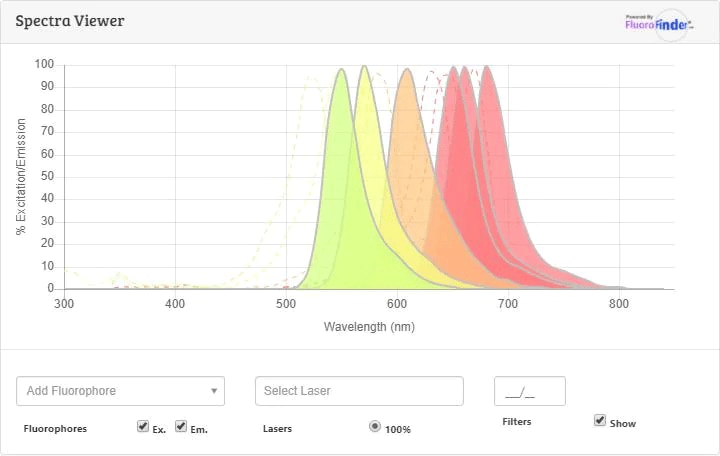
Flow Cytometry Panel Builder
Bio-Techne Knows Flow Cytometry
Save time and reduce costly mistakes by quickly finding compatible reagents using the Panel Builder Tool.
Advanced Features
- Spectra Viewer - Custom analysis of spectra from multiple fluorochromes
- Spillover Popups - Visualize the spectra of individual fluorochromes
- Antigen Density Selector - Match fluorochrome brightness with antigen density

Formulation, Preparation, and Storage
Purification
Protein A or G purified from hybridoma culture supernatant
Formulation
50mM Sodium Borate
Preservative
0.05% Sodium Azide
Concentration
Please see the vial label for concentration. If unlisted please contact technical services.
Shipping
The product is shipped with polar packs. Upon receipt, store it immediately at the temperature recommended below.
Stability & Storage
Store at 4C in the dark.
Background: KLRG1
KLRG1's primary ligand is E-cadherin, which is expressed on non-neural epithelial tissues, but the KLRG1 receptor also recognizes both N- and R-cadherin expressed in nervous system tissues (1,3,5,6). E-cadherin binding of KLRG1 leads to ITIM triggering and, ultimately, either reduced T cell proliferation or decreased NK cell cytotoxicity (3,5,6). More precisely, upon differentiation of CD8+ T cells, cells switch from signaling through CD28 and instead signal through the inhibitory KLRG1 receptor molecule (3,4). Phosphorylation of KLRG1's ITIM causes recruitment of two phosphatases, SH2-containing inositol polyphosphate 5-phoshate (SHIP-1) and SH-2 containing protein-tyrosine phosphatase 2 (SHP-2) (3,5). The effectors SHIP-1 and SHP-2 degrade PIP3 to PIP2, preventing Akt phosphorylation and inhibiting proliferation (3,5,6). Conversely, when KLRG1 signaling is blocked in highly differentiated T cells, Akt signaling is restored and cell proliferation resumes (3). An increase in highly differentiated T cells is observed in many age-related infections such as meningitis, pneumonia, and influenza, which also correlates with elevated KLRG1 levels (3). This observation suggests that KLRG1 may be a potential immunotherapeutic target, especially for vaccinations which typically have decreased response in aged patients (3).
References
1. Li Y, Hofmann M, Wang Q, Teng L, Chlewicki LK, Pircher H, Mariuzza RA. Structure of natural killer cell receptor KLRG1 bound to E-cadherin reveals basis for MHC-independent missing self recognition. Immunity. 2009 Jul 17;31(1):35-46. http://doi.org/10.1016/j.immuni.2009.04.019
2. Uniprot(Q96E93)
3. Henson SM, Akbar AN. KLRG1--more than a marker for T cell senescence. Age (Dordr). 2009 Dec;31(4):285-91. http://doi.org/10.1007/s11357-009-9100-9.
4. Thimme R, Appay V, Koschella M, Panther E, Roth E, Hislop AD, Rickinson AB, Rowland-Jones SL, Blum HE, Pircher H. Increased expression of the NK cell receptor KLRG1 by virus-specific CD8 T cells during persistent antigen stimulation. J Virol. 2005 Sep;79(18):12112-6.http://doi.org/10.1128/JVI.79.18.12112-12116.2005.
5. Borys SM, Bag AK, Brossay L, Adeegbe DO. The Yin and Yang of Targeting KLRG1+ Tregs and Effector Cells. Front Immunol. 2022 Apr 29;13:894508. http://doi.org10.3389/fimmu.2022.894508.
6. Van den Bossche J, Malissen B, Mantovani A, De Baetselier P, Van Ginderachter JA. Regulation and function of the E-cadherin/catenin complex in cells of the monocyte-macrophage lineage and DCs. Blood. 2012 Feb 16;119(7):1623-33. http://doi.org/10.1182/blood-2011-10-384289.
Long Name
Killer Cell Lectin-like Receptor Subfamily G Member 1
Alternate Names
CLEC15A, MAFA, MAFAL
Additional KLRG1 Products
Product Documents for KLRG1 Antibody (2F1) [DyLight 405]
Certificate of Analysis
To download a Certificate of Analysis, please enter a lot or batch number in the search box below.
Product Specific Notices for KLRG1 Antibody (2F1) [DyLight 405]
DyLight (R) is a trademark of Thermo Fisher Scientific Inc. and its subsidiaries.
This product is for research use only and is not approved for use in humans or in clinical diagnosis. Primary Antibodies are guaranteed for 1 year from date of receipt.
Related Research Areas
Customer Reviews for KLRG1 Antibody (2F1) [DyLight 405]
There are currently no reviews for this product. Be the first to review KLRG1 Antibody (2F1) [DyLight 405] and earn rewards!
Have you used KLRG1 Antibody (2F1) [DyLight 405]?
Submit a review and receive an Amazon gift card!
$25/€18/£15/$25CAN/¥2500 for a review with an image
$10/€7/£6/$10CAN/¥1110 for a review without an image
Submit a review
Protocols
Find general support by application which include: protocols, troubleshooting, illustrated assays, videos and webinars.
- 7-Amino Actinomycin D (7-AAD) Cell Viability Flow Cytometry Protocol
- Extracellular Membrane Flow Cytometry Protocol
- Flow Cytometry Protocol for Cell Surface Markers
- Flow Cytometry Protocol for Staining Membrane Associated Proteins
- Flow Cytometry Staining Protocols
- Flow Cytometry Troubleshooting Guide
- Intracellular Flow Cytometry Protocol Using Alcohol (Methanol)
- Intracellular Flow Cytometry Protocol Using Detergents
- Intracellular Nuclear Staining Flow Cytometry Protocol Using Detergents
- Intracellular Staining Flow Cytometry Protocol Using Alcohol Permeabilization
- Intracellular Staining Flow Cytometry Protocol Using Detergents to Permeabilize Cells
- Propidium Iodide Cell Viability Flow Cytometry Protocol
- Protocol for Liperfluo
- Protocol for the Characterization of Human Th22 Cells
- Protocol for the Characterization of Human Th9 Cells
- Protocol: Annexin V and PI Staining by Flow Cytometry
- Protocol: Annexin V and PI Staining for Apoptosis by Flow Cytometry
- Troubleshooting Guide: Fluorokine Flow Cytometry Kits
- View all Protocols, Troubleshooting, Illustrated assays and Webinars
Loading...
Associated Pathways
