
The definitive hematopoietic system is made up of all adult blood cell types including megakaryocytes, erythrocytes, and cells of the myeloid and lymphoid lineages. All of these cells are derived from multipotent hematopoietic stem cells (HSCs) through a succession of precursors with progressively limited potential. Hematopoietic stem cells are tissue-specific stem cells that exhibit remarkable self-renewal capacity and are responsible for the life-long mainteÂnance of the hematopoietic system. HSCs are rare cells that reside in adult bone marrow where hematopoiesis is continuÂously taking place. They can also be found in cord blood, fetal liver, adult spleen, and peripheral blood. R&D Systems offers several products for studying hematopoietic lineage cells including serum-free media, lineage depleÂtion antibodies and kits, and reagents for performing colony forming cell (CFC) assays.
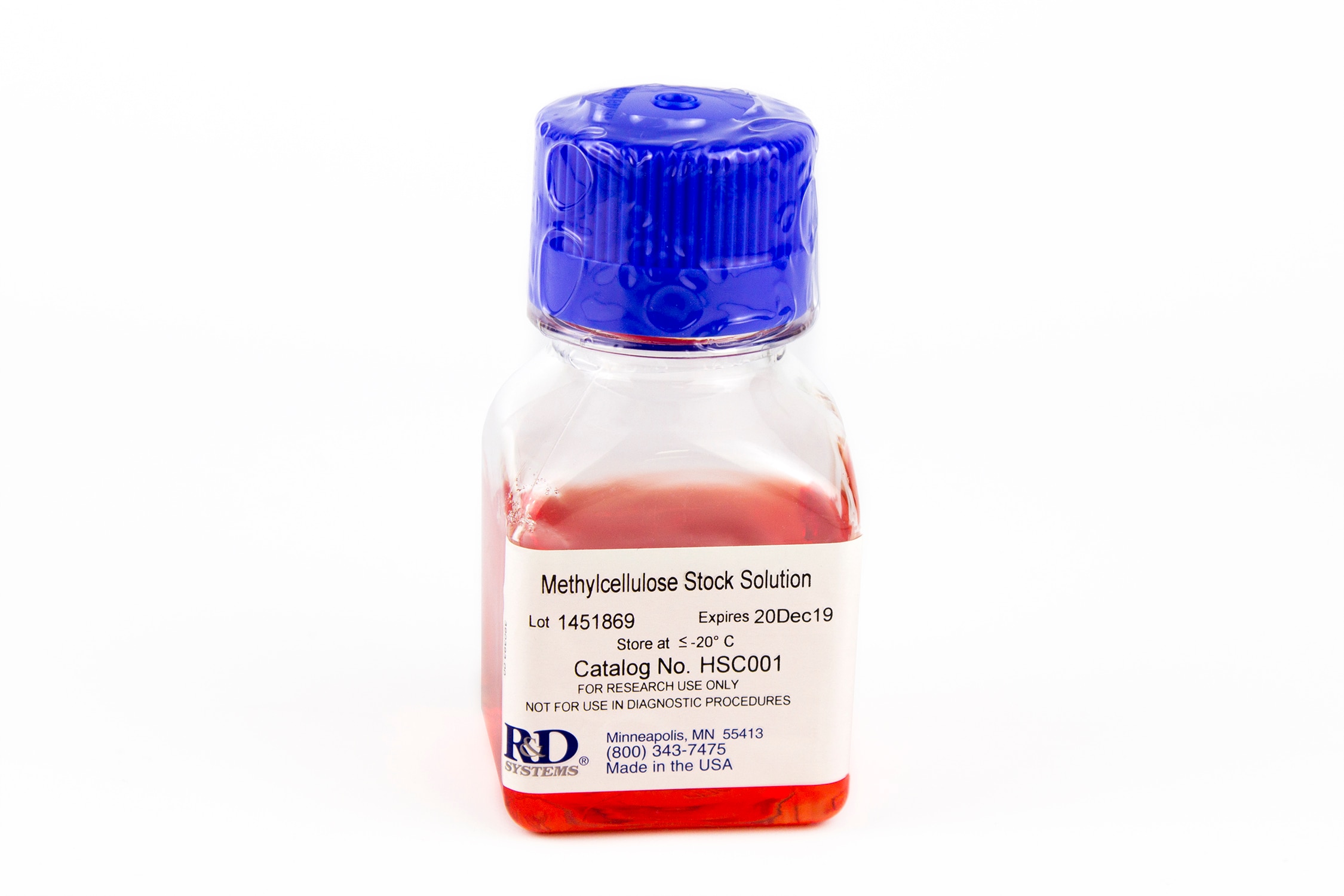
Methylcellulose Stock Solution
R&D Systems | Catalog # HSC001

Product Summary for Methylcellulose Stock Solution
Kit Summary
For the growth and differentiation of human, mouse, and rat hematopoietic stem cells using Iscove’s Modified Dulbecco’s Media.
Key Benefits
- Can be supplemented with user-defined cytokines and growth factors
- Excellent optical clarity facilitates colony identification
- High lot-to-lot consistency decreases variation
Why is it Important to Verify Hematopoietic Progenitor Cell Identity using Established Markers?
Colony forming cell (CFC) assays, which are used to enumerate and quantify multi-potent and single lineage hematopoietic progenitors, can be time consuming and laborious.
Successful growth and enumeration of cell colonies is dependent on factors such as accurate cell counts, the presence of growth factors and/or cytokines, adequate humidity, and the use of high quality media. R&D Systems offers high quality Methylcellulose Stock Solution with superior optical clarity to support optimal colony growth, enumeration, and identification.
R&D Systems Methylcellulose Stock Solution:
- Optical clarity facilitates colony identification.
- High lot-to-lot consistency decreases variation.
- Supports reproducible in vitro growth of hematopoietic stem and progenitor cells.
- Can be supplemented with user-defined cytokines and growth factors.
- Increased cloning efficiency and improved colony growth compared to agar.
- 100 mL of 3% Methylcellulose in Iscove's Modified Dulbecco's Medium.
| Contents | Concentration |
| Methylcellulose (1500 cps) in Iscove’s Modified Dulbecco's Medium |
3.0% |
Stability and Storage
Methylcellulose Stock Solution should be stored at =-20 °C upon receipt. Storage at 2 °C to 8 °C is not recommended.
Precautions
The acute and chronic effects of overexposure to this media are unknown. Safe laboratory procedures should be followed and protective clothing should be worn when handling this media.
Limitations
- The safety and efficacy of this product in diagnostic or other clinical uses has not been established.
- The reagent should not be used beyond the expiration date indicated on the label.
- Human hematopoietic progenitors derived from different individuals may cause results to vary.
Guide to Choosing Media for the Colony Forming Cell (CFC) Assay
Human Methylcellulose Stock and Base Media
| Catalog # | Product Description | Volume | Colonies Selected for | Contains Serum | Cytokines Included |
| HSC001 | Methylcellulose Stock Solution | 100 mL | N/A* | No | None |
| HSC002 | Human Methylcellulose Base Media |
90 mL | N/A* | Yes | None |
| HSC011 | StemXVivo® Methylcellulose Concentrate |
50 mL | N/A* | No | None |
Complete Human Methylcellulose Media
| Catalog # | Product Description | Volume | Colonies Selected for | Contains Serum | Cytokines Included |
| HSC003 | Human Methylcellulose Complete Media | 100 mL | BFU-E CFU-E CFU-G CFU-GEMM CFU-GM CFU-M |
Yes | Epo GM-CSF IL-3 SCF |
| HSC004 | Human Methylcellulose Complete Media without Epo | 100 mL | CFU-G CFU-GM CFU-M |
Yes | SCF GM-CSF IL-3 |
| HSC005 | Human Methylcellulose Enriched Media |
100 mL | BFU-E CFU-E CFU-G CFU-GEMM CFU-GM CFU-M |
Yes | Epo G-CSF GM-CSF IL-3 IL-6 SCF |
| HSC005SF | Human Methylcellulose Serum-Free Enriched Media |
100 mL | BFU-E CFU-E CFU-G CFU-GEMM CFU-GM CFU-M |
No | Epo G-CSF GM-CSF IL-3 IL-6 SCF |
Mouse Methylcellulose Stock and Base Media
| Catalog # | Product Description | Volume | Colonies Selected for | Contains Serum | Cytokines Included |
| HSC001 | Methylcellulose Stock Solution | 100 mL | N/A* | No | None |
| HSC006 | Mouse Methylcellulose | 90 mL | N/A* | Yes | None |
| HSC011 | StemXVivo® Methylcellulose Concentrate |
50 mL | N/A* | No | None |
Complete Mouse Methylcellulose Media
| Catalog # | Product Description | Volume | Colonies Selected for | Contains Serum | Cytokines Included |
| HSC007 | Mouse Methylcellulose Complete Media | 100 mL | BFU-E CFU-E CFU-G CFU-GEMM CFU-GM CFU-M |
Yes | Epo IL-3 IL-6 SCF |
*Base media and stock solutions do not contain cytokines and will not support colony growth unless conditioned media, cytokines, or other culture supplements are added.
Scientific Data Images for Methylcellulose Stock Solution
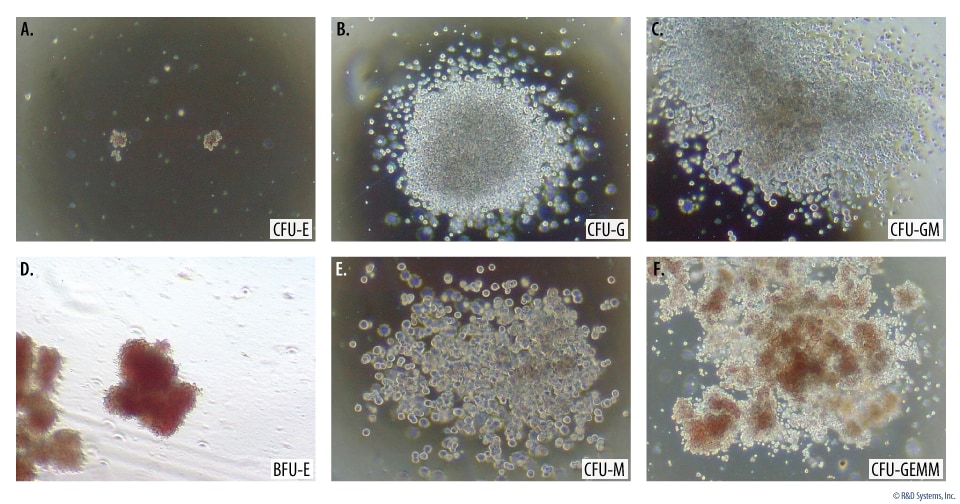
Human Hematopoietic Colony Formation Using the Methylcellulose-based Colony Forming Cell Assay.
Colony forming unit-erythroid (CFU-E) are clonogenic progenitors that produce only one or two clusters with each cluster containing from 8 to approximately 100 hemoglobinized erythroblasts. It represents the more mature erythroid progenitors that have less proliferative capacity.B. Colony forming unit-granulocyte (CFU-G) are clonogenic progenitors of granulocytes that give rise to a homogeneous population of eosinophils, basophils, or neutrophils.C. Colony forming unit-granulocyte, macrophage (CFU-GM) are progenitors that give rise to colonies containing a heterogeneous population of macrophages and granulocytes. The morphology is similar to the CFU-M and CFU-G descriptions.D. Burst forming unit-erythroid (BFU-E) colonies can be described as small (3 to 8 clusters), intermediate (9 to 16 clusters), or large (more than 16 clusters) according to the number of clusters present. These are primitive erythroid progenitors that have high proliferative capacity.E. Colony forming unit-macrophage (CFU-M) are clonogenic progenitors of macrophages that give rise to a homogenous population of macrophages.F. Colony forming unit-granulocyte, erythrocyte, macrophage, megakaryocyte (CFU-GEMM) are multi-lineage progenitors that give rise to erythroid, granulocyte, macrophage and megakaryocyte lineages, as the name indicates.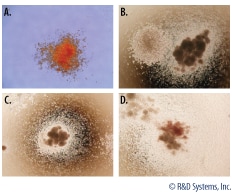
Mouse Hematopoietic Colony Formation Using the Methylcellulose-based Colony Forming Cell Assay.
A. Burst forming unit-erythroid (BFU-E) colonies are defined as clusters with a minimal of 30 cells that can be seen from day 7 onward. Each individual cluster consisted of tiny, irregular shaped cells that may appear fused together. Each cluster normally contains 5-8 cells, and the size of the cluster is similar to that of a single macrophage. The cluster may vary in sizes and color. A large BFU-E is usually bright red and is differentiable even without the use of a microscope. Smaller BFU-E may not appear red in color but is distinguishable based on the morphology. B. Colony forming unit-macrophage (CFU-M; left) are clonogenic progenitors of macrophages that give rise to a homogenous population of macrophages. Colony forming unit-granulocyte (CFU-G; right) are clonogenic progenitors of granulocytes that give rise to a homogeneous population of eosinophils, basophils, or neutrophils. C. Colony forming unit-granulocyte, macrophage (CFU-GM) are progenitors that give rise to colonies containing a heterogeneous population of macrophages and granulocytes. The morphology is similar to the CFU-M and CFU-G descriptions. D. Colony forming unit-granulocyte, erythrocyte, macrophage, megakaryocyte (CFU-GEMM) are multi-lineage progenitors that give rise to the lineage of erythroid, granulocytes, macrophages, and megakaryocytes as the name indicates. It can be identified as reddish colored cells (erythroid) mixed with colorless cells (granulocytes, macrophages, and megakaryocytes) in a single colony. This progenitor is typically the largest colony on the culture dish; occasionally CFU-GM may attain a size comparable or larger than that of CFU-GEMM.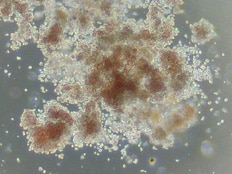
Tips to Identify CFU-GEMM Colonies in the Human Colony Forming Unit Assay.
CFU-GEMMs contain a mixture of granulocytes, erythrocytes, megakaryocytes, and macrophages. Human CFU-GEMMs have the obvious red color of the BFU-E as well as the complex morphological features of both the small, compact granulocytes and the large, round macrophages. Viewing the cluster in multiple focal planes is again important to ensure that the colony contains all of the GEMM cell types. CFU-GEMM appearance is similar for human and mouse cells. For more tips please visit watch our CFC Assay video tutorial.Background: Hematopoietic Stem Cells
Additional Hematopoietic Stem Cells Products
Product Documents for Methylcellulose Stock Solution
Certificate of Analysis
To download a Certificate of Analysis, please enter a lot or batch number in the search box below.
Note: Certificate of Analysis not available for kit components.
Product Specific Notices for Methylcellulose Stock Solution
For research use only
Related Research Areas
Citations for Methylcellulose Stock Solution
 Powered by Bioz
Customer Reviews for Methylcellulose Stock Solution (3)
Have you used Methylcellulose Stock Solution?
Submit a review and receive an Amazon gift card!
$25/€18/£15/$25CAN/¥2500 for a review with an image
$10/€7/£6/$10CAN/¥1110 for a review without an image
Submit a review
-
Verified Customer | Posted 01/10/2022
-
Verified Customer | Posted 12/02/2021
-
Verified Customer | Posted 12/06/2016We use to make stem cell spheres using methylcellulose.
There are no reviews that match your criteria.
Protocols
View specific protocols for Methylcellulose Stock Solution (HSC001):
Refer to the product datasheet for complete product details.
Briefly, Methylcellulose Stock Solution is used in the Colony Forming Cell Assay using the following procedure:
- Prepare human mononuclear cells or mouse bone marrow cells
- Add cells and desired supplements to Methylcellulose Stock Solution
- Plate and incubate cells
- Identify and count colonies


Reagents Provided
Reagent supplied in the Methylcellulose Stock Solution (Catalog # HSC001):
- 100 mL of 3% Methylcellulose in Iscove’s Modified Dulbecco’s Medium.
| Contents | Concentration |
| Methylcellulose (1500 cps) in Iscove’s Modified Dulbecco's Medium |
3.0% |
Other Supplies Required
Reagents
- Cells derived from bone marrow, blood, or enriched CD34+ cells
- Iscove's Modified Dulbecco's Media (IMDM)
- Ca2+/Mg2+-Free Hank's Balanced Salt Solution (HBSS)
- Ficoll-Paque™ PLUS (GE Healthcare) or equivalent
Materials
- 100 mm culture plates
- 35 mm culture plates
- 15 mL centrifuge tubes
- 50 mL centrifuge tubes
- 10 mL syringes
- 3 mL syringes
- 5 mL vials
- 16 gauge 1½ inch needle
- 14 gauge laboratory pipetting needle
- Heparinized syringes or Vacutainers®
- Serological pipettes
- Pipettes and pipette tips
Equipment
- 37 °C and CO2 humidified incubator
- Centrifuge
- Vortex mixer
- Hemocytometer
- Inverted Microscope
Other Supplies Required
Reagents
- Cells derived from mouse bone marrow, spleen, peripheral blood, or fetal liver. Mice are routinely used between 6 - 12 weeks.
- Iscove's Modified Dulbecco’s Media (IMDM)
- Fetal Bovine Serum
- IMDM/2% Fetal Bovine Serum
- (Optional) Flow Cytometry Mouse Lyse Buffer (Catalog # FC003)
Materials
- 100 mm culture plates
- 35 mm culture plates
- 15 mL centrifuge tubes
- 10 mL syringes
- 3 mL syringes
- 5 mL vials
- 16 gauge 1½ inch needle
- 14 gauge laboratory pipetting needle
- Serological pipettes
- Pipettes and pipette tips
Equipment
- 37 °C and CO2 humidified incubator
- Centrifuge
- Vortex mixer
- Hemocytometer
- Inverted Microscope
Procedure Overview
Procedure for the Human Colony Forming Cell Assay
Prepare mononuclear cells by Ficoll-Paque gradient centrifugation.
Wash the cells two times with HBSS and pool the cells.
Centrifuge the cells at 400 x g for 10 minutes.

Thaw aliquots of Methylcellulose Stock Solution at room temperature.

Resuspend mononuclear cells in 10 mL of IMDM.

Perform a cell count.

Transfer the appropriate volume of cells plus a slight excess into a new 15 mL centrifuge tube.
Centrifuge at 300 x g for 10 minutes.

Remove the supernatant.
Resuspend the cells in IMDM to the desired stock cell number to generate a 10X stock concentration.
Combine the appropriate volume of 10X cell stock with the desired cell culture supplements/cytokines, and Methylcellulose Stock Solution. The final Methylcellulose concentration should be 1.27%.
Vortex the samples vigorously.
Wait approximately 20 minutes to allow air bubbles to escape.
Add 1.1 mL of the cell mixture to a 35 mm culture plate using a 3 mL syringe and a 16 gauge needle.
Spread the media evenly by gently rotating the plate.

Place two 35 mm plates into a 10 cm plate.
Add one uncovered 35 mm plate that contains 3-4 mL of sterile water.
Cover the 10 cm plate and place it in a 37 °C and 5% CO2 incubator.
Incubate the cells for 14-16 days.

Use an inverted microscope and a scoring grid to identify and count individual colonies.

Procedure for the Mouse Colony Forming Cell Assay
Pass a suspension of mouse bone marrow cells through a 70 μm nylon strainer to remove clumps and debris.
Remove red blood cells if necessary.
Wash the cells with IMDM/2% FBS by centrifugation at 300 x g for 8 minutes and pool the cells.

Remove the supernatant.
Resuspend the cells in 10 mL of IMDM/2% FBS.
Thaw aliquots of Methylcellulose Stock Solution at room temperature for approximately 30 minutes.

Perform a cell count.
Transfer the appropriate volume of cells plus a slight excess into a new 15 mL centrifuge tube.
Centrifuge at 300 x g for 10 minutes.
Remove the supernatant.
Resuspend the cells in IMDM to the desired stock cell number to generate a 10X stock concentration.
Combine the appropriate volume of 10X cell stock with the desired cell culture supplements/cytokines, and Methylcellulose Stock Solution. The final Methylcellulose concentration should be 1.27%.
Vortex the samples vigorously.
Wait approximately 20 minutes to allow air bubbles to escape.
Add 1.1 mL of the cell mixture to a 35 mm culture plate using a 3 mL syringe and a 16 gauge needle.
Spread the media evenly by gently rotating the plate.
Place two 35 mm plates into a 10 cm plate.
Add one uncovered 35 mm plate that contains 3-4 mL of sterile water.
Cover the 10 cm plate and place it in a 37 °C and 5% CO2 incubator.
Incubate the cells for 8-12 days.
Use an inverted microscope and a scoring grid to identify and count individual colonies.
FAQs for Methylcellulose Stock Solution
-
Q: How many freeze-thaws cycles can Methylcellulose stock solution, Catalog # HSC001, undergo?
A: We recommend keeping freeze-thaw cycles to a minimum. In our experience, two freeze-thaw cycles of the material received is acceptable, but after that, the viscosity of the product may be affected.
-
Q: Burst Forming Unit-Erythroid (BFU-E ) colonies representing erythorid progenitors appear to be low in frequency. Is there a strategy to count these colonies and visualize them?
A: It is true that BFU-E colonies are low in frequency. To count and see good BFU-E colonies, the CFC assay is set up at two cell densities. For counting BFU-E colonies, a 10X cell concentration of 1.5-3x10⁵ cells/mL is used. For properly visualizing the BFU-E colonies, an assay at half that cell density is used.
-
Q: Can the CFU assay using Methycellulose based media be performed using frozen PBMCs instead of fresh PBMCs?
A: Yes, the CFU assay can be performed using frozen PBMCs. The PBMCs can be frozen in DMEM containing 10% FBS and 10% DMSO.
-
Q: Is lot-specific information on viscosity available for Methyl Cellulose Stock Solution (Catalog # HSC001)?
A: Methyl cellulose Stock Solution is prepared using Methyl cellulose with an estimated viscosity of 1500 CPS. Because of our stringent quality control assays, we don’t expect large variations in viscosity from lot to lot.
-
Q: What is the difference between Methylcellulose Stock (Catalog # HSC001) and Base Media (Catalog # HSC002)?
A: The Methylcellulose Stock (Catalog # HSC001) contains methylcellulose in Iscove's Modified Dulbecco's Medium. The Base Media (Catalog # HSC002) contains methylcellulose in Iscove's Modified Dulbecco's Medium along with serum, albumin, L-glutamine, and 2-mercaptoethanol. The additional components of HSC002 are needed to sustain the viability and growth of HSCs. The advantage to using HSC002 is that R&D Systems has already evaluated the serum, albumin, L-glutamine, and 2-mercaptoethanol in-house to ensure lot-to-lot consistency, eliminating the need for the researcher to evaluate these components individually.
-
Q: What is the molecular weight of Methylcellulose used in Catalog # HSC001?
A: The Methylcellulose in Catalog # HSC001 has a molecular weight range of 208272 - 219639 g/mol.
-
Q: Why does the Human, Mouse and Rat colony forming assay protocol (CFC assay protocol) recommed use of non-tissue culture treated petri dishes?
A: The CFC assay promotes the growth of cells as colonies suspended in methylcellulose. However, if you use tissue culture treated dishes, the cells will also adhere and grow out on the bottom of the plate. Sometimes this appears as a round colony that is sticking and growing out on the edges (like an egg) and sometimes you can see patches of a monolayer. This makes it difficult to see the suspended colonies.
-
Q: Why is there color difference observed sometimes between two bottles of Methylcellulose Stock Solution (Catalog # HSC001)?
A: The difference in color can be because of dry ice added to the shipment. Dry ice can cause minor pH changes and slight changes in color, but this will not affect performance.
-
Q: How many freeze-thaws cycles can Methylcellulose stock solution, Catalog # HSC001, undergo?
A: We recommend keeping freeze-thaw cycles to a minimum. In our experience, two freeze-thaw cycles of the material received is acceptable, but after that, the viscosity of the product may be affected.
-
Q: Burst Forming Unit-Erythroid (BFU-E ) colonies representing erythorid progenitors appear to be low in frequency. Is there a strategy to count these colonies and visualize them?
A: It is true that BFU-E colonies are low in frequency. To count and see good BFU-E colonies, the CFC assay is set up at two cell densities. For counting BFU-E colonies, a 10X cell concentration of 1.5-3x10⁵ cells/mL is used. For properly visualizing the BFU-E colonies, an assay at half that cell density is used.
-
Q: Can the CFU assay using Methycellulose based media be performed using frozen PBMCs instead of fresh PBMCs?
A: Yes, the CFU assay can be performed using frozen PBMCs. The PBMCs can be frozen in DMEM containing 10% FBS and 10% DMSO.
-
Q: Is lot-specific information on viscosity available for Methyl Cellulose Stock Solution (Catalog # HSC001)?
A: Methyl cellulose Stock Solution is prepared using Methyl cellulose with an estimated viscosity of 1500 CPS. Because of our stringent quality control assays, we don’t expect large variations in viscosity from lot to lot.
-
Q: What is the difference between Methylcellulose Stock (Catalog # HSC001) and Base Media (Catalog # HSC002)?
A: The Methylcellulose Stock (Catalog # HSC001) contains methylcellulose in Iscove's Modified Dulbecco's Medium. The Base Media (Catalog # HSC002) contains methylcellulose in Iscove's Modified Dulbecco's Medium along with serum, albumin, L-glutamine, and 2-mercaptoethanol. The additional components of HSC002 are needed to sustain the viability and growth of HSCs. The advantage to using HSC002 is that R&D Systems has already evaluated the serum, albumin, L-glutamine, and 2-mercaptoethanol in-house to ensure lot-to-lot consistency, eliminating the need for the researcher to evaluate these components individually.
-
Q: What is the molecular weight of Methylcellulose used in Catalog # HSC001?
A: The Methylcellulose in Catalog # HSC001 has a molecular weight range of 208272 - 219639 g/mol.
-
Q: Why does the Human, Mouse and Rat colony forming assay protocol (CFC assay protocol) recommed use of non-tissue culture treated petri dishes?
A: The CFC assay promotes the growth of cells as colonies suspended in methylcellulose. However, if you use tissue culture treated dishes, the cells will also adhere and grow out on the bottom of the plate. Sometimes this appears as a round colony that is sticking and growing out on the edges (like an egg) and sometimes you can see patches of a monolayer. This makes it difficult to see the suspended colonies.
-
Q: Why is there color difference observed sometimes between two bottles of Methylcellulose Stock Solution (Catalog # HSC001)?
A: The difference in color can be because of dry ice added to the shipment. Dry ice can cause minor pH changes and slight changes in color, but this will not affect performance.
-
Q: How many freeze-thaws cycles can Methylcellulose stock solution, Catalog # HSC001, undergo?
A: We recommend keeping freeze-thaw cycles to a minimum. In our experience, two freeze-thaw cycles of the material received is acceptable, but after that, the viscosity of the product may be affected.
-
Q: Burst Forming Unit-Erythroid (BFU-E ) colonies representing erythorid progenitors appear to be low in frequency. Is there a strategy to count these colonies and visualize them?
A: It is true that BFU-E colonies are low in frequency. To count and see good BFU-E colonies, the CFC assay is set up at two cell densities. For counting BFU-E colonies, a 10X cell concentration of 1.5-3x10⁵ cells/mL is used. For properly visualizing the BFU-E colonies, an assay at half that cell density is used.
-
Q: Can the CFU assay using Methycellulose based media be performed using frozen PBMCs instead of fresh PBMCs?
A: Yes, the CFU assay can be performed using frozen PBMCs. The PBMCs can be frozen in DMEM containing 10% FBS and 10% DMSO.
-
Q: Is lot-specific information on viscosity available for Methyl Cellulose Stock Solution (Catalog # HSC001)?
A: Methyl cellulose Stock Solution is prepared using Methyl cellulose with an estimated viscosity of 1500 CPS. Because of our stringent quality control assays, we don’t expect large variations in viscosity from lot to lot.
-
Q: What is the difference between Methylcellulose Stock (Catalog # HSC001) and Base Media (Catalog # HSC002)?
A: The Methylcellulose Stock (Catalog # HSC001) contains methylcellulose in Iscove's Modified Dulbecco's Medium. The Base Media (Catalog # HSC002) contains methylcellulose in Iscove's Modified Dulbecco's Medium along with serum, albumin, L-glutamine, and 2-mercaptoethanol. The additional components of HSC002 are needed to sustain the viability and growth of HSCs. The advantage to using HSC002 is that R&D Systems has already evaluated the serum, albumin, L-glutamine, and 2-mercaptoethanol in-house to ensure lot-to-lot consistency, eliminating the need for the researcher to evaluate these components individually.
-
Q: What is the molecular weight of Methylcellulose used in Catalog # HSC001?
A: The Methylcellulose in Catalog # HSC001 has a molecular weight range of 208272 - 219639 g/mol.
-
Q: Why does the Human, Mouse and Rat colony forming assay protocol (CFC assay protocol) recommed use of non-tissue culture treated petri dishes?
A: The CFC assay promotes the growth of cells as colonies suspended in methylcellulose. However, if you use tissue culture treated dishes, the cells will also adhere and grow out on the bottom of the plate. Sometimes this appears as a round colony that is sticking and growing out on the edges (like an egg) and sometimes you can see patches of a monolayer. This makes it difficult to see the suspended colonies.
-
Q: Why is there color difference observed sometimes between two bottles of Methylcellulose Stock Solution (Catalog # HSC001)?
A: The difference in color can be because of dry ice added to the shipment. Dry ice can cause minor pH changes and slight changes in color, but this will not affect performance.
-
Q: How many freeze-thaws cycles can Methylcellulose stock solution, Catalog # HSC001, undergo?
A: We recommend keeping freeze-thaw cycles to a minimum. In our experience, two freeze-thaw cycles of the material received is acceptable, but after that, the viscosity of the product may be affected.
-
Q: Burst Forming Unit-Erythroid (BFU-E ) colonies representing erythorid progenitors appear to be low in frequency. Is there a strategy to count these colonies and visualize them?
A: It is true that BFU-E colonies are low in frequency. To count and see good BFU-E colonies, the CFC assay is set up at two cell densities. For counting BFU-E colonies, a 10X cell concentration of 1.5-3x10⁵ cells/mL is used. For properly visualizing the BFU-E colonies, an assay at half that cell density is used.
-
Q: Can the CFU assay using Methycellulose based media be performed using frozen PBMCs instead of fresh PBMCs?
A: Yes, the CFU assay can be performed using frozen PBMCs. The PBMCs can be frozen in DMEM containing 10% FBS and 10% DMSO.
-
Q: Is lot-specific information on viscosity available for Methyl Cellulose Stock Solution (Catalog # HSC001)?
A: Methyl cellulose Stock Solution is prepared using Methyl cellulose with an estimated viscosity of 1500 CPS. Because of our stringent quality control assays, we don’t expect large variations in viscosity from lot to lot.
-
Q: What is the difference between Methylcellulose Stock (Catalog # HSC001) and Base Media (Catalog # HSC002)?
A: The Methylcellulose Stock (Catalog # HSC001) contains methylcellulose in Iscove's Modified Dulbecco's Medium. The Base Media (Catalog # HSC002) contains methylcellulose in Iscove's Modified Dulbecco's Medium along with serum, albumin, L-glutamine, and 2-mercaptoethanol. The additional components of HSC002 are needed to sustain the viability and growth of HSCs. The advantage to using HSC002 is that R&D Systems has already evaluated the serum, albumin, L-glutamine, and 2-mercaptoethanol in-house to ensure lot-to-lot consistency, eliminating the need for the researcher to evaluate these components individually.
-
Q: What is the molecular weight of Methylcellulose used in Catalog # HSC001?
A: The Methylcellulose in Catalog # HSC001 has a molecular weight range of 208272 - 219639 g/mol.
-
Q: Why does the Human, Mouse and Rat colony forming assay protocol (CFC assay protocol) recommed use of non-tissue culture treated petri dishes?
A: The CFC assay promotes the growth of cells as colonies suspended in methylcellulose. However, if you use tissue culture treated dishes, the cells will also adhere and grow out on the bottom of the plate. Sometimes this appears as a round colony that is sticking and growing out on the edges (like an egg) and sometimes you can see patches of a monolayer. This makes it difficult to see the suspended colonies.
-
Q: Why is there color difference observed sometimes between two bottles of Methylcellulose Stock Solution (Catalog # HSC001)?
A: The difference in color can be because of dry ice added to the shipment. Dry ice can cause minor pH changes and slight changes in color, but this will not affect performance.
-
Q: How many freeze-thaws cycles can Methylcellulose stock solution, Catalog # HSC001, undergo?
A: We recommend keeping freeze-thaw cycles to a minimum. In our experience, two freeze-thaw cycles of the material received is acceptable, but after that, the viscosity of the product may be affected.
-
Q: Burst Forming Unit-Erythroid (BFU-E ) colonies representing erythorid progenitors appear to be low in frequency. Is there a strategy to count these colonies and visualize them?
A: It is true that BFU-E colonies are low in frequency. To count and see good BFU-E colonies, the CFC assay is set up at two cell densities. For counting BFU-E colonies, a 10X cell concentration of 1.5-3x10⁵ cells/mL is used. For properly visualizing the BFU-E colonies, an assay at half that cell density is used.
-
Q: Can the CFU assay using Methycellulose based media be performed using frozen PBMCs instead of fresh PBMCs?
A: Yes, the CFU assay can be performed using frozen PBMCs. The PBMCs can be frozen in DMEM containing 10% FBS and 10% DMSO.
-
Q: Is lot-specific information on viscosity available for Methyl Cellulose Stock Solution (Catalog # HSC001)?
A: Methyl cellulose Stock Solution is prepared using Methyl cellulose with an estimated viscosity of 1500 CPS. Because of our stringent quality control assays, we don’t expect large variations in viscosity from lot to lot.
-
Q: What is the difference between Methylcellulose Stock (Catalog # HSC001) and Base Media (Catalog # HSC002)?
A: The Methylcellulose Stock (Catalog # HSC001) contains methylcellulose in Iscove's Modified Dulbecco's Medium. The Base Media (Catalog # HSC002) contains methylcellulose in Iscove's Modified Dulbecco's Medium along with serum, albumin, L-glutamine, and 2-mercaptoethanol. The additional components of HSC002 are needed to sustain the viability and growth of HSCs. The advantage to using HSC002 is that R&D Systems has already evaluated the serum, albumin, L-glutamine, and 2-mercaptoethanol in-house to ensure lot-to-lot consistency, eliminating the need for the researcher to evaluate these components individually.
-
Q: What is the molecular weight of Methylcellulose used in Catalog # HSC001?
A: The Methylcellulose in Catalog # HSC001 has a molecular weight range of 208272 - 219639 g/mol.
-
Q: Why does the Human, Mouse and Rat colony forming assay protocol (CFC assay protocol) recommed use of non-tissue culture treated petri dishes?
A: The CFC assay promotes the growth of cells as colonies suspended in methylcellulose. However, if you use tissue culture treated dishes, the cells will also adhere and grow out on the bottom of the plate. Sometimes this appears as a round colony that is sticking and growing out on the edges (like an egg) and sometimes you can see patches of a monolayer. This makes it difficult to see the suspended colonies.
-
Q: Why is there color difference observed sometimes between two bottles of Methylcellulose Stock Solution (Catalog # HSC001)?
A: The difference in color can be because of dry ice added to the shipment. Dry ice can cause minor pH changes and slight changes in color, but this will not affect performance.
-
Q: How many freeze-thaws cycles can Methylcellulose stock solution, Catalog # HSC001, undergo?
A: We recommend keeping freeze-thaw cycles to a minimum. In our experience, two freeze-thaw cycles of the material received is acceptable, but after that, the viscosity of the product may be affected.
-
Q: Burst Forming Unit-Erythroid (BFU-E ) colonies representing erythorid progenitors appear to be low in frequency. Is there a strategy to count these colonies and visualize them?
A: It is true that BFU-E colonies are low in frequency. To count and see good BFU-E colonies, the CFC assay is set up at two cell densities. For counting BFU-E colonies, a 10X cell concentration of 1.5-3x10⁵ cells/mL is used. For properly visualizing the BFU-E colonies, an assay at half that cell density is used.
-
Q: Can the CFU assay using Methycellulose based media be performed using frozen PBMCs instead of fresh PBMCs?
A: Yes, the CFU assay can be performed using frozen PBMCs. The PBMCs can be frozen in DMEM containing 10% FBS and 10% DMSO.
-
Q: Is lot-specific information on viscosity available for Methyl Cellulose Stock Solution (Catalog # HSC001)?
A: Methyl cellulose Stock Solution is prepared using Methyl cellulose with an estimated viscosity of 1500 CPS. Because of our stringent quality control assays, we don’t expect large variations in viscosity from lot to lot.
-
Q: What is the difference between Methylcellulose Stock (Catalog # HSC001) and Base Media (Catalog # HSC002)?
A: The Methylcellulose Stock (Catalog # HSC001) contains methylcellulose in Iscove's Modified Dulbecco's Medium. The Base Media (Catalog # HSC002) contains methylcellulose in Iscove's Modified Dulbecco's Medium along with serum, albumin, L-glutamine, and 2-mercaptoethanol. The additional components of HSC002 are needed to sustain the viability and growth of HSCs. The advantage to using HSC002 is that R&D Systems has already evaluated the serum, albumin, L-glutamine, and 2-mercaptoethanol in-house to ensure lot-to-lot consistency, eliminating the need for the researcher to evaluate these components individually.
-
Q: What is the molecular weight of Methylcellulose used in Catalog # HSC001?
A: The Methylcellulose in Catalog # HSC001 has a molecular weight range of 208272 - 219639 g/mol.
-
Q: Why does the Human, Mouse and Rat colony forming assay protocol (CFC assay protocol) recommed use of non-tissue culture treated petri dishes?
A: The CFC assay promotes the growth of cells as colonies suspended in methylcellulose. However, if you use tissue culture treated dishes, the cells will also adhere and grow out on the bottom of the plate. Sometimes this appears as a round colony that is sticking and growing out on the edges (like an egg) and sometimes you can see patches of a monolayer. This makes it difficult to see the suspended colonies.
-
Q: Why is there color difference observed sometimes between two bottles of Methylcellulose Stock Solution (Catalog # HSC001)?
A: The difference in color can be because of dry ice added to the shipment. Dry ice can cause minor pH changes and slight changes in color, but this will not affect performance.
-
Q: How many freeze-thaws cycles can Methylcellulose stock solution, Catalog # HSC001, undergo?
A: We recommend keeping freeze-thaw cycles to a minimum. In our experience, two freeze-thaw cycles of the material received is acceptable, but after that, the viscosity of the product may be affected.
-
Q: Burst Forming Unit-Erythroid (BFU-E ) colonies representing erythorid progenitors appear to be low in frequency. Is there a strategy to count these colonies and visualize them?
A: It is true that BFU-E colonies are low in frequency. To count and see good BFU-E colonies, the CFC assay is set up at two cell densities. For counting BFU-E colonies, a 10X cell concentration of 1.5-3x10⁵ cells/mL is used. For properly visualizing the BFU-E colonies, an assay at half that cell density is used.
-
Q: Can the CFU assay using Methycellulose based media be performed using frozen PBMCs instead of fresh PBMCs?
A: Yes, the CFU assay can be performed using frozen PBMCs. The PBMCs can be frozen in DMEM containing 10% FBS and 10% DMSO.
-
Q: Is lot-specific information on viscosity available for Methyl Cellulose Stock Solution (Catalog # HSC001)?
A: Methyl cellulose Stock Solution is prepared using Methyl cellulose with an estimated viscosity of 1500 CPS. Because of our stringent quality control assays, we don’t expect large variations in viscosity from lot to lot.
-
Q: What is the difference between Methylcellulose Stock (Catalog # HSC001) and Base Media (Catalog # HSC002)?
A: The Methylcellulose Stock (Catalog # HSC001) contains methylcellulose in Iscove's Modified Dulbecco's Medium. The Base Media (Catalog # HSC002) contains methylcellulose in Iscove's Modified Dulbecco's Medium along with serum, albumin, L-glutamine, and 2-mercaptoethanol. The additional components of HSC002 are needed to sustain the viability and growth of HSCs. The advantage to using HSC002 is that R&D Systems has already evaluated the serum, albumin, L-glutamine, and 2-mercaptoethanol in-house to ensure lot-to-lot consistency, eliminating the need for the researcher to evaluate these components individually.
-
Q: What is the molecular weight of Methylcellulose used in Catalog # HSC001?
A: The Methylcellulose in Catalog # HSC001 has a molecular weight range of 208272 - 219639 g/mol.
-
Q: Why does the Human, Mouse and Rat colony forming assay protocol (CFC assay protocol) recommed use of non-tissue culture treated petri dishes?
A: The CFC assay promotes the growth of cells as colonies suspended in methylcellulose. However, if you use tissue culture treated dishes, the cells will also adhere and grow out on the bottom of the plate. Sometimes this appears as a round colony that is sticking and growing out on the edges (like an egg) and sometimes you can see patches of a monolayer. This makes it difficult to see the suspended colonies.
-
Q: Why is there color difference observed sometimes between two bottles of Methylcellulose Stock Solution (Catalog # HSC001)?
A: The difference in color can be because of dry ice added to the shipment. Dry ice can cause minor pH changes and slight changes in color, but this will not affect performance.
-
Q: How many freeze-thaws cycles can Methylcellulose stock solution, Catalog # HSC001, undergo?
A: We recommend keeping freeze-thaw cycles to a minimum. In our experience, two freeze-thaw cycles of the material received is acceptable, but after that, the viscosity of the product may be affected.
-
Q: Burst Forming Unit-Erythroid (BFU-E ) colonies representing erythorid progenitors appear to be low in frequency. Is there a strategy to count these colonies and visualize them?
A: It is true that BFU-E colonies are low in frequency. To count and see good BFU-E colonies, the CFC assay is set up at two cell densities. For counting BFU-E colonies, a 10X cell concentration of 1.5-3x10⁵ cells/mL is used. For properly visualizing the BFU-E colonies, an assay at half that cell density is used.
-
Q: Can the CFU assay using Methycellulose based media be performed using frozen PBMCs instead of fresh PBMCs?
A: Yes, the CFU assay can be performed using frozen PBMCs. The PBMCs can be frozen in DMEM containing 10% FBS and 10% DMSO.
-
Q: Is lot-specific information on viscosity available for Methyl Cellulose Stock Solution (Catalog # HSC001)?
A: Methyl cellulose Stock Solution is prepared using Methyl cellulose with an estimated viscosity of 1500 CPS. Because of our stringent quality control assays, we don’t expect large variations in viscosity from lot to lot.
-
Q: What is the difference between Methylcellulose Stock (Catalog # HSC001) and Base Media (Catalog # HSC002)?
A: The Methylcellulose Stock (Catalog # HSC001) contains methylcellulose in Iscove's Modified Dulbecco's Medium. The Base Media (Catalog # HSC002) contains methylcellulose in Iscove's Modified Dulbecco's Medium along with serum, albumin, L-glutamine, and 2-mercaptoethanol. The additional components of HSC002 are needed to sustain the viability and growth of HSCs. The advantage to using HSC002 is that R&D Systems has already evaluated the serum, albumin, L-glutamine, and 2-mercaptoethanol in-house to ensure lot-to-lot consistency, eliminating the need for the researcher to evaluate these components individually.
-
Q: What is the molecular weight of Methylcellulose used in Catalog # HSC001?
A: The Methylcellulose in Catalog # HSC001 has a molecular weight range of 208272 - 219639 g/mol.
-
Q: Why does the Human, Mouse and Rat colony forming assay protocol (CFC assay protocol) recommed use of non-tissue culture treated petri dishes?
A: The CFC assay promotes the growth of cells as colonies suspended in methylcellulose. However, if you use tissue culture treated dishes, the cells will also adhere and grow out on the bottom of the plate. Sometimes this appears as a round colony that is sticking and growing out on the edges (like an egg) and sometimes you can see patches of a monolayer. This makes it difficult to see the suspended colonies.
-
Q: Why is there color difference observed sometimes between two bottles of Methylcellulose Stock Solution (Catalog # HSC001)?
A: The difference in color can be because of dry ice added to the shipment. Dry ice can cause minor pH changes and slight changes in color, but this will not affect performance.