
Mouse CD74 Antibody (829706) [APC]
R&D Systems | Catalog # FAB7478A

Scientific images may be resized, cropped, or adjusted for brightness or contrast for presentation purposes. These updates are limited to presentation and do not affect the underlying scientific interpretation of the data. Where available, additional source data may be provided upon request.
Key Product Details
Species Reactivity
Validated:
Cited:
Applications
Validated:
Cited:
Label
Antibody Source
Product Specifications
Immunogen
Gln56-Cys215
Accession # P04441
Specificity
Clonality
Host
Isotype
Scientific Data Images for Mouse CD74 Antibody (829706) [APC]
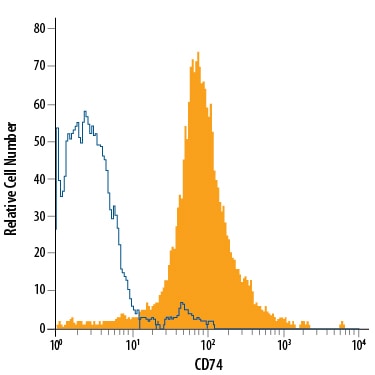
Detection of CD74 in A20 Mouse Cell Line by Flow Cytometry.
A20 mouse B cell lymphoma cell line was stained with Rat Anti-Mouse CD74 APC-conjugated Monoclonal Antibody (Catalog # FAB7478A, filled histogram) or isotype control antibody (Catalog # IC005A, open histogram). View our protocol for Staining Membrane-associated Proteins.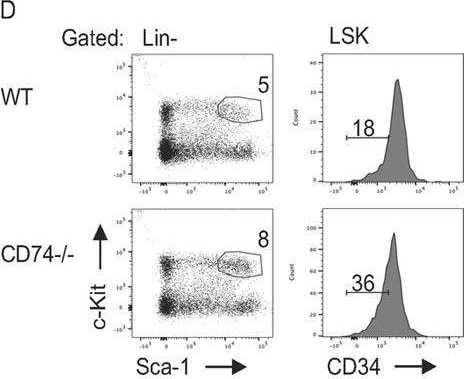
Detection of CD74 by Flow Cytometry
Expansion of HSPCs in the BM of CD74−/− mice.(A) BM cells derived from WT or CD74−/− were purified. Histograms show representative analysis of CD74 expression on HSPCs in WT and CD74−/− mice. n = 3. (B) Total BM cellularity per femur and tibia in WT and CD74−/− mice, Data A in S1 Data. (C–J) The percent of the different populations in WT and CD74−/−-derived BM cells. (C) Lin-; Data B in S1 Data(D) Representative FACS analysis of WT and CD74−/− HSPCs; (E) LSK; Data C in S1 Data(F) CD34-/LSK; Data D in S1 Data and (G) CD34+; Data E in S1 Data(H) CD150+CD48-LSK; Data F in S1 Data(I) CD150-CD48-/LSK; Data G in S1 Data and (J) CD150-CD48+/LSK; n = 14–18, Data H in S1 Data. (K) CFUC assay: Total BM cells from WT and CD74−/− mice were seeded at 15,000 cells/mL in semisolid cultures supplemented with cytokines and nutrients. CFU-C were counted 7 days later; n = 7, Data I in S1 Data. Bars show SEM. Unpaired two-tailed t test *p < 0.05; **p < 0.01; ***p < 0.001; ****p < 0.0001. The fcs files and gates can be found at the Flow Repository (accession number FR-FCM-Z3F2). BM, bone marrow; CFU-C, colony-forming unit cell; FACS, fluorescence-activated cell sorting; HSPC, hematopoietic stem and progenitor cell; WT, wild-type. Image collected and cropped by CiteAb from the following open publication (https://pubmed.ncbi.nlm.nih.gov/33661886), licensed under a CC-BY license. Not internally tested by R&D Systems.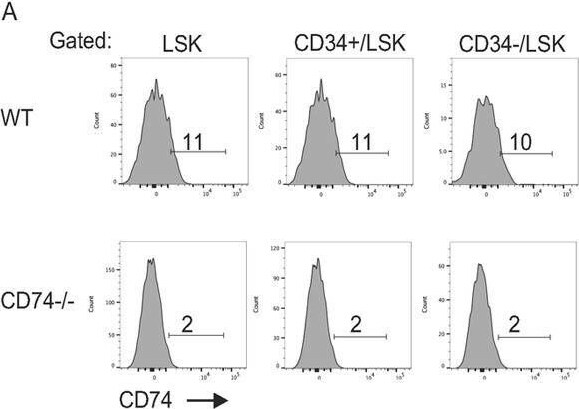
Detection of CD74 by Flow Cytometry
Expansion of HSPCs in the BM of CD74−/− mice.(A) BM cells derived from WT or CD74−/− were purified. Histograms show representative analysis of CD74 expression on HSPCs in WT and CD74−/− mice. n = 3. (B) Total BM cellularity per femur and tibia in WT and CD74−/− mice, Data A in S1 Data. (C–J) The percent of the different populations in WT and CD74−/−-derived BM cells. (C) Lin-; Data B in S1 Data(D) Representative FACS analysis of WT and CD74−/− HSPCs; (E) LSK; Data C in S1 Data(F) CD34-/LSK; Data D in S1 Data and (G) CD34+; Data E in S1 Data(H) CD150+CD48-LSK; Data F in S1 Data(I) CD150-CD48-/LSK; Data G in S1 Data and (J) CD150-CD48+/LSK; n = 14–18, Data H in S1 Data. (K) CFUC assay: Total BM cells from WT and CD74−/− mice were seeded at 15,000 cells/mL in semisolid cultures supplemented with cytokines and nutrients. CFU-C were counted 7 days later; n = 7, Data I in S1 Data. Bars show SEM. Unpaired two-tailed t test *p < 0.05; **p < 0.01; ***p < 0.001; ****p < 0.0001. The fcs files and gates can be found at the Flow Repository (accession number FR-FCM-Z3F2). BM, bone marrow; CFU-C, colony-forming unit cell; FACS, fluorescence-activated cell sorting; HSPC, hematopoietic stem and progenitor cell; WT, wild-type. Image collected and cropped by CiteAb from the following open publication (https://pubmed.ncbi.nlm.nih.gov/33661886), licensed under a CC-BY license. Not internally tested by R&D Systems.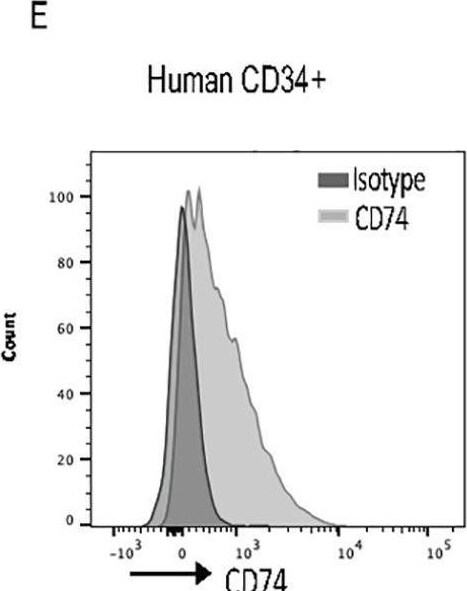
Detection of CD74 by Flow Cytometry
CD74 can serve as a potential target for therapy.(A, B) WT and CD74−/− BM cells were cultured alone or incubated with blocking anti-CD74 antibody (20, 50, and 100 μg/ml). After 48 h, percent LSK from live cells was analyzed by FACS; n = 4–7, Data A and B in S8 Data. (C, D) Survival curve: 5-FU (150 mg/kg and 125mg/kg) was injected to WT and CD74−/− mice once a week. Log-rank test *<0.05; n = 10 in each group, Data C and D in S8 Data. (G) Human CD34+ BM cells were stained for CD74 cell surface expression by FACS; n = 5. (H) Human BM were cultured with anti-CD74 (LN2) antibody or isotype control for 48 h, and percent of CD18 on human CD34+ cells was analyzed by FACS; n = 5, Data E in S8 Data. Bars show SEM. Unpaired two-tailed t test *p < 0.05; **p < 0.01; ***p < 0.001. The fcs files and gates can be found at the Flow Repository (accession number FR-FCM-Z3F2). 5-FU, 5-fluorouracil; BM, bone marrow; FACS, fluorescence-activated cell sorting; WT, wild-type. Image collected and cropped by CiteAb from the following open publication (https://pubmed.ncbi.nlm.nih.gov/33661886), licensed under a CC-BY license. Not internally tested by R&D Systems.Applications for Mouse CD74 Antibody (829706) [APC]
Flow Cytometry
Sample: A20 mouse B cell lymphoma cell line
Spectra Viewer
Plan Your Experiments
Use our spectra viewer to interactively plan your experiments, assessing multiplexing options. View the excitation and emission spectra for our fluorescent dye range and other commonly used dyes.
Spectra Viewer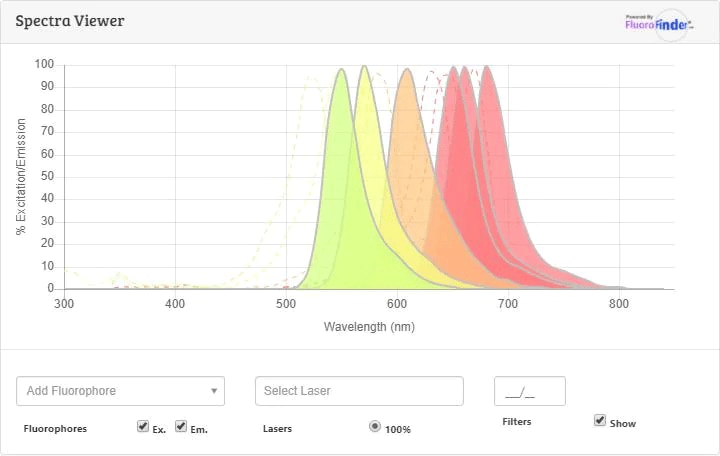
Flow Cytometry Panel Builder
Bio-Techne Knows Flow Cytometry
Save time and reduce costly mistakes by quickly finding compatible reagents using the Panel Builder Tool.
Advanced Features
- Spectra Viewer - Custom analysis of spectra from multiple fluorochromes
- Spillover Popups - Visualize the spectra of individual fluorochromes
- Antigen Density Selector - Match fluorochrome brightness with antigen density

Formulation, Preparation, and Storage
Purification
Formulation
Shipping
Stability & Storage
- 12 months from date of receipt, 2 to 8 °C as supplied.
Background: CD74
References
- Beswick, E.J. and V.E. Reyes (2009) World J. Gastroenterol. 15:2855.
- Koch, N. et al. (1987) EMBO J. 6:1677.
- Riberdy, J.M. et al. (1992) Nature 360:474.
- Koch, N. et al. (1991) J. Immunol. 147:2643.
- Roche, P.A. et al. (1991) Nature 354:392.
- Leng, L. et al. (2003) J. Exp. Med. 197:1467.
- Takahashi, K. et al. (2009) Respir. Res. 10:33.
- Heinrichs, D. et al. (2011) Proc. Natl. Acad. Sci. 104:17444.
- Shi, X. et al. (2006) Immunity 25:595.
- Gore, Y. et al. (2008) J. Biol. Chem. 283:2784.
- Veillat, V. et al. (2010) J. Clin. Endocrinol. Metab. 95:E403.
- Bryan, K.J. et al. (2008) Mol. Neurodegen. 3:13.
- Martin-Ventura, J.L. et al. (2009) Cardiovasc. Res. 83:586.
- Liu, Y.-H. et al. (2008) J. Immunol. 181:6584.
Alternate Names
Gene Symbol
UniProt
Additional CD74 Products
Product Documents for Mouse CD74 Antibody (829706) [APC]
Certificate of Analysis
To download a Certificate of Analysis, please enter a lot or batch number in the search box below.
Note: Certificate of Analysis not available for kit components.
Product Specific Notices for Mouse CD74 Antibody (829706) [APC]
For research use only
Related Research Areas
Citations for Mouse CD74 Antibody (829706) [APC]
 Powered by Bioz
Customer Reviews for Mouse CD74 Antibody (829706) [APC]
There are currently no reviews for this product. Be the first to review Mouse CD74 Antibody (829706) [APC] and earn rewards!
Have you used Mouse CD74 Antibody (829706) [APC]?
Submit a review and receive an Amazon gift card!
$25/€18/£15/$25CAN/¥2500 for a review with an image
$10/€7/£6/$10CAN/¥1110 for a review without an image
Submit a review
Protocols
Find general support by application which include: protocols, troubleshooting, illustrated assays, videos and webinars.
- 7-Amino Actinomycin D (7-AAD) Cell Viability Flow Cytometry Protocol
- Extracellular Membrane Flow Cytometry Protocol
- Flow Cytometry Protocol for Cell Surface Markers
- Flow Cytometry Protocol for Staining Membrane Associated Proteins
- Flow Cytometry Staining Protocols
- Flow Cytometry Troubleshooting Guide
- Intracellular Flow Cytometry Protocol Using Alcohol (Methanol)
- Intracellular Flow Cytometry Protocol Using Detergents
- Intracellular Nuclear Staining Flow Cytometry Protocol Using Detergents
- Intracellular Staining Flow Cytometry Protocol Using Alcohol Permeabilization
- Intracellular Staining Flow Cytometry Protocol Using Detergents to Permeabilize Cells
- Propidium Iodide Cell Viability Flow Cytometry Protocol
- Protocol for Liperfluo
- Protocol for the Characterization of Human Th22 Cells
- Protocol for the Characterization of Human Th9 Cells
- Protocol: Annexin V and PI Staining by Flow Cytometry
- Protocol: Annexin V and PI Staining for Apoptosis by Flow Cytometry
- Troubleshooting Guide: Fluorokine Flow Cytometry Kits
- View all Protocols, Troubleshooting, Illustrated assays and Webinars