
The galectins constitute a large family of carbohydrate-binding proteins with specificity for N-acetyl-lactosamine-containing glycoproteins. At least 14 mammalian galectins, which share structural similarities in their carbohydrate recognition domains (CRD), have been identified. The galectins have been classified as either prototype galectins (-1, -2, -5, -7, -10, -11, -13, -14), which contain one CRD and exist either as a monomer or a noncovalent homodimer; chimera galectins (Galectin-3) containing one CRD linked to a nonlectin domain; or tandem-repeat galectins (-4, -6, -8, -9, -12) that consist of two CRDs joined by a linker peptide. Galectins lack a classical signal peptide and can be localized to the cytosolic compartments where they have intracellular functions. However, via one or more as yet unidentified non-classical secretory pathways, galectins can also be secreted to act extracellularly. Individual members of the galectin family have different tissue distribution profiles and exhibit subtle differences in their carbohydrate-binding specificities. Each family member may preferentially bind to a unique subset of cell-surface glycoproteins. Galectin-3, also known as Mac-2, L29, CBP35, and epsilon BP, is a chimera galectin that has a tendency to dimerize. Galectin-3 is expressed in tumor cells, macrophages, activated T cells, osteoclasts, epithelial cells, and fibroblasts. It binds various matrix glycoproteins including laminin, fibronectin, LAMPS, 90K/Mac-2BP, MP20, and CEA. Galectin-3 promotes cell growth and proliferation for many cell types. Galectin-3 acts intracellularly to prevent apoptosis. Depending on the cell types, Galectin-3 exhibits pro- or anti-adhesive properties. In particular, it is reported to bind NG2 when complexed to Integrin alpha 3 beta 1 on endothelial cells, initiating cell motility and angiogenesis. Galectin-3 has proinflammatory activities in vitro and in vivo. It induces Th1 type and inhibits Th2 type cytokine production. Galectin-3 chemoattracts monocytes and macrophages. It activates and degranulates basophils and mast cells. Elevated circulating levels of Galectin-3 has been show to correlate with the malignant potential of several types of cancer, suggesting that Galectin-3 is also involved in tumor growth and metastasis. Human and mouse Galectin-3 shares approximately 80% amino acid sequence similarity.
Mouse Galectin-3 Antibody (202213) [PE]
R&D Systems | Catalog # FAB1197P

Scientific images may be resized, cropped, or adjusted for brightness or contrast for presentation purposes. These updates are limited to presentation and do not affect the underlying scientific interpretation of the data. Where available, additional source data may be provided upon request.
Key Product Details
Species Reactivity
Validated:
Cited:
Applications
Validated:
Cited:
Label
Antibody Source
Product Specifications
Immunogen
Ala2-Ile264
Accession # P16110
Specificity
Clonality
Host
Isotype
Scientific Data Images for Mouse Galectin-3 Antibody (202213) [PE]
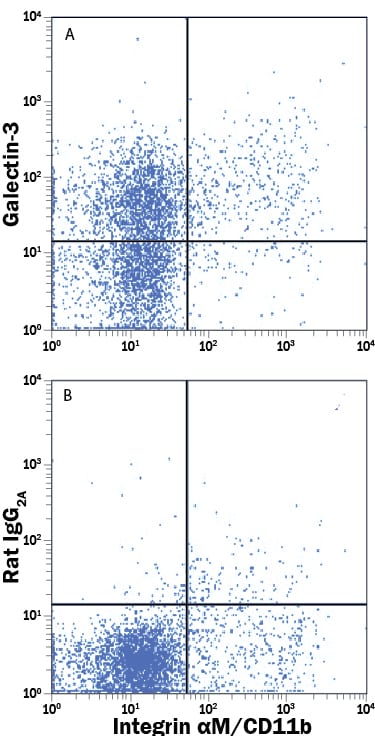
Detection of Galectin‑3 in Mouse Splenocytes by Flow Cytometry.
Mouse splenocytes were stained with Rat Anti-Mouse Integrin aM/CD11b APC-conjugated Monoclonal Antibody (Catalog # FAB1124A) and either (A) Rat Anti-Mouse Galectin-3 PE-conjugated Monoclonal Antibody (Catalog # FAB1197P) or (B) Rat IgG2APhycoerythrin Isotype Control (Catalog # IC006P). View our protocol for Staining Membrane-associated Proteins.Applications for Mouse Galectin-3 Antibody (202213) [PE]
Flow Cytometry
Sample: Mouse splenocytes
Spectra Viewer
Plan Your Experiments
Use our spectra viewer to interactively plan your experiments, assessing multiplexing options. View the excitation and emission spectra for our fluorescent dye range and other commonly used dyes.
Spectra Viewer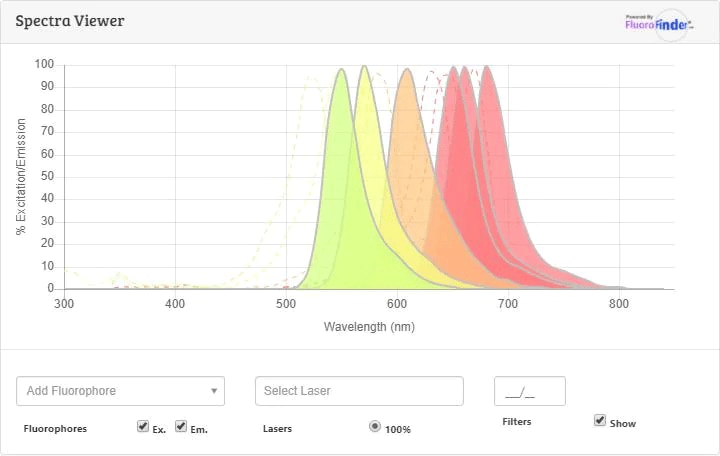
Flow Cytometry Panel Builder
Bio-Techne Knows Flow Cytometry
Save time and reduce costly mistakes by quickly finding compatible reagents using the Panel Builder Tool.
Advanced Features
- Spectra Viewer - Custom analysis of spectra from multiple fluorochromes
- Spillover Popups - Visualize the spectra of individual fluorochromes
- Antigen Density Selector - Match fluorochrome brightness with antigen density

Formulation, Preparation, and Storage
Purification
Formulation
Shipping
Stability & Storage
Background: Galectin-3
Alternate Names
Gene Symbol
UniProt
Additional Galectin-3 Products
Product Documents for Mouse Galectin-3 Antibody (202213) [PE]
Certificate of Analysis
To download a Certificate of Analysis, please enter a lot or batch number in the search box below.
Note: Certificate of Analysis not available for kit components.
Product Specific Notices for Mouse Galectin-3 Antibody (202213) [PE]
For research use only
Citations for Mouse Galectin-3 Antibody (202213) [PE]
 Powered by Bioz
Customer Reviews for Mouse Galectin-3 Antibody (202213) [PE]
There are currently no reviews for this product. Be the first to review Mouse Galectin-3 Antibody (202213) [PE] and earn rewards!
Have you used Mouse Galectin-3 Antibody (202213) [PE]?
Submit a review and receive an Amazon gift card!
$25/€18/£15/$25CAN/¥2500 for a review with an image
$10/€7/£6/$10CAN/¥1110 for a review without an image
Submit a review
Protocols
Find general support by application which include: protocols, troubleshooting, illustrated assays, videos and webinars.
- 7-Amino Actinomycin D (7-AAD) Cell Viability Flow Cytometry Protocol
- Extracellular Membrane Flow Cytometry Protocol
- Flow Cytometry Protocol for Cell Surface Markers
- Flow Cytometry Protocol for Staining Membrane Associated Proteins
- Flow Cytometry Staining Protocols
- Flow Cytometry Troubleshooting Guide
- Intracellular Flow Cytometry Protocol Using Alcohol (Methanol)
- Intracellular Flow Cytometry Protocol Using Detergents
- Intracellular Nuclear Staining Flow Cytometry Protocol Using Detergents
- Intracellular Staining Flow Cytometry Protocol Using Alcohol Permeabilization
- Intracellular Staining Flow Cytometry Protocol Using Detergents to Permeabilize Cells
- Propidium Iodide Cell Viability Flow Cytometry Protocol
- Protocol for Liperfluo
- Protocol for the Characterization of Human Th22 Cells
- Protocol for the Characterization of Human Th9 Cells
- Protocol: Annexin V and PI Staining by Flow Cytometry
- Protocol: Annexin V and PI Staining for Apoptosis by Flow Cytometry
- Troubleshooting Guide: Fluorokine Flow Cytometry Kits
- View all Protocols, Troubleshooting, Illustrated assays and Webinars