
HVEM (Herpesvirus Entry Mediator) is a type I membrane protein that is TNF receptor superfamily member 14 (TNFRSF14) (1). The mouse HVEM cDNA encodes a 275 amino acid (aa) protein. It contains a 36 aa signal peptide, a 170 aa extracellular domain with three cysteine rich domains (CRD), a 24 aa transmembrane region and a 45 aa cytoplasmic tail with a TRAF interaction domain (1). HVEM expression is highest on naïve, memory and regulatory T cells, but declines during T cell activation (2, 3). It is present at low levels on most resting leukocytes (4). HVEM is a receptor for the IGSF member BTLA (B and T Lymphocyte Attenuator), CD160, and the TNF family ligand LIGHT (2, 9). HVEM and BTLA are constitutively expressed on T cells, while LIGHT is generally considered to be inducible upon TCR activation. In the absence of activation, HVEM and BTLA interact monomerically, either in cis, or in trans. A same cell (or cis) interaction likely promotes general cell survival, while a between cell (or trans) interaction promotes a state of lymphocyte inactivity through the BTLA cytoplasmic domain. Following T cell activation, LIGHT appears and disrupts existing HVEM-BTLA bonds. A LIGHT-HVEM trimer now forms in trans, initiating HVEM-mediated NF kappa B signaling and a proinflammatory response (10). BTLA and LIGHT interactions are not mutually exclusive, but BTLA appears dominant (4, 6, 7). The herpesvirus envelope glycoprotein gD, which binds HVEM CRD1 to initiate membrane fusion, can antagonize both BTLA and LIGHT binding (1, 6, 7, 9). Human, but not mouse, HVEM can also bind lymphotoxin a within CRD2 3 (9, 11). Graft‑vs‑host disease and Th1 type intestinal inflammation can be ameliorated by interrupting T cell LIGHT/HVEM interactions, while disruption of BTLA/HVEM interaction promotes intestinal inflammation (12-14). Mouse HVEM ECD shares 89% and 53% aa identity with rat and human HVEM, respectively. Mouse HVEM can recognize human BTLA and LIGHT, but human HVEM does not recognize mouse ligands (2, 11).
Mouse HVEM/TNFRSF14 Antibody (2024B) [PE]
R&D Systems | Catalog # FAB2516P

Key Product Details
Species Reactivity
Applications
Label
Antibody Source
Product Specifications
Immunogen
Gln39-Val207
Accession # NP_849262
Specificity
Clonality
Host
Isotype
Scientific Data Images for Mouse HVEM/TNFRSF14 Antibody (2024B) [PE]
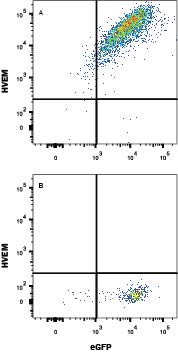
Detection of HVEM/TNFRSF14 in HEK293 human embryonic kidney cell line transfected with mouse HVEM/TNFRSF14 and eGFP by Flow Cytometry.
HEK293 human embryonic kidney cell line transfected with either (A) mouse HVEM/TNFRSF14 or (B) irrelevant transfectants and eGFP was stained with Rabbit Anti-Mouse HVEM/TNFRSF14 PE-conjugated Monoclonal Antibody (Catalog # FAB2516P). Quadrant markers were set based on control antibody staining (Catalog # IC1051P). View our protocol for Staining Membrane-associated Proteins.Applications for Mouse HVEM/TNFRSF14 Antibody (2024B) [PE]
Flow Cytometry
Sample: HEK293 human embryonic kidney cell line transfected with mouse HVEM and eGFP
Spectra Viewer
Plan Your Experiments
Use our spectra viewer to interactively plan your experiments, assessing multiplexing options. View the excitation and emission spectra for our fluorescent dye range and other commonly used dyes.
Spectra Viewer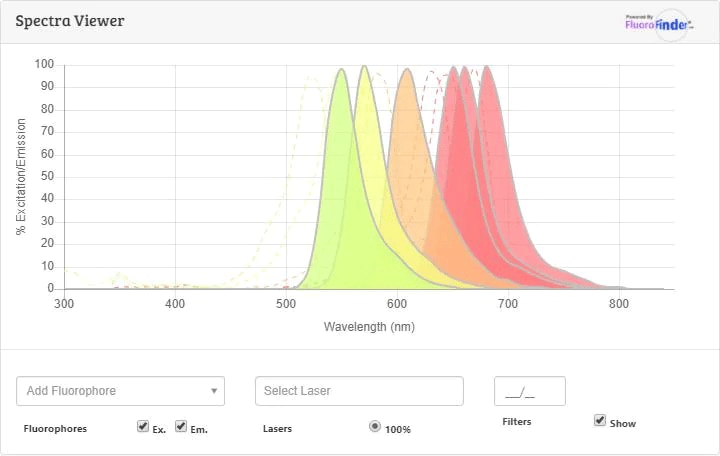
Flow Cytometry Panel Builder
Bio-Techne Knows Flow Cytometry
Save time and reduce costly mistakes by quickly finding compatible reagents using the Panel Builder Tool.
Advanced Features
- Spectra Viewer - Custom analysis of spectra from multiple fluorochromes
- Spillover Popups - Visualize the spectra of individual fluorochromes
- Antigen Density Selector - Match fluorochrome brightness with antigen density

Formulation, Preparation, and Storage
Purification
Formulation
Shipping
Stability & Storage
- 12 months from date of receipt, 2 to 8 °C as supplied.
Background: HVEM/TNFRSF14
References
- Hsu, H. et al. (1997) J. Biol. Chem. 272:13471.
- Sedy, J.R. et al. (2005) Nat. Immunol. 6:90.
- Tao, R. et al. (2008) J. Immunol. 180:6649.
- Wang, Y. et al. (2005) J. Clin. Invest. 115:711.
- Nelson, C.A. et al. (2008) J. Immunol. 180:940.
- Gonzales, L.C. et al. (2005) Proc. Natl. Acad Sci. USA 102:1116.
- Compaan, D.M. et al. (2005) J. Biol. Chem. 280:39553.
- Cai, G. et al. (2008) Nat. Immunol. 9:176.
- Mauri, D.N. et al. (1998) Immunity 8:21.
- Ware, C.F. (2008) Immunol. Rev. 223:186.
- Bossen, C. et al. (2006) J. Biol. Chem. 281:13964.
- Xu, Y. et al. (2007) Blood 109:4097.
- Wang, J. et al. (2005) J. Immunol. 174:8173.
- Steinberg, M.W. et al. (2008) J. Exp. Med. 205:1463.
Long Name
Alternate Names
Gene Symbol
UniProt
Additional HVEM/TNFRSF14 Products
Product Documents for Mouse HVEM/TNFRSF14 Antibody (2024B) [PE]
Certificate of Analysis
To download a Certificate of Analysis, please enter a lot or batch number in the search box below.
Note: Certificate of Analysis not available for kit components.
Product Specific Notices for Mouse HVEM/TNFRSF14 Antibody (2024B) [PE]
For research use only
Customer Reviews for Mouse HVEM/TNFRSF14 Antibody (2024B) [PE]
There are currently no reviews for this product. Be the first to review Mouse HVEM/TNFRSF14 Antibody (2024B) [PE] and earn rewards!
Have you used Mouse HVEM/TNFRSF14 Antibody (2024B) [PE]?
Submit a review and receive an Amazon gift card!
$25/€18/£15/$25CAN/¥2500 for a review with an image
$10/€7/£6/$10CAN/¥1110 for a review without an image
Submit a review
Protocols
Find general support by application which include: protocols, troubleshooting, illustrated assays, videos and webinars.
- 7-Amino Actinomycin D (7-AAD) Cell Viability Flow Cytometry Protocol
- Extracellular Membrane Flow Cytometry Protocol
- Flow Cytometry Protocol for Cell Surface Markers
- Flow Cytometry Protocol for Staining Membrane Associated Proteins
- Flow Cytometry Staining Protocols
- Flow Cytometry Troubleshooting Guide
- Intracellular Flow Cytometry Protocol Using Alcohol (Methanol)
- Intracellular Flow Cytometry Protocol Using Detergents
- Intracellular Nuclear Staining Flow Cytometry Protocol Using Detergents
- Intracellular Staining Flow Cytometry Protocol Using Alcohol Permeabilization
- Intracellular Staining Flow Cytometry Protocol Using Detergents to Permeabilize Cells
- Propidium Iodide Cell Viability Flow Cytometry Protocol
- Protocol for Liperfluo
- Protocol for the Characterization of Human Th22 Cells
- Protocol for the Characterization of Human Th9 Cells
- Protocol: Annexin V and PI Staining by Flow Cytometry
- Protocol: Annexin V and PI Staining for Apoptosis by Flow Cytometry
- Troubleshooting Guide: Fluorokine Flow Cytometry Kits
- View all Protocols, Troubleshooting, Illustrated assays and Webinars
Associated Pathways
