Mouse IL-18 R alpha/IL-1 R5 Antibody (112614)
R&D Systems | Catalog # MAB1216


Scientific images may be resized, cropped, or adjusted for brightness or contrast for presentation purposes. These updates are limited to presentation and do not affect the underlying scientific interpretation of the data. Where available, additional source data may be provided upon request.
Key Product Details
Species Reactivity
Validated:
Cited:
Applications
Validated:
Cited:
Label
Antibody Source
Product Specifications
Immunogen
Ser19-Gly326
Accession # Q61098
Specificity
Clonality
Host
Isotype
Scientific Data Images for Mouse IL-18 R alpha/IL-1 R5 Antibody (112614)
Detection of IL‑18 R alpha /IL‑1 R5 in Mouse Splenocytes by Flow Cytometry.
Mouse splenocytes were stained with Rat Anti-Mouse IL‑18 Ra/IL‑1 R5 Monoclonal Antibody (Catalog # MAB1216, filled histogram) or isotype control antibody (Catalog # MAB005, open histogram), followed by Phycoerythrin-conjugated Anti-Rat IgG F(ab')2Secondary Antibody (Catalog # F0105B).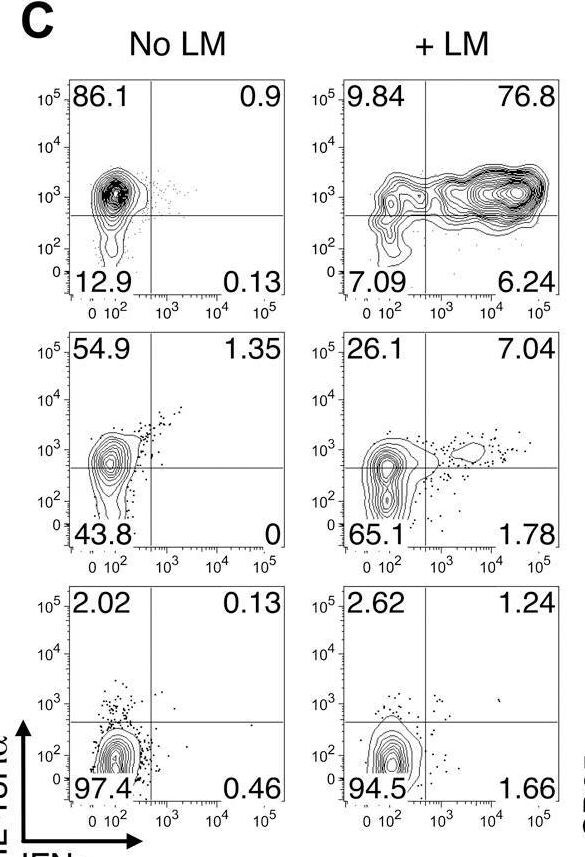
Detection of IL-18 R alpha /IL-1 R5 by Flow Cytometry
Memory but not exhausted T cells express IFN-gamma and CD25 in response to LM infection. Cohorts of mice were challenged with wild-type LM 59-81 days following acute (LCMV-Arm), protracted (LCMV-cl13 infected B6 mice) and chronic (LCMV-cl13 infected CD4-/- mice) infections. Splenocytes were prepared 20 hr after the bacterial infection and cultured in the presence of BFA for 3hr prior to surface MHC tetramer staining and intracellular staining for IFN-gamma accumulation. (A) Overview of the experimental design. (B) Representative flow cytometry plots show IL-18R alpha expression and IFN-gamma production by gated CD8 T cells are shown with and without LM infection. (C) IL-18R alpha and (D) CD25 expression in conjunction with IFN-gamma production are shown for gated LCMV DbGP33+ CD8 T cells. The percentages of (E) IFN-gamma -producing and (F) CD25-expressing IFN-gamma + LCMV Db(GP33) and Db(GP276) epitope-specific CD8 T cells are shown for individual mice, and mean values are indicated by the horizontal bars. (G) and (H) Bacterial titers in the spleens and livers, respectively, following LM challenge of the cohorts of mice that were previously infected with LCMV. Flow cytometry plots show representative data from either (B, C) three or (D) two independent experiments analyzing a total of 11-12 LM challenged mice per group. Graphs show results from (E) 4–5 experiments with 15-18 mice per group, from (F) two experiments with 6-8 mice per group, from (G) four experiments with 14-15 mice per group, and from (H) three experiments with 10–12 mice per group. *** p<0.001, ** p<0.01, * p<0.05. Image collected and cropped by CiteAb from the following open publication (https://pubmed.ncbi.nlm.nih.gov/21980291), licensed under a CC-BY license. Not internally tested by R&D Systems.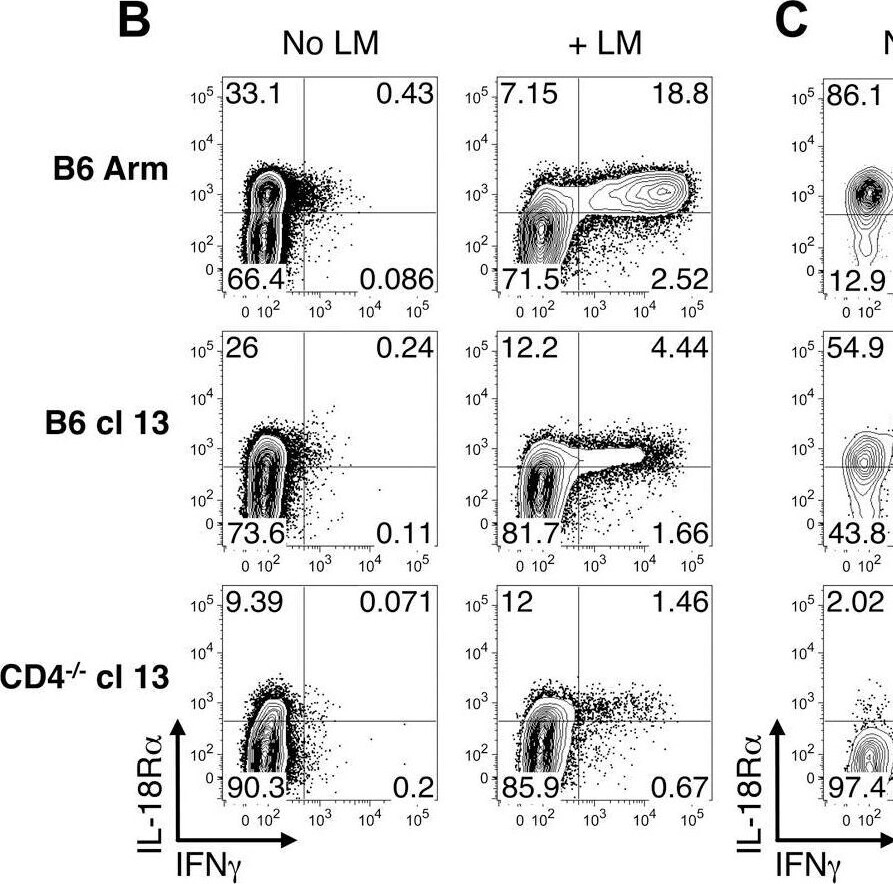
Detection of IL-18 R alpha /IL-1 R5 by Flow Cytometry
Memory but not exhausted T cells express IFN-gamma and CD25 in response to LM infection. Cohorts of mice were challenged with wild-type LM 59-81 days following acute (LCMV-Arm), protracted (LCMV-cl13 infected B6 mice) and chronic (LCMV-cl13 infected CD4-/- mice) infections. Splenocytes were prepared 20 hr after the bacterial infection and cultured in the presence of BFA for 3hr prior to surface MHC tetramer staining and intracellular staining for IFN-gamma accumulation. (A) Overview of the experimental design. (B) Representative flow cytometry plots show IL-18R alpha expression and IFN-gamma production by gated CD8 T cells are shown with and without LM infection. (C) IL-18R alpha and (D) CD25 expression in conjunction with IFN-gamma production are shown for gated LCMV DbGP33+ CD8 T cells. The percentages of (E) IFN-gamma -producing and (F) CD25-expressing IFN-gamma + LCMV Db(GP33) and Db(GP276) epitope-specific CD8 T cells are shown for individual mice, and mean values are indicated by the horizontal bars. (G) and (H) Bacterial titers in the spleens and livers, respectively, following LM challenge of the cohorts of mice that were previously infected with LCMV. Flow cytometry plots show representative data from either (B, C) three or (D) two independent experiments analyzing a total of 11-12 LM challenged mice per group. Graphs show results from (E) 4–5 experiments with 15-18 mice per group, from (F) two experiments with 6-8 mice per group, from (G) four experiments with 14-15 mice per group, and from (H) three experiments with 10–12 mice per group. *** p<0.001, ** p<0.01, * p<0.05. Image collected and cropped by CiteAb from the following open publication (https://pubmed.ncbi.nlm.nih.gov/21980291), licensed under a CC-BY license. Not internally tested by R&D Systems.Applications for Mouse IL-18 R alpha/IL-1 R5 Antibody (112614)
CyTOF-ready
Flow Cytometry
Sample: Mouse splenocytes
Western Blot
Sample: Recombinant Mouse IL‑18 R alpha /IL‑1 R5
Flow Cytometry Panel Builder
Bio-Techne Knows Flow Cytometry
Save time and reduce costly mistakes by quickly finding compatible reagents using the Panel Builder Tool.
Advanced Features
- Spectra Viewer - Custom analysis of spectra from multiple fluorochromes
- Spillover Popups - Visualize the spectra of individual fluorochromes
- Antigen Density Selector - Match fluorochrome brightness with antigen density

Formulation, Preparation, and Storage
Purification
Reconstitution
Formulation
Shipping
Stability & Storage
- 12 months from date of receipt, -20 to -70 °C as supplied.
- 1 month, 2 to 8 °C under sterile conditions after reconstitution.
- 6 months, -20 to -70 °C under sterile conditions after reconstitution.
Calculators
Background: IL-18 R alpha/IL-1 R5
Long Name
Alternate Names
Gene Symbol
UniProt
Additional IL-18 R alpha/IL-1 R5 Products
Product Documents for Mouse IL-18 R alpha/IL-1 R5 Antibody (112614)
Certificate of Analysis
To download a Certificate of Analysis, please enter a lot or batch number in the search box below.
Note: Certificate of Analysis not available for kit components.
Product Specific Notices for Mouse IL-18 R alpha/IL-1 R5 Antibody (112614)
For research use only
Citations for Mouse IL-18 R alpha/IL-1 R5 Antibody (112614)
 Powered by Bioz
Customer Reviews for Mouse IL-18 R alpha/IL-1 R5 Antibody (112614)
There are currently no reviews for this product. Be the first to review Mouse IL-18 R alpha/IL-1 R5 Antibody (112614) and earn rewards!
Have you used Mouse IL-18 R alpha/IL-1 R5 Antibody (112614)?
Submit a review and receive an Amazon gift card!
$25/€18/£15/$25CAN/¥2500 for a review with an image
$10/€7/£6/$10CAN/¥1110 for a review without an image
Submit a review
Protocols
Find general support by application which include: protocols, troubleshooting, illustrated assays, videos and webinars.
- 7-Amino Actinomycin D (7-AAD) Cell Viability Flow Cytometry Protocol
- Cellular Response to Hypoxia Protocols
- Extracellular Membrane Flow Cytometry Protocol
- Flow Cytometry Protocol for Cell Surface Markers
- Flow Cytometry Protocol for Staining Membrane Associated Proteins
- Flow Cytometry Staining Protocols
- Flow Cytometry Troubleshooting Guide
- Intracellular Flow Cytometry Protocol Using Alcohol (Methanol)
- Intracellular Flow Cytometry Protocol Using Detergents
- Intracellular Nuclear Staining Flow Cytometry Protocol Using Detergents
- Intracellular Staining Flow Cytometry Protocol Using Alcohol Permeabilization
- Intracellular Staining Flow Cytometry Protocol Using Detergents to Permeabilize Cells
- Propidium Iodide Cell Viability Flow Cytometry Protocol
- Protocol for Liperfluo
- Protocol for the Characterization of Human Th22 Cells
- Protocol for the Characterization of Human Th9 Cells
- Protocol: Annexin V and PI Staining by Flow Cytometry
- Protocol: Annexin V and PI Staining for Apoptosis by Flow Cytometry
- R&D Systems Quality Control Western Blot Protocol
- Troubleshooting Guide: Fluorokine Flow Cytometry Kits
- Troubleshooting Guide: Western Blot Figures
- Western Blot Conditions
- Western Blot Protocol
- Western Blot Protocol for Cell Lysates
- Western Blot Troubleshooting
- Western Blot Troubleshooting Guide
- View all Protocols, Troubleshooting, Illustrated assays and Webinars
Associated Pathways